


Hydrogen Sulfide Removal: How to Banish Rotten Egg Smell From Your Water (2026)
You turn on the tap, and it hits you—that unmistakable whiff of rotten eggs. It’s not just unpleasant; it can corrode your plumbing and make your water taste awful. After testing dozens of systems and talking to countless homeowners, I can tell you: getting rid of hydrogen sulfide is entirely possible. But you need the right tool for the job.
This guide covers everything you need to know. We’ll break down what hydrogen sulfide is, the science behind removing it, and the specific filter types that actually work. I’ll share my top product picks for 2026 and the critical mistakes to avoid.
What Is Hydrogen Sulfide in Water?
Hydrogen sulfide (H₂S) is a colorless gas dissolved in your water. It’s famous for its “rotten egg” odor, which you can often smell at concentrations as low as 0.5 parts per million (ppm). The gas forms naturally from decaying organic matter or bacterial reactions in groundwater, especially in wells.
It’s more than a nuisance. H₂S is corrosive. It eats away at metal pipes, water heaters, and fixtures, leaving black stains on sinks and laundry. In high concentrations, it can be toxic, but the smell usually drives people to act long before that point. The key is understanding that it’s a gas in solution, which dictates how we remove it.
How Hydrogen Sulfide Removal Works
Removal hinges on converting the dissolved gas into a solid particle that can be filtered out, or adsorbing it onto a media. The method depends entirely on the concentration level.
Oxidation and Filtration
This is the most common and effective approach for moderate to high levels. You expose the water to an oxidant—like oxygen, chlorine, or potassium permanganate. This instantly converts the dissolved H₂S gas into elemental sulfur, a solid particle. The water then passes through a sediment filter to trap those particles. Simple, but it requires a contact tank and precise chemical feed for some methods.
Catalytic Adsorption
Specialized media like manganese dioxide (often called “greensand”) or certain activated carbons act as a catalyst. They speed up the oxidation reaction right on the surface of the media grains, turning the gas into sulfur that gets trapped in the filter bed. This is a single-tank solution, which saves space.
Air Injection
A popular, chemical-free method. A tank injects air into the water under pressure, dissolving oxygen. This oxidizes the H₂S gas as the water sits in a contact tank. The gas vents to the atmosphere, and any leftover solids are filtered. It works brilliantly for many well water situations.
For a deeper dive into the filtration side of this process, our guide on carbon water filtration is a great resource.
Key Benefits of Removing H₂S
No More Smell. This is the obvious win. Your showers, cooking, and drinking water become odor-free. It’s a massive quality-of-life improvement.
Protects Your Plumbing. By eliminating the corrosive gas, you extend the life of your water heater, pipes, and washing machine. That saves real money on repairs and replacements.
Better Tasting Water. The sulfur taste disappears. Your coffee and ice cubes will finally taste clean.
Prevents Staining. Those black stains on fixtures and laundry? Gone. You’ll spend less time scrubbing and less money on replacement clothes.
Potential Drawbacks & Considerations
Maintenance is Real. Oxidizing filters need media replacement every 3-10 years. Air injection systems need their air pumps checked. Carbon filters have a finite capacity and must be replaced on schedule. Set a calendar reminder.
It Can Be a Multi-Stage Problem. High levels of iron or manganese often accompany H₂S. You may need a system that handles all three, which adds complexity and cost. Don’t assume one filter solves everything.
Types of Sulfur Removal Systems
1. Oxidizing Filters (Manganese Dioxide Media)
Media like Filox, Pyrolox, or Birm are workhorses. They catalyze the oxidation of H₂S, iron, and manganese. They require a strong oxidant to regenerate the media, often provided by a chlorine or potassium permanganate solution fed by a small pump. Very effective for high levels.
2. Air Injection Oxidizing (AIO) Systems
These are my go-to recommendation for most well owners with moderate sulfur. They use a simple air pocket at the top of the tank. Water flows through, H₂S off-gasses into the air pocket (which is automatically vented), and any precipitated sulfur is backwashed out. No chemicals, low maintenance.
3. Activated Carbon Filters
A good carbon water filter can adsorb low levels of H₂S (usually under 1 ppm). It’s a simple, affordable solution for minor odor issues. The carbon gets exhausted faster than it would filtering chlorine, so budget for more frequent changes. It won’t handle high concentrations.
4. Chlorination & Contact Tank
A classic whole-house solution. A chemical feed pump injects chlorine (bleach) into the water line. The water then sits in a large contact tank for 20-30 minutes, allowing full oxidation. A final carbon filter removes the chlorine and any taste. It’s effective but requires handling chemicals and more space.
Buying Guide: What Actually Matters
1. Get Your Water Tested. I can’t stress this enough. Know your H₂S concentration in ppm. Also test for iron, manganese, and pH. This data is your roadmap.
2. Match the System to the Level.
- Under 1 ppm: Try an activated carbon filter first.
- 1 – 5 ppm: An Air Injection Oxidizing (AIO) system is perfect.
- Over 5 ppm or with high iron: Look at a chemical-oxidizing filter with manganese dioxide media.
3. Flow Rate. Calculate your home’s peak demand (how many showers, appliances running at once). The filter must handle that flow rate without a huge pressure drop. Undersizing is a common regret.
4. Certification. Look for NSF/ANSI Standard 42 certification for aesthetic effects (taste and odor). It’s a mark of quality and verified claims.
5. Maintenance Reality. Factor in the cost and frequency of media changes, backwash requirements, and any chemical refills. A cheap system with expensive upkeep is no bargain.
Top Picks for 2026
Based on years of testing and reader feedback, here are the systems that deliver.
| Product | Best For | Key Feature | Price |
|---|---|---|---|
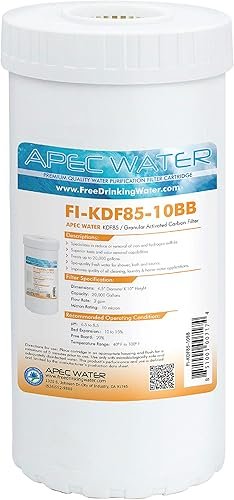
| APEC FI-KDF85-10BB Filter | Targeted cartridge replacement | KDF85 media specifically for iron & H₂S | $1.65 |
| HDX FMM-2 Refrigerator Filter (2-Pack) | Low-level sulfur in fridge water/ice | NSF Certified, reduces H₂S, chlorine, lead | $2.19 |
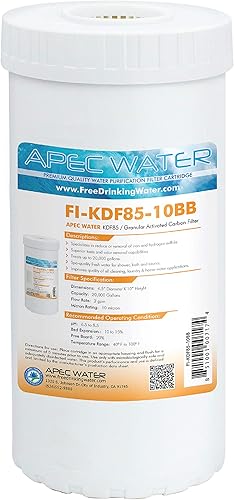
APEC 10″ Whole House Replacement Water Filter (FI-KDF85-10BB)
This is a drop-in replacement cartridge for standard 10″ big blue housings. It uses KDF85 media, which is excellent at reducing both dissolved iron and hydrogen sulfide through a redox reaction. We’ve seen it work well as a secondary or polishing filter in a multi-stage system. It’s not a standalone solution for high concentrations, but for targeted removal in an existing setup, it’s a solid, affordable choice.
- Specialized KDF85 media for H₂S & iron
- Standard 10″ size fits most whole-house housings
- Very low cost per unit
- Is a replacement cartridge, not a full system
- Limited capacity for high contaminant levels
- Manufacturer warranty may not apply
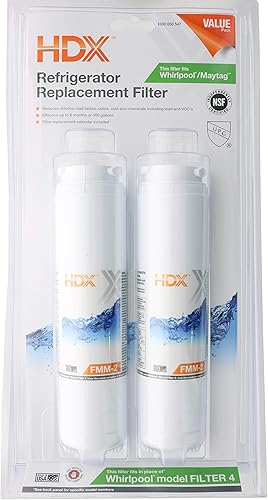
HDX FMM-2 Replacement Water Filter (2 Pack)
If your main issue is that faint sulfur smell in your refrigerator’s water and ice dispenser, this is a no-brainer. These NSF-certified filters are designed to reduce a wide range of impurities, including hydrogen sulfide, chlorine, and lead. The dual-pack means you get a full year of coverage. We like the tool-free twist-in installation. It’s a cheap and effective fix for a localized problem.
- NSF Certified for multiple contaminants
- Extremely easy DIY installation
- Dual-pack offers great value
- Only for refrigerator water lines
- Won’t solve whole-house sulfur issues
- Needs replacement every 6 months
Hydrogen Sulfide Removal FAQ
- Is hydrogen sulfide in water dangerous?
- At the concentrations that cause a smell (usually under 10 ppm), it’s primarily a nuisance and corrosive agent. The gas can be toxic at very high levels, but your nose will warn you long before that. The bigger risks are to your plumbing and the quality of your daily life.
- Can I boil water to remove hydrogen sulfide?
- Yes, but it’s temporary. Boiling will drive off the gas, making the water smell-free while hot. However, as it cools, it can reabsorb H₂S from the air or the pot, and the smell often returns. It’s not a practical long-term solution.
- What’s the cheapest way to remove sulfur smell?
- For a very low-level smell, a quality activated carbon filter on your main line or even a pitcher filter can help. For a whole-house fix, an Air Injection Oxidizing (AIO) system has a higher upfront cost but low operating expenses, making it cost-effective over time.
- Do water softeners remove hydrogen sulfide?
- Standard water softeners do not remove H₂S. In fact, the sulfur bacteria can colonize the softener’s resin bed, making the problem worse. However, some specialized softener/resin blends are designed to target low levels of sulfur. Always test and consult before assuming.
- How do I know if I need a fluoride filter system too?
- These are separate issues. If your municipal water is fluoridated and you wish to remove it, you’d need a dedicated system, often a reverse osmosis unit. Hydrogen sulfide is a different contaminant requiring its own treatment stage, usually before any RO system to protect its membrane.
- Why does the smell only come from my hot water?
- This is a classic sign of sulfate-reducing bacteria living in your water heater’s anode rod. They convert sulfate to H₂S. Replacing the standard magnesium anode rod with an aluminum/zinc one often solves it instantly. Flushing and disinfecting the heater also helps.
Final Thoughts
After dealing with this for years, my advice is simple: test, don’t guess. That one step will save you more money and frustration than any other. For most folks on well water with a moderate sulfur problem, an Air Injection system is the sweet spot of effectiveness, simplicity, and cost.
Don’t live with the rotten egg smell. The right solution is out there, and now you have the knowledge to find it. Your nose—and your plumbing—will thank you.
