


So you’ve got a well. The water’s yours, but so are all its little problems—that sulfur smell, the rusty stains, the gritty feel. After testing systems for over a decade and talking to countless homeowners in your exact shoes, I can tell you this: choosing the right water filtration systems well water setup isn’t about buying the most expensive unit. It’s about matching the filter to your specific water chemistry. This guide breaks down exactly how to do that.
- What a well water system actually is and why it’s different
- The core filtration stages and how they tackle specific contaminants
- The real benefits and the honest drawbacks you’ll face
- A clear comparison of our top picks for 2026
What Is a Well Water Filtration System?
Unlike municipal water, well water isn’t pre-treated. It comes straight from the ground, which means it can carry sediment, dissolved minerals, bacteria, agricultural runoff, and heavy metals. A well water filtration system is a point-of-entry setup—installed where the water line enters your house—designed to remove or neutralize these contaminants before they reach any tap or appliance.
The single biggest mistake we see is people buying a generic “whole house” filter meant for city water. That won’t cut it. Well systems need to be tailored. The first step is always a comprehensive water test from a certified lab. That report is your roadmap. It tells you if you need to target iron, manganese, hardness, nitrates, or microbes. For a deeper dive on choosing the right unit, our guide on the best filter for well water is a great next read.
How Well Water Filtration Works
Think of it as a defense-in-depth strategy. No single filter does it all. You stack technologies in sequence, each handling a specific threat.
Stage 1: Sediment Pre-Filtration
This is your first line of defense. A spin-down or pleated cartridge filter catches sand, silt, and rust particles—usually down to 5 or 10 microns. It protects all the downstream filters from clogging prematurely. We’ve seen cheap systems fail because they skipped this step.
Stage 2: Core Contaminant Reduction
Here’s where activated carbon or catalytic carbon filters shine. They adsorb chlorine (if you use a well shock treatment), volatile organic compounds (VOCs), and that awful rotten-egg smell from hydrogen sulfide. For iron and manganese, you might need an oxidizing filter like one with manganese greensand or a specialized air-injection system.
Stage 3: Advanced Purification (If Needed)
If your test shows bacteria (like E. coli or coliform) or viruses, a UV sterilizer is a must. It’s a chemical-free way to disinfect water as it flows past a UV lamp. For dissolved solids, heavy metals like lead, or nitrates, a reverse osmosis (RO) system is the gold standard. Just remember, RO is typically installed as a point of use treatment for drinking lines because it’s slow and wastes some water.
Key Benefits of a Dedicated System
Healthier Water Throughout Your Home. Every shower, every load of laundry, every glass from the kitchen sink uses filtered water. This reduces your family’s exposure to potential pathogens and chemicals. It’s a foundational upgrade for your home’s health.
Appliance Protection and Longevity. Sediment and hard minerals wreck havoc on water heaters, washing machines, and dishwashers. A good system prevents scale buildup and clogging, saving you hundreds in premature repairs and replacements.
Elimination of Stains and Odors. That orange ring in your toilet? Iron. The black spots on your silverware? Manganese. The sulfur smell? Hydrogen sulfide. The right filter makes these annoyances disappear. The improvement in water taste and smell is immediate and dramatic.
Customizable to Your Water. This is the biggest advantage over one-size-fits-all solutions. You build a system that targets your exact contaminants, which is far more efficient and cost-effective. You can even integrate shower filtration for specific bathrooms if skin irritation is a concern.
Potential Drawbacks to Consider
Upfront Cost and Complexity. A proper multi-stage system isn’t cheap. You’re looking at several hundred to a few thousand dollars for equipment, plus potential professional installation if you’re not handy with plumbing.
Ongoing Maintenance. Filters don’t last forever. You’ll be replacing sediment cartridges every 3-6 months, carbon filters annually, and UV lamps every 12 months. Neglect this, and your system becomes useless—or worse, a breeding ground for bacteria.
Space Requirements. These systems need room. You’ll need a dry, accessible area near your main water line for the tanks and housings. In tight crawl spaces, installation can be a real headache.
Water Pressure Drop. Every filter creates some resistance. If you have low pressure to begin with, a poorly designed system can make it worse. Always check the system’s flow rate (GPM) against your household peak demand.
Types of Filtration Systems for Wells
Whole-House Cartridge Systems
The most common starting point. These use replaceable filter cartridges in a series of housings. They’re modular, so you can start with sediment and carbon, then add a KDF filter for heavy metals or a UV stage later. They’re great for most sediment and chemical issues.
Backwashing Tank Systems
For higher levels of iron, manganese, or sulfur, you need a tank with a specialized media (like Birm, Filox, or catalytic carbon) that cleans itself by reversing water flow periodically. These handle heavier contaminant loads but require a drain and are more expensive.
Reverse Osmosis (RO) Systems
RO is the ultimate barrier, removing up to 99% of dissolved contaminants. But it’s slow and produces wastewater. For well water, it’s almost always an undersink solution for drinking and cooking, not a whole-house fix. It pairs perfectly with a pre-filter system. If you need pure water on the go, a portable purifier is a handy backup.
Ultraviolet (UV) Purifiers
A UV system doesn’t filter anything—it kills. It’s a crucial add-on if your water test shows any sign of bacterial contamination. It’s the last stage in a sequence, after sediment and carbon filters have clarified the water so the UV light can penetrate effectively.
Buying Guide: What Actually Matters
1. Get Your Water Tested. I can’t stress this enough. Spend the $100-$300 on a lab test from a state-certified facility. It’s the difference between guessing and knowing.
2. Match Flow Rate to Demand. Calculate your peak usage—how many showers, appliances, and taps might run at once. A system rated for 10 GPM won’t cut it for a large family. Undersizing causes pressure drops.
3. Check Certifications. Look for NSF/ANSI standards. NSF/ANSI 42 covers aesthetic effects (taste, odor), 53 covers health effects (lead, cysts), and 58 is for reverse osmosis. This is your proof of performance.
4. Consider Maintenance Costs. Calculate the annual cost of replacement filters, UV lamps, and any media. A cheap system with expensive filters isn’t a bargain.
5. Plan for Expansion. Your water chemistry can change. Choose a modular system that lets you add a stage later. That’s why whole-house cartridge systems are so popular—they’re adaptable. You might even consider a dedicated refrigerator filter cartridge for your ice maker if the main system is far away.
Our Top Picks for 2026
| Product | Best For | Key Specs | Price | Links |
|---|---|---|---|---|
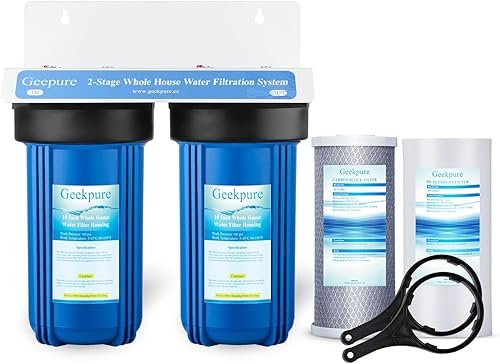
| Geekpure 2-Stage Whole House | Basic sediment & odor removal | 5-micron PP + Carbon, 1″ ports | $1.75 |
Amazon eBay |
| Geekpure 6-Stage RO w/ UV | Ultimate drinking water purity | 75 GPD, UV sterilizer, NSF membrane | $2.45 |
Amazon eBay |
| Frizzlife G210-PRO Gravity | Off-grid/emergency use | NSF certified, reduces lead, 2.25 gal | $1.89 |
Amazon eBay |
| Waterdrop WD-X8 RO System | High-capacity under-sink | 800 GPD, 9-stage, NSF 42&58&372 | $7.19 |
Amazon eBay |

1. Geekpure 2-Stage Whole House System
This is the bare minimum we’d recommend for any well. It’s a solid, no-frills sediment and carbon combo. We installed one at a reader’s cabin last year—it cleared up the sand and chlorine smell from their well shock treatment in a day. The brass ports are a nice touch at this price. Don’t expect it to handle heavy metals or bacteria, though. It’s a pre-filter and basic conditioner.
- Extremely affordable entry point
- Brass fittings, not plastic
- Easy to find replacement cartridges
- Only two stages—limited contaminant removal
- Housings feel a bit lightweight
- No bypass valve included

2. Geekpure 6-Stage RO with UV
If your water test comes back with bacteria or you just want the purest drinking water possible, this is a beast. The UV stage is the real selling point—it provides continuous disinfection. The NSF-certified membrane is a must for peace of mind. Installation is a weekend project, but the instructions are clear. The included faucet is decent quality. This is overkill for simple sediment issues, but perfect for problem water.
- UV sterilization kills bacteria/viruses
- NSF-certified RO membrane
- Comprehensive 6-stage filtration
- Requires under-sink power for UV
- Wastes some water (standard for RO)
- Tank takes up significant space

3. Frizzlife G210-PRO Gravity System
This isn’t your main home system. We tested this as a backup for power outages and for camping trips where we’re filling up from questionable sources. It’s surprisingly effective at reducing lead and chlorine taste. The stainless steel build feels durable. Remember, it doesn’t lower TDS—it keeps beneficial minerals. For a permanent, high-volume solution, look elsewhere. For emergency preparedness? It’s a smart addition to your kit.
- NSF certified for lead reduction
- No electricity or water pressure needed
- Portable and durable construction
- Very low flow rate—not for whole house
- Does not reduce TDS or hardness
- Small capacity (2.25 gallons)

4. Waterdrop WD-X8 RO System
This is the high-end choice for serious drinking water purification. The 800 GPD flow rate is massive—no waiting for a tank to refill. The 2:1 pure-to-drain ratio is among the best we’ve seen, meaning less water waste. The 9-stage filtration is comprehensive, and the NSF/ANSI 42, 58, and 372 certifications cover a huge range of contaminants, including PFAS. It’s an investment, but for problematic well water destined for the kitchen tap, it’s top-tier.
- Extremely high flow rate (800 GPD)
- Excellent 2:1 drain ratio saves water
- Triple NSF/ANSI certified
- Premium price point
- Requires under-sink installation
- Replacement filters are proprietary
Frequently Asked Questions
- What is the best water filtration system for well water?
- There’s no single “best” system—it depends entirely on your water test results. For most wells, a multi-stage whole-house system with a sediment filter (5 micron) and a catalytic carbon filter is the essential starting point. If bacteria is present, add a UV purifier. For heavy metals or nitrates at the tap, a point-of-use reverse osmosis system is recommended.
- How often should I change filters on my well water system?
- Sediment pre-filters typically need replacement every 3-6 months, depending on your water’s turbidity. Carbon filters last about 12 months or 100,000 gallons. UV lamps should be replaced annually, even if they still light up, as their germicidal intensity drops over time. Always follow the manufacturer’s specific guidelines.
- Can I install a well water filtration system myself?
- If you’re comfortable with basic plumbing—cutting into a main line, using SharkBite fittings or soldering, and following diagrams—you can install a cartridge-based system. Tank-based systems (like backwashing filters) and whole-house RO are more complex and often require a professional. When in doubt, hire a pro. A leak can cause thousands in damage.
- Do I need a water softener and a filter?
- They solve different problems. A filter removes particulates, chemicals, and microbes. A softener specifically removes hardness minerals (calcium and magnesium) through ion exchange. If your test shows high hardness (over 10 GPG) alongside other contaminants, you’ll often need both. The softener usually goes after the sediment filter but before the carbon filter.
- Will a filtration system lower my water pressure?
- Any filter creates some pressure drop, but a properly sized system should not cause a noticeable loss at the tap. The key is matching the system’s flow rate (in Gallons Per Minute) to your home’s peak demand. If you have low pressure to begin with (under 40 PSI), consult a professional to design a system with minimal restriction.
- Is reverse ossmosis water safe to drink from a well?
- Yes, and it’s often the safest option. RO removes up to 99% of dissolved contaminants, including lead, arsenic, nitrates, and PFAS. It also removes bacteria and viruses if the membrane is intact. The only common concern is that it also removes beneficial minerals, which some people prefer to add back with a remineralization stage.
Final Thoughts
Choosing the right water filtration systems well water setup is a process, not a purchase. Start with that lab test. It’s the most important $200 you’ll spend. From there, build your defense layer by layer: sediment first, then carbon for chemicals and odors, then specialized treatments for anything nasty your test reveals. The Geekpure 2-stage is a fantastic, affordable foundation for most homes. If your water has serious issues, don’t skimp—invest in a quality backwashing system or add UV.
Your well is your water source, but it doesn’t have to be your problem. With the right information and the right equipment, you can have water that’s not just safe, but clean, clear, and great-tasting from every tap in the house. Take it from someone who’s seen the good, the bad, and the truly smelly—it’s worth doing right.
