


So you’re standing in the aisle or scrolling online, eyeing the water filter pitchers at Walmart. It’s a wall of blue plastic. Which one actually works? After testing dozens of these in our lab and in real kitchens for years, I’ll cut through the noise. This guide covers what these pitchers really do, their limits, and which ones are worth your money in 2026.
- What a pitcher filter can and can’t do for your tap water.
- How the filtration actually works (it’s simpler than you think).
- The key benefits and honest drawbacks.
- Our top picks from Walmart’s 2026 lineup, with direct comparisons.
What Is a Water Filter Pitcher?
It’s a plastic jug with a filter cartridge screwed into the top chamber. You pour tap water in the top. It trickles through the filter media and collects as cleaner-tasting water in the bottom. That’s the core idea. The ones you find at Walmart are designed for convenience and low upfront cost. They sit in your fridge door.
But let’s be real about their job. A pitcher is not a whole-house system. It won’t tackle serious well water problems like high iron or sulfur. For those, you need a dedicated iron and sulfur filter. Pitchers are for municipal tap water users who want better-tasting water and a reduction in some common contaminants.
How a Water Filter Pitcher Works
The magic is in the cartridge. Most use a mix of activated carbon and sometimes an ion-exchange resin. Here’s the breakdown.
Activated Carbon: The Workhorse
This is the main component. Think of it as a microscopic sponge with a massive surface area. As water passes through, contaminants like chlorine, some pesticides, and organic compounds that cause bad taste and odor get adsorbed—stuck—to the carbon’s surface. This is the primary chlorine filtration method in these pitchers. It’s effective for taste and smell.
Ionic Exchange & Mechanical Filtration
Many filters also include an ion-exchange resin. This swaps ions in the water (like calcium and magnesium, which cause hardness) for other ions, like sodium. It can also help reduce some heavy metals. Finally, there’s a physical barrier—a fine mesh—that blocks larger particles like sediment and rust. The combination tackles a broad range of aesthetic issues.
Key Benefits
Dramatically Better Taste: This is the number one reason people buy them. By removing chlorine and other off-flavors, your water tastes crisp and clean. Your coffee and tea will thank you.
Low Cost of Entry: You can get a solid pitcher for under $40. That’s a tiny fraction of the cost of an under-sink system. No installation, no plumber.
Portability and Simplicity: It lives in your fridge. Perfect for renters, dorm rooms, or offices. You can take it anywhere.
Reduces Some Contaminants: While not comprehensive, a good filter certified to NSF/ANSI Standards 42 and 53 will reduce specific contaminants like lead, mercury, and certain pesticides. Check the packaging for the specific claims.
Potential Drawbacks
Ongoing Cost: The filters need replacing every 40 gallons or two months, typically. Those $7-$10 filters add up over a year.
Slow Filtration: You’ll wait a few minutes for a full reservoir to drain. It’s not instant like a tap-mounted filter.
Limited Scope: They don’t soften water. If you have hard water, a pitcher won’t solve limescale issues. You’d need a proper iron filtration or softening system for mineral problems.
Types of Pitcher Filters
Standard Carbon Pitchers
The most common type you’ll see at Walmart. Brita, PUR, and store brands dominate. They use the activated carbon and ion-exchange process described above. Best for chlorine taste, odor, and a basic set of contaminants.
Alkaline & Mineral-Enhancing Pitchers
These add a step. After filtering, the water passes over mineral stones or an alkaline layer, raising the pH and adding back trace minerals like calcium and magnesium. They’re popular for health-conscious buyers, though the benefits are debated.
Fluoride-Reducing Pitchers
A niche category. Most standard pitchers do not remove fluoride. If this is a concern for you, look for pitchers with specific NSF/ANSI 58 certification for fluoride reduction, or consider a dedicated fluoride filter system for more reliable results.
Buying Guide: What Actually Matters
Forget the flashy marketing. Focus on these criteria.
1. Filter Certification: This is non-negotiable. Look for NSF/ANSI 42 (aesthetic effects—taste, odor) and NSF/ANSI 53 (health effects—specific contaminants like lead). The brand should list exactly which contaminants are reduced and by what percentage.
2. Capacity & Filter Life: Pitchers come in 5-cup to 10-cup sizes. Filter life is measured in gallons (usually 40). A filter-change indicator (a timer or sticker) is a lifesaver. Don’t rely on memory.
3. Pour-Through Design: Some have a flip-top lid you can fill without removing the reservoir. Others require you to take the top off. The flip-top is way more convenient. Trust me.
4. Cost of Ownership: Calculate the annual filter cost. A cheap pitcher with expensive filters is no bargain.
Our Top Picks for 2026
We’ve focused on models commonly available at major retailers. Here’s a quick comparison of the Brita Marella lineup, which represents their core pitcher offering.
| Product | Capacity | Key Feature | Price |
|---|---|---|---|
| Brita Marella Blue | 2.4L (1.4L filtered) | Compact, fridge-door friendly | $39 |
| Brita Marella Graphite | 2.4L (1.4L filtered) | Same great filter, sleek color | $39 |
| Brita Marella XL White | 3.5L (2.0L filtered) | Larger capacity for families | $44 |
| Brita Marella XL + 4 Filters | 3.5L (2.0L filtered) | Best long-term value bundle | $71 |

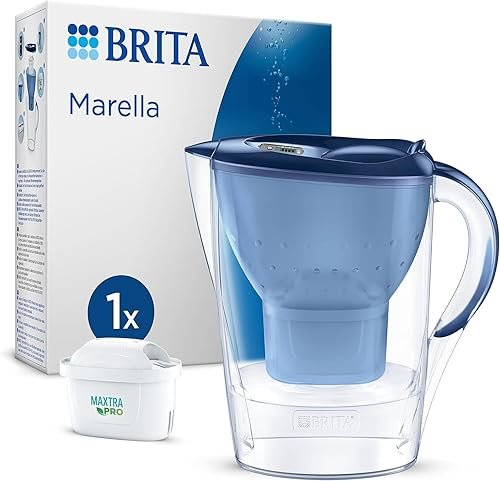
Brita Marella (2.4L, Blue)
This is the workhorse. The 2.4L size is perfect for one or two people. It fits perfectly in a standard fridge door, and the flip-top lid means you can refill it with one hand while holding a glass. The MAXTRA PRO filter is solid for chlorine and taste. Honestly, for a single person or a couple, the extra cost of the XL isn’t justified. This gets the job done.
- Excellent one-hand operation
- Very fridge-space efficient
- Proven filtration performance
- Small capacity means frequent refills
- Only one filter included

Brita Marella XL (3.5L, White)
The XL is for households that drink a lot of water. The 2.0L filtered capacity means you’re not constantly playing the refill-and-wait game. The filtration is identical to the smaller Marella. The trade-off is it takes up more fridge space. If you have a family of three or more, or you just hate waiting, spend the extra $5 for this model.
- Larger capacity reduces refill frequency
- Same reliable MAXTRA PRO filter
- Still fits in most fridge doors
- Takes up more shelf space
- Slightly heavier when full

Brita Marella XL + 4 Filters (Best Value Bundle)
This is the smart buy if you’re committing to the pitcher life. Buying filters separately costs about $10 each. This bundle gets you the XL pitcher and four filters for $71, which is like getting the filters for $6.75 each. That’s a significant saving over a year. If you know you’ll use it, start here.
- Best long-term cost savings
- You’re set for filters for ~8 months
- Includes the larger XL pitcher
- Higher upfront cost
- You’re locked into Brita filters
Frequently Asked Questions
- How often should I change my water filter pitcher filter?
- Change it every 40 gallons or every two months, whichever comes first. Most pitchers have a sticker indicator or electronic timer. Don’t push it—a saturated filter stops working and can even release trapped contaminants back into your water.
- Do Brita filters remove lead?
- Some do, but not all. You must check the specific filter’s certification. Look for NSF/ANSI 53 certification for lead reduction on the packaging. The standard Brita filter focuses on chlorine; their “Longlast” or “Elite” filters are the ones typically certified for lead.
- Can I use well water with a filter pitcher?
- We don’t recommend it. Well water can have bacteria, high levels of sediment, iron, or sulfur that pitcher filters aren’t designed to handle. You need a proper treatment system. Test your well water first and consult a specialist.
- Why does my filtered water have black specks?
- That’s activated carbon dust, or “fines.” It’s harmless but annoying. It means you didn’t flush the new filter enough. Always run 1-2 full pitchers of water through a new filter and discard that water before drinking.
- Are store-brand (e.g., Walmart’s) pitcher filters as good as Brita?
- Sometimes, but you have to check the certifications. Some store-brand filters are made by the same manufacturers. Compare the NSF/ANSI certification numbers and the list of reduced contaminants side-by-side. If they’re identical, the performance should be similar.
- What’s the difference between a pitcher and a refrigerator filter cartridge?
- They use similar technology, but a fridge filter is inline—it filters water as it comes from the tap to your dispenser. It often has a higher capacity and flow rate. A pitcher is a standalone, portable unit you manually fill.
Final Thoughts
A water filter pitcher from Walmart is a fantastic, low-commitment way to improve your daily water. It’s not magic, and it’s not for every water problem. But for making municipal tap water taste better and reducing a handful of common contaminants, it’s hard to beat the convenience and price.
Our clear recommendation for most people is the Brita Marella XL with the filter bundle. The upfront cost pays for itself in filter savings within months. Just remember to change the filter on time and wash the pitcher regularly. That’s the real secret to making it work.
