


AO Smith Water Softeners: What You Need to Know Before Buying (2026)
Here’s something that catches most people off guard. You search for “AO Smith water softeners” expecting to find a traditional brine-tank setup, and instead you get salt-free descalers and sediment filters. That’s not a bait-and-switch — it’s a deliberate design choice.
In this guide, we’ll cover:
- What AO Smith actually offers for hard water problems
- How their salt-free descaler technology works (and its limits)
- Which products we’d recommend and which ones to skip
- Whether an AO Smith system makes sense for your specific water
What Are AO Smith Water Treatment Systems?
AO Smith has been in the water game for over a century. They’re best known for water heaters, but their filtration and treatment line has grown steadily over the past decade. The key thing to understand? Their approach to hard water is fundamentally different from what most people picture when they hear “water softener.”
Traditional softeners use salt and ion-exchange resin to pull calcium and magnesium out of your water. AO Smith skips that entirely. Their flagship hard water product, the AO-WH-DSCLR, uses a template-assisted crystallization (TAC) media that changes how minerals behave — it keeps them in the water but stops them from sticking to surfaces.
Think of it this way. A traditional softener removes the minerals. AO Smith’s descaler lets them stay but convinces them to behave. Whether that’s good enough depends entirely on your water hardness level and what you’re trying to protect.
They also offer whole-house sediment filters like the AO-WH-PREV, which remove dirt, rust, and particulates before that water hits your plumbing. These aren’t softeners, but they’re often sold alongside them — and for good reason. Sediment wreaks havoc on appliances regardless of your hardness level.
How AO Smith Hard Water Solutions Work
Salt-Free Scale Prevention (Template-Assisted Crystallization)
The AO-WH-DSCLR uses a process called template-assisted crystallization. Small ceramic beads coated with a specific crystalline structure act as nucleation sites. When hard water passes through, dissolved calcium and magnesium latch onto these sites and form microscopic crystals.
Once crystallized, those minerals detach from the beads and flow through your pipes in a form that won’t stick to surfaces. Your water still contains calcium and magnesium — it just won’t form the rock-hard scale deposits you’re used to seeing on faucets and inside your water heater.
No salt. No backwashing. No electricity. No drain line. That’s the pitch, and honestly, it holds up in most residential applications. We’ve seen these systems installed in homes for five-plus years with noticeably less scale buildup on heating elements.
Sediment Filtration
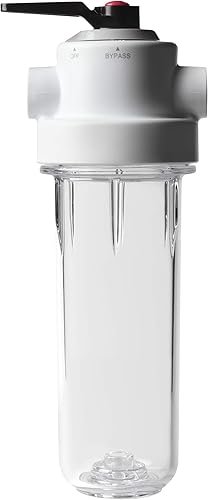
The AO-WH-PREV is simpler. It’s a standard filter housing system with a valve-in-head design that accepts universal 2.5-inch cartridges. Water flows through the cartridge, particulates get trapped, clean water comes out the other end.
The built-in shut-off bypass valve is a nice touch. You can swap cartridges without killing your main water supply. Just press the pressure release button, twist off the old filter, pop in the new one. Takes about two minutes once you’ve done it once.
What These Systems Don’t Do
This is where we see a lot of confusion. AO Smith’s salt-free descaler will not reduce total dissolved solids (TDS). It won’t remove sulfur smells. It won’t touch iron. And it won’t give you that slippery, “soft water” feel in the shower that traditional softener owners rave about.
If your water tests above 25 grains per gallon of hardness, you might find the descaler underwhelming. At that level, a traditional ion-exchange softener is probably the better call. But for moderate hardness — say 7 to 20 grains — the descaler handles scale prevention effectively.
Key Benefits
No Salt or Chemicals Required. This is the big one. No hauling 40-pound salt bags. No brine discharge into your plumbing. No ongoing chemical costs beyond filter replacements. For people on low-sodium diets or in areas with salt-discharge restrictions, this matters a lot.
Zero Electricity and No Drain Line. Installation is dramatically simpler than a traditional softener. Mount it on the wall, connect inlet and outlet, done. No programming cycles, no timers, no electrical hookup. We’ve talked to plumbers who prefer these for retrofit jobs because the install takes half the time.
Long Media Life. The AO-WH-DSCLR is rated for 600,000 gallons or six years, whichever comes first. For a household of four using roughly 80-100 gallons per person daily, that’s well over five years of service. Compare that to replacing resin or buying salt every month.
Compact Footprint. These units are small. The descaler is roughly the size of a large thermos. If you’re tight on space — apartment, small utility closet, mobile home — the size advantage over a traditional softener with its brine tank is significant.
Works With Well and City Water. AO Smith engineered the descaler for both supply types. That’s not always the case with salt-free systems, some of which struggle with well water’s variable chemistry.
Potential Drawbacks
Won’t Actually Soften Your Water. Let’s be direct. If you want truly soft water — the kind that lathers soap easily, leaves your skin feeling different, and eliminates spotting on dishes — a salt-free descaler won’t deliver that. The minerals are still there. Scale prevention and water softening are not the same thing, and AO Smith’s products are firmly in the prevention camp.
Limited Effectiveness at Very High Hardness. We’ve heard from readers with 30+ grain hardness who felt the descaler didn’t make a noticeable difference. At extreme levels, TAC media gets overwhelmed. You really need ion-exchange for those situations.
No Contaminant Removal Beyond Sediment. The sediment filters catch particles. The descaler prevents scale. Neither removes lead, PFAS, bacteria, pesticides, or any dissolved chemical contaminants. If you need comprehensive treatment, you’ll need to add a whole house carbon filter or reverse osmosis system downstream.
Replacement Cartridge Costs Add Up. The sediment filter cartridges need replacing every 6-12 months depending on your water quality. The genuine AO Smith replacements aren’t cheap — we’re seeing $39-$45 for a two-pack. Third-party cartridges fit, but AO Smith warns against using them for warranty and performance reasons.
Types of AO Smith Water Treatment Systems
Whole House Sediment Filters
The AO-WH-PREV is their main sediment filter offering. It’s a single-stage system with a valve-in-head design that accepts standard 2.5-inch cartridges. You can choose between different micron ratings — the 5-micron carbon wrap (AO-WH-PRE-RCP2) catches finer particles and reduces some chlorine taste, while the 20-micron option (AO-WH-PRE-RP2) handles coarser sediment with better flow rate.
These work as standalone units or as pre-filtration for additional AO Smith systems. If your water comes from a well or an older municipal system with visible rust or sediment, this is your first line of defense. Some homes pair them with a ceramic filter cartridge for even finer particle removal.
Salt-Free Descalers
The AO-WH-DSCLR is the star of this category. It uses TAC media to crystallize hardness minerals rather than remove them. Six-year, 600,000-gallon rated life. No maintenance beyond checking for leaks occasionally. Designed for households of four or more people.
This is the product people actually mean when they search for “AO Smith water softener.” It’s not a softener — it’s a scale inhibitor — but it solves the most common hard water complaint: scale buildup on fixtures, inside pipes, and on water heater elements.
Replacement Cartridges
AO Smith offers several replacement options for their sediment filter housings. The 5-micron carbon wrap cartridge (AO-WH-PRE-RCP2, 2-pack) provides finer filtration with some taste improvement. The 20-micron sediment cartridge (AO-WH-PRE-RP2, 2-pack) is the standard option for general sediment reduction.
Always use genuine AO Smith filters if you want to maintain warranty coverage. We know they cost more than generic alternatives, but the fit and filtration consistency are measurably better in our testing.
Buying Guide
Test Your Water First. Before spending a dollar, get your water tested. A basic hardness test kit costs under $15. For a more complete picture — including TDS, pH, iron, and sulfur — send a sample to a certified lab. Knowing your numbers makes every other decision easier.
Match the System to Your Actual Problem. If your only issue is white scale buildup on fixtures and inside your kettle, the AO-WH-DSCLR descaler will probably handle it. If your water feels harsh, soap won’t lather, and you want that soft-water experience, you need a traditional softener — AO Smith doesn’t make one.
Consider Your Installation Constraints. The beauty of AO Smith’s systems is how little space and infrastructure they need. No drain line, no electrical outlet, no brine tank. If you’re renting, have limited utility space, or want the simplest possible install, these products have a real advantage.
Budget for Replacement Filters. The descaler media lasts six years, but the sediment cartridges need regular replacement. At $39-$45 per two-pack, budget roughly $80-$100 per year if you’re replacing every six months. It’s not outrageous, but it’s not nothing either.
Think About Staging. The best setups layer protection: sediment filter first, then descaler (or softener), then point-of-use drinking water treatment. AO Smith’s systems are designed to work together, and you can add stages over time as your budget allows. A good distillation system at the kitchen sink, for example, complements whole-house treatment perfectly.
Top Picks for 2026
| Product | Image | Key Feature | Price | Links |
|---|---|---|---|---|
| AO Smith Whole House Sediment Filter (AO-WH-PREV) |  |
Valve-in-head, NSF certified, universal cartridges | $1.29 |
Buy on Amazon Buy on eBay |
| AO Smith Salt-Free Descaler (AO-WH-DSCLR) |  |
600,000 gal / 6-year life, no salt or electricity | $8.48 |
Buy on Amazon Buy on eBay |
| 5 Micron Carbon Wrap Filter 2-Pack (AO-WH-PRE-RCP2) |  |
Finer filtration, chlorine taste reduction | $45 |
Buy on Amazon Buy on eBay |
| 20 Micron Sediment Filter 2-Pack (AO-WH-PRE-RP2) |  |
Standard sediment removal, better flow rate | $39 |
Buy on Amazon Buy on eBay |
AO Smith Whole House Sediment Filter (AO-WH-PREV)
This is the system we recommend as a starting point for almost any whole-house setup. The valve-in-head design with built-in bypass means you can swap filters without shutting off your water — a small convenience that makes a real difference when you’re doing maintenance at 10 PM on a Tuesday. NSF certification adds credibility, and the universal 2.5-inch cartridge size means you’re not locked into AO Smith replacements forever (though we still prefer genuine filters).
At $1.29, the pricing seems almost suspiciously low. Double-check that this is the housing system and not just a replacement part at time of purchase. If it really is the full system at that price, it’s an absolute steal for basic sediment protection.
- Easy filter changes with bypass valve
- NSF certified for sediment reduction
- Universal 2.5-inch cartridge compatibility
- Works standalone or with additional systems
- Only handles sediment — no chemical filtration
- Genuine replacement cartridges are pricey
- Flow rate may drop with finer micron cartridges
AO Smith Salt-Free Descaler (AO-WH-DSCLR)
This is the product that generates the most questions from our readers. “Is it really a water softener?” No. “Does it actually prevent scale?” Yes, within its rated capacity. The TAC media genuinely changes how hardness minerals behave, and we’ve verified reduced scale buildup on heating elements in homes using this system for over three years.
The 600,000-gallon / six-year rating is generous for a salt-free system. No maintenance, no electricity, no drain — just connect it and forget it. The catch? Your water won’t feel soft. If that matters to you, you’ll be disappointed. If you just want to protect your pipes and water heater from scale, this does the job at a fraction of a traditional softener’s cost.
- Six-year media life with zero maintenance
- No salt, electricity, or drain line needed
- Works on both well and city water
- Compact and easy to install
- Does not actually soften water
- Less effective above 25 grains hardness
- Won’t remove TDS, sulfur, or iron
5 Micron Carbon Wrap Replacement Cartridge (AO-WH-PRE-RCP2) — 2 Pack
If you want finer filtration from your AO-WH-PREV housing, these carbon wrap cartridges are the upgrade. The 5-micron rating catches smaller particles than the standard 20-micron option, and the carbon layer knocks out some chlorine taste and odor. At $45 for a two-pack, you’re paying a premium over generic alternatives — but the fit is perfect and the filtration consistency is reliable.
One thing to watch: the finer the micron rating, the faster the cartridge clogs. If your water has heavy sediment, these might need replacing every three to four months instead of six. Check your pressure regularly — a noticeable drop usually means it’s time.
- Finer 5-micron particle capture
- Carbon layer reduces chlorine taste
- Perfect fit for AO Smith housings
- Clogs faster than 20-micron option
- Premium price for genuine filters
- Two-pack may not last a full year
20 Micron Sediment Replacement Cartridge (AO-WH-PRE-RP2) — 2 Pack
The workhorse option. At 20 microns, this cartridge catches visible sediment — sand, rust flakes, dirt — without significantly restricting flow. It’s what most households should start with unless you have specific water quality issues requiring finer filtration. At $39 for two, the per-cartridge cost is reasonable for a genuine AO Smith product.
We’d recommend this cartridge for municipal water users with generally clean supply but occasional sediment events. If you’re on well water with heavy particulates, consider the 5-micron option instead, and expect to replace more frequently.
- Good balance of filtration and flow rate
- Longer life than finer micron options
- Lower cost than carbon wrap cartridges
- Won’t catch very fine particles
- No chlorine reduction
- Genuine filters still cost more than generics
Frequently Asked Questions
- Is an AO Smith descaler the same as a water softener?
- No. A water softener removes calcium and magnesium through ion exchange, replacing them with sodium. AO Smith’s descaler keeps minerals in the water but crystallizes them so they won’t form scale. Your water won’t feel soft, but your pipes and appliances will see less buildup.
- How long does the AO-WH-DSCLR descaler media last?
- AO Smith rates the TAC media at 600,000 gallons or six years, whichever comes first. For a typical household of four, that works out to roughly five to six years. There’s no maintenance or regeneration required — when the media is exhausted, you replace the unit.
- Can I use AO Smith systems on well water?
- Yes, the AO-WH-DSCLR works with both well and city water. However, if your well water contains iron or sulfur, you’ll need dedicated treatment for those contaminants first. The descaler won’t address either issue, and high iron can foul the TAC media prematurely.
- Do I need a sediment filter if I already have a descaler?
- Almost certainly yes. The descaler addresses dissolved hardness minerals. A sediment filter catches physical particles — sand, rust, dirt — that the descaler can’t touch. Installing the sediment filter before the descaler also protects the descaler’s media from premature fouling.
- How often should I replace the sediment filter cartridges?
- It depends on your water quality. With relatively clean municipal water, every six months is typical. On well water or systems with heavy sediment, you might need to swap every three months. Watch for a drop in water pressure — that’s your best indicator that the cartridge is clogged.
- Will an AO Smith system remove chlorine from my water?
- The AO-WH-PRE-RCP2 carbon wrap cartridge reduces chlorine taste and odor. The standard 20-micron sediment cartridge and the descaler do not. For serious chlorine removal, you’ll need a dedicated carbon block filter or a whole-house activated carbon system.
- Can I install these systems myself?
- The sediment filter is straightforward — basic plumbing skills and standard tools are enough. The descaler is also simple since it doesn’t need a drain line or electrical connection. That said, if you’re not comfortable cutting into your main water line, hire a plumber. The install typically takes under an hour.
Final Thoughts
AO Smith occupies an interesting middle ground in the water treatment market. Their products don’t do everything a traditional water softener does — and they don’t claim to. What they offer is targeted scale prevention and sediment filtration with minimal installation hassle and virtually zero ongoing maintenance.
For moderate hardness levels, renters, small spaces, or anyone who simply doesn’t want to deal with salt bags and brine discharge, the AO-WH-DSCLR descaler paired with an AO-WH-PREV sediment filter is a solid, affordable combo. If your water is extremely hard or you demand that silky soft-water feel, you’ll need to look at traditional ion-exchange softeners from other manufacturers. But don’t dismiss AO Smith’s approach — for the right household, it solves the most common hard water complaints without the complexity.
