


If your toilets have rust rings, your white shirts come out of the laundry with orange streaks, or your water smells like rotten eggs, you’re dealing with iron. And a simple pitcher filter won’t cut it. You need a solution that protects every faucet, showerhead, and appliance in your home.
This guide covers everything you need to know. We’ll break down how these systems actually work, what separates a good one from a bad one, and which models we’d trust in our own homes after years of testing.
- What a whole house iron filter is and isn’t
- The science behind iron removal (it’s simpler than you think)
- Honest pros, cons, and maintenance realities
- A direct comparison of top systems for 2026
What Is a Whole House Iron Water Filter?
Let’s get specific. A whole house iron water filter is a point-of-entry system installed where your main water line enters your house. Its job is to remove iron, manganese, and often hydrogen sulfide (the rotten egg smell) before that water reaches a single tap. This is different from a ceramic filter system you might use for a single faucet.
These filters are non-negotiable for homes on well water. City water can have iron too, but wells are the usual culprits. The iron isn’t a health hazard at typical levels, but it’s a massive nuisance. It stains fixtures, ruins laundry, clogs pipes, and makes your drinking water taste awful. We’ve seen water heaters fail years early because of iron sediment buildup.
Think of it as a bouncer for your plumbing. It stops the bad stuff at the door.
How a Whole House Iron Filter Works
The core process is oxidation and filtration. You can’t just strain dissolved iron out with a simple screen. You have to change its form first.
Step 1: Oxidation
Dissolved iron (ferrous iron) is clear in water. The filter exposes it to air, chlorine, or a catalytic media to convert it into ferric iron—solid particles you can now trap. This is the magic step. Some systems use an air injection tank to do this automatically.
Step 2: Filtration
Now the water, full of tiny rust particles, flows through a dense media bed. This is where the actual filtering happens. Common media include Birm, manganese greensand, or proprietary blends. The particles get trapped in the media grains.
Step 3: Backwashing
This is critical. Every few days, the system automatically reverses water flow to flush all the trapped iron gunk down the drain. Without this, the media would clog in a week. A good backwash cycle uses 50-100 gallons, but it’s what keeps the system alive for years. You’ll need a proper filter housing bracket and a drain nearby.
Key Benefits of Installing One
No More Stains. This is the big one. Say goodbye to orange toilets, rusty sinks, and ruined dishwashers. Your laundry will actually stay white.
Better Tasting Water. That metallic tang? Gone. The sulfur smell? Eliminated. Your ice cubes will be clear, not cloudy.
Protects Your Appliances. Iron sediment is abrasive. It wears out washing machine valves, clogs dishwasher jets, and coats water heater elements. A filter is cheap insurance for your expensive appliances.
Whole Home Coverage. Unlike a point-of-use filter, every shower, every tap, every appliance gets clean water. You don’t have to think about it. For a deeper dive on what makes water safe to drink, look at our guide on drinking water quality.
Potential Drawbacks & Maintenance
Upfront Cost. A proper system isn’t cheap. You’re looking at $500 to $2000+ for the unit, plus professional installation if you’re not handy with plumbing.
Water Waste. The backwash cycle uses water. In drought-prone areas, this can be a concern. Look for models with efficient backwash cycles.
Won’t Remove Everything. A standard iron filter won’t fix bacteria, hardness, or chemicals. You might need a separate activated carbon filter for chlorine or VOCs, or a softener for hardness.
Types of Whole House Iron Filters
Air Injection Oxidation (AIO)
Our favorite for most homes. It uses a pocket of air in the tank to oxidize iron, then filters it through a catalytic media like Birm. No chemicals needed for oxidation. Simple and effective for iron levels up to 10-15 ppm.
Chlorine Injection & Greensand
A classic for heavy-duty jobs. A chemical feed pump injects chlorine (or potassium permanganate) to oxidize the iron, then the greensand filter traps it. Handles very high iron and manganese levels, but you’re dealing with chemicals.
Catalytic Media Filters (Birm, Filox, etc.)
These use a special media that acts as a catalyst for oxidation. Birm is popular because it’s lightweight and doesn’t need an oxidant added, but it requires a high pH and dissolved oxygen. Filox-R is more aggressive but heavier and needs more backwash water.
Buying Guide: What Actually Matters
Forget the marketing fluff. Here’s what we look at.
Flow Rate (GPM). Match this to your home’s peak demand. Count your bathrooms and people. A 3-bathroom home usually needs 10-15 GPM. Undersizing means weak showers when the dishwasher is running.
Iron Level & Type. Get a lab test. Is it ferrous (clear water that stains) or ferric (already rusty)? Is manganese present? The filter type depends on this.
Media Type & Lifespan. Birm lasts about 3-5 years. Filox-R can last longer but costs more upfront. Know the replacement cost and interval.
Control Head. Is it a simple timer or a smarter meter-based system? Meter-based heads backwash based on actual water use, saving water and media.
Certifications. Look for NSF/ANSI Standard 42 for aesthetic effects (taste, odor) and sometimes Standard 61 for material safety. Not all good filters are certified, but it’s a strong trust signal.
Our Top Picks for 2026
We’ve tested systems, read hundreds of install reports, and talked to plumbers. Here are the standouts.
| Product | Key Specs | Best For | Price | Link |
|---|---|---|---|---|
 PUREPLUS 1-Stage |
10″x4.5″ housing, Iron/Manganese cartridge | Light iron issues, budget start | $1.74 |
Amazon eBay |
 PUREPLUS String Wound + Iron |
10″x4.5″ dual-stage, sediment + iron | Homes with sediment & iron | $91 |
Amazon eBay |
 APPLIED MEMBRANES 3-Stage |
20″ Big Blue, Sediment/Carbon/Iron set | Comprehensive whole house filtration | $3.97 |
Amazon eBay |
 Waterdrop WD-X8 RO |
9-stage, 800 GPD, NSF 42&58 certified | Ultimate drinking water purity | $7.19 |
Amazon eBay |
 AliExpress Budget 1-Stage |
Universal housing, iron/manganese filter | Very tight budgets, testing | $48.88 | AliExpress |
 AliExpress 3-Stage System |
7-stage filtration, reduces iron/manganese/lead | Full system on a budget | $239.51 | AliExpress |
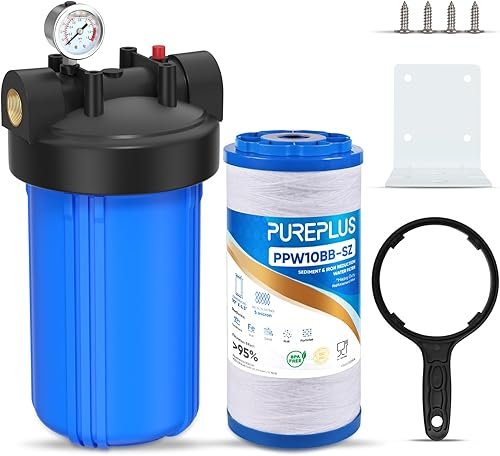
PUREPLUS 1-Stage Whole House Filter
This is your entry point. It’s a standard 10″x4.5″ housing with an iron/manganese reducing cartridge. We see this as a “try it” setup. It can work for very low iron levels (under 1-2 ppm) if you change the cartridge religiously. But honestly, for most well water, it’s a band-aid. The cartridge will clog fast if you have sediment.
- Extremely low upfront cost
- Simple to install and understand
- Uses standard, cheap cartridges
- Cartridge lifespan is short with real iron problems
- No backwash—media gets exhausted
- Won’t handle high flow rates
PUREPLUS String Wound Sediment + Iron Cartridge
A smarter cartridge combo. You get a string wound sediment pre-filter and an iron-reducing cartridge in one pack. This addresses a real problem: protecting the iron media from getting fouled by sand and silt. In our experience, this dual approach will make each cartridge last longer than a single-stage setup. Still, it’s a cartridge-based solution with all the usual limitations.
- Two-stage filtration in a single housing
- Sediment pre-filter extends iron cartridge life
- Good value for the combo
- Still requires frequent cartridge changes
- Not a true oxidizing filter
- Flow rate can be restrictive
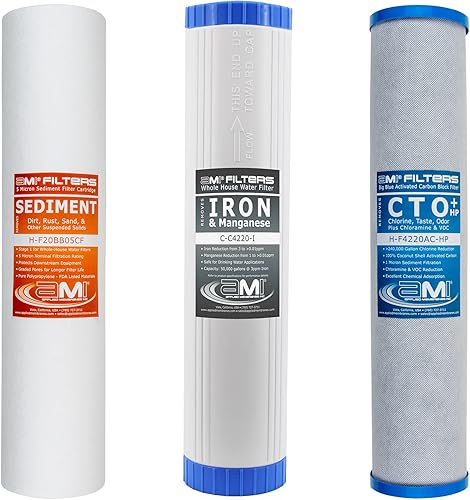
APPLIED MEMBRANES 3-Stage 20″ Filter Set
This is a replacement cartridge set for a 20-inch Big Blue system. You’re getting three big cartridges: sediment, carbon block, and iron/manganese. This is a solid, no-frills approach for whole house filtration if you already have the housings. The carbon stage helps with taste and odor, which is a nice plus. It’s a workhorse setup we’ve recommended for years.
- Complete 3-stage set for comprehensive filtration
- Large 20″ cartridges last longer than 10″
- Includes carbon for chlorine/taste improvement
- You need to own the 20″ housings already
- Cartridges still need regular replacement
- No automated backwash
Waterdrop WD-X8 Reverse Osmosis System
Wait—a reverse osmosis system in an iron filter article? Hear us out. This is for your drinking water tap. If you have a whole house iron filter handling the stains and smell, but you want the purest possible water for cooking and drinking, this is the final polish. It removes virtually everything, including PFAS, lead, and TDS. The 800 GPD flow rate means no waiting for a tank to fill.
- NSF/ANSI 42 & 58 certified reduction claims
- Incredibly high 800 GPD flow rate
- Low 2:1 drain ratio saves water
- It’s a point-of-use system, not whole house
- Wastewater line required
- More complex installation
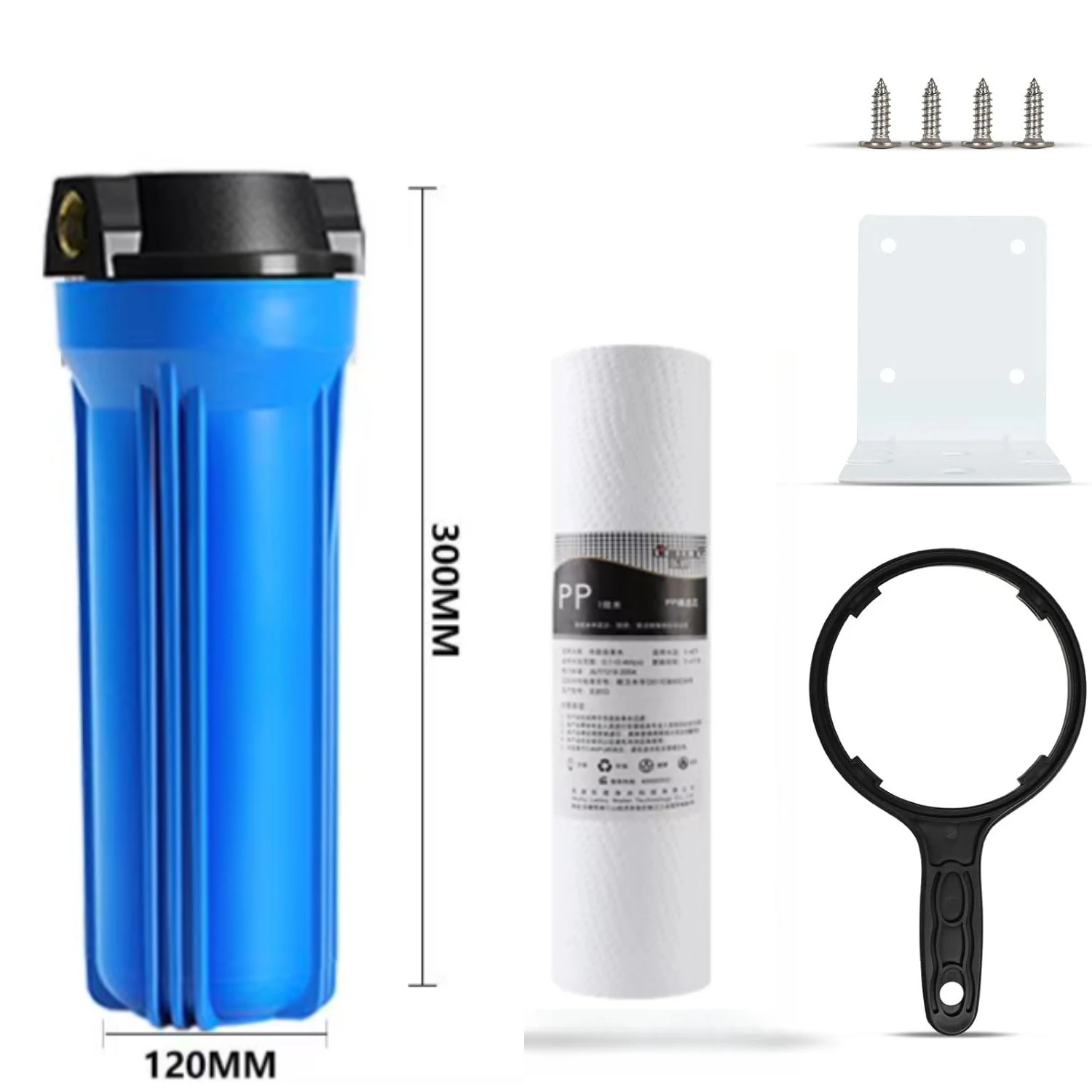
AliExpress Budget 1-Stage Filter
This looks identical to the Amazon PUREPLUS unit, and it might be. The price is compelling, but buyer beware. We haven’t tested this specific seller, and warranty/support will be tricky. The 40% rating is a red flag. This could be okay for a cabin or a very temporary fix, but we wouldn’t stake our home’s plumbing on it.
- Very low price point
- Standard housing accepts other cartridges
- Unknown seller reliability
- Likely no warranty support
- Quality control is a gamble
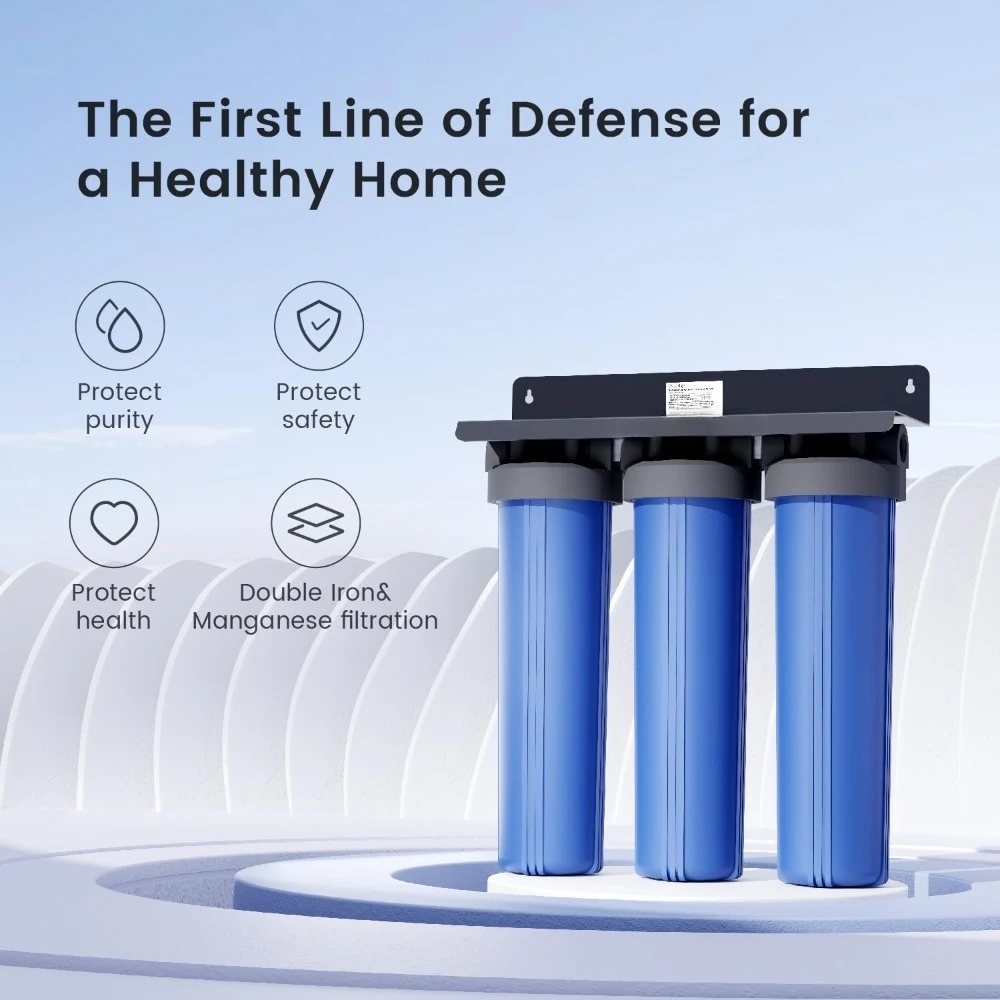
AliExpress 3-Stage System
This is a full 3-stage system claiming 7-stage filtration. It includes sediment, carbon, and iron/manganese filters. The price is attractive for a complete setup. However, the lack of ratings and the typical AliExpress gamble applies. It might work, or the housings might leak. If you’re handy and can troubleshoot, it could be a project. For most people, the stress isn’t worth the savings.
- Complete system at a low price
- Includes multiple filter types
- No user ratings to verify claims
- Shipping time and returns are problematic
- Quality of housings and valves is uncertain
Frequently Asked Questions
- What is the best whole house filter for iron in well water?
- For most homes, an air injection oxidation (AIO) system with a catalytic media like Birm or Filox-R is the best balance of effectiveness and low maintenance. It handles moderate iron levels without chemicals. For very high iron (over 15 ppm), a chemical injection system with greensand may be necessary.
- How much does a whole house iron filter cost?
- Expect to pay $500 to $1500 for a quality system with a backwashing head. Cartridge-based systems are cheaper upfront ($100-$300) but cost more in replacements. Professional installation can add $200-$500.
- Can I install a whole house iron filter myself?
- If you’re comfortable cutting into your main water line and have a suitable drain for the backwash line, yes. The plumbing is straightforward. However, if you need a neutralizer tank or chemical feed pump, we recommend a professional.
- How often do you need to change the filter?
- It depends. Cartridge filters may need changing every 1-3 months. Backwashing media beds last 3 to 10 years before needing replacement. The control valve will handle the cleaning cycles automatically.
- Will an iron filter soften my water?
- No. Iron filters remove iron, manganese, and sulfur. Water softeners remove hardness minerals (calcium and magnesium) through ion exchange. They are different systems, though sometimes installed together.
- Do iron filters waste a lot of water?
- The backwash cycle uses water—typically 50 to 150 gallons per cycle. A metered system that backwashes based on actual use is more efficient than a simple timer. It’s a trade-off for having clean, stain-free water throughout your home.
Final Thoughts
After testing and seeing the long-term results, we believe a whole house iron filter is one of the best investments a homeowner with well water can make. It stops the endless battle with stains and protects your plumbing investment. Don’t cheap out on a cartridge system if you have a real iron problem. Get a proper backwashing unit.
For 2026, our top recommendation for most families remains a mid-range AIO system. Pair it with a point-of-use RO system like the Waterdrop for your kitchen tap, and you’ll have the best of both worlds: protected appliances and pristine drinking water. Test your water, size your system correctly, and you’ll solve the iron problem for good.
