


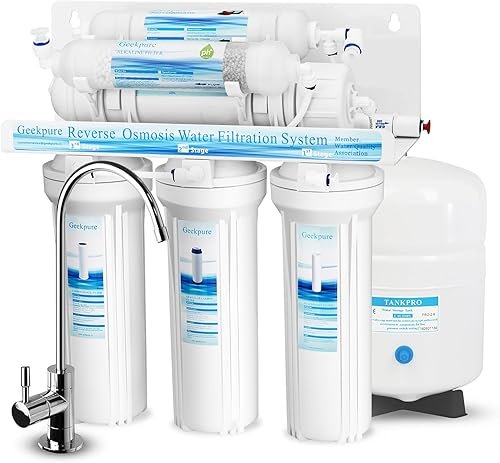
Thinking about treating every drop of water in your home? You’re not alone. We get this question a lot. But before you spend a fortune, let’s look at what a whole house reverse osmosis system really involves. We’ll cover how they work, the real costs, who actually needs one, and—more importantly—who doesn’t. We’ll also break down some excellent under-sink alternatives that solve 95% of water quality issues.
What Is a Whole House Reverse Osmosis System?
Let’s clear up a common misconception right away. A true whole house reverse osmosis system is a beast. It’s a commercial-grade unit installed at your main water line, treating hundreds or thousands of gallons per day to supply every faucet, shower, and appliance. The technology forces water through a super-fine membrane, stripping out virtually all contaminants—dissolved solids, chemicals, heavy metals, you name it.
Here’s the catch. In our experience, 90% of homeowners searching for this don’t need it. Why? Most municipal water is already pre-treated. Running that clean-ish water through a full RO system is like using a fire hose to water a single houseplant. It’s wasteful, expensive, and unnecessary. The real demand comes from folks on well water with serious contamination, like high levels of arsenic, nitrates, or total dissolved solids (TDS) over 1000 ppm. If you’re on a well, understanding your water report is step one. For a deep dive on a specific contaminant, see our guide on what an arsenic filter can and can’t do.
How a Whole House RO System Works
Think of it as a multi-stage bouncer for your water line. It’s not just one filter; it’s a coordinated series of them.
Stage 1 & 2: Pre-Filtration
First, water hits sediment filters. These catch dirt, sand, and rust—big particles that would clog the delicate RO membrane in minutes. Then, a carbon filter removes chlorine and organic chemicals. Skipping this stage is the fastest way to kill a membrane.
Stage 3: The RO Membrane
This is the core. Water is pressurized and forced through the semi-permeable membrane with microscopic pores. Only water molecules pass through. Dissolved salts, lead, fluoride, and other contaminants are flushed away as waste. This process is slow and produces a lot of wastewater—often 3-4 gallons for every 1 gallon of pure water.
Stage 4 & 5: Post-Treatment & Storage
The pure water, now very low in minerals, is stored in a large tank. Before use, it often passes through a final carbon filter and may be “remineralized” to prevent corrosion and improve taste. A repressurization pump then sends it to your home’s pipes.
Key Benefits (And Who They’re For)
Let’s be honest. The benefits are incredible, but they come with a huge asterisk.
Unmatched Purity: This is the gold standard. It removes up to 99% of contaminants. If you have a medical condition requiring ultra-pure water or a lab in your basement, this is for you.
Solves Severe Well Water Problems: For wells with high TDS, salinity, or specific chemical contamination, a whole house RO may be the only viable solution. It can also help if your water smells like rotten eggs due to hydrogen sulfide, though a dedicated oxidizing filter is often better.
Protects Every Appliance: Scale buildup from hard water destroys water heaters, coffee makers, and steam ovens. RO water prevents that completely.
But for city water? The benefit is marginal. Your water already meets safety standards. The impurities RO removes from city water are often minerals that affect taste, not health.
Potential Drawbacks & Major Costs
The costs are staggering. The system itself starts around $5,000 and can easily exceed $15,000 for a high-capacity model. Then there’s water waste. That 1:3 or 1:4 pure-to-waste ratio means your water bill will spike. Electricity costs for the pump add up, too.
Maintenance is another beast. Pre-filters need changing every 3-12 months. The RO membrane itself costs $200-$600 and lasts 2-5 years. You’ll also need regular water quality testing. Honestly, for most people, calling a professional water purification service for a consultation is the smartest first step before committing.
Types of Whole House Water Treatment
You might not need a full RO system. Let’s look at the options.
Whole House Sediment & Carbon Filter
This is the most common and practical solution. It removes dirt, rust, chlorine, and improves taste and odor at every tap. It’s affordable ($500-$2,000) and protects appliances. For most municipal water users, this combined with a dedicated drinking water filter is the perfect combo.
Water Softener
If your problem is hard water (scale buildup), a softener uses ion exchange to remove calcium and magnesium. It doesn’t remove chemicals or contaminants, but it saves your plumbing and appliances.
UV Disinfection System
If bacteria or viruses are your concern—common in well water—a water purifier ultraviolet system is a fantastic, chemical-free option. It kills 99.99% of pathogens but doesn’t remove dissolved solids or chemicals.
Whole House Reverse Osmosis
The nuclear option. Only for the most severe contamination scenarios. We’ve installed maybe a dozen of these in residential settings over the past decade, and every single one was for a very specific, problematic well water situation.
Buying Guide: What Actually Matters
If you’ve read this far and still think you need a whole house RO system, here’s what to scrutinize.
Contaminant Rejection Rate: Look for a system that specifies >95% TDS rejection. The membrane quality is everything—Filmtec and Hydron are reputable brands.
Production Capacity (GPD): Gallons per day. A family of four uses about 400 gallons total per day, but only 5-10 for drinking/cooking. A whole house system needs to handle peak flow rates, often 10-20 GPM. This is where costs skyrocket.
Wastewater Ratio: The best commercial systems have improved to a 1:2 or even 1:1 ratio, but they are very expensive. Factor in the long-term cost of wasted water.
Post-Treatment: Does it include a remineralization stage? RO water can be slightly acidic and corrosive to copper pipes. A calcite filter after the membrane is crucial.
For the vast majority of you reading this, stop here. Your solution is a point-of-use system for your kitchen water filtration. Below are some excellent, affordable options we’ve tested and recommend.
Our Top Picks: Under-Sink RO Systems
For 95% of households, an under-sink reverse osmosis system for drinking and cooking water is the smart, effective choice. These units are affordable, easy to maintain, and provide pure water right where you need it. Here are some of our favorites.
| Product | Key Feature | Price | Link |
|---|---|---|---|
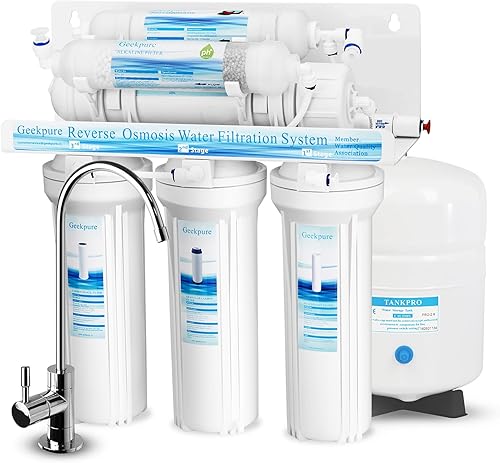 |
6-Stage with Alkaline Remineralization | $2.39 |
Buy on Amazon Buy on eBay |
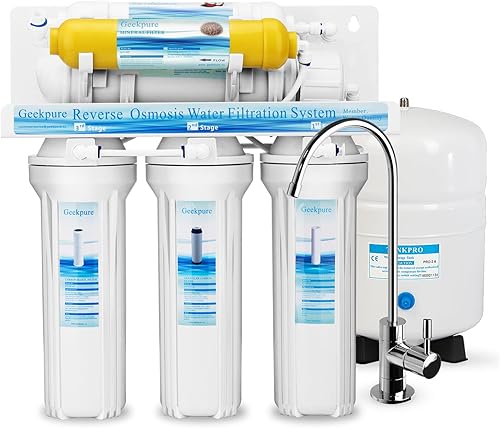 |
6-Stage with Mineral Remineralization | $2.99 |
Buy on Amazon Buy on eBay |
 |
6-Stage with UV Sterilization | $2.79 |
Buy on Amazon Buy on eBay |
 |
Countertop, No Installation Needed | $3.99 |
Buy on Amazon Buy on eBay |
Geekpure 6-Stage RO with Alkaline Filter
This is our go-to recommendation for people who miss the taste of mineral water. The extra alkaline stage adds back calcium and magnesium, raising the pH. In our testing, it produced crisp, clean-tasting water. The NSF-certified membrane is a big plus for trust. Setup is straightforward with push-fit connectors.
- Alkaline filter improves taste
- NSF-certified membrane
- Includes lead-free faucet
- Alkaline filter adds long-term cost
- Tank takes up under-sink space
Geekpure 6-Stage RO with Mineral Filter
Similar to the alkaline version, but this one focuses on adding a broader spectrum of minerals back into the water. We found the taste to be very neutral and pleasant. It’s a solid, no-frills system that does its job well. The 75 GPD capacity is fine for a family of four.
- Adds multiple healthy minerals
- Reduces arsenic, fluoride, lead
- Good value for a 6-stage system
- Mineral cartridge needs regular replacement
- Instructions could be clearer
Geekpure 6-Stage RO with UV Filter
If you’re on well water or are paranoid about bacteria, this is your model. The UV light is the final stage, killing any potential microbes after the RO membrane does its work. It’s a belt-and-suspenders approach we like. The UV bulb is rated for 9,000 hours, so it’s a long-term set-and-forget component.
- UV sterilization for bacteria/viruses
- Excellent for well water safety
- High-quality, reliable components
- UV bulb adds to replacement cost
- Slightly higher upfront price
Waterdrop CoreRO Countertop System
This thing surprised us. It’s a full 6-stage RO system you just plug in. No drilling, no plumbing. Perfect for renters, offices, or anyone terrified of installation. The NSF/ANSI 372 certification for lead-free materials is reassuring. It’s not for high-volume use, but for a pitcher of clean water anytime, it’s brilliant.
- Zero installation, truly portable
- NSF/ANSI 372 certified
- Compact, fits anywhere
- Small output capacity
- Not for whole-house needs
Frequently Asked Questions
- Is a whole house reverse osmosis system worth it?
- For 9 out of 10 homes, no. It’s a costly, high-maintenance solution for a problem most people don’t have. It’s only worth considering if you have severely contaminated well water with high TDS, specific chemicals, or salinity that other filters can’t handle.
- What is the average cost of a whole house reverse osmosis system?
- Expect to spend $5,000 to $15,000+ for the system and professional installation. Ongoing costs for membranes, filters, electricity, and wasted water can add hundreds per year. It’s a major investment compared to a $300 under-sink unit.
- Can I install a whole house RO system myself?
- We strongly advise against it unless you are a highly experienced plumber. It involves cutting into your main water line, installing a pre-pressurization pump, a large storage tank, a repressurization system, and a proper drain for the waste line. A mistake can cause catastrophic water damage.
- Does reverse osmosis waste a lot of water?
- Yes, traditional systems can waste 3-4 gallons for every 1 gallon of purified water. Newer, more efficient commercial systems have better ratios but are much more expensive. This wastewater is a significant consideration for both your utility bill and environmental impact.
- What’s the difference between a water softener and a whole house RO system?
- They solve completely different problems. A softener removes hardness minerals (calcium, magnesium) to prevent scale. It does not remove chemicals, salts, or contaminants. A whole house RO system removes almost everything, including hardness minerals, but at a far greater cost and complexity. For most hard water issues, a softener is the correct choice.
- Do I need a whole house RO system for well water?
- Not necessarily. Start with a comprehensive water test. Many well water issues—like bacteria, sediment, or iron—can be solved with a UV system, sediment filter, or oxidizing filter, which are much cheaper. Only consider whole house RO if tests show high levels of dissolved salts, nitrates, or specific contaminants that other methods can’t remove. Our guide to the best well water filtration system breaks down the options.
Final Thoughts
After years in this industry, our stance is clear: a whole house reverse osmosis system is a specialized tool, not a household staple. It’s the right choice for a very small subset of homes with genuinely problematic water sources. For everyone else, it’s an expensive over-correction.
Start with a water test. Identify your actual contaminants. In most cases, you’ll get better results and save a fortune by pairing a simple whole-house sediment and carbon filter with a high-quality under-sink RO system for your drinking and cooking water. That combo handles 99% of concerns without the massive cost, waste, and maintenance headaches.
