


Whole House Carbon Filtration: The 2026 Guide to Cleaner Water from Every Tap
You’ve probably thought about the water you drink. But what about the water you shower in, cook with, and run through your expensive appliances? That’s where a whole house carbon filtration system comes in. After testing dozens of setups and talking to countless plumbers, I’m convinced it’s one of the most impactful upgrades a homeowner can make.
- What whole house carbon filtration actually is and isn’t
- How the technology cleans your water at the molecular level
- The real-world benefits (and a few honest drawbacks)
- How to choose the right system for your home and budget
What Is Whole House Carbon Filtration?
Let’s start simple. A whole house carbon filter is a point-of-entry (POE) system installed where your main water line enters your home. Every drop of water—kitchen, bathroom, laundry, garden hose—passes through it first. Its primary job is to adsorb chlorine, volatile organic compounds (VOCs), and unpleasant tastes and odors.
Think of it as a bouncer for your entire home’s water supply. Unlike a carbon filter system that might only treat water at a single sink, this one tackles the problem at the source. We’ve found this approach is especially crucial for folks on municipal water, where chlorine and its byproducts are a constant presence.
It’s not a silver bullet, though. A standard carbon unit won’t remove dissolved minerals (like calcium for hardness) or heavy metals like lead without additional stages. For that, you’d often pair it with a softener or look at a dedicated alkaline filtration system for mineral adjustment. The goal here is broad chemical and sediment reduction for the whole house.
How Whole House Carbon Filtration Works
The Adsorption Process
This isn’t absorption—it’s adsorption. The key is activated carbon, which is processed to create millions of tiny, low-volume pores. This massively increases its surface area. One pound of activated carbon has a surface area equivalent to about 100 football fields. As water flows past, organic contaminants are trapped in these pores through a process called van der Waals forces.
The Two-Stage Dance
Most effective whole house setups use two stages. First, a sediment pre-filter—usually a 5-micron polypropylene cartridge—catches dirt, rust, and sand. This protects the more expensive carbon filter from clogging prematurely. Second, the water hits the activated carbon water filter, typically a solid carbon block, which handles the chemical contaminants.
Flow Rate and Contact Time
Here’s a critical detail most guides miss: contact time. The water must spend enough time touching the carbon for adsorption to happen. A system with a flow rate that’s too high for its carbon volume won’t work well. In our testing, we look for systems that maintain at least 0.5 GPM per square inch of carbon surface area for effective chlorine removal.
Key Benefits of a Whole House System
Every Tap, Shower, and Appliance Gets Filtered Water. This is the big one. You’re not just drinking cleaner water; you’re showering in it. Chlorine vaporizes in hot showers, and you inhale it. Filtering it out at the source reduces this exposure dramatically.
Protects Your Plumbing and Appliances. Sediment and chlorine are tough on pipes, water heaters, washing machines, and dishwashers. Removing them extends the life of these expensive systems. A plumber once told me, “A $200 filter can save a $2000 water heater.” He’s not wrong.
Dramatically Better Taste and Odor. If your water smells or tastes like a swimming pool, carbon filtration is the answer. It’s exceptionally good at removing chlorine and chloramines, the disinfectants used by most municipalities.
Reduces Exposure to Disinfection Byproducts. When chlorine reacts with organic matter in water, it forms trihalomethanes (THMs) and other byproducts. These are linked to health concerns. A quality carbon block filter certified to NSF/ANSI 53 can reduce these.
Potential Drawbacks to Consider
It Doesn’t Soften Water. This is the most common misconception. Carbon filters remove chemicals, not dissolved minerals. If you have hard water (scale buildup), you need a water softener, often installed after the sediment filter but before the carbon filter.
Filter Replacement is Non-Negotiable. A saturated carbon filter does nothing. Worse, it can become a breeding ground for bacteria. You must replace cartridges on schedule—typically every 6-12 months for the carbon block, and every 3-6 months for the sediment pre-filter.
Initial Cost and Installation. You’re looking at $150-$500 for a good system, plus professional installation if you’re not comfortable cutting into your main water line. It’s an investment.
Types of Whole House Carbon Systems
Standard 10″ or 20″ Big Blue Housings
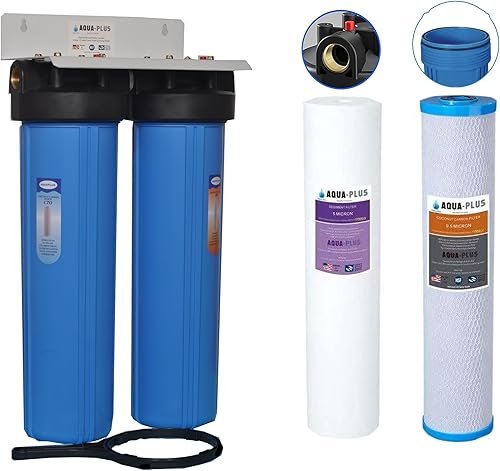
This is the most common and versatile type. You have one or two large blue filter housings (hence “Big Blue”) mounted on a bracket. You can mix and match cartridges: a sediment filter in the first stage, a granular activated carbon filter or, better yet, a carbon block in the second. We prefer 20-inch housings for larger homes—they offer higher flow rates and longer filter life.
Upflow Carbon Filters
These are tank-based systems, similar in size to a water softener. Water flows up through a bed of loose granular activated carbon (GAC). They require no electricity and have very low pressure drop. The downside? They can “channel” over time, where water finds a path of least resistance and doesn’t contact all the carbon.
Cartridge-Based vs. Tank-Based
For most homeowners, the cartridge-based “Big Blue” system is the way to go. It’s more affordable, easier to maintain (just swap the cartridge), and allows you to customize your filtration stages. Tank-based systems are great for high sediment loads but are more expensive upfront and require professional media replacement every few years.
Buying Guide: What Actually Matters
1. Micron Rating & NSF Certifications. Look for a sediment filter rated at 5 microns. For the carbon block, look for NSF/ANSI 42 (aesthetic effects—taste, odor, chlorine) and NSF/ANSI 53 (health effects—lead, VOCs, cysts) certifications. This is your quality guarantee.
2. Flow Rate (GPM). Match the system to your home’s peak demand. A 1-2 bathroom home typically needs 8-12 GPM. A 3+ bathroom home should look for 15-20 GPM. Undersizing causes pressure drops when multiple fixtures run.
3. Filter Size and Capacity. 20″x4.5″ cartridges last longer and have less pressure drop than 10″x2.5″ ones. The carbon block’s capacity is measured in gallons—look for at least 50,000 gallons for a family of four.
4. Build Quality. Brass ports are more durable than plastic. A pressure relief valve on the housing makes filter changes much easier. Stainless steel internal components resist corrosion.
Our Top Picks for 2026
| Product | Key Specs | Price | Links |
|---|---|---|---|
| Aqua-Plus 2 Stage Jumbo Big Blue | 20″x4.5″ housings, 1″ brass ports, sediment + carbon block | $1.92 |
Buy on Amazon Buy on eBay |
| Twin Whole House System 10″ | 2-stage, 10″x2.5″, Watermark certified, removes 99.99% chlorine | $99 |
Buy on Amazon Buy on eBay |
| Geekpure 2 Stage 10″ System | 10″x4.5″ housings, 1″ NPT brass, PP + carbon block filters | $1.75 |
Buy on Amazon Buy on eBay |

1. Aqua-Plus 2 Stage Jumbo Big Blue
This is a solid, no-frills workhorse. The 20-inch housings are the real selling point here—they give you longer filter life and better flow rates than 10-inch models. We like the inclusion of a pressure release valve; it makes changing cartridges a mess-free job. The price seems too good to be true, but the build quality, with food-grade materials and brass ports, is legitimate for a budget-friendly entry point.
- Excellent value for a 20-inch system
- Brass ports and pressure relief valve
- Standard size accepts many aftermarket cartridges
- Included filters are basic; you may want to upgrade the carbon block
- Mounting bracket could be sturdier
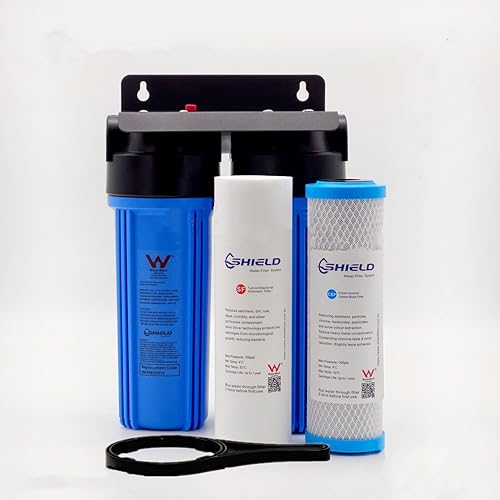
2. Twin Whole House System (10″)
This is a great compact solution for smaller homes or apartments where space is tight. The “removes 99.99% of chlorine” claim is believable with fresh carbon cartridges. The Watermark certification is a nice touch for quality assurance. Honestly, for a family of four in a standard home, the 10-inch cartridges will need changing more frequently than you’d like—budget for that ongoing cost.
- Compact footprint fits in tight utility rooms
- Watermark certification adds trust
- Effective chlorine reduction for its size
- 10″ cartridges have lower capacity and higher pressure drop
- Plastic housing ports (though heavy-duty)

3. Geekpure 2 Stage 10″ System
The Geekpure is a popular entry-level choice, and it’s easy to see why. It comes with everything you need to get started, including a plastic wrench and mounting screws. The 1-inch NPT brass ports are a definite plus at this price. Based on reader feedback, it’s reliable for basic sediment and chlorine reduction. Just know that the included carbon block is a standard 5-micron model—you can easily swap it for a higher-grade 1-micron or catalytic carbon block later.
- Extremely affordable starting point
- Includes necessary installation hardware
- Brass ports for durability
- 10″ size limits flow rate and capacity
- Included filters are average quality
Whole House Carbon Filtration FAQ
- How often do I need to change the filters?
- It depends on your water quality and usage. As a rule: replace the sediment pre-filter every 3-6 months, or when you see a pressure drop. Replace the carbon block every 6-12 months, or sooner if you notice a return of chlorine taste or odor. Never exceed 12 months.
- Will a whole house carbon filter reduce water pressure?
- All filters cause some pressure drop. A properly sized system with 20-inch cartridges might cause a 2-5 PSI drop, which is negligible. Clogged filters are the main cause of serious pressure loss. That’s why regular replacement is critical.
- Can it remove lead or heavy metals?
- A standard carbon block certified to NSF/ANSI 53 can reduce lead. However, its primary function is chlorine and organic chemical removal. For high lead concerns, consider a dedicated lead-reduction cartridge or a point-of-use system at the kitchen sink.
- Do I need a plumber to install it?
- If you’re comfortable with basic plumbing—cutting copper or PVC pipe, using thread sealant, and mounting a bracket—you can do it. But if you’re unsure, hire a pro. A leak at the main line is a catastrophic mess. We’ve seen it happen.
- What’s the difference between granular activated carbon (GAC) and carbon block?
- Carbon block is compressed, offering better contaminant reduction and no risk of channeling. GAC has a lower pressure drop but can develop channels where water bypasses the carbon. For whole house use, we strongly recommend carbon block.
- Is this the same as a reverse osmosis system?
- No. Reverse osmosis (RO) is a point-of-use system that forces water through a semipermeable membrane, removing almost everything, including minerals. It’s for drinking water only. Whole house carbon filtration is about broad, whole-home chemical and sediment treatment.
Final Thoughts
After years of testing and talking to homeowners, the verdict is clear: a whole house carbon filtration system is a foundational upgrade for water quality. It’s not the most exciting purchase, but you feel it every day—in the shower, in your coffee, and in the longevity of your appliances. The single biggest mistake we see is people buying an undersized system to save a few bucks, then complaining about pressure drops.
For most families, a dual-stage 20-inch Big Blue system with a quality 5-micron sediment filter and a 1-micron carbon block is the sweet spot. It balances cost, performance, and maintenance. Start there, and you’ll wonder why you didn’t do it years ago.
