


You’ve heard the claims. “Kills 99.99% of germs!” But what does UV water purification actually do, and is it the right choice for your home? We’ve installed, tested, and stress-tested these systems for years. This guide cuts through the marketing to show you exactly how UV works, when it shines, and when you need something else.
- What UV purification is and what it targets
- How the technology works in plain English
- The real benefits and the honest drawbacks
- A clear buying guide and our top system picks for 2026
What Is UV Water Purification?
UV water purification is a disinfection method that uses ultraviolet light to inactivate microorganisms. Think of it as a targeted, chemical-free sunburn for bacteria and viruses. The UV-C light (at a specific 254nm wavelength) penetrates the cell walls of pathogens and scrambles their DNA. They can’t reproduce, so they can’t make you sick.
Here’s the critical part: UV is a disinfection tool, not a filtration tool. It doesn’t physically remove anything from your water. Dead microbes, sediment, heavy metals, and chlorine pass right through. That’s why you’ll almost always see a UV lamp as the last stage in a multi-stage system, sitting after sediment and carbon filters. It’s the final guard at the gate. For a deeper dive into what constitutes safe drinking water, our main guide breaks it down.
How UV Water Purification Works
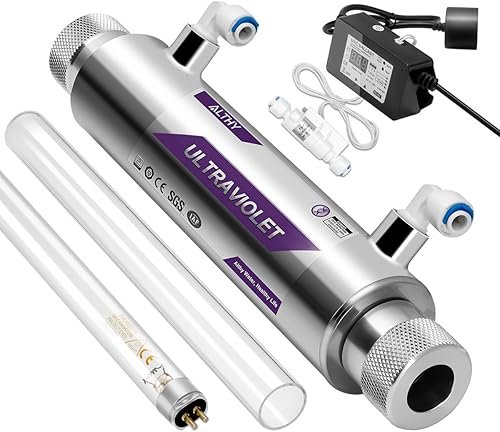
The process is simple in principle but requires precise engineering. Water flows into a stainless steel chamber. Inside, a quartz glass sleeve protects a powerful UV-C lamp. As water swirls around the sleeve, it’s blasted with intense ultraviolet light.
The Science of DNA Disruption
The UV-C light energy is absorbed by the DNA and RNA of microorganisms. This energy causes adjacent thymine bases to fuse together, creating a “kink” in the DNA strand. This damage is catastrophic. The pathogen’s genetic code is scrambled, making it unable to replicate or cause infection. It’s a physical, not chemical, process.
Flow Rate & Dose: The Two Things That Matter
Effectiveness boils down to two numbers: UV dose (measured in mJ/cm²) and flow rate (GPM or LPM). The dose is a product of light intensity and exposure time. A slower flow rate means more exposure time. This is why a system rated for 1 GPM at a 40 mJ/cm² dose will fail if you force 3 GPM through it—the water zips past too fast for the light to work. Always match the system’s rated flow to your home’s peak demand.
Key Benefits of UV Treatment
Chemical-Free Disinfection: No chlorine, no iodine, no byproducts. You’re just using light. This makes UV ideal for people sensitive to chemical additives or who want to avoid that “pool water” taste.
Extremely Effective Against Pathogens: When properly sized and maintained, UV destroys 99.99% of bacteria, viruses, and protozoan cysts like Giardia and Cryptosporidium. It’s a proven technology used by municipalities and bottled water plants worldwide.
Low Maintenance & Energy Use: Once installed, a UV system is quiet and cheap to run. The lamps use about the same energy as a small light bulb. The main task is replacing the lamp annually (or after 9,000 hours) and keeping the quartz sleeve clean.
Potential Drawbacks & Limitations
Electricity Dependent: No power, no protection. During an outage, you have zero disinfection. Some systems have battery backups, but most don’t.
Lamp & Sleeve Maintenance: The lamp intensity fades over time, even if it still glows. You must replace it on schedule. The quartz sleeve can get coated with mineral scale, especially in hard water, blocking UV transmission. Regular cleaning is essential.
No Residual Disinfection: Unlike chlorine, UV offers no ongoing protection. Once the water leaves the chamber, if it encounters a bacteria-laden pipe or faucet downstream, it can get re-contaminated. This is why it’s the last step before your tap.
Types of UV Water Systems
Point-of-Entry (POE) Whole House Systems
These are installed on your main water line to treat every drop entering your home. They’re sized for higher flow rates (often 8-20+ GPM) and are the gold standard for comprehensive protection. Ideal for well water homes or anyone wanting whole-house peace of mind.
Point-of-Use (POU) Under-Sink Systems
Smaller units designed to treat water at a single tap, usually the kitchen. They’re often the final stage in a reverse osmosis or multi-stage filter system. Flow rates are lower (0.5-1 GPM), which is fine for drinking and cooking. If you’re on a municipal supply and just want extra safety for your countertop RO system, this is the way to go.
Portable & Specialty UV Devices
From SteriPEN wands for hikers to UV stages in a travel water filter, these are for on-the-go use. They’re great for adventure but not for home water treatment. We’ve even seen UV integrated into a glass pitcher with filter—neat, but the contact time is usually too short for serious disinfection.
UV System Buying Guide
1. Flow Rate is King: Calculate your peak demand. How many bathrooms? What’s your household size? A 1 GPM POU unit won’t cut it for a whole house. For a typical family home on well water, look for a 10-12 GPM POE system.
2. Check the UV Dose: Look for systems certified to NSF/ANSI 55 Class A (40 mJ/cm²) for disinfection. Class B systems are for treated water only. Don’t trust vague “99.99%” claims without a certified dose.
3. Pre-Filtration is a Must: You need a sediment filter (5-micron or less) upstream to ensure water clarity. For well water with high manganese or iron, you’ll need specific pre-treatment—a water filter for manganese is often required before UV.
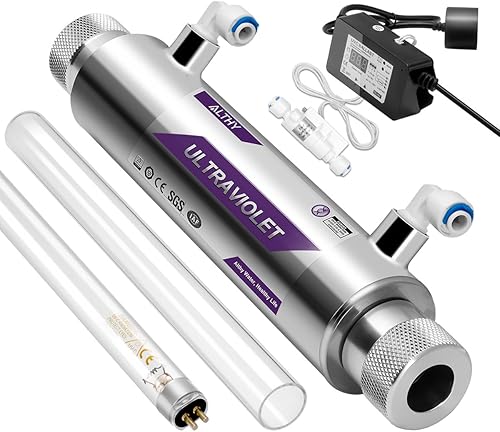
4. Look for Smart Features: A UV intensity monitor is worth its weight in gold. It tells you the actual germicidal power, not just if the lamp is on. A flow sensor switch, like on the ALTHY model below, saves lamp life by only activating when water flows.
Our Top UV System Picks (2026)
| Product | Key Specs | Best For | Price |
|---|---|---|---|
 |
1 GPM, 11W, Smart Flow Sensor, 304 SS Chamber | Adding UV to an existing under-sink or RO system | $1.29 |
 |
75 GPD RO, 6-Stage with UV, NSF Membrane | A complete all-in-one drinking water solution | $2.45 |
 |
1 GPM, 12W, Whole House, SS Housing | Budget-friendly whole house UV for small homes | $1.00 |
 |
800 GPD RO, 9-Stage, NSF 42&58&372, Low Drain Ratio | High-capacity, certified purity for demanding households | $7.19 |
ALTHY UVF-FS11 UV Ultraviolet Water Filter Purifier
This is the unit we recommend to readers who already have a good sediment and carbon filter in place and just want to add that final UV barrier. The smart flow sensor is a killer feature—it only powers the lamp when you’re drawing water, which can double the bulb’s lifespan. The 1 GPM flow is perfect for a dedicated drinking water faucet. It’s a Philips lamp in a 304 stainless steel chamber, which is exactly what you want.
- Smart flow sensor saves energy and lamp life
- Quality Philips 11W UV-C lamp
- Easy DIY install for under-sink use
- Very affordable entry point
- 1 GPM is only for point-of-use
- You need a pre-existing filtration system
- No UV intensity monitor
Geekpure 6-Stage Reverse Osmosis System with UV
If you’re starting from scratch and want one box that does it all, this Geekpure is a solid contender. The 6-stage process tackles sediment, chlorine, TDS via the RO membrane, and then polishes it with a final UV disinfection stage. The NSF-certified membrane and lead-free faucet add trust. We like it for its simplicity—everything you need for safe drinking water is in one package.
- All-in-one: RO + UV in a single unit
- NSF-certified RO membrane
- Includes lead-free faucet and tank
- ISO9001-certified manufacturer
- 75 GPD is a slower production rate
- More complex install than a standalone UV
- UV bulb life not specified in listing
VEVOR 12W UV Water Purifier, Whole House
For homeowners on a tighter budget, VEVOR offers a straightforward whole-house UV solution. The stainless steel chamber and 12W lamp are standard for this class. The 1 GPM flow rate is its main limitation—it’s really only suitable for very small households or as a dedicated line. We’d call this an entry-level whole house unit. It’ll do the job if your water demand is low, but for a family, look for higher GPM.
- Extremely low price point for whole-house UV
- Stainless steel construction
- Includes installation clamps
- Claims 99.99% sterilization rate
- 1 GPM is too low for most whole-house needs
- No flow sensor or UV monitor
- Brand is less established in water treatment
Waterdrop X8 Reverse Osmosis System (9-Stage with UV)
This is the premium pick. The Waterdrop X8 is a beast—800 GPD means no waiting for a tank to fill, and the 2:1 drain ratio is incredibly efficient. The 9-stage filtration includes a UV stage for final disinfection. But the real story is the triple NSF/ANSI certification (42, 58, 372). That’s third-party proof it reduces what it says it does. If you want the highest flow, lowest waste, and certified performance, this is it.
- 800 GPD high flow, tankless design
- NSF/ANSI 42, 58 & 372 certified
- Excellent 2:1 pure-to-drain ratio
- 9-stage filtration including UV
- Premium price tag
- Requires under-sink power outlet
- Overkill if you just need UV disinfection
UV Water Purification FAQ
- Does UV water purification remove chlorine?
- No. UV light does not remove chlorine, chloramine, heavy metals, or dissolved solids. It only inactivates microorganisms. You need an activated carbon filter to remove chlorine and improve taste.
- How often do I need to change the UV lamp?
- Most manufacturers recommend annual replacement, or after about 9,000 hours of continuous use. The lamp may still glow after this, but its germicidal intensity drops below effective levels. Always follow the maker’s schedule.
- Can I use UV with well water?
- Absolutely—it’s highly recommended. However, well water often has sediment, iron, or manganese that must be filtered out first to prevent blocking the UV light. A proper pre-filtration setup is essential.
- Is UV better than chlorination?
- They have different strengths. UV is chemical-free and kills pathogens instantly but leaves no residual. Chlorination leaves a residual that protects water in pipes but can create disinfection byproducts. For homes, UV is often preferred for taste and safety.
- What does “NSF/ANSI 55 Class A” mean for UV systems?
- It’s a critical certification. Class A systems are validated to deliver a minimum UV dose of 40 mJ/cm² and are designed to disinfect microbiologically unsafe water. Class B systems are for already-treated water. Always look for Class A for well or unknown sources.
- Can UV water purification help with a water filter for manganese?
- Indirectly, yes, but not directly. UV doesn’t remove manganese. However, if your water has manganese bacteria (the slimy black kind), UV can kill the bacteria. You still need an oxidizing filter to remove the actual mineral. Proper sequencing is key.
Final Thoughts
After testing systems for years, our stance is clear: UV is a powerful, reliable tool, but it’s a specialist, not a generalist. It’s the best final barrier against biological contaminants you can buy. For anyone on a private well, it’s a non-negotiable part of a complete water filtration system for well water. For city water users, it’s an extra layer of security, especially if you’re immune-compromised or just want the purest water possible.
Don’t buy a UV system in isolation. Match its flow rate to your demand, insist on a certified dose (NSF/ANSI 55 Class A), and never skip the pre-filtration. Start with the ALTHY unit for a simple add-on, or go for the Waterdrop X8 if you want the top-tier integrated solution. Get the setup right, and you’ll have genuinely safe water on tap for years.
