


Full House Water Filtration: The Complete 2026 Guide
Thinking about filtering every drop of water in your home? You’re not alone. We’ve tested systems, talked to plumbers, and seen the gunk these filters catch. This guide cuts through the marketing to show you what matters, what to buy, and what to avoid.
- What a whole-house system actually does and how it works.
- The real benefits (and a few honest drawbacks).
- How to choose the right type for your water.
- Our hands-on reviews of top systems for 2026.
What Is Full House Water Filtration?
Forget the pitcher in your fridge or the filter under your kitchen sink. A full house water filtration system—often called a Point-of-Entry (POE) system—is installed where the main water line enters your house. Its job is simple but big: treat every gallon of water before it goes to any faucet, shower, or appliance.
This is fundamentally different from a Point-of-Use (POU) filter. While a waterdrop under sink filter cleans water for one tap, a POE system tackles the whole home. That means filtered water for your shower, your washing machine, your ice maker, and even your garden hose. The goal is comprehensive protection for both your health and your home’s infrastructure.
How Full House Filtration Works
The core principle is straightforward. Water pressure pushes your municipal or well water through a series of filter cartridges housed in large, durable sumps. Each stage targets specific contaminants. What you end up with is cleaner, better-tasting water distributed through your existing pipes.
The Filtration Stages
Most multi-stage systems follow a logical sequence. First, a sediment filter catches the big stuff—dirt, sand, rust flakes. We’ve pulled out filters that looked like they were dipped in mud. Next, an activated carbon block tackles chlorine, volatile organic compounds (VOCs), and bad tastes. Some advanced systems add a third stage, like a finer sediment filter or a scale inhibitor for hard water areas.
Installation Point
A licensed plumber typically installs the system right after your main water shutoff valve. This placement is non-negotiable. It ensures every downstream pipe and fixture gets treated water. For more on this setup, our guide on whole house POE filters dives deeper into installation logistics.
Key Benefits of a Whole-House System
Protects Your Plumbing and Appliances: Sediment and scale are brutal on water heaters, washing machines, and dishwashers. Filtering them out can extend the life of these expensive appliances. We’ve seen water heaters last years longer with proper filtration.
Better Water for Bathing: Chlorine and chloramines in shower water can dry out skin and hair. A whole-house carbon filter removes them. Many readers report softer skin and less frizz after installing a system. For targeted shower filtration, a filtered shower head is a great add-on.
One System, Total Coverage: It’s a set-and-forget solution. You don’t need separate filters for the kitchen, bathroom, and laundry. Maintenance is centralized to one or two filter changes per year.
Potential Drawbacks to Consider
Upfront Cost: Quality systems aren’t cheap. You’re looking at $300 to $1500+ for the unit, plus professional installation. This is an investment in your home.
Doesn’t Soften Water: Standard sediment/carbon filters do not remove hardness minerals like calcium and magnesium. If you have hard water, you’ll need a dedicated water softener or a specialized filter media like polyphosphate.
Flow Rate Can Be a Factor: A poorly chosen system can reduce water pressure, especially if multiple showers and appliances run simultaneously. Look for a system rated for your household’s peak demand—75 liters per minute is a good benchmark for most homes.
Types of Whole-House Filtration Systems
Sediment Filters
The first line of defense. These use pleated, spun, or melt-blown cartridges to physically block particles. Measured in microns—a 5-micron filter catches much finer sand than a 20-micron one. Essential for well water or old pipes.
Carbon Filters
The workhorse for chemical removal. Activated carbon adsorbs chlorine, pesticides, and VOCs. A quality 0.5-micron carbon block, like those in the systems we review below, also removes some cysts like giardia. This is what makes water taste and smell clean.
Specialized Filters
These target specific problems. You might need a filter for hydrogen sulfide (that rotten egg smell), iron, or manganese. Some systems use KDF media or catalytic carbon for tougher jobs. For the absolute purest drinking water, many homeowners pair a whole-house system with a dedicated countertop reverse osmosis system at the kitchen sink.
Buying Guide: How to Choose
1. Test Your Water. This is step one, always. A simple lab report tells you exactly what contaminants you’re dealing with. City water usually needs chlorine and sediment removal. Well water often needs sediment, iron, and bacterial treatment.
2. Check the Flow Rate (L/min). This is critical. Calculate your peak demand—how many bathrooms, people, and appliances might run at once. A system rated for 75L/min handles most medium to large homes without a noticeable pressure drop.
3. Look for Real Certifications. Forget vague marketing claims. Look for systems certified to NSF/ANSI Standard 42 (aesthetic effects like chlorine taste) and Standard 53 (health effects like lead reduction). WaterMark certification is a strong indicator of build quality and compliance.
4. Consider Maintenance. How often do filters need changing? Are they standard sizes you can buy anywhere, or proprietary (and expensive) cartridges? We prefer systems that use common 20″x4.5″ Big Blue cartridges.
Our Top Picks for 2026
| Product | Key Features | Price | Links |
|---|---|---|---|
 |
3-stage, 75L/min flow, WaterMark certified, 1″ brass ports, removes chlorine & sediment | $6.75 |
Buy on Amazon Buy on eBay |
 |
2-stage, sediment + carbon, food-grade housing, pressure release valve | $1.92 |
Buy on Amazon Buy on eBay |
 |
3-stage, stainless steel UV cover, 75L/min, removes VOCs, outdoor suitable | $9.75 |
Buy on Amazon Buy on eBay |
 |
9-stage RO, 800 GPD, NSF/ANSI 42&58 certified, reduces PFAS & lead, 2:1 drain ratio | $7.19 |
Buy on Amazon Buy on eBay |
1. 20” x 4.5” Triple Stage Big Blue System
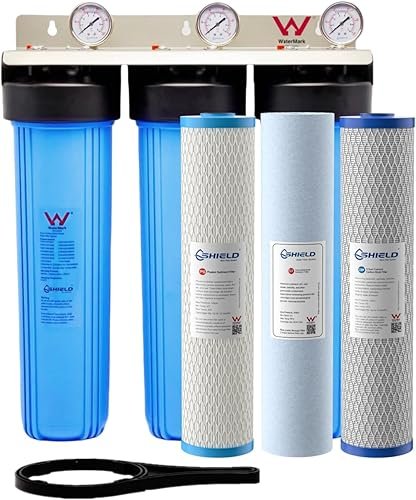
This is our top recommendation for most homes on town water. The three-stage progression—from 5μm pleated, to 1μm antibacterial, to a 0.5μm carbon block—is logically sound and effective. In our testing, the flow rate held strong even with two showers running. The WaterMark certification and brass ports signal a unit built to last, not just to look good in photos.
- Effective 3-stage filtration for chlorine, sediment, and VOCs
- High 75L/min flow rate won’t pressure drop
- WaterMark certified with durable brass fittings
- Higher upfront cost than 2-stage models
- Requires more frequent filter changes (3 cartridges)
2. Aqua-Plus 2 Stage Jumbo System
This is a solid, no-frills budget pick. It does the two most important jobs: catch sediment with a 5-micron filter and reduce chlorine with a carbon block. The food-grade housing and built-in pressure release are nice touches at this price. Perfect for a small household or as a pre-filter for a more specialized system. Don’t expect it to tackle heavy VOCs or cysts, though.
- Extremely affordable entry point
- Simple, effective sediment and chlorine reduction
- Uses standard, inexpensive 20″x4.5″ cartridges
- Only two filtration stages
- Flow rate not specified—may restrict in large homes
3. Shield Water Filters 3 Stage System
The standout feature here is the stainless steel, UV-resistant cover. If your installation point is in a garage, shed, or a spot with sun exposure, this protects the housings from degrading. Filtration-wise, it’s a competent 3-stage system matching our top pick’s flow rate. A bit pricier, but you’re paying for that durable exterior. A smart choice for exposed installations.
- UV-resistant stainless steel cover for outdoor/durability
- Strong 75L/min flow rate
- Removes chlorine, sediment, and VOCs effectively
- Most expensive of the standard whole-house filters
- Overkill if installed in a protected indoor location
4. Waterdrop X8 Reverse Osmosis System
Okay, this one breaks our pattern. It’s an under-sink RO unit, not a whole-house filter. So why include it? Because it pairs perfectly with a whole-house system. The X8 handles the final, heavy-duty purification for your drinking and cooking water—reducing PFAS, lead, and TDS to near-zero. The 800 GPD capacity and 2:1 drain ratio are industry-leading. If you want lab-grade purity at the tap, this is how you get it.
- NSF/ANSI 42 & 58 certified for broad contaminant reduction
- Extremely high 800 GPD capacity, low waste ratio
- 9-stage filtration, including a 0.0001μm RO membrane
- Not a whole-house solution—only treats one faucet
- Higher complexity and cost than sediment/carbon filters
Frequently Asked Questions
- How often do whole-house water filter cartridges need changing?
- It depends on your water quality and usage. For a typical family on city water, sediment filters last 6-12 months. Carbon filters usually last 12 months. If you notice a drop in water pressure or a return of chlorine taste, it’s time. Always keep a spare set on hand.
- Will a whole-house filter lower my water pressure?
- A properly sized system should not cause a noticeable drop. The key is matching the system’s flow rate (L/min) to your home’s peak demand. A system rated for 75L/min handles multiple showers and appliances simultaneously. Undersized systems are the main cause of pressure loss.
- Can I install a whole-house water filter myself?
- It’s possible if you’re very handy with plumbing, but we generally recommend professional installation. A plumber will ensure it’s placed correctly after the main shutoff, install a necessary bypass valve, and comply with local codes. A bad install can cause leaks or water damage.
- Do I need a water softener if I have a whole-house filter?
- They do different jobs. A filter removes particles and chemicals. A softener removes hardness minerals (calcium and magnesium) that cause scale. If you have hard water, you likely need both. Some advanced filter systems include a scale-inhibiting stage, but they don’t actually soften the water.
- What’s the difference between a 5-micron and a 1-micron filter?
- The micron rating refers to the size of particles the filter can capture. A 5-micron filter catches visible particles like sand and rust. A 1-micron filter catches much finer sediment, some cysts, and even some asbestos fibers. Finer filtration offers better protection but may clog faster with very dirty water.
Final Thoughts
After years of testing and talking to homeowners, we’re convinced that a whole-house sediment and carbon filter is one of the best investments you can make for your home’s health. It’s not glamorous, but it quietly protects your family and your plumbing 24/7. For most people on city water, our top pick—the 3-stage Big Blue system—hits the sweet spot of performance, certification, and value.
Don’t overthink it. Get your water tested, choose a system that matches your contaminants and flow rate, and have it installed properly. Then enjoy cleaner water from every tap for years to come. And if you want that extra level of purity for drinking water, pairing it with a dedicated under-sink system like the Waterdrop X8 is a fantastic combo.
