


After fifteen years testing filters, I can tell you one thing for sure: most people overcomplicate clean drinking water. They chase fancy gadgets when the basics are what matter. Let’s cut through the noise.
This guide will walk you through:
- What “clean” really means for your tap water
- How different filtration technologies actually work
- The pros and cons nobody talks about
- How to choose the right system for your home
- Our top picks for maintenance and emergency kits
What Is Clean Drinking Water?
Here’s a shocker: “clean” doesn’t mean the same thing everywhere. Your municipal supply might meet legal standards but still taste like a swimming pool. That’s because “clean” has two parts.
First, there’s safety. This means removing or killing harmful pathogens—bacteria, viruses, parasites—and reducing toxic chemicals like lead, arsenic, or pesticides to levels deemed safe by health authorities. For that, you need filters certified to standards like NSF/ANSI 53 for cyst reduction or NSF/ANSI 58 for reverse osmosis systems.
Second, there’s aesthetics. This is the stuff that won’t kill you but makes water unpleasant: chlorine taste, sulfur smells, cloudiness, or metallic flavors. A good filter tackles both. Honestly, for most city dwellers, the aesthetic improvements are what they notice first. The water just tastes better.
But is your tap water actually dangerous? Usually not. The real risk is often in older homes with lead solder in pipes or in private wells that aren’t regularly tested. That’s where targeted filtration becomes non-negotiable.
How Water Filtration Works
Filtration is basically a series of traps. Different technologies trap different things. Think of it like a bouncer at a club with a very specific guest list.
Mechanical Filtration
This is the simplest layer. A physical barrier with tiny holes blocks particles based on size. It’s rated in microns—a human hair is about 70 microns wide. A 5-micron filter catches most dirt and rust. A 1-micron filter gets most parasites like Giardia. For bacteria, you need sub-micron, around 0.2 to 0.4 microns. This is where a quality ceramic candle filter shines, offering precise pore sizes.
Adsorption (Carbon)
This is the workhorse for taste and chemicals. Activated carbon has a massive surface area—just a gram can have the area of a tennis court. It works like a magnet for organic compounds, chlorine, and many pesticides. The key metric is the carbon block quality and contact time. Granular carbon (GAC) is cheaper but can channel water, reducing effectiveness. A solid carbon block forces water through more material, doing a better job.
Ion Exchange & Reverse Omosis
Ion exchange swaps bad ions for good ones. It’s how water softeners work, replacing calcium with sodium. For drinking water, specialized resins can target heavy metals like lead. Reverse osmosis (RO) is the heavy artillery. It forces water through a semi-permeable membrane at high pressure, stripping out nearly everything—dissolved salts, fluoride, nitrates, and most contaminants. The downside? It wastes water and removes beneficial minerals, which is why some people look into the distilled water benefits debate.
Key Benefits of Proper Filtration
Health Security: The obvious one. A properly certified filter removes specific threats. If you have lead pipes, a filter certified for NSF/ANSI 53 lead reduction is a must. It’s a cheap insurance policy.
Taste and Odor: This is why most people buy a filter. Removing chlorine and its by-products makes water taste like water again. You’ll drink more of it, which is a win for your kidneys and your wallet compared to bottled water.
Appliance Protection: Sediment and hardness minerals wreck coffee makers, kettles, and ice machines. A simple sediment filter can double the life of your appliances. It’s the boring benefit that saves real money.
Environmental Impact: One filter cartridge can replace thousands of plastic bottles. The math is simple. If you’re concerned about microplastics—which are now found in most tap water—a sub-micron filter or RO system handles that too.
Potential Drawbacks & Hidden Costs
Ongoing Cost: The unit price is just the start. Replacement filters are the real cost. A $150 system might need $80 in filters every year. Always check the annual cost before buying.
Maintenance Hassle: You have to change them. It’s a 10-minute job twice a year, but people forget. We’ve tested filters 6 months past their due date—the flow rate drops and the taste comes right back.
Water Waste (RO Systems): Traditional reverse osmosis systems can waste 3-4 gallons for every gallon of pure water they produce. Newer “zero-waste” models exist but are more expensive and complex.
Mineral Removal: RO and deionization strip out everything, including calcium and magnesium. Some folks prefer mineral-rich water. You can add a remineralization stage, or just get your minerals from food. This is where the water distiller machine comparison gets interesting, as distillation has a similar effect.
Types of Filtration Systems
Pitcher & Faucet-Mount Filters
The entry point. Cheap, easy, no installation. Great for renters or improving taste on a budget. The limitation is capacity and flow rate. They use granular carbon, so contact time is short. Good for chlorine, not great for heavy metals or pesticides.
Under-Sink & Countertop Systems
The sweet spot for most homes. Installed under the sink with a dedicated faucet. They have more space for better filter media and higher flow rates. You can get multi-stage systems with sediment, carbon, and even RO. This is where you find serious chlorine water filter options.
Whole-House Systems
Installed where water enters your home. They protect every tap, shower, and appliance. Usually focus on sediment and hardness (with a softener). For drinking water, you still often need a point-of-use filter at the kitchen sink for the final polishing stage.
Emergency & Portable Solutions
Think gravity-fed filters, pump filters, and purification tablets. Essential for camping, travel, or boil-water advisories. They’re your backup when the infrastructure fails. Not for daily use, but critical to have on hand.
Buying Guide: What Actually Matters
1. Test Your Water First. Seriously. You can’t fix a problem you don’t understand. Get a lab test from a certified service, not just a strip from the hardware store. Know your starting point.
2. Match Contaminants to Certification. Look for NSF/ANSI certification numbers on the box. NSF/ANSI 42 is for aesthetic effects (taste, odor). NSF/ANSI 53 is for health effects (lead, cysts). NSF/ANSI 58 is for reverse osmosis. If a filter doesn’t list these, walk away.
3. Calculate Total Annual Cost. Add the unit price plus two years of replacement filters. That’s your real cost. Don’t be seduced by a low upfront price.
4. Consider Flow Rate & Maintenance. Will it slow your faucet to a trickle? How hard is it to change the filters? If it’s a pain, you won’t do it. We prefer systems with quick-change cartridges.
5. Think About Your Water Source. City water usually has chlorine. Well water can have bacteria, nitrates, or hardness. Your needs are different. For well owners, a multi-stage system is often the only right answer.
Top Picks for 2026
These aren’t filters—they’re the maintenance and emergency gear we actually use. Keeping your system clean is just as important as the system itself.
| Product | Key Features | Price | Links |
|---|---|---|---|
 |
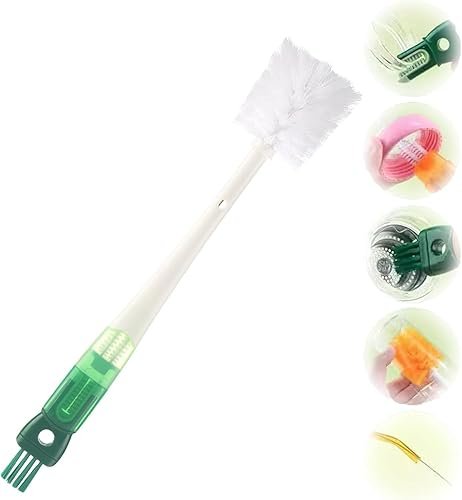
5-in-1 set: bottle brush, U-gap brush, crevice tool, corner scrubber, straw cleaner. Non-slip grip. | $15 |
Buy on Amazon Buy on eBay |
 |
Same 5-in-1 kit in orange. Great for color-coding if you have multiple bottles. | $15 |
Buy on Amazon Buy on eBay |
 |
Combo pack with both colors. Perfect for families or a dedicated bottle and travel kit. | $21 |
Buy on Amazon Buy on eBay |
 |
100 tablets. Each treats 1-2L. NaDCC chlorine formula. Compact for travel/emergency kits. | $14 |
Buy on Amazon Buy on eBay |
5-in-1 Water Bottle Cleaner Brush (Green)
This is the toolkit we keep in our test lab. The U-shaped gap brush is genius for cleaning the threads on bottle lids where mold loves to hide. The crevice brush gets into the silicone gaskets that most people forget about. It’s simple, sturdy, and solves a real problem: your reusable bottle is only as clean as its dirtiest part.
- All the brushes you need in one set
- Non-slip handles actually work when wet
- Reaches spots a sponge can’t
- Straw brush could be longer for some insulated bottles
- Plastic construction, not stainless steel
Ef-Chlor Water Purification Tablets (100 Tablets)
We’ve used these on three continents. They’re not for daily use, but for an emergency kit or a hiking trip, they’re worth their weight in gold. The NaDCC formula is more stable than old-school iodine tablets and doesn’t taste as bad. Each tablet clearly treats 1 liter in 30 minutes. The packaging is compact enough to forget in your backpack until you need it.
- Proven, reliable chemical treatment
- Lightweight and long shelf life
- Clear, simple instructions
- Leaves a slight chlorine taste (let it air out)
- Doesn’t remove sediment or chemicals—kills pathogens only
Frequently Asked Questions
- Is boiling water better than filtering it?
- Boiling kills bacteria, viruses, and parasites. It does nothing for chemicals, heavy metals, sediment, or taste. It’s a great emergency disinfection method, but for daily use, a filter is more practical and improves palatability. Think of boiling as killing germs, filtering as cleaning the water.
- How often should I really change my filter?
- Follow the manufacturer’s gallon rating or time limit—whichever comes first. If your water has high sediment, you’ll change pre-filters more often. A good rule: if the flow rate slows noticeably or the taste changes, it’s overdue. Don’t push it.
- Do I need a filter if I have city water?
- Probably, but for taste more than safety. City water is treated but picks up contaminants in old pipes. A simple carbon filter removes chlorine and its by-products, lead from old solder, and any odd tastes. It’s a cheap upgrade to what you already have.
- What’s the difference between a water filter and a purifier?
- A filter removes particulates, chemicals, and most microbes (bacteria, protozoa). A purifier also removes or inactivates viruses, which are much smaller. For travel in developing countries, you need a purifier. For North American tap water, a filter is usually sufficient.
- Can water filters remove forever chemicals (PFAS)?
- Some can. Activated carbon and reverse osmosis are both effective at reducing certain PFAS compounds. Look for filters independently tested and certified for PFAS reduction. This is a fast-moving area of research, so check for recent test data.
- Is it safe to drink distilled water?
- Yes, it’s safe. The debate about it leaching minerals from your body is largely a myth. You get minerals from food. Distilled water is just pure H2O. Some people find it tastes flat, which is why RO systems often add a remineralization stage. You can read more about distilled water benefits on our site.
Final Thoughts
After all these years, the best advice is the simplest: know your water, then choose the right tool for the job. Don’t buy a complex RO system if your only issue is a slight chlorine taste. And don’t expect a $20 pitcher to fix lead contamination.
Start with a test. Invest in a quality system that’s certified for your specific contaminants. And for goodness sake, change the filters. Clean water isn’t a one-time purchase—it’s a maintenance habit. Your body will thank you.
