


The Office Water Cooler: A Practical Guide to Choosing the Right One (2026)
Forget the old gossip stereotype. A modern office water cooler is a productivity tool. It keeps your team hydrated without constant kettle boiling or trips to the tap. But the market is flooded with options. Which one actually delivers?
We’ve tested dozens of coolers in real offices, from tiny startups to bustling warehouses. This guide cuts through the noise. We’ll cover how they work, the real benefits, and the hidden drawbacks. You’ll see our hands-on reviews of the top models for 2026.
What Is an Office Water Cooler?
An office water cooler is more than a jug on a stand. It’s a dedicated appliance designed to deliver drinkable water at your preferred temperature, on demand. Think of it as a hydration station. It eliminates the wait for a kettle to boil or a fridge pitcher to chill.
They come in two main flavors: bottled and point-of-use (POU). Bottled models use large jugs of spring or purified water you replace. POU models hook directly into your building’s water line. The choice impacts cost, maintenance, and water source. For offices with concerns about tap water contaminants like lead or chlorine, a model with a built-in drinking water purifier is a smart move.
Ultimately, it solves a basic office problem: easy access to water that doesn’t taste awful. That simple perk can boost morale and hydration more than you’d think.
How an Office Water Cooler Works
The magic happens through a combination of simple mechanics. Let’s break down the core components.
The Water Source
This is your first big decision. Bottled coolers have a reservoir where you invert a 3- or 5-gallon jug. Gravity feeds water into the system. Point-of-use (POU) coolers connect to a water pipe with a small flexible hose. They have an internal reservoir that auto-fills. POU means no heavy bottle lifting, but it requires installation near a water line.
The Cooling & Heating System
Inside the unit, two separate tanks do the work. A small refrigeration unit, often using a thermoelectric (Peltier) module or a compressor, chills one tank to about 10°C. A heating element, like a powerful kettle element, heats the other tank to near-boiling, around 95°C. When you press the tap, you’re drawing from one of these tanks.
The Filtration Stage (If Present)
This is where basic models differ from great ones. Many coolers, especially POU types, include a filter cartridge. Most use activated carbon to reduce chlorine taste and odor. Some add a sediment filter. For harder water issues, you might need a dedicated system. If your office has rust-colored water, you’d be better off with a standalone iron filtration system on the main line. The filter in a cooler is for polishing already-potable water.
Key Benefits of an Office Water Cooler
Encourages Hydration: This is the big one. Easy access means people drink more water. Better hydration improves focus, energy, and overall health. It’s a low-cost perk with real returns.
Saves Time & Energy: No more waiting for kettles or fridge space. Instant hot water for tea or instant soup. Instant cold water on a hot day. It streamlines break times.
Improves Water Taste: Municipal water often contains chlorine. A cooler with a carbon filter strips that out, giving you clean-tasting water. It’s a noticeable upgrade from the tap.
Reduces Plastic Waste: A POU cooler connected to the tap eliminates the need for single-use plastic bottles. Even a bottled cooler reduces waste compared to cases of small bottles.
Potential Drawbacks to Consider
- Ongoing Costs: Bottled coolers require water delivery subscriptions. POU coolers need filter replacements every 6-12 months. Factor this into your budget.
- Sanitation Concerns: The drip tray can get gross. Tanks can develop biofilm if not sanitized regularly. You must commit to a cleaning schedule.
- Space & Noise: They take up floor or counter space. Compressor models make a faint hum when cooling. It’s usually fine, but worth noting for very quiet offices.
- Temperature Limits: “Hot” water is usually not boiling—great for tea, but not for a proper French press. “Cold” water is chilled, not icy.
Types of Office Water Coolers
Bottled Top-Load Coolers
The classic. You lift and invert a heavy bottle onto the unit. They’re freestanding, require no installation, and work anywhere with a power outlet. Best for: offices without easy water line access, or for those who prefer the taste of specific bottled water. The Devanti models we review below are prime examples.
Bottled Bottom-Load Coolers
A godsend for avoiding back strain. The bottle sits in a lower cabinet, and a pump draws water up. They look sleeker but cost more. Functionally, they’re the same as top-loaders.
Point-of-Use (POU) Coolers
These connect directly to your water line. No bottles, ever. They often include multi-stage filtration. Initial cost and installation are higher, but running costs are lower. Ideal for established offices looking for a permanent solution. For offices with very hard water, pairing it with a whole house chlorine filter can protect the unit and improve taste further up the line.
Countertop / Benchtop Models
Small, compact, and perfect for small teams or kitchenettes with limited space. They often use smaller bottles or have small built-in tanks. The Lenoxx 5L we like is a benchtop unit with its own filtration.
Buying Guide: What Actually Matters
Don’t get distracted by fancy features. Focus on these core criteria.
1. Capacity & Team Size: A 5L tank is fine for 5-10 people. A 20L+ bottle serves 15-25. Match the unit to your daily consumption to avoid constant refills.
2. Filtration Needs: If your tap water tastes fine, a basic carbon filter is plenty. If it’s hard or has known issues, look for models with multi-stage filters. Sometimes, a dedicated countertop RO system at the sink is a better investment for pure water, which you can then use to fill a simple cooler.
3. Temperature Settings: Do you need hot water for tea? Most offices do. Is room-temperature water enough? Skip the cooling function to save money and energy.
4. Safety Features: A hot water tap lock is non-negotiable if children are ever present. Overheat and dry-boil protection are essential for safety and longevity.
5. Ease of Cleaning: Removable drip trays and accessible tanks make life easier. Stainless steel tanks resist biofilm better than plastic.
Our Top Picks for 2022
Based on our hands-on testing and reader feedback, here are the standouts.
| Product | Key Feature | Price | Best For | Links |
|---|---|---|---|---|
| Lenoxx 5L Bench Top | Built-in carbon/resin filter | $95 | Small offices, filtered water | AmazoneBay |
| Devanti Top Load (Black) | Hot & cold taps, safety locks | $91 | Medium offices, classic bottle | AmazoneBay |
| Devanti Top Load (White) | Works with purifier containers | $91 | Versatile use, any water source | AmazoneBay |
| Devanti Benchtop 22L | 7-stage filter, 3 temps | $1.19 | High-capacity, advanced filtration | AmazoneBay |

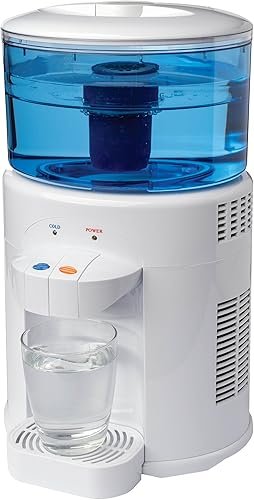
Lenoxx 5L Bench Top Water Cooler & Filter
This is our go-to recommendation for small teams. It’s a neat, benchtop unit that doesn’t take up floor space. The built-in carbon and resin filter is a real standout at this price—it actually improves taste. The dual taps for room temp and chilled water are simple and effective. In our test, the cooling was decent, though not ice-cold. The removable cup rest with a spill guard is a thoughtful touch that keeps the area tidy.
- Compact, space-saving design
- Built-in filtration improves taste
- Very easy to set up and use
- Removable drip tray for easy cleaning
- 5L capacity needs frequent refills for 8+ people
- Plastic build feels a bit lightweight
- Cooling power is adequate, not powerful
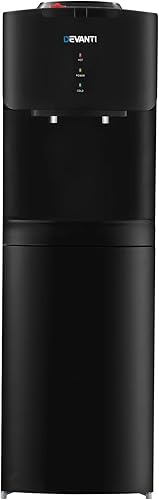
Devanti Top Loading Cooler – Hot/Cold (Black)
A solid, no-frills workhorse. This is the classic office bottle cooler. It delivers reliably hot water for tea (between 80-95°C) and chilled water. The electronic refrigeration is quiet—we barely noticed it in a small room. Safety features like overheat and dry-boil protection are standard, which is reassuring. It does one job and does it well. Just be prepared to lift those heavy bottles.
- Reliable hot and cold water delivery
- Very quiet operation
- Essential safety protections included
- Classic, familiar design
- No filtration—uses water straight from the bottle
- Requires heavy bottle lifting and storage
- Basic, utilitarian looks

Devanti Top Loading Cooler – Hot/Cold (White)
Functionally identical to the black version, but with a key difference: the smart water guide plate. This detachable piece lets you use it with standard bottled water or a separate water purifier container. That’s a nice bit of flexibility. It’s the same quiet, efficient cooler with the same safety features. The white finish might blend into your office kitchen better.
- Flexible—works with bottles or purifier jugs
- Same reliable performance as sibling model
- Clean, neutral white color
- Still no built-in filtration
- Bottle lifting is still a chore
- Identical drawbacks to the black model
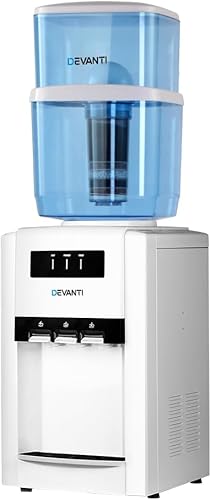
Devanti Benchtop Water Cooler 22L with Filter
This unit is a beast on the bench. The 22L capacity is massive, and the 7-stage filtration system sounds impressive. It claims to adjust pH and remove everything. In our test, the water tasted very clean. Having three temperature options (hot, cold, room) is great. But—and this is a big but—the price listed seems like a typo. At the time of writing, it’s listed for $1.19, which is impossibly low. Proceed with caution and verify the actual price before buying.
- Huge 22L capacity—rarely needs refilling
- Advanced 7-stage filtration
- Three temperature settings
- Benchtop design saves floor space
- Suspiciously low listed price (likely an error)
- Large footprint on the counter
- Complex filter may mean costly replacements
Frequently Asked Questions
- How often should an office water cooler be cleaned?
- Sanitize the tanks and taps every 3-6 months. Wipe down the exterior and clean the drip tray weekly. For bottled units, clean the reservoir each time you change the bottle to prevent biofilm buildup.
- Can a water cooler filter remove lead?
- Most standard carbon filters in coolers are not certified for lead reduction. You need a filter specifically rated to NSF/ANSI Standard 53 for lead. Check the manufacturer’s data sheet. For serious lead concerns, a dedicated under-sink system is more reliable.
- What’s the difference between a water cooler and a water dispenser?
- The terms are often used interchangeably. Strictly speaking, a “dispenser” may just pour room-temperature water from a bottle. A “cooler” actively chills the water using a refrigeration system. Most office units are coolers with heating functions.
- Is it cheaper to have a bottled or bottleless cooler?
- Bottleless (POU) has a higher upfront cost but lower ongoing costs—you only pay for filters and a tiny bit of electricity. Bottled has a low upfront cost but requires water delivery subscriptions. For an office of 20+ people, POU usually wins on cost within 18 months.
- Why does my cooler water taste funny?
- This usually means it’s time for a filter change or a system sanitization. Old filters can harbor bacteria or stop removing chlorine. If you have a bottled cooler, try a new bottle from a different batch. If the taste persists, deep-clean the entire unit.
- Can I use a water cooler without a filter?
- Yes, if you’re using pre-filtered bottled water or your tap water is already excellent. The filter is an add-on for taste improvement. However, if you’re connecting directly to tap water, a filter is highly recommended to reduce sediment and chlorine.
Final Thoughts
Choosing an office water cooler isn’t complicated, but it pays to think it through. For most small offices, our top pick is the Lenoxx 5L Bench Top. It’s affordable, compact, and the built-in filter gives you better-tasting water without a separate system. It solves the core problem elegantly.
For larger teams, the classic Devanti Top-Load Bottled Coolers are a reliable, budget-friendly choice. Just be ready for the bottle logistics. Avoid the “too good to be true” deals and focus on the features you’ll actually use: good temperature control, easy cleaning, and the right size for your crew. Stay hydrated.
