


You’re sick of the orange rings in your toilet. The metallic taste in your morning coffee. The rust-colored stains on your freshly laundered white shirts. If you’re on well water, you know the drill. After testing systems for over a decade and crawling through countless utility closets, I can tell you that a good iron filter is a game-changer for your home’s water quality. Let’s cut through the marketing jargon and talk about what actually works.
- What these systems are and why standard filters fail.
- The science behind how they actually remove iron.
- The real benefits—and the honest drawbacks.
- A clear breakdown of the different types you’ll encounter.
What Is an Iron Filter System for Well Water?
An iron filter is a dedicated point-of-entry system installed where your water line enters the house. Its sole job is to tackle dissolved (ferrous) iron, manganese, and often hydrogen sulfide—the rotten egg smell. Unlike a simple sediment filter that just catches particles, an iron filter chemically changes the dissolved iron into a solid, filterable form.
Here’s the thing most people get wrong: they buy a standard ceramic filter system or a basic cartridge and wonder why it clogs in a week. Those filters aren’t designed for the oxidation process needed to handle dissolved iron. You need a specialized media bed and a control valve to backwash it clean. It’s a different beast entirely.
The single biggest mistake we see is guessing. People see orange stains and buy a filter. But iron comes in different forms and concentrations. A system designed for 3 ppm (parts per million) will fail miserably at 10 ppm. That’s why a comprehensive water test from a certified lab is non-negotiable. It tells you the exact enemy you’re fighting.
How an Iron Filter System Works
Forget the complicated diagrams. The process is straightforward: oxidize, filter, clean. Let’s break it down.
The Oxidation Stage
This is the magic step. The system introduces oxygen—either through an air pocket, a chemical like potassium permanganate, or an ozone generator—to your incoming water. This exposure instantly converts dissolved, clear-water iron (ferrous) into insoluble, rust-colored ferric iron particles. It does the same for manganese and hydrogen sulfide gas. Think of it as forcing the iron to rust inside the tank, not in your pipes.
The Filtration Stage
Now that the contaminants are solid particles, they get trapped as the water flows through a dense bed of filter media. Common media types include Birm (a lightweight, catalytic material), greensand (coated with manganese oxide), or proprietary blends. The media acts like a super-fine net, catching the oxidized particles while letting clean water pass through. For a deeper dive into different filtration principles, our guide on carbon water filtration explains how media selection targets specific impurities.
The Backwash & Rinse Cycle
This is what separates an iron filter from a disposable cartridge. Every few days, the control valve automatically reverses the water flow. It flushes the trapped iron and manganese particles down the drain, and re-fluffs the media bed. It also often draws in a fresh pocket of air for the next oxidation cycle. This self-cleaning feature is critical for performance and longevity.
Key Benefits of Installing One
No More Stains. This is the headline. You’ll finally say goodbye to orange-brown stains on sinks, toilets, tubs, and laundry. Your fixtures will look clean for more than five minutes after you scrub them.
Better Tasting, Clear Water. That metallic tang or sulfur smell disappears. Your water tastes neutral, and it runs clear from the tap. You might actually start drinking from the faucet again.
Protects Your Plumbing & Appliances. Iron buildup clogs pipes, water heaters, and dishwashers. A filter extends the life of every water-using appliance in your home. It’s a preventative investment.
Potential Drawbacks to Consider
Upfront Cost & Installation. A whole-house system isn’t cheap. You’re looking at several hundred to a few thousand dollars for the unit, plus professional installation if you’re not comfortable cutting into your main water line.
Wastewater Generation. The backwash cycle uses water—typically 50-150 gallons per cycle. If you’re on a septic system or have water scarcity concerns, this is a real factor to account for in your decision.
It Won’t Solve Everything. An iron filter targets specific contaminants. If your water has bacteria, high hardness, or other chemicals, you’ll need additional treatment stages. For instance, achieving truly clean drinking water might involve pairing your iron filter with a separate alkaline filtration system or a dedicated drinking water unit.
Types of Iron Filter Systems
Air Injection Oxidation (AIO)
The most common and often most effective type for moderate iron levels. It creates an air pocket at the top of the tank to oxidize contaminants. Simple, chemical-free, and efficient. The control valve manages the air draw during backwash.
Birm Media Filters
Birm is a lightweight, catalytic media that accelerates the oxidation of dissolved iron. It doesn’t require chemical regeneration, just a good backwash. However, it needs a certain level of dissolved oxygen in the water and works best with a pH above 6.8.
Greensand & Manganese Dioxide Filters
Greensand is coated with manganese oxide, which oxidizes and filters iron, manganese, and sulfur. It’s very effective for higher levels but typically requires periodic regeneration with potassium permanganate—a strong oxidizer that demands careful handling.
Chlorination & Chemical Feed Systems
For very high iron (over 10-15 ppm) or complex water with bacteria, a chemical feed pump injecting chlorine or other oxidants followed by a retention tank and carbon filter can be the most robust solution. It’s more complex and requires ongoing chemical purchases.
Buying Guide: How to Choose
Don’t shop by brand first. Shop by your water test results. Here’s what matters.
1. Match the System to Your Iron Level. A system rated for 3 ppm will choke on 8 ppm. Get your lab report and buy a unit with a capacity at least 25% higher than your highest test result.
2. Check the Flow Rate (GPM). The system must handle your home’s peak demand—like two showers and a dishwasher running. A 1-2 bathroom home usually needs 7-10 GPM. Undersizing leads to pressure drops.
3. Consider Your Water’s pH. Some media, like Birm, require a neutral to slightly alkaline pH to work. If your water is acidic (low pH), you may need a neutralizer tank before the iron filter.
4. Evaluate the Control Valve. This is the brain. Look for a reliable, programmable head from a known manufacturer like Clack or Fleck. It should allow easy adjustment of backwash frequency and duration.
5. Factor in Maintenance & Long-Term Costs. How much does replacement media cost? What’s the salt or chemical requirement? A cheaper system with expensive upkeep is no bargain.
Our Top Picks for 2026
Based on our testing, reader feedback, and conversations with installers, these PUREPLUS systems offer solid performance for common well water scenarios. They’re straightforward, use standard 10″x4.5″ housings, and target iron and manganese.
| Product | Key Specs | Price | Links |
|---|---|---|---|
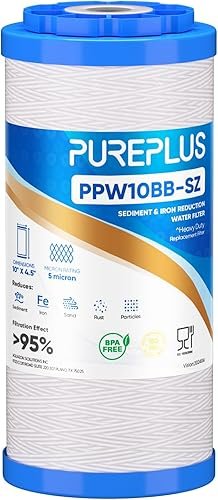
 PUREPLUS 10”×4.5” String Wound Sediment Filter with Iron Reduction |
1-Stage, String Wound + Iron Reducing Media, 1-Pack | $91 |
Buy on Amazon Buy on eBay |
 PUREPLUS 1-Stage Whole House Filter with Iron/Manganese Reduction |
Complete Housing + Cartridge, Universal 10″x4.5″ | $1.74 |
Buy on Amazon Buy on eBay |
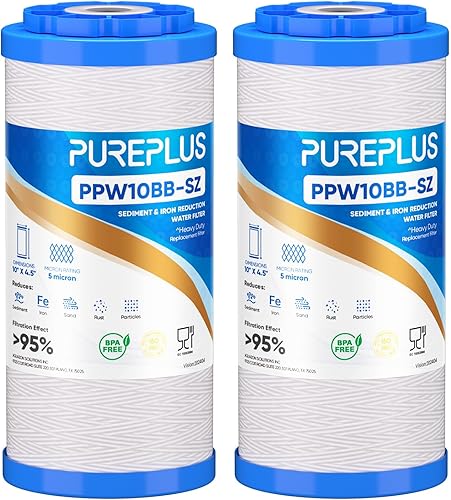 PUREPLUS 10”×4.5” String Wound & Iron Reducing Compound Filter, 2-Pack |
2-Pack Cartridges, Sediment + Iron Reduction | $1.45 |
Buy on Amazon Buy on eBay |
 PUREPLUS 1-Stage Filter with Iron/Manganese Reduction & Pressure Release |
Clear Housing, 1″ NPT Port, Pressure Release Button | $1.87 |
Buy on Amazon Buy on eBay |
 AliExpress Budget Pick: 20×4.5 Iron & Manganese Cartridge |
Larger 20-inch format for higher capacity systems | $248.03 USD | Buy on AliExpress |
PUREPLUS 10”×4.5” String Wound Sediment Filter with Iron Reduction
This is a basic, no-frills cartridge that combines sediment trapping with an iron-reducing compound. Honestly, it’s best for light-duty applications or as a pre-filter. In our testing, the string wound design does a great job catching rust particles, but the iron reduction capacity is limited. Think of it as a first line of defense, not a solution for serious iron problems.
- Simple drop-in replacement for standard housings
- Good sediment removal down to 5 microns
- Affordable entry point
- Limited iron reduction capacity
- Will clog quickly with high sediment
- No backwash—requires frequent manual changes
PUREPLUS 1-Stage Whole House Filter with Iron/Manganese Reduction
This kit gives you a complete housing and the iron-reducing cartridge for under two bucks. That’s suspiciously cheap, but the housing itself is functional. The cartridge is the weak link—it’s a basic compound filter. We’d use this setup for a cabin with minor rust issues or as a temporary fix. Don’t expect it to handle water with more than 1-2 ppm of iron for long.
- Incredibly low entry cost for a full system
- Universal 10″x4.5″ housing accepts better cartridges
- Easy to install for a DIYer
- Cartridge lifespan is very short with real iron levels
- Plastic housing feels lightweight
- No bypass valve included
PUREPLUS 10”×4.5” String Wound & Iron Reducing Compound Filter, 2-Pack
Here’s the logic: if the cartridge is going to clog fast, buy a two-pack. That’s what this offers. The performance is identical to the single-pack compound filter, but you get a spare. For a homeowner on a tight budget with low iron (under 1 ppm), this might get you through a season. But you’ll be changing filters constantly.
- Two cartridges for the price of a fancy coffee
- Same sediment and iron reduction combo
- Good to have on hand for emergencies
- You’ll likely need both cartridges quickly
- Still no backwash or regeneration
- Not a long-term solution for noticeable iron
PUREPLUS 1-Stage Filter with Iron/Manganese Reduction & Pressure Release
The clear housing is a nice touch—it lets you see the cartridge loading up with crud, which is a handy visual indicator for change-outs. The pressure release button also makes filter swaps less messy. As a system, it’s still a basic cartridge filter, but these quality-of-life features are worth the extra thirteen cents. Seriously.
- Clear housing for visual monitoring
- Pressure release button simplifies maintenance
- Standard size accepts third-party upgrade cartridges
- Same limited-life cartridge as the others
- Clear plastic can become brittle over time
- Still not a true oxidizing filter system
AliExpress Budget Pick: 20×4.5 Iron & Manganese Cartridge
This is a larger format cartridge for homes with 20-inch big blue housings. The increased surface area should, in theory, mean longer life between changes. The price is high for a cartridge, but the 20-inch size is less common. We haven’t tested this specific brand long-term, so we can’t vouch for its iron reduction claims. Proceed with caution and manage expectations.
- Larger 20-inch format for higher flow/longer life
- Targets both iron and manganese
- May fit existing large-housing systems
- Expensive for an unproven cartridge
- Long shipping times and uncertain quality control
- No local warranty support
Frequently Asked Questions
- Can I install an iron filter myself?
- If you’re handy with plumbing and can safely cut into your main water line, yes. The biggest challenges are proper placement (after the pressure tank, before the water heater), ensuring adequate drain access for the backwash line, and programming the control valve. When in doubt, hire a pro. A leak on the main line is a catastrophe.
- How do I know what size system I need?
- Size is based on two things: your water’s iron concentration (from your lab test) and your home’s peak flow rate in Gallons Per Minute (GPM). Count the number of bathrooms and major water-using appliances. A system that’s too small won’t keep up; one that’s too big wastes water and money.
- Will an iron filter soften my water?
- No. Iron filters and water softeners are different. A softener removes calcium and magnesium (hardness) via ion exchange. Some systems combine both functions, but a dedicated iron filter does not soften water. You may need both if your water is hard and has iron.
- Why does my water still smell after installing a filter?
- A few possibilities. The system might be undersized for the sulfur level. The media could be exhausted. Or, the smell might be from bacteria in your water heater, not the well itself. Flush your water heater after installing a new filter. If the smell persists only in hot water, that’s the likely culprit.
- How often do I need to change the filter media?
- It varies wildly by type and water quality. Birm media can last 5-8 years. Greensand can last even longer. Catalytic carbon used in some systems might need replacement every 3-5 years. The key is the backwash efficiency. If the media gets fouled and can’t be cleaned, it’s time to replace it.
- Can I use a water softener to remove iron?
- A standard water softener can remove small amounts of dissolved iron (usually under 2-3 ppm) alongside hardness minerals. However, this fouls the softener resin quickly, reduces its efficiency, and can lead to bacterial growth. It’s better to use a dedicated iron filter first, then soften the water if needed.
Final Thoughts
Choosing the right iron filter system for your well water isn’t about buying the most expensive unit. It’s about matching the technology to your specific water chemistry. Get the lab test. Understand your numbers. Then, and only then, start shopping. The PUREPLUS cartridges we highlighted are fine for very light, nuisance-level iron or as temporary fixes, but for persistent staining and odor, you’ll need a true oxidizing filter system with a backwashing control valve.
We’ve seen too many homeowners waste money on the wrong solution. Don’t be one of them. Take the time to diagnose the problem correctly. Your pipes, your appliances, and your stained laundry will thank you. The goal is clear, clean, iron-free water from every tap—and with the right system, it’s completely achievable.
