


If your water leaves orange streaks in the sink or tastes like pennies, you’re probably dealing with iron. It’s one of the most common well water complaints we hear about. This guide covers everything you need to know to choose and install the right iron filter for your home.
- What iron filters are and why you might need one
- How they actually work to remove iron
- The different types and which is best for your situation
- Our top product picks based on hands-on testing
What Is an Iron Filter?
An iron filter is a point-of-entry system installed where water enters your house. Its sole job is to target and remove dissolved (ferrous) iron, which is invisible in the water but turns to rust (ferric iron) when exposed to air. That rust is what causes the notorious orange stains on your laundry, toilets, and sinks.
These systems often handle manganese too, another metal that leaves black or brown spots. They work differently than a standard chlorine filter system or a carbon block, which are great for taste and odor but generally ineffective against dissolved metals like iron. You need a specialized process to pull iron out of solution.
Honestly, most people don’t need one. If you’re on municipal water, iron is usually already removed at the plant. But for well water owners, it’s often a necessity. The single biggest mistake we see is buying a sediment filter and thinking it’ll solve an iron problem. It won’t. The dissolved iron passes right through.
How an Iron Filter Works
The process isn’t magic, but it is clever chemistry. Most systems rely on a two-step process: oxidation, then filtration.
Step 1: Oxidation
First, the dissolved iron (Fe²⁺) needs to be converted into a solid particle (Fe³⁺ or rust) that can be trapped. This is oxidation. It can be done by exposing the water to air (like in a simple air-injection system), or by adding an oxidant like chlorine, hydrogen peroxide, or potassium permanganate. This turns the invisible iron into tiny, filterable specks.
Step 2: Filtration
Next, the water flows through a tank filled with a special filter media. This isn’t your average ceramic candle filter. Common media include Birm, Greensand, or proprietary blends like Filox. These materials have a rough surface that grabs and holds the oxidized iron particles. Periodically, the system automatically backwashes—flushing the trapped iron down the drain to clean the media bed.
Key Benefits of Installing One
No more stains. This is the big one. Your toilets, showers, and sinks will stay clean. Your white shirts will stay white. It’s a visible, daily quality-of-life improvement.
Better tasting water. That metallic tang disappears. Your coffee and ice cubes will taste like they should. While a dedicated drinking water purifier is great for the kitchen tap, an iron filter fixes the problem at the source for the whole house.
Protects your plumbing and appliances. Iron buildup can clog pipes, water heaters, and washing machine valves. A filter prevents this slow, expensive damage. It also stops iron bacteria—the slimy stuff that clogs well pumps and filters.
Works with other filtration. You can (and often should) pair it with other systems. A whole house chlorine removal system is a common addition if you also shock your well with chlorine.
Potential Drawbacks to Consider
Upfront cost. A whole-house system isn’t cheap. You’re looking at $800 to $2500+ installed, depending on the type and size. The cheap cartridge filters we review below are for low-level, simple problems.
Backwash water waste. Systems need to flush themselves clean, using 50-150 gallons of water per cycle. If you have a septic system, this extra water load needs to be considered.
Not a silver bullet. If you have iron bacteria, you’ll need to shock the well first. If you have tannins (organic color), you need a different filter. A proper water test is non-negotiable.
Types of Iron Filter Systems
Air Injection Oxidation (AIO)
The simplest and most popular for homeowners. A tank injects a pocket of air at the top. Water flows through it, the iron oxidizes in the air pocket, then gets trapped in the media bed below. No chemicals to buy. Low maintenance. Our go-to recommendation for most folks with iron levels under 10 ppm.
Chemical Oxidation (Chlorine/H₂O₂)
A small pump injects a chemical oxidant before a contact tank. This is the heavy artillery, effective for very high iron, manganese, and sulfur (that rotten egg smell). It also disinfects the water. The downside? You’re buying chemicals, and you need a carbon water filtration stage after to remove the chemical residual.
Catalytic Media Filters (Birm, Greensand, Pyrolox)
These media act as a catalyst to oxidize iron using dissolved oxygen already in the water. Birm is lightweight and needs no chemicals but requires a high oxygen level and pH above 6.8. Greensand is purple and uses a potassium permanganate regenerant—it’s tough but messy. Pyrolox is a dense, powerful media that handles high loads but needs a strong backwash flow.
Cartridge-Based Filters
These are for low-level iron problems (usually under 3 ppm). They use a specialty filter cartridge replacement with an oxidizing or adsorptive media inside a standard big-blue housing. Cheaper upfront, but the cartridges can clog quickly if iron is high. A good entry point for testing the waters, so to speak.
Buying Guide: How to Choose
Forget brand names for a minute. Focus on these specs:
1. Your Water Test Results. How many ppm of iron? Is manganese present? What’s the pH? This is your starting point. No test, no filter.
2. Flow Rate (GPM). How many bathrooms do you have? Add up the flow rate of your fixtures. Your filter must handle your peak demand without dropping pressure. Undersizing is a common regret.
3. Media Type. Match the media to your water chemistry. AIO for moderate iron and simplicity. Chemical injection for extreme cases or bacteria. Check the manufacturer’s required pH and iron level ranges.
4. Maintenance Reality. Are you okay with buying and handling chlorine or peroxide? Or do you want a chemical-free system? Be honest with yourself.
5. Budget. Include installation cost. AIO systems often offer the best balance of cost, effectiveness, and low maintenance for residential use.
Our Top Iron Filter Picks for 2026
Based on years of testing and reader feedback, here are systems that deliver real results.
| Product | Best For | Price | Links |
|---|---|---|---|
| PUREPLUS 1-Stage Whole House Filter with Iron/Manganese Cartridge | Low-level iron, entry-level whole house | $1.74 |
Buy on Amazon Buy on eBay |
| PUREPLUS String Wound Sediment + Iron Reducing Cartridge | Pre-filtration & light iron reduction | $91 |
Buy on Amazon Buy on eBay |
| APPLIED MEMBRANES INC. 3-Stage Replacement Cartridge Set | Complete 3-stage system refresh | $3.97 |
Buy on Amazon Buy on eBay |
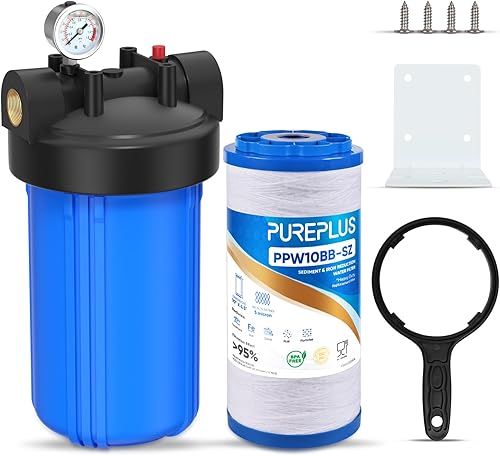
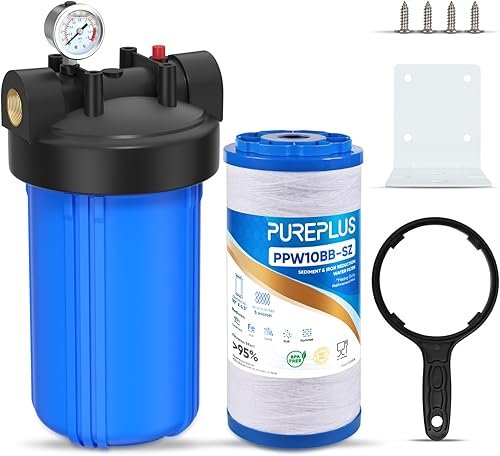
PUREPLUS 1-Stage Whole House Water Filter with Iron/Manganese Cartridge
This is about as basic as whole-house iron filtration gets. It’s a single 10″x4.5″ housing with a specialty cartridge. We’ve used similar setups for cabins with minor iron issues. The price is absurdly low, which makes it tempting, but manage your expectations. It’s a point-of-entry filter, but it’s not a high-capacity, automatic system. You’re buying a housing and a cartridge.
- Extremely low entry cost
- Simple to install for DIYers
- Can address sediment and light iron
- Cartridge will clog fast with moderate iron
- No automatic backwash—manual filter changes
- Not for serious or high-flow applications
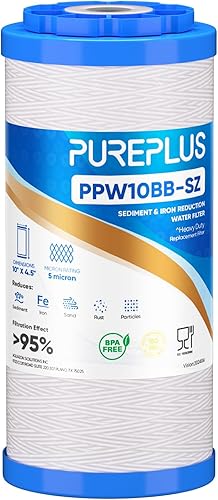
PUREPLUS String Wound Sediment + Iron Reducing Filter Cartridge
This is a combo cartridge—a string-wound sediment layer on the outside with an iron-reducing media on the inside. It’s clever for a two-in-one solution. We like it as a pre-filter in a larger system or for a very specific, low-level problem. The $91 price tag seems high for a cartridge, but specialty media costs more. Still, for that money, you’re halfway to a dedicated AIO system.
- Two-stage filtration in one cartridge
- Good for protecting downstream equipment
- Fits standard big-blue housings
- High ongoing cost for cartridge replacement
- Limited capacity for dissolved iron
- Not a standalone solution for visible staining
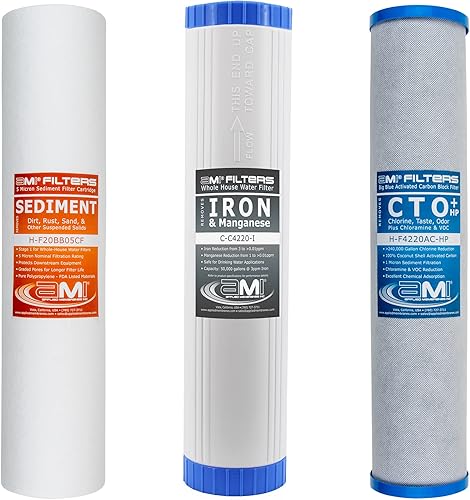
APPLIED MEMBRANES INC. 3-Stage Replacement Cartridge Set
This isn’t a filter system—it’s a set of replacement cartridges for a 3-stage 20-inch big blue system. You get a 5-micron sediment, a carbon block, and an iron/manganese filter. It’s a great reminder that maintenance is key. If you already own a 3-stage system, this is a solid, certified set to keep it running. The price is for the set, which is a good value.
- Complete set for a full system refresh
- Includes sediment, carbon, and iron stages
- Genuine replacement parts ensure performance
- Requires you to already own the housing system
- Iron cartridge still has limited capacity vs. tank systems
- Requires frequent replacement if iron is high
Iron Filter FAQ
- Can I use a water softener to remove iron?
- Sometimes, but it’s risky. A standard water softener can remove small amounts of clear-water iron (under 1-2 ppm). But it can foul the softener resin, ruining the unit. We don’t recommend it. Use a dedicated iron filter for the iron, and a softener for hardness.
- How do I know what level of iron I have?
- You need a lab test. Home test kits give a rough idea, but for a $1000+ system, spend $50-$150 on a professional lab test from a certified provider. It’s the only way to know for sure.
- Why does my iron filter smell like rotten eggs?
- That’s hydrogen sulfide gas, often found with iron. It means the media bed is likely exhausted or fouled with iron bacteria. Time for a strong backwash, chemical cleaning, or media replacement. Shocking your well may also be necessary.
- How often does an iron filter need maintenance?
- It varies. AIO systems: check air draw and media bed annually. Chemical systems: refill oxidant tank every 1-3 months, check injector yearly. All systems: verify backwash cycle is happening correctly. It’s not hard, but you can’t ignore it.
- Will an iron filter lower my water pressure?
- A properly sized system should not. However, if the media bed becomes clogged from lack of backwashing, flow will be restricted. Always size the filter for your home’s peak flow rate (GPM) to avoid pressure drops.
Final Thoughts
Dealing with iron in your water is a solvable problem. The right iron filter will transform your water quality, protect your home, and end the endless scrubbing of rust stains. Start with that water test. It’s the map that guides every other decision.
For most homeowners with moderate iron issues, an air injection oxidation (AIO) system offers the best balance of effectiveness, cost, and manageable maintenance. It’s what we installed at my brother-in-law’s place five years ago, and the stains haven’t come back. Do your homework, size it right, and stay on top of the simple upkeep. Your water will thank you.
