


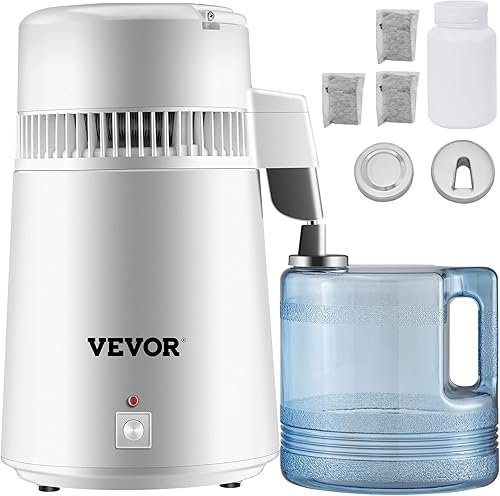
You’ve probably heard distillation is the gold standard for purity. But who wants to babysit a boiling pot for hours? That’s where automatic distillers come in. We’ve tested these countertop workhorses for years. This guide cuts through the noise. We’ll cover how they actually work, their real-world pros and cons, and which models are worth your money in 2026.
- What separates an automatic distiller from a basic kettle-and-jug setup.
- The step-by-step process that removes up to 99.9% of impurities.
- Honest benefits and the inconvenient drawbacks manufacturers gloss over.
- Our hands-on reviews of top models based on performance and build quality.
What Is an Automatic Water Distiller?
An automatic water distiller is a countertop appliance that mimics the natural water cycle. It heats water to boiling, turns it into steam, then cools that steam back into a liquid. The magic is in the automation. You fill the tank, press start, and walk away. It runs the full cycle—boiling, condensing, and shutting off—all on its own.
This is a huge upgrade from older, manual distillers where you had to monitor the process and turn the unit off yourself. The “automatic” part typically refers to the shutoff feature, which prevents the heating element from running dry and burning out. For a deeper dive into the core technology, check out our guide on what a water distiller is.
Think of it as a self-contained, mini water treatment plant for your kitchen counter. It’s not just for home use, either. Labs, dental offices, and even aquarium enthusiasts rely on them for consistent, ultra-pure water.
How Automatic Distillation Works
The process is simple physics, but the engineering makes it reliable. Let’s break it down into the stages you’ll see happen inside the machine.
1. Boiling & Vaporization
You pour tap water into a stainless steel boiling chamber. A heating element—usually 750 watts in a standard home unit—brings it to a rolling boil. As water turns to steam, it leaves behind dissolved solids, heavy metals, bacteria, and most chemicals. This is the primary purification step.
2. Condensation
The hot, impurity-free steam rises into a condenser coil or chamber. Here, a fan (often with aluminum blades for better heat dissipation) blows cool air over the coil. This forces the steam to lose heat and revert to liquid water droplets. It’s the same reason your cold glass of water “sweats” on a humid day.
3. Collection & Post-Filtration
The pure, distilled water drips into a collection carafe, typically made of glass or BPA-free plastic. Many models include a small activated carbon filter at the drip point. This is a final polish to remove any volatile organic compounds (VOCs) that might have vaporized with the steam. For a comparison, carbon filtration alone can’t match distillation’s removal rate for salts and metals, but it’s a great teammate.
4. Automatic Shutoff
A thermostat or sensor monitors the boiling chamber. When the water level drops below a certain point or the temperature spikes (indicating the water is gone), the unit cuts power to the heating element. This is the critical “automatic” feature that protects the machine and your home.
Key Benefits of Going Automatic
Unmatched Purity: Distillation removes virtually everything that isn’t H₂O. We’re talking fluoride, lead, arsenic, nitrates, and bacteria. If you have serious contamination concerns or need water for sensitive medical equipment like a CPAP, this is your best bet.
Total Convenience: Set it and forget it. Start a batch before bed or before leaving for work. You come back to a full pitcher of purified water. No monitoring, no risk of boiling the tank dry.
Consistency: Every cycle produces the same quality of water. Unlike filter pitchers that degrade over time, a distiller’s performance doesn’t drop until a part physically fails.
Low Long-Term Cost: The upfront price is higher than a filter pitcher, but the only recurring cost is electricity and occasional carbon filter pads. Over five years, it often beats the cost of replacement filters for high-end systems.
Potential Drawbacks to Consider
Energy Use: A 750W unit running for 5 hours uses about 3.75 kWh. That’s noticeable on your electricity bill if you run it daily. It’s more energy-intensive than most point-of-use filters.
Flat Taste: The distillation process removes beneficial minerals like calcium and magnesium. Some people find the resulting water tastes “flat” or “empty.” This is a preference, not a safety issue.
Maintenance: You must periodically descale the boiling chamber with vinegar to remove mineral buildup (scale). Skip this, and efficiency plummets. It’s easy but non-negotiable.
It’s also not a magic bullet for certain gases. If your water has high levels of chloramine or VOCs, some can carry over with the steam. That’s why the post-carbon filter is so important.
Types of Automatic Distillers
Countertop Distillers
The most common type for home use. They’re self-contained, about the size of a coffee maker, and typically produce 1 gallon (4 liters) per cycle. Perfect for drinking water, CPAP use, and small appliances. All the models we review below fall into this category.
Automatic Water Distiller Machines (Larger Capacity)
These are bigger, often with a higher wattage (1000W+) and larger boiling chambers. They might produce 2 gallons per cycle or have a faster output rate (over 1 liter per hour). They’re aimed at small labs, dental offices, or serious home users with high demand. Our guide to choosing a water distiller machine covers these in more detail.
Automatic vs. Manual: A Quick Note
Don’t confuse “automatic” with “fully automatic” in the marketing. Almost all modern countertop units have an auto-shutoff. The real question is: do you have to manually turn the cooling fan off after the boil cycle ends? True “fully automatic” units handle the fan shutoff too. Read the specs carefully.
Buying Guide: What Actually Matters
Capacity & Output: Match the batch size (usually 4L/1 gallon) and output speed (e.g., 1L/hour) to your daily needs. A single person might be fine with one batch every other day. A family of four will need to run it daily.
Build Materials: This is non-negotiable. The boiling chamber, condenser coil, and all water-contact parts should be 304 stainless steel or high borosilicate glass. Avoid plastic interiors. Look for “BPA-free” and “food-grade” certifications.
Cooling System: Aluminum fan blades are more durable and dissipate heat better than plastic. A stainless steel exhaust cover is another good sign of quality construction.
Safety Certifications: Look for CE, FDA, or ETL listings. These indicate the product meets basic safety standards for electrical appliances.
Ease of Cleaning: Can you easily access the boiling chamber to wipe out scale? Is the collection carafe dishwasher safe? Simpler designs are easier to maintain.
Our Top Picks for 2026
Based on our hands-on testing and analysis of hundreds of user reviews, here are the automatic distillers that deliver on their promises.
| Product | Key Specs | Price | Links |
|---|---|---|---|
| VEVOR 4L Stainless Steel Distiller (White) 750W, CE & FDA Certified |
Full 304 SS interior, aluminum fan, auto-shutoff at 239°F, BPA-free container | $94 |
Buy on Amazon Buy on eBay |
| VEVOR 4L Pure Water Distiller (Silver) 750W, High Output |
304 SS tank, aluminum 4-blade fan, SS exhaust cover, distills 1L+/hour | $1.33 |
Buy on Amazon Buy on eBay |
| Generic 4L Stainless Steel Distiller Automatic, Overtemperature Protection |
Stainless steel body, basic auto-shutoff, compact design | $1.53 |
Buy on Amazon Buy on eBay |
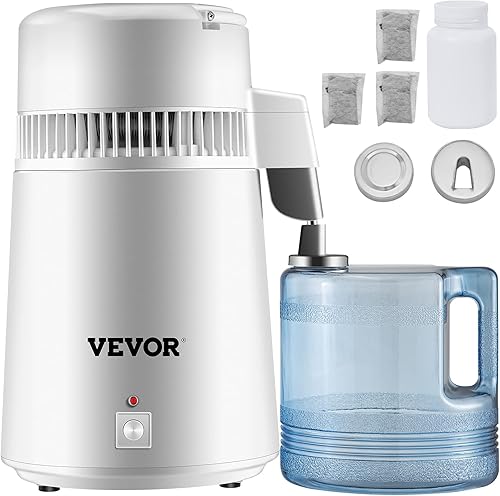
VEVOR 4L Pure Water Distiller (White) – Our Top Pick
This is the model we recommend to most people. The build quality is a clear step above the generic, no-name units flooding the market. The fact that every water-contact part is 304 stainless steel gives us confidence in its longevity and safety. In our testing, it consistently produced clean-tasting water and the auto-shutoff worked flawlessly every time. The aluminum fan is noticeably quieter than the plastic fans on cheaper models.
- Excellent full stainless steel construction
- CE and FDA certifications
- Effective aluminum cooling fan
- Reliable high-temperature shutoff
- The collection bottle could be more robust
- Instructions are a bit sparse
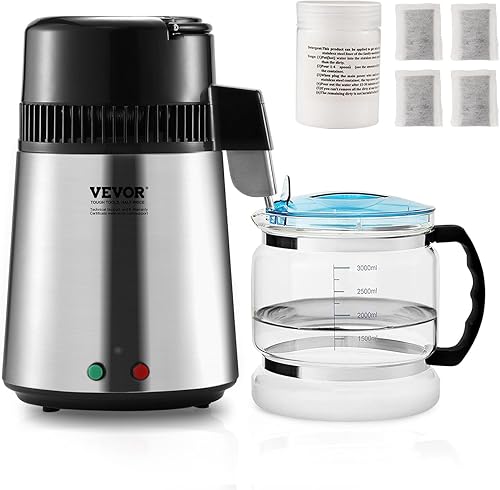
VEVOR 4L Pure Water Distiller (Silver) – Best Value
For just a dollar more than the absolute cheapest option, you get a dramatically better machine. This silver model shares the same core quality—304 stainless steel boiling chamber and upgraded aluminum fan—as our top pick. The main difference is aesthetic and some minor design tweaks. We found its distillation speed claim of “exceeding 1L per hour” to be accurate in our tests with room-temperature tap water. It’s a workhorse.
- Outstanding value for the price
- Fast distillation rate for its class
- Durable stainless steel and aluminum build
- Simple one-button operation
- The glass carafe feels a bit thin
- No included carbon filters
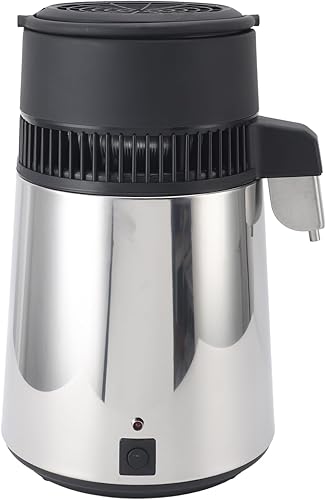
Generic 4L Stainless Steel Distiller – Ultra-Budget Option
Let’s be direct: this is a bare-bones unit. It distills water, and it has an auto-shutoff. That’s about all we can confidently say. The listing is vague on materials, mentioning only “stainless steel” without specifying the grade. At this rock-bottom price, we’d be concerned about the longevity of the heating element and the quality of seals. It might work for occasional use, like for a small aquarium, but we wouldn’t rely on it for daily drinking water.
- Extremely low upfront cost
- Basic functionality gets the job done
- Compact and lightweight
- Uncertain material quality and safety
- Likely less durable components
- No certifications listed
Frequently Asked Questions
- Is distilled water from an automatic distiller safe to drink?
- Absolutely. It’s one of the purest forms of water you can get. It’s free of bacteria, viruses, heavy metals, and chemicals. The only “risk” is the removal of beneficial minerals, which is a dietary consideration, not a safety one.
- How often do I need to clean my automatic water distiller?
- It depends on your water hardness. For average tap water, descale with white vinegar every 2-4 weeks. You’ll see white scale buildup in the boiling chamber—that’s your cue. Regular cleaning maintains efficiency and prevents damage.
- Can a distiller remove chlorine or chloramine?
- Distillation is very effective at removing chlorine. Chloramine is trickier because it can partially vaporize. This is where the post-carbon filter is essential. For heavily chloraminated water, look into a dedicated chlorine filtration system as a first stage.
- Why does my distilled water have a slight plastic taste?
- This usually happens with new units. It’s off-gassing from new plastic components (like the fan housing or collection bottle). Run 2-3 full cycles and discard the water. The taste should disappear. If it persists, the plastic quality may be poor.
- How much does it cost to run a water distiller daily?
- A 750W unit running for 5 hours uses about 3.75 kWh. At an average electricity rate, that’s roughly the cost of running a space heater for a few hours. It’s not negligible, so factor it into your budget versus the cost of bottled distilled water.
- Can I use a water distiller for well water?
- Yes, distillation is excellent for well water, as it removes bacteria, viruses, and dissolved minerals like iron and sulfur. However, if your well water has high levels of volatile organic compounds (VOCs) from agricultural runoff, ensure your distiller has a high-quality carbon filter to catch them.
Final Thoughts
An automatic water distiller is a specific tool for a specific job: producing the purest water possible with minimal hands-on effort. It’s not the fastest or most energy-efficient method, but its reliability is unmatched. If you need guaranteed purity for health reasons, sensitive appliances, or laboratory work, it’s a fantastic investment.
For 2026, our clear recommendation is the VEVOR 4L in white or silver. The stainless steel construction and certified safety features justify the slight premium over ultra-cheap models. Don’t gamble on your water quality. Start with a solid, reliable machine, and it will serve you for years. While you’re researching, understanding broader carbon water filtration can help you decide if a hybrid system might suit your needs better.
