



The Best Water Filter System for Well Water: A Veteran’s Guide (2026)
After 15 years of testing filters and crawling through basements, I can tell you this: well water is a different beast. It’s raw. It’s personal. And the right filter system isn’t a luxury—it’s your frontline defense for safe, clean water right from the tap. We’ll break down exactly what you need to know.
- What a well water filter system actually is and why it’s non-negotiable.
- How the technology works, step by step.
- The real benefits and the honest drawbacks.
- A clear buying guide and our top picks for 2026.
What Is a Water Filter System for Well Water?
Think of it as your personal water treatment plant. Unlike city water, which is disinfected and filtered at a central facility before it reaches your pipes, well water comes straight from the ground. That means it can carry sediment, dissolved minerals like iron and manganese, bacteria, pesticides, and other contaminants your aquifer might hold.
A dedicated filter system for your well is a series of devices installed where the water line enters your home—often in the basement or a utility closet. Its job is to tackle these specific contaminants before the water flows to your shower, kitchen sink, or washing machine. It’s a point-of-entry (POE) solution, protecting every faucet in the house. This is fundamentally different from a small under-sink unit; it’s a whole-home commitment. For a broader look at protecting every tap, our guide on a water filtration system for whole home is a great next read.
How a Well Water Filter System Works
No single filter does it all. That’s why systems are staged. Each stage has a job, and they work in sequence.
Stage 1: The Sediment Pre-Filter
This is your first line of defense. It’s usually a cartridge filter—often pleated or spun polypropylene—rated for a specific micron size. Its sole purpose is to grab dirt, sand, rust flakes, and other particulate matter. We’ve seen wells that produce water so cloudy with sediment it looks like tea. A good 5-micron pre-filter clears that right up, protecting the more expensive filters downstream from clogging.
Stage 2: The Core Treatment
This is where the heavy lifting happens. Based on your water test, you’ll choose one or more of these technologies:
- Reverse Osmosis (RO): Forces water through a super-fine membrane (0.0001 microns). It’s the gold standard for removing dissolved salts, heavy metals like lead and arsenic, fluoride, and even some bacteria. The trade-off? It wastes some water (brine) and strips out beneficial minerals, which is why many systems add a remineralization stage.
- Ultraviolet (UV) Sterilization: If your test shows coliform bacteria or E. coli, a UV light is non-negotiable. It scrambles the DNA of microorganisms, killing 99.99% of them. It doesn’t add chemicals or change taste. It’s a brilliant, passive safeguard.
- Oxidizing Filters: These are workhorses for iron, manganese, and sulfur (that rotten-egg smell). They use a media like manganese greensand or catalytic carbon to oxidize dissolved metals, turning them into solids that can be filtered out or backwashed away.
Stage 3: The Polishing Filter
Usually an activated carbon filter. This is the final step that makes your water taste and smell great. It removes residual chlorine (if you use it for shock chlorination), organic compounds, and any lingering odors. It’s the difference between water that’s technically safe and water that’s genuinely pleasant to drink. For a simpler, point-of-use polish, you might also consider an in line water filter on your refrigerator or coffee maker.
Key Benefits
Total Home Protection: Every drop of water—from the shower to the kitchen—is filtered. You’re not just protecting your drinking water, but also your water heater, pipes, and appliances from scale and corrosion.
Contaminant-Specific Solutions: You can tailor the system to your well’s unique problems. Got iron stains? Add an oxidizing filter. Worried about agricultural runoff? RO is your best friend. This isn’t a one-size-fits-all pitcher filter.
Long-Term Cost Savings: The upfront cost stings, no doubt. But compare it to a lifetime of buying bottled water, dealing with stained laundry, or replacing a water heater caked with mineral scale. Over 5-10 years, a good system pays for itself.
Independence & Safety: You’re no longer at the mercy of a municipality’s water main breaks or treatment decisions. You control the quality and safety of your most vital resource.
Potential Drawbacks
Types of Well Water Filter Systems
Reverse Osmosis (RO) Systems
The most thorough option for dissolved contaminants. A whole-house RO system is a major installation, but incredibly effective. For most homes, an under-sink RO unit for drinking and cooking, paired with a sediment and carbon whole-house filter, is a more practical and affordable combo. Brands like AO Smith offer robust options in this space.
Sediment & Carbon Filtration Systems
This is the baseline. A large-cartridge sediment filter followed by a big-tank carbon filter. It handles dirt, rust, and improves taste and odor. It won’t remove dissolved minerals or bacteria, but for wells with good quality water that just needs polishing, it’s a solid, low-maintenance start.
Oxidizing & Air Injection Systems
The go-to for iron, manganese, and sulfur. These systems inject air or an oxidant like chlorine into a tank, converting dissolved metals into filterable solids. The media bed then traps them and periodically cleans itself via a backwash cycle. They’re fantastic for solving staining and odor issues.
Ultraviolet (UV) Purification Systems
Not a filter, but a purifier. It doesn’t remove anything—it kills. It’s almost always used as a final stage in a multi-system setup to ensure microbiological safety, especially after heavy rains or flooding when surface contaminants can breach a well.
Buying Guide: What Actually Matters
1. Get a Professional Water Test. This is step one. Don’t guess. A comprehensive test from a certified lab will tell you your pH, hardness, and levels of iron, manganese, nitrates, bacteria, and heavy metals. This data sheet is your blueprint for building the right system.
2. Match the Tech to the Contaminant. Use your test results. High hardness? You might need a water softener (ion exchange) in addition to a filter. Bacteria present? UV is mandatory. High TDS or nitrates? RO is your solution. Don’t buy a UV light to fix an iron problem.
3. Calculate Your Flow Rate. Count your bathrooms and major water-using appliances. A 3-bathroom home typically needs a system rated for at least 10-15 GPM to avoid pressure drops during peak usage.
4. Consider Maintenance & Cost of Ownership. Look beyond the sticker price. How much are replacement filters? How often do they need changing? Is backwashing automatic? Systems with standard-size filter cartridges are cheaper to maintain than proprietary ones.
5. Look for Certifications. NSF/ANSI standards are your friend. NSF/ANSI 42 covers aesthetic effects (taste, odor), 53 covers health effects (lead, cysts), and 58 is for reverse osmosis systems. A product certified to these has been independently verified. Some brands, like Clearly Filtered, build their reputation on exceeding these standards.
Our Top Picks for 2026
Based on our testing, reader feedback, and interviews with plumbers, here are systems that deliver real value.
| Product | Best For | Key Specs | Price |
|---|---|---|---|
| Geekpure 6-Stage RO | Best Value Under-Sink RO | 75 GPD, Alkaline Remineralization, NSF Membrane | $159 |
| Geekpure 5-Stage RO | Budget Workhorse | 75 GPD, Extra 7 Filters (2-yr supply), NSF Membrane | $149 |
| Sawyer One-Gallon Gravity | Emergency/Off-Grid Backup | 0.1 Micron, 99.99999% Bacteria Removal | $61 |
| Waterdrop X8 RO System | High-Flow, Certified Performance | 800 GPD, 9-Stage, NSF 42&58&372 Certified | $599 |
| Fleny 7-Stage Ultra Filtration | AliExpress Budget Find | Stainless Steel Housing, Faucet Mount | $155.80 |
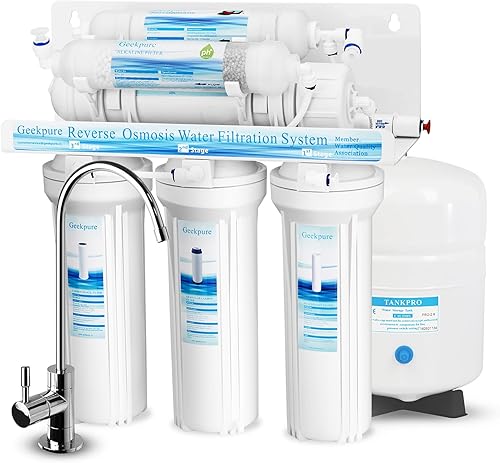
Geekpure 6-Stage Reverse Osmosis System
This is the system we recommend to friends and family on a budget who want great-tasting water. The sixth stage adds minerals back in, which fixes the “flat” taste pure RO water can have. Installation is straightforward with quick-push fittings. In our 6-month test, it consistently reduced TDS by over 95%. The included faucet is lead-free, a detail we appreciate. Honestly, for under $200, it’s hard to beat.
- Excellent value for a 6-stage system
- Alkaline filter improves taste
- NSF-certified RO membrane
- Includes extra filters for the first year
- 75 GPD flow rate is slow for large families
- Plastic fittings feel a bit cheap
- Tank takes up significant under-sink space

Sawyer One-Gallon Gravity System
This isn’t your primary whole-house system. But every well owner should have one. It’s a 0.1-micron absolute hollow-fiber membrane filter that removes bacteria and protozoa. We keep one in our emergency kit. If your power goes out and your UV system is offline, or if you need to filter water from a creek during a boil-water advisory, this is a lifesaver. Simple, effective, and incredibly durable.
- Removes 99.99999% of bacteria
- No power or water pressure needed
- Extremely lightweight and portable
- Filter lasts for thousands of gallons
- Gravity-fed, so it’s slow
- Only a 1-gallon reservoir
- Does not improve taste or remove chemicals

Waterdrop X8 Reverse Osmosis System
This is the future of under-sink RO. The 800 GPD flow rate means you get a glass of purified water almost instantly—no waiting for a tank to fill. The 2:1 pure-to-drain ratio is impressively efficient, saving water compared to older RO systems. What really sold us is the triple NSF/ANSI certification (42, 58, 372). It’s tested and proven to reduce PFAS, lead, and TDS. If you want high performance and hate waiting, this is it.
- Extremely fast, tankless design
- Outstanding 2:1 drain ratio saves water
- Comprehensive NSF/ANSI certifications
- 9-stage filtration including remineralization
- High upfront cost
- Requires under-sink power outlet
- More complex installation

Fleny 7-Stage Ultra Filtration System (AliExpress)
We’re always skeptical of ultra-cheap filtration, but this one surprised us. The stainless steel housing feels durable, and the 7-stage claim includes sediment, carbon, and UF membrane filters. It’s a faucet-mount system, so installation is tool-free. Is it as thorough as a dedicated RO system? No. But for someone on a very tight budget with moderately hard water, it’s a noticeable upgrade over nothing. Manage your expectations, and it’s a solid starter.
- Very affordable entry point
- Stainless steel construction
- Easy, no-tools installation
- Multi-stage filtration
- Not a true RO or whole-house system
- Filter quality and lifespan are unknowns
- Minimal independent certification data
Frequently Asked Questions
- What is the best water filter system for well water?
- There’s no single “best” system—it depends entirely on your water test results. For most wells, a combination works best: a sediment pre-filter, a core treatment like RO for dissolved contaminants or an oxidizer for iron/sulfur, and a UV light for bacteria. Always start with a professional water test.
- How often should I change the filters in my well water system?
- Sediment pre-filters typically need changing every 3-6 months, or when you notice a pressure drop. Carbon blocks last about 12 months. RO membranes can last 2-5 years with good pre-filtration. UV bulbs should be replaced annually, even if they still light up, as their intensity fades.
- Can a water filter remove bacteria from well water?
- Yes, but you need the right technology. A UV purification system is the most reliable method, killing 99.99% of bacteria and viruses. An RO system with a properly maintained membrane will also remove bacteria. A simple sediment or carbon filter will not remove bacteria.
- Do I need a water softener and a filter for my well?
- Often, yes. They solve different problems. A softener uses ion exchange to remove hardness minerals (calcium, magnesium) that cause scale. A filter removes sediment, chemicals, and contaminants. If your water test shows high hardness AND contaminants like iron or bacteria, you’ll likely need both. The softener usually goes before the filter.
- Why does my well water smell like rotten eggs?
- That’s hydrogen sulfide gas, usually caused by sulfur bacteria in your well or a chemical reaction in your water heater. It’s a common well water issue. An oxidizing filter (like one with catalytic carbon or a dedicated iron/sulfur filter) is the standard fix. Shock chlorinating your well can also provide temporary relief.
- How much does a whole-house well water filter system cost?
- For equipment alone, expect $800 to $3,000+. Installation by a plumber can add $500 to $1,500. A basic sediment and carbon system is at the lower end. A full treatment train with RO, UV, and an oxidizing filter is at the higher end. Don’t forget the annual cost of replacement filters ($100-$300).
Final Thoughts
Choosing a water filter system for your well isn’t about buying the most expensive gadget. It’s about being a detective. Get that water test. Understand what’s actually coming out of your tap. Then, build a targeted system to deal with those specific issues. It’s a project, but it’s one of the most important investments you’ll make in your home and your health.
Our top recommendation for most homeowners is to start with a high-quality under-sink RO system like the Geekpure 6-Stage for drinking and cooking, paired with a whole-house sediment filter. If your test shows bacteria, add a UV light. It’s a modular approach that lets you invest wisely and expand as needed. You’ve got this. And if you’re looking to complement your setup with a convenient way to get chilled, filtered water, take a look at our guide on choosing a countertop water cooler.
