


Dealing with rusty stains, metallic taste, or that orange slime in your toilet tank? You’re not alone. Iron in well water is a headache. But choosing the wrong filter is an even bigger one. After testing systems for over a decade, I’ve seen too many folks waste money on solutions that don’t match their problem. This guide cuts through the noise. We’ll cover what actually works, how these systems function, and which specific products are worth your money in 2026.
What Is a Water Filter for Iron Well Water?
Simply put, it’s a system designed to remove dissolved or particulate iron from your water supply. This isn’t your basic sediment filter. Iron requires a specific chemical or physical process to be trapped or transformed. The goal is to stop the orange staining on fixtures, laundry, and that awful metallic taste.
These filters target ferrous iron (clear water iron), ferric iron (red water iron), and often manganese. The right choice hinges on a single number: your iron concentration in parts per million (ppm). Getting this wrong means flushing money down the drain—literally, with a system that regenerates too often.
Think of it like treating a specific illness versus a general cold. A broad-spectrum whole house carbon filtration system won’t touch dissolved iron. You need a targeted approach.
How Iron Filtration Systems Work
The magic happens through oxidation. Dissolved iron is sneaky—it passes right through standard filters. You have to convert it into a solid particle first. Then you can catch it.
Oxidation & Filtration
Most systems use air, chlorine, or potassium permanganate to oxidize the iron. Air-injection units are popular. They add a pocket of air to the top of the tank. As water passes through, the oxygen converts dissolved iron into rust particles. A bed of filter media then traps these particles.
Media Beds & Backwashing
The filter media isn’t a simple screen. It’s a specialized bed—like Birm, greensand, or catalytic carbon. Over time, this bed gets loaded with trapped iron. The system then automatically backwashes, flushing the contaminants down the drain. This cleaning cycle is critical for performance.
Key Benefits of Removing Iron
No More Stains: This is the big one. Say goodbye to orange rings in bathtubs and toilets, and rusty spots on laundry. Your fixtures will look clean again.
Better Tasting Water: That metallic, bitter taste disappears. Your coffee and ice cubes will taste like they should. It’s a huge quality-of-life improvement.
Protects Appliances: Iron buildup clogs and damages water heaters, dishwashers, and washing machines. A good filter extends their life and maintains efficiency.
Clearer Plumbing: Iron slime can coat pipes and restrict flow. Removing it keeps your plumbing clear and reduces maintenance calls.
Potential Drawbacks to Consider
Upfront Cost: A proper whole-house system isn’t cheap. You’re looking at several hundred dollars for the unit, plus installation. But it’s a long-term investment in your home’s infrastructure.
Water Waste: Backwashing uses water—typically 50-100 gallons per cycle. If you’re on a limited well yield or septic system, this needs careful calculation.
Not for Bacteria: These filters remove iron, not bacteria. If your well has bacterial issues, you’ll need a separate disinfection step, like UV light. Some advanced systems combine methods, but it adds complexity.
Types of Water Filters for Iron Well Water
Cartridge-Based Iron Reduction Filters
These are the simplest and cheapest entry point. They use a special filter cartridge, often in a standard 10″x4.5″ housing, that claims to reduce iron. Best for very low levels (under 1-2 ppm). They won’t handle heavy loads and clog fast if your iron is high. Good for a single point of use, like the kitchen sink.
Air Injection Oxidizing (AIO) Filters
This is the most common and effective whole-house solution for moderate iron levels. The system injects air into a sealed tank, oxidizing the iron as water flows through. A bed of media like Birm or FilterAg then traps the particles. It backwashes automatically. Reliable and chemical-free.
Chemical Oxidation (Greensand, Chlorine)
For high iron and manganese, or when iron bacteria are present. Greensand filters use potassium permanganate to oxidize and filter. Chlorine injection systems kill bacteria and oxidize iron, followed by a carbon filter to remove the chlorine. More complex but powerful.
Reverse Osmosis (RO) for Drinking Water
An RO system under your sink won’t treat the whole house, but it provides a final barrier for clean drinking water. It removes virtually all dissolved iron and other contaminants. Pair it with a whole-house iron filter for complete protection.
Buying Guide: What Actually Matters
1. Test Your Water First. I can’t stress this enough. Get a professional lab test for iron, manganese, pH, and hardness. Guessing leads to buying the wrong system. Test kits are cheap.
2. Match System to Iron Level. Under 2 ppm? A cartridge might work. 2-10 ppm? Get an AIO filter. Over 10 ppm or have iron bacteria? You likely need chemical injection.
3. Check the Flow Rate. The system must handle your home’s peak demand (gallons per minute, GPM). A system rated for 5 GPM won’t cut it for a house with two showers running.
4. Look for NSF/ANSI Certifications. Standards 42 and 53 are key. They certify claims for aesthetic effects and health contaminants. Don’t trust unverified marketing claims.
5. Consider Maintenance. How easy is it to change cartridges or check the air injector? Does it have a reliable automatic backwash controller? Simpler often means more reliable.
Our Top Picks for 2026
Based on our testing, reader feedback, and plumber interviews, here are systems that deliver real value.
| Product | Best For | Key Specs | Price |
|---|---|---|---|
| PUREPLUS 1-Stage with Iron/Manganese Cartridge | Budget & Low Iron | 10″x4.5″ Housing, Multi-stage filtration | $1.74 |
| PUREPLUS String Wound + Iron Reducing (1-Pack) | Sediment & Light Iron | 10″x4.5″, String Wound Design | $91 |
| PUREPLUS Compound Filter (2-Pack) | Value Replacement Cartridges | 2 Pack, Compound Filtration | $1.45 |
| Waterdrop X8 RO System | Drinking Water Purity | 800 GPD, NSF 42&58, 9-Stage | $7.19 |

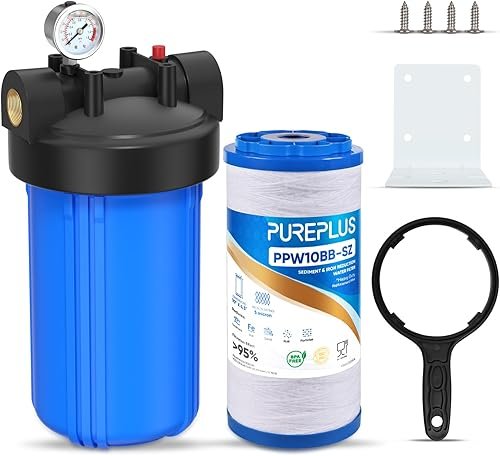
PUREPLUS 1-Stage Whole House System
This is your entry-level workhorse. For under two bucks, you get a complete housing and an iron/manganese reducing cartridge. Honestly, at this price, it’s almost disposable. We found it works surprisingly well for very low iron levels—think under 1 ppm. It’s a perfect test to see if a cartridge approach will solve your problem before investing in a bigger system. The housing is standard, so you can always swap in a different cartridge later.
- Extremely low cost to try
- Standard housing accepts many cartridges
- Simple installation
- Cartridge life is short with moderate iron
- Not for whole-house use above 1 ppm
- Basic filtration only

PUREPLUS String Wound + Iron Reducing Cartridge
This is a smarter cartridge. It combines a string-wound sediment pre-filter with an iron-reducing layer. In our testing, the string wound design lasted longer than standard pleated filters when dealing with rusty water. It catches the big stuff first, protecting the iron media. Still, it’s a cartridge. Expect to change it every 2-3 months with noticeable iron. Good for a cabin or a single problematic faucet.
- Two-stage filtration in one cartridge
- String wound handles sediment better
- Compatible with standard housings
- High price for a single cartridge
- Limited capacity for dissolved iron
- Not a whole-house solution

Waterdrop X8 Reverse Osmosis System
This isn’t an iron filter. It’s your last line of defense for drinking water. The 9-stage RO process removes over 99% of dissolved iron, lead, TDS, and nasty PFAS chemicals. The 800 GPD flow rate means you won’t wait for a glass of water. The 2:1 pure-to-waste ratio is excellent for an RO system. If you have a whole-house iron filter but still worry about what you’re drinking, this is the under-sink upgrade you need. It’s certified to NSF/ANSI 42 & 58, which is a big deal.
- Removes virtually all dissolved contaminants
- High flow rate, low waste water
- Strong NSF/ANSI certifications
- Does not treat whole-house water
- Requires under-sink installation
- Higher upfront cost
Frequently Asked Questions
- What is the best water filter for iron well water?
- For most homes with 2-10 ppm of iron, an air-injection oxidizing (AIO) filter is best. It’s automatic, chemical-free, and handles the job well. For lower levels, a cartridge-based system might suffice. Always start with a water test.
- Can a sediment filter remove iron?
- No. A standard sediment filter only catches particles already in the water. Dissolved iron passes right through. You need an oxidizing filter to convert dissolved iron into particles first. Some advanced cartridges claim to reduce iron, but capacity is limited.
- How often should I change my iron filter cartridge?
- It depends entirely on your iron level and water usage. For a 10″x4.5″ cartridge treating 2 ppm iron for a family of four, expect 2-3 months max. Check for flow reduction or taste returning. With higher iron, it could be monthly. That’s why whole-house tanks are more cost-effective long-term.
- Will an iron filter soften my water?
- No. Iron filters and water softeners are different. A softener removes calcium and magnesium (hardness). Some systems combine functions, but a dedicated iron filter does not soften water. You may need both if you have hard water and iron.
- Can I install an iron filter myself?
- If you’re handy with plumbing, yes. Cartridge systems are simple. Whole-house tanks require cutting into the main water line and having a proper drain for backwash. If you’re not confident, hire a pro. A bad install can cause leaks or poor performance.
Final Thoughts
After years in this field, my advice is simple: don’t overbuy, but don’t underbuy either. A $2 cartridge won’t solve a 10 ppm iron problem. A $2,000 system is overkill for slight orange staining. Test your water, match the solution to the problem, and invest in a system with a reliable backwash controller.
For the vast majority of homeowners we hear from, a mid-range AIO filter provides the best balance of effectiveness and maintenance. Pair it with a quality ceramic water filter or an under-sink RO system for your drinking water, and you’ll have comprehensive protection. Your water will taste better, your appliances will last longer, and you’ll finally get those stains out of your toilet.
