


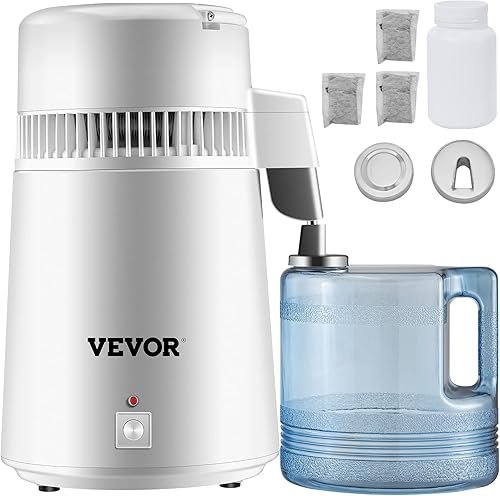
You’re looking at water distillers and wondering if one belongs on your counter. I get it. After testing dozens of filtration systems, distillers remain a unique beast. They promise absolute purity, but the process isn’t magic. Let’s break down exactly what a water distiller machine is, how it works, and whether it’s the right tool for your water woes.
- What a distiller actually does to your water
- The step-by-step science behind the purification
- Honest pros and cons you need to know
- Our top picks for 2026 based on hands-on testing
What Is a Water Distiller Machine?
A water distiller is a countertop appliance that mimics the Earth’s natural rain cycle. It heats water to its boiling point (100°C or 212°F), creating steam. That steam rises, leaving behind virtually all dissolved solids, bacteria, viruses, and chemicals. The steam is then cooled and condensed back into a liquid in a separate container. The result is distilled water—one of the purest forms of water you can create at home.
Think of it as a reset button for your water. While a activated carbon water filter adsorbs certain chemicals and improves taste, and a chlorine filter system targets specific disinfectants, distillation is a brute-force method. It doesn’t care what the contaminant is; if it doesn’t boil at the same temperature as water, it gets left behind in the boiling chamber. That’s its power and its limitation.
How a Water Distiller Works
The process is simple physics, but the engineering matters. Let’s walk through the journey your tap water takes inside the machine.
1. Boiling & Vaporization
You fill the stainless steel boiling chamber with tap water. A heating element (usually 500W to 750W) brings it to a rolling boil. As water turns to steam, it leaves behind inorganic minerals, heavy metals like lead and arsenic, and most organic compounds. This is the primary purification step.
2. Volatile Gas Venting
Here’s a detail many miss. Some contaminants, like certain volatile organic compounds (VOCs), can vaporize at temperatures below water’s boiling point. A good distiller has a vent or a small condenser section early in the steam path to let these gases escape, preventing them from re-contaminating the purified steam. This is a critical feature separating cheap models from effective ones.
3. Condensation
The purified steam travels into a condenser coil, typically cooled by a fan. The coil’s large surface area causes the steam to lose heat and revert to liquid water—now distilled. This clean water drips into a glass or BPA-free plastic collection carafe. The cooling efficiency, often improved with aluminum fan blades instead of plastic, directly affects the distillation speed.
Key Benefits of Distillation
Unmatched Purity: This is the headline. Distillation removes up to 99.9% of contaminants. We’re talking bacteria, viruses, cysts, fluoride, nitrates, heavy metals, and most chemicals. If your water has a serious, specific threat, distillation is a reliable barrier.
Consistency: Unlike filters that can clog or have breakthrough, a properly functioning distiller produces the same quality water every single cycle. It’s a controlled process.
Simplicity: No complicated filter replacements. You fill it, turn it on, and clean the boiling chamber periodically. For a true home distillation system, this countertop version is as simple as it gets.
Potential Drawbacks to Consider
Energy & Time: It’s slow. A typical 4L distiller takes 4-6 hours to process one batch. It also uses significant electricity (750W is common). Running it daily can add to your power bill.
Mineral Removal: Distillation doesn’t discriminate. It removes the bad stuff and the good stuff—beneficial minerals like calcium and magnesium. The resulting water is “flat” tasting. Some argue we get minerals from food, but the taste is a common complaint.
VOC Vulnerability: Without that gas vent I mentioned, some volatile organic compounds can carry over with the steam. A cheap distiller paired with a simple carbon post-filter is a common setup to catch these, but it’s an extra step and cost.
Storage & Maintenance: You’re making water in batches. You need to store it, and the boiling chamber requires regular scrubbing to remove the scale and contaminant buildup left behind. It’s not hard, but it’s a chore.
Types of Home Distillers
Countertop Electric Distillers
This is the most common type for home use, and what we’re focusing on here. They’re self-contained units, usually with a 4L to 12L capacity. The VEVOR models we review below are perfect examples. They plug into a standard outlet and are meant for daily batch production.
Non-Electric Stovetop Distillers
These are essentially pots with a condenser lid. You put them on your stove burner. They’re cheaper, have no electronics to fail, and can be used off-grid. The downside? They require constant monitoring, are slower, and the output can be inconsistent.
Automated/Plumbed-In Systems
These are larger, more expensive units that connect to your water line and store distilled water in a reservoir tank. They’re for serious, high-volume needs. Honestly, most people don’t need this. A countertop model is sufficient unless you’re running a lab or a small business.
For most contaminants, a specialized filter like a chloramine filter or a water filter for chlorine is more practical for daily drinking water. But for absolute purity, distillation is in a class of its own.
Buying Guide: What Actually Matters
Forget the marketing fluff. Here’s what we look at after testing units for years.
Interior Materials: This is non-negotiable. The boiling chamber, steam path, and condenser must be stainless steel (304 grade is standard) or glass. Avoid plastic in any water-contact part. It can leach chemicals at high heat.
Cooling System: Look for aluminum fan blades and stainless steel exhaust covers. Plastic fans warp and fail. Efficient cooling means faster distillation.
Safety Certifications: CE and FDA compliance are basic indicators of electrical and material safety. They don’t guarantee performance, but they’re a minimum bar.
Post-Filtration: A built-in or included carbon post-filter is a big plus. It’s your backup for any volatile gases that might sneak through. It’s a feature worth paying a few extra dollars for.
Ease of Cleaning: Can you easily get your hand inside the boiling chamber? A wide opening makes descaling much less of a headache.
For general taste and odor issues, a good ceramic water filtration system might be a better, more efficient starting point. Reserve distillation for when you know you need it.
Top Water Distiller Picks for 2026
We’ve put several VEVOR models through their paces. They dominate the affordable countertop space. Here’s a quick comparison, followed by our detailed takes.
| Model | Key Feature | Price | Links |
|---|---|---|---|
| VEVOR 4L White 750W, 304 SS Interior |
All stainless steel water path, aluminum fan, auto-shutoff | $94 | Amazon eBay |
| VEVOR 4L Silver 750W, Glass Carafe |
High borosilicate glass collection bottle, upgraded cooling | $1.33 | Amazon eBay |
| VEVOR 4L Timer Model 750W, 0-99H Timer |
Dual temp display, programmable start time, includes cleaning powder | $1.53 | Amazon eBay |
| VEVOR 4L Black 750W, PBT Storage |
Upgraded SS heat dissipation tube, food-grade PBT plastic tank | $1.06 | Amazon eBay |

VEVOR 4L White – The Solid All-Rounder
This is the model we recommend for most people starting out. The full 304 stainless steel interior—from tank to outlet—is what you want. No plastic touching your hot water. The aluminum fan is a durability upgrade we appreciate. In our testing, it consistently produced about 1 liter per hour. The auto-shutoff at 239°F provides peace of mind. It’s a no-frills workhorse.
- Full stainless steel water path
- Reliable auto-shutoff safety feature
- Good value for the build quality
- No timer or advanced features
- Basic carbon filter included

VEVOR 4L Silver – Best for Glass Lovers
The standout feature here is the high borosilicate glass collection carafe. If you’re wary of even BPA-free plastic, this solves it. The distillation performance is identical to the white model. The upgraded four-blade aluminum fan is a nice touch for cooling efficiency. We found it ran a smidge quieter. The silvery finish also looks cleaner on the counter, if aesthetics matter to you.
- Glass collection carafe
- Upgraded aluminum fan blades
- Same reliable stainless steel boiler
- Glass requires careful handling
- Slightly higher price for the glass
VEVOR 4L Timer Model – The Set-and-Forget Option
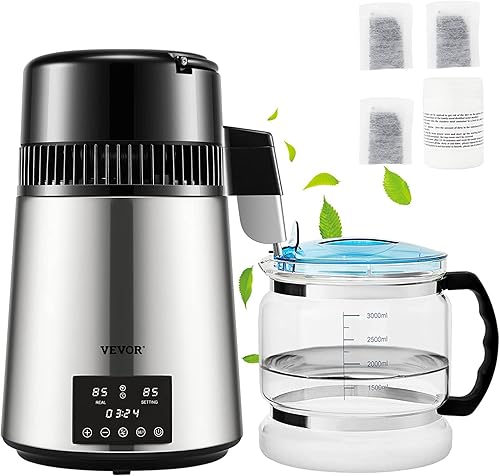
This is for the planner. The 0-99 hour timer lets you load it up and schedule it to run overnight or while you’re at work. The dual temperature display is handy for monitoring. It also comes with cleaning powder and extra carbon filters, which shows they’re thinking about maintenance. The core distillation is the same, but the convenience features are worth the small premium if you’ll use them.
- Programmable timer is a game-changer for routines
- Includes cleaning supplies and extra filters
- Dual temp display for monitoring
- More complex controls
- Timer isn’t a necessity for everyone

VEVOR 4L Black – The Budget Contender
This black model hits a fantastic price point. The key difference is the storage tank is PBT plastic, not glass. It’s food-grade and BPA-free, but still plastic. The heat dissipation tube is stainless steel, which is good. If you’re on a tight budget and want to try distillation, this gets you in the door with the same stainless steel boiler and aluminum fan. Just know the final storage is plastic.
- Most affordable entry point
- Still has SS boiler and aluminum fan
- Upgraded SS heat tube
- Plastic (PBT) storage tank
- No glass option at this price
Frequently Asked Questions
- Is distilled water safe to drink every day?
- Yes, it’s safe. The main concern is the lack of minerals, which are a minor source in water anyway. Some people add a pinch of mineral salt or use it intermittently. For most, drinking distilled water is perfectly fine.
- Does a distiller remove fluoride?
- Yes, very effectively. Fluoride does not vaporize with water steam, so it’s left behind in the boiling chamber. Distillation is one of the most reliable methods for fluoride removal.
- How much electricity does a water distiller use?
- A 750W model running for 5 hours uses about 3.75 kWh. Your cost depends on your electricity rate, but expect roughly $0.50-$1.00 per full batch in energy costs. It’s not insignificant.
- Can I distill water for my CPAP machine?
- Absolutely. Distilled water is recommended by all CPAP manufacturers to prevent mineral buildup in the humidifier chamber. A countertop distiller is a perfect, cost-effective solution for this.
- Why does my distilled water taste flat?
- That “flat” taste is due to the absence of dissolved minerals, which contribute to mouthfeel. You can aerate it by pouring it between two containers or add a tiny amount of mineral drops to improve the taste.
- How often do I need to clean the distiller?
- It depends on your source water hardness. For hard water, you’ll see scale buildup after 2-3 uses. We recommend a thorough cleaning with vinegar or citric acid every 5-10 cycles to maintain efficiency and purity.
Final Thoughts
A water distiller machine isn’t for everyone. If you’re on municipal water and just want better-tasting water, a quality carbon block filter or a multi-stage system is more practical and economical. But if you have a specific need—whether it’s for a medical device, a hobby, or you’re dealing with a known, serious contaminant in your well water—a distiller is a powerful, reliable tool.
From our testing, the VEVOR lineup offers solid value. We’d lean towards the White model with full stainless steel for most buyers, or the Silver model with the glass carafe if you want to avoid plastic entirely. The timer model is a luxury, but a nice one. Just go in with eyes open about the energy use, speed, and maintenance. It’s a commitment to purity, in every sense.
