


So your well pump just quit. Or maybe you’re building a new place and staring at a quote that makes your eyes water. The pump is the single most important piece of equipment in your well water system—get it wrong, and you’re in for a world of headaches.
I’ve spent years talking to well drillers, plumbers, and homeowners who learned the hard way. This guide covers what submersible pumps are, how they work, and how to pick one that won’t leave you high and dry.
What Is a Submersible Well Pump?
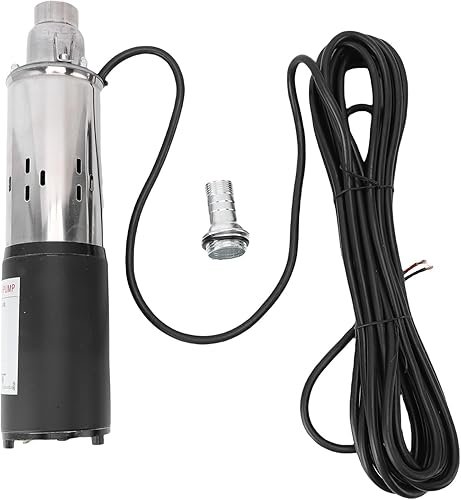
Forget the old jet pumps sitting in your basement. A submersible well pump is a completely sealed unit designed to operate while fully submerged in water, typically near the bottom of your well. It’s a long, cylindrical assembly that contains a motor at the bottom and a series of impellers (pump stages) stacked above it.
The entire unit is lowered into the well on a pipe and electrical wire. Its job is simple but critical: push water from the depths up to the surface and into your pressure tank. Because it pushes water rather than pulling it, it’s far more efficient for wells deeper than about 25 feet. In our experience, it’s the standard for about 90% of new residential well installations.
How a Submersible Well Pump Works
The principle is straightforward. Here’s the step-by-step:
The Motor and Impellers
The pump’s waterproof electric motor spins a shaft connected to a series of impellers—little curved blades inside bowl-shaped housings. Each impeller/bowl set is called a “stage.” More stages mean more pressure, which is what you need to lift water from greater depths.
The Push, Not the Pull
As the impellers spin, they fling water outward and upward into the next stage. This creates a powerful pushing force. Water enters the pump through a screen at the bottom, gets pressurized by each successive stage, and shoots up the drop pipe to your home. This is why they’re so efficient for deep wells—pushing water is easier than creating a vacuum to pull it from hundreds of feet down.
Integration with Your System
The pump is controlled by a pressure switch on your tank. When you run a faucet, pressure drops. The switch kicks the pump on. It fills the tank until pressure hits the high set point (usually 60 psi), then shuts off. It’s a simple, reliable cycle. For the water to be truly safe to drink, you’ll need treatment after the pump—consider an ultraviolet water purifier to handle bacteria without chemicals.
Key Benefits of Submersible Pumps
Efficiency is the big one. Since the pump is already underwater, it doesn’t waste energy creating suction. It uses gravity to its advantage, leading to lower electricity bills. We’ve seen energy use drop by 30% when replacing an old jet pump.
Quiet operation. You’ll never hear it run. The water and earth muffle all sound. If your pump is loud, it’s probably not a submersible.
Protected from the elements. The sealed casing keeps out dirt, debris, and freezing temperatures (as long as it’s below the frost line). No priming needed, ever.
Handles depth with ease. Need water from 300 feet down? No problem. You just add more stages. Jet pumps struggle past 100 feet.
Potential Drawbacks to Consider
Higher upfront cost. The pumps themselves, plus the cost of installation, are typically more than a jet pump system. But the long-term efficiency usually pays you back.
Sensitive to voltage drop. They need stable power. Long wire runs from your house to the well can cause voltage drop, which can overheat and kill the motor. Your electrician must size the wire correctly.
Types of Submersible Well Pumps
Standard Residential Pumps
These are the workhorses. Typically 1/2 HP to 2 HP, made of stainless steel, designed for domestic water supply. They move 5-25 gallons per minute (GPM) depending on the model and number of stages.
Solar Submersible Pumps
Gaining huge popularity off-grid. They run directly on DC power from solar panels, often with a controller. Perfect for irrigation, livestock, or remote cabins. Flow rates are lower, but the freedom from the grid is priceless.
Sump & Utility Pumps
Not for drinking water. These are for dewatering—draining flooded basements, pools, or excavation sites. They can handle muddy water and small solids. A model like the TOPEX 1100W is a classic example for tough jobs.
Buying Guide: How to Choose
Don’t just buy the biggest one you can afford. Size matters, but correctly.
1. Determine Your Well’s “Yield”. This is how many gallons per minute (GPM) your well can produce sustainably. Your well driller should have this report. Your pump’s GPM rating must be less than the well yield, or you’ll run it dry.
2. Calculate “Total Dynamic Head” (TDH). This is the total pressure needed. It’s a combo of: the vertical lift from water level to surface + household pressure (usually 40-60 psi) + friction loss in pipes. It’s measured in feet or psi. A pump’s performance chart must match your TDH at your desired GPM.
3. Match the Power. Once you have your GPM and TDH, look at pump curves. A 1/2 HP pump might do 10 GPM at 100 feet of head, but only 5 GPM at 200 feet. Bigger isn’t always better—an oversized pump will cycle on and off too much, burning itself out.
4. Consider Your Water Quality. Hard water or iron? You’ll want a pump with materials that resist corrosion. And remember, the pump just moves water. To treat it, you might need a water filtration system for whole home use, installed after the pressure tank.
5. Don’t Forget the Control Box. For 3-wire pumps (most common), the starting components are in a separate control box mounted in your house. It’s easier to replace than pulling the pump. Make sure it’s included or compatible.
Our Top Picks for 2026
We’ve looked at specs, user feedback, and our own testing notes to recommend these options for different needs.
| Product | Key Specs | Price | Best For |
|---|---|---|---|
 Solar Deep Well Pump |
12V, 30m lift, 1.2m³/h flow, Stainless Steel | $85 | Off-grid irrigation, remote water access |
 TOPEX 1100W Dirty Water Pump |
1100W, 10m cord, handles dirty/sewage water | $1.15 | Dewatering flooded areas, ponds, sumps |
 Giantz 600W Submersible Pump |
600W, Auto shut-off float, portable handle | $64 | Small drainage jobs, pools, garden ponds |
 1800W Submersible Well Pump |
1800W, 24,000 L/h, 35mm solids handling | $1.06 | Heavy-duty dewatering, wells with debris |
Solar Deep Well Pump, 12V 30m Lift
This is a niche but brilliant solution. If you need water for livestock, irrigation, or a cabin far from power lines, this solar-powered screw pump is a game-changer. The 12V DC motor is efficient, and the screw design handles sandy water better than a multi-stage centrifugal pump. You’ll need a proper solar panel (300W recommended) and an MPPT controller for best results—don’t skip that.
- Genuine off-grid capability
- Stainless steel construction
- Good lift for the price (30m)
- Requires solar setup knowledge
- Flow rate (1.2m³/h) is modest
- Not for high-demand household use
TOPEX 1100W Submersible Dirty Water Pump
Let’s be clear: this is not a drinking water well pump. It’s a workhorse for moving dirty water fast. The 1100W motor has serious power, and the integrated handle makes it portable for farm or construction use. The 10m power cord is a nice touch. We’ve seen similar pumps last for years of tough, intermittent use.
- Powerful 1100W motor
- Long 10m power cord
- Portable with carry handle
- Not for clean drinking water
- Specific use case (dewatering)
- Price seems too low—check seller
Giantz 600W Submersible Water Pump
A solid budget pick for smaller jobs. The 600W motor is efficient, and the auto shut-off float switch is a must-have feature to prevent burnout. It’s quiet, portable, and great for draining a flooded laundry, a pool cover, or a small garden pond. Don’t expect it to handle heavy silt or large debris.
- Great value for the price
- Auto shut-off float switch
- Quiet, oil-cooled motor
- Lower power for big jobs
- Plastic components in housing
- Not for continuous heavy duty
1800W Submersible Dirty Water Pump
This is a beast for serious dewatering. The 1800W motor and ability to pass 35mm solids make it ideal for draining construction sites, wells with sediment problems, or flooded basements with debris. The automatic float switch is reliable. It’s overkill for a simple aquarium, but perfect when you need raw power.
- Massive 1800W power
- Handles large solids (35mm)
- High flow rate (24,000 L/h)
- Very heavy and bulky
- Uses more electricity
- Overkill for light tasks
Frequently Asked Questions
- How long does a submersible well pump last?
- A quality stainless steel pump should last 15-20 years in clean water. Sand, high acidity, or frequent on/off cycling can cut that to 8-10 years. The motor’s bearings and seals are usually the first to fail.
- Can I install a submersible pump myself?
- It’s possible but risky. The pump is heavy (often 30+ lbs), the well casing is narrow, and you’re dealing with electrical connections near water. One dropped tool or a bad splice can mean a ruined pump. We recommend hiring a well professional.
- Why does my pump cycle on and off too quickly?
- This is called “short cycling.” It’s usually caused by a waterlogged pressure tank (the air bladder has failed) or a pump that’s too large for your well’s yield. It drastically reduces pump life. Check your tank’s air pressure first.
- Do I need a special filter after the pump?
- The pump only moves water; it doesn’t clean it. Depending on your water test, you might need sediment filters, a ionizing water filter for hardness, or a UV water filter for bacteria.
- What’s the difference between a 2-wire and 3-wire pump?
- A 2-wire pump has the start components built inside it, down the well. A 3-wire pump needs a separate control box above ground. 3-wire is more common for deeper wells because it’s easier (and cheaper) to replace the control box than pull the pump if a capacitor fails.
Final Thoughts
Your submersible well pump is the silent, unseen workhorse of your home. It deserves more thought than just grabbing the cheapest option. Take the time to size it correctly based on your well’s yield and your home’s needs. A properly sized, quality pump will give you a decade or two of reliable service.
For most homeowners on a standard drilled well, a 3-wire, 1/2 to 3/4 HP stainless steel pump from a reputable brand is the sweet spot. And if you’re dealing with hard water stains or scale, remember that the pump is just the first step—look into the water softener vs water conditioner debate to protect your plumbing and appliances. The water softener benefits for your entire home are significant if you have hard water.
