


You’re planning a backcountry trip or maybe just building an emergency kit. You’ve heard you need a personal water filter, but the options are dizzying. After testing dozens in streams, lakes, and questionable hotel sinks, here’s the real deal. We’ll cover what they actually do, how to choose, and which ones won’t let you down when it matters.
- What separates a good personal filter from a gimmick
- The science behind how they make water safe to drink
- Honest pros, cons, and our top field-tested picks
What Is a Personal Water Filter?
A personal water filter is a compact, portable device designed to remove harmful contaminants from water sources as you drink. Think of it as a microscopic gatekeeper. You either suck water through it like a straw or pump it into a container. Its job is to catch bacteria, parasites, and debris while letting clean water pass through.
These aren’t your bulky under sink filter cartridge systems. They’re built for mobility. The core technology is a hollow fiber membrane with pores so small—often 0.2 microns or less—that pathogens can’t squeeze through. We’ve relied on them from mountain streams to remote villages, and they’re a non-negotiable piece of gear for anyone venturing beyond municipal taps.
They solve a specific problem: access to safe drinking water when you’re away from reliable infrastructure. That could be on a trail, during a boil-water advisory, or while traveling internationally.
How a Personal Water Filter Works
The magic happens at a microscopic level. Most personal filters use one or a combination of these methods to clean your water.
Mechanical Filtration (The Main Event)
This is the primary defense. Water is forced through a bundle of tiny hollow fibers. The walls of these fibers have microscopic pores, typically rated at 0.1 or 0.2 microns. Bacteria (like E. coli and Salmonella) and parasites (like Giardia and Cryptosporidium) are physically too large to pass through. They get trapped on the outside of the fibers, and you get clean water from the inside. It’s simple, effective, and doesn’t require chemicals.
Activated Carbon (For Taste and Chemicals)
Many filters include an activated carbon stage. This doesn’t remove viruses or bacteria. Instead, it adsorbs chemicals, improves taste, and reduces odors by trapping organic compounds. It’s great for making stream water taste less like dirt. But if your main concern is pathogens, the mechanical filter is doing the heavy lifting.
Absorption and Other Tech
Some advanced models incorporate charged media that attracts and holds certain contaminants. You might also see claims about reducing heavy metals. Always check the certifications—NSF/ANSI standards 42 (aesthetic effects) and 53 (health effects) are your best friends here. A filter claiming to remove lead should be tested to Standard 53.
Key Benefits of Using One
Portability is king. The best ones weigh under two ounces. You can clip one to your pack and forget it’s there until you need it. No batteries, no pumping (for straw types), no waiting.
Immediate access to water. Find a source, scoop your bottle, insert the filter, and drink. It eliminates the need to carry all your water for a day hike, lightening your load significantly.
Emergency preparedness. When the power’s out and the stores are empty, a personal filter turns a rain barrel or a local stream into a viable drinking source. It’s a cornerstone of any serious 72-hour kit.
Travel confidence. We’ve used them in places where tap water is a gamble. It beats buying endless plastic bottles and gives you peace of mind. For broader home solutions, you might look at point of use filtration, but for on-the-go, these are perfect.
Potential Drawbacks to Consider
They have a lifespan. Every filter clogs eventually. The LifeStraw, for example, is rated for 4,000 liters. That’s a lot, but it’s not infinite. You can’t backflush most straw-style filters to extend their life.
Source water quality affects performance. Very silty or muddy water will clog the pores faster. Pre-filtering through a bandana helps a lot. Also, they don’t soften water or remove dissolved minerals—if you have hard water at home, you need a different system, possibly an iron filter system for well water.
You can’t filter for a group easily. It’s a one-person, one-drink-at-a-time solution. For filtering water for cooking or a family, you’ll want a gravity bag or pump system.
Types of Personal Water Filters
Straw Filters
The simplest form. You place one end in the water source and suck through the other. They’re ultralight and foolproof. The downside? You have to be right at the water source. Great for day hikes and emergency backups.
Bottle-Integrated Filters
A filter is built into the cap of a water bottle. You fill the bottle, screw on the cap, and drink. It’s more versatile than a straw because you can carry filtered water with you. We find this the most convenient style for most people.
Pump Filters
You manually pump water from a source through a filter into a clean container. They can handle larger volumes and often have cleaner output ports. The trade-off is weight, bulk, and effort. They’re a favorite for group trips.
Squeeze Filters
A hybrid. You fill a soft pouch, screw on the filter, and squeeze water into your mouth or a container. They offer a good balance of weight and convenience. The pouches can wear out, though.
For home use where you want filtered water on demand, a glass pitcher with filter is a stylish countertop option, but it’s not for the trail.
Buying Guide: What Actually Matters
Don’t get lost in marketing. Focus on these four criteria.
1. Filtration Claims & Certifications. Look for specific log reduction claims (e.g., 99.99999% of bacteria). The gold standard is testing to US EPA and NSF/ANSI protocols. If a brand is vague, walk away.
2. Filter Lifespan & Cost. Calculate the cost per liter. A $30 filter that lasts 1,000L is cheaper over time than a $20 filter that lasts 400L. Also, can you replace the element, or is the whole unit disposable?
3. Flow Rate & Ease of Use. You won’t use a filter that’s a pain. If you can, check reviews for comments on sucking effort. For pump or squeeze models, how many strokes per liter?
4. Weight & Packability. For backpacking, every gram counts. Straw filters win here. For travel or car camping, a bottle filter’s convenience might outweigh a few extra ounces. If you’re dealing with specific contaminants like iron at your cabin, you’ll need a dedicated iron water filtration setup, not a personal straw.
Our Top Picks for 2026
| Product | Key Specs | Best For | Links |
|---|---|---|---|
 |
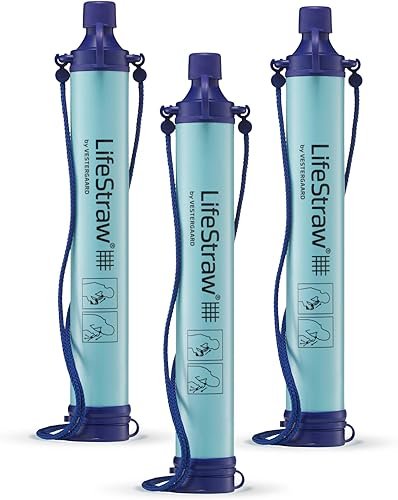
LifeStraw 3-Pack Filter life: 4,000L each Weight: 2 oz Removes: Bacteria, parasites, microplastics |
Families, group leaders, emergency kits | Buy on Amazon Buy on eBay |
 |
LifeStraw Personal (1-Pack) Filter life: 4,000L Weight: 2 oz Removes: Bacteria, parasites, microplastics |
Solo hikers, travelers, budget pick | Buy on Amazon Buy on eBay |
 |
Waterdrop WD-X8 RO System Flow: 800 GPD Certifications: NSF/ANSI 42, 58, 372 Reduces: PFAS, lead, TDS, chloride |
Permanent home installation (not portable) | Buy on Amazon Buy on eBay |
 |
LifeStraw 5-Pack Filter life: 4,000L each Weight: 2 oz each Removes: Bacteria, parasites, microplastics |
Large groups, long-term preparedness | Buy on Amazon Buy on eBay |
LifeStraw Personal Water Filter, 3 Pack
This is our go-to recommendation for most people. The 3-pack is perfect for a family or for stashing in different bags. We’ve used these for years and they just work. The sucking effort is minimal, and the 4,000-liter lifespan per straw is more than enough for occasional use. Honestly, the single biggest mistake is buying an off-brand to save $10. Stick with the proven name here.
- Unbeatable reliability and brand trust
- Ultralight and packable
- Great value in a multi-pack
- Straw design means you must be at the source
- Cannot backflush to extend life
LifeStraw Personal Water Filter, 1 Pack
The original. If you need one filter for your daypack or travel bag, this is it. It’s the benchmark we test everything else against. The performance is identical to the 3-pack, just in a single unit. For the price, it’s an incredible piece of insurance. We’ve lent these to skeptical friends on trips, and they always end up buying their own.
- Industry-standard reliability
- Extremely affordable entry point
- Verified by labs to NSF/ANSI standards
- Only useful for direct drinking
- Not for filtering water for cooking
Waterdrop WD-X8 Reverse Osmosis System
Wait, a whole-house system in a portable article? We’re including it for contrast. This is the opposite of a personal filter—it’s a permanent, powerful installation. It’s relevant if you’re reading this because you want cleaner water at home. The 9-stage filtration and NSF certifications are impressive. It tackles things a personal straw can’t, like dissolved solids and PFAS. But it’s not something you’ll take camping.
- Exceptional filtration for home use
- High flow rate (800 GPD)
- Multiple trusted certifications
- Requires installation under a sink
- Not portable in any sense
Personal Water Filter FAQ
- Can a personal water filter remove viruses?
- Most standard personal filters, like the LifeStraw, do not remove viruses. They are designed for bacteria and parasites. If you’re traveling to areas with known viral contamination in water sources, you need a purifier that adds a chemical (like iodine) or UV light stage.
- How long does a personal water filter last?
- It depends on the model. The popular LifeStraw is rated for 4,000 liters. However, using it in very dirty or silty water will clog it faster. Always check the manufacturer’s rating and consider it a maximum under ideal conditions.
- Can I use a personal filter for saltwater?
- No. Personal filters are for freshwater sources only. Removing salt requires reverse osmosis, which is a different, much more complex technology. Drinking filtered saltwater will still dehydrate you.
- What’s the difference between a filter and a purifier?
- A filter removes bacteria, parasites, and protozoa. A purifier does all that AND removes or inactivates viruses. Purifiers are typically more expensive and complex, using chemicals, UV light, or a much finer pore size (0.01 microns).
- Do I need to clean or maintain my filter?
- For straw-style filters, maintenance is minimal. You can blow air back through to clear water after use. Some pump or squeeze filters allow backflushing to extend their life. Always let the filter air dry completely before long-term storage to prevent mold.
- Can I filter water for my dog?
- Yes! The same bacteria and parasites that make you sick can affect your pets. Letting your dog drink from a filtered bottle or a bowl you’ve filled with filtered water is a smart move on the trail.
Final Thoughts
After all our testing, the conclusion is simple. For most people venturing outdoors or building a safety net, a LifeStraw personal filter is the right starting point. It’s not fancy. It doesn’t need batteries. It just works, reliably, every time you need a drink from a stream. The 3-pack is our top recommendation for the value and preparedness it offers.
Think of it like a seatbelt. You hope you never desperately need it, but you’ll be profoundly glad it’s there when you do. Don’t overcomplicate it. Get a certified filter, learn how to use it before your trip, and enjoy the freedom of not having to carry every drop of water you’ll need.
