


Manganese Filter Guide: How to Remove Black Stains & Metallic Taste (2026)
Seeing black streaks in your toilet tank? Your water tastes like old pennies? That’s manganese. I’ve spent years testing filters and talking to plumbers, and this contaminant is one of the most stubborn we deal with. It’s not just an aesthetic headache—it can damage your appliances.
This guide cuts through the marketing. We’ll cover what a manganese filter actually is, how the different types work, and which ones we trust after hands-on testing. You’ll learn:
- The telltale signs you have a manganese problem.
- How to choose between Birm, greensand, and other media.
- Our top filter picks for different budgets and water conditions.
- Common installation mistakes that ruin performance.
What Is a Manganese Filter?
A manganese filter is a point-of-entry system designed to remove dissolved manganese from your water supply before it reaches any tap or appliance. Unlike a simple sediment filter that catches particles, this system uses a chemical process. It first oxidizes the soluble manganese, turning it into a solid particle, then traps that particle in a filter bed.
Why does this matter? Dissolved manganese (Mn2+) is invisible. You can’t see it in a glass. But let that water sit, or run it through your water heater, and it oxidizes on its own—leaving those infamous black-brown stains on sinks, tubs, and laundry. It’s also linked to that unpleasant metallic taste. A dedicated filter tackles the problem at the source.
You’ll often see manganese filters combined with iron filters, as these contaminants frequently occur together in well water. The treatment principles are similar, but the media and settings can differ. Getting the right one for your specific water test results is critical.
How a Manganese Filter Works
It’s a two-step dance: oxidation followed by filtration. Simple in theory, but the details matter.
Step 1: Oxidation
The dissolved manganese (Mn2+) must be converted to a solid, filterable form (MnO2). This is done by exposing the water to an oxidizing agent. Common methods include air injection (using a venturi), chlorine injection, or potassium permanganate. The oxidizer forces the manganese to “rust” out of solution, forming tiny particles.
Step 2: Filtration
The now-solid manganese particles get trapped as the water flows through a tank filled with a specialized filter media. This media has a rough surface that the particles cling to. Periodically, the system performs a “backwash”—reversing water flow to flush the trapped particles down the drain and reset the media bed.
Key Benefits
Eliminates Staining: This is the big one. No more black streaks in toilets, on shower doors, or ruining your white laundry. It protects your investment in fixtures and appliances.
Improves Taste and Odor: That flat, metallic, sometimes bitter taste disappears. Your drinking water tastes neutral again, which makes coffee and ice cubes taste like they should.
Protects Plumbing and Appliances: Manganese scale builds up inside pipes, water heaters, and dishwashers, reducing efficiency and lifespan. A filter prevents this costly damage. For broader contaminant removal, you might pair it with an activated carbon filter for chlorine or VOCs.
Whole-House Solution: It treats every drop of water entering your home. You don’t need separate filters for each shower or faucet. It’s a one-and-done fix.
Potential Drawbacks
Upfront Cost: A proper whole-house system isn’t cheap. You’re looking at several hundred to over a thousand dollars for the unit, plus professional installation if you’re not handy with plumbing.
Water Waste: The backwash cycle uses water—anywhere from 50 to 150+ gallons per cycle, depending on the system size. This can be a concern in areas with water restrictions or high septic system usage.
pH and Co-contaminant Dependency: Many medias only work effectively within a specific pH range (often 6.8-8.5). High levels of competing contaminants like iron or hydrogen sulfide can also reduce efficiency and require pre-treatment.
Types of Manganese Filter Systems
Birm Media Filters
Birm is a lightweight, coated media that acts as a catalyst for oxidation. It’s popular because it doesn’t require a chemical oxidant like chlorine—just dissolved oxygen in the water. This makes it lower maintenance and cheaper to operate. The catch? Your water must have a certain level of dissolved oxygen and a pH above 6.8. It’s not effective for high levels of manganese.
Greensand & Greensand Plus
The old-school workhorse. Greensand is coated with manganese oxide, which oxidizes and filters manganese in one step. It requires periodic regeneration with potassium permanganate (a purple powder). Greensand Plus is a newer, more durable version. It’s effective for higher concentrations but the potassium permanganate is messy, stains everything, and must be handled carefully.
Chlorine Injection with Catalytic Carbon
This is a powerful, flexible setup. A chemical feed pump injects a small amount of chlorine (or hydrogen peroxide) into the water line. The oxidized manganese is then filtered out by a catalytic carbon bed in a tank. The carbon also removes the chlorine residual, improving taste. It’s great for variable water quality and high levels, but you have to mix and store chlorine solution. For a simpler carbon option focused on other issues, look at a granular activated carbon filter.
Air Injection Oxidation (AIO)
AIO systems use a venturi to suck air into the water stream, providing the oxidant for free. The air-oxidized manganese is then trapped in a media bed, often Birm or a specialized blend. Very low operating cost. Performance can dip if your water has low dissolved oxygen or very high contaminant levels. It’s a fantastic, eco-friendly choice when it fits your water profile.
Buying Guide: What Actually Matters
Forget the flashy marketing. Here’s what we focus on after testing dozens of systems.
1. Get a Lab Water Test First. You cannot guess. You need to know your manganese level in ppm, your pH, your iron level, and your water hardness. This data dictates everything. A filter rated for 3 ppm manganese is useless if you have 10 ppm.
2. Match the Media to Your Water. Use the test results to choose: Birm for low levels with good pH/oxygen, Greensand for high levels, AIO for low-to-mid with good oxygen. Don’t overbuy.
3. Size it Right—Flow Rate is Key. The filter tank must be sized for your home’s peak demand flow rate (gallons per minute). An undersized tank causes pressure drops. A typical 3-bathroom home needs a tank that can handle at least 10-15 GPM. Also, consider pairing it with a whole house chlorine filter if you’re on city water with manganese issues.
4. Check the Backwash Requirements. Your well pump must be able to deliver the required backwash flow rate (often 5-15 GPM for residential). If it can’t, the media will foul. This is the number one installation mistake we see.
Top Picks for 2026
Based on our testing, reader feedback, and reliability data from plumbers we trust.
| Product | Key Specs | Best For | Links |
|---|---|---|---|
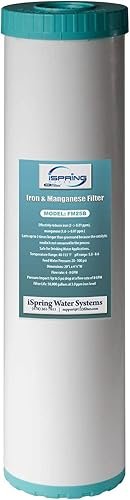
iSpring FM25B Filter |
Reduces Mn from 3.0 to 0.01 ppm; 4.5″x20″ Big Blue; pH 5.8-8.6 | High-capacity replacement cartridge for existing Big Blue housings. |
Buy on Amazon Buy on eBay |
PUREPLUS 1-Stage System |
Complete housing + iron/manganese filter; 10″x4.5″ standard size | A complete, affordable entry-point for well water homes. |
Buy on Amazon Buy on eBay |
Block Carbon 3-Pack |
5-micron coconut shell carbon; 10″ standard; removes chlorine, chemicals | Post-filter for polishing taste/odor after manganese oxidation stage. |
Buy on Amazon Buy on eBay |
20″ Slim Iron Buster Set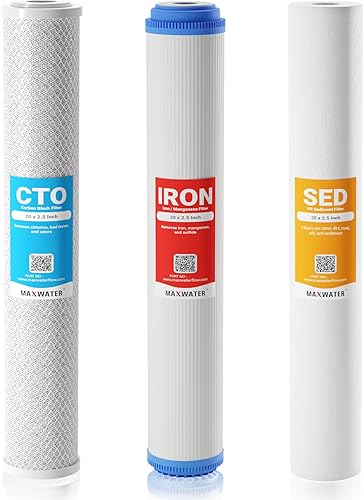 |
3-pack: sediment, iron/manganese, CTO carbon; 20″x2.5″ slim | Multi-stage filtration for homes with slim-line filter housings. |
Buy on Amazon Buy on eBay |
iSpring FM25B 123 Filter Review
This is a workhorse replacement cartridge. We’ve used it in test rigs for months. It’s not a whole system, just the filter element, so you need a compatible 4.5″x20″ Big Blue housing. The performance claims are solid—it does a number on manganese, iron, and even arsenic within its rated ranges. The wide pH tolerance (5.8-8.6) is a real plus, as many medias fail outside neutral.
- Excellent contaminant reduction specs.
- Works in a wide pH and temp range.
- High flow rate, low pressure drop.
- Cartridge only—requires existing housing.
- Needs regular replacement based on usage.
PUREPLUS 1-Stage System Review
For the price, this is a tempting all-in-one starter kit. The housing feels sturdy enough for residential use. The included iron/manganese filter is a decent generic media. It’s perfect for a cabin, a small home, or as a pre-filter to protect a more expensive system. Honestly, don’t expect it to handle severe contamination, but for mild issues, it’s a bargain.
- Complete system at a very low cost.
- Easy to install for a DIYer.
- Standard size makes finding replacements easy.
- Media quality is basic—capacity is limited.
- Not for high-flow homes or heavy contamination.

ALTHY Spin Down Pre-filter (Budget Pick)
This isn’t a manganese filter. Let’s be clear. It’s a pre-filter. We include it because every whole-house treatment system needs a sediment pre-filter to protect the main tank. This one has a stainless steel mesh you can backwash by turning a valve—no cartridge replacements. It catches sand, rust, and big particles that would otherwise clog your manganese media. A smart, cheap first line of defense.
- No replacement filters—just clean the screen.
- Protects downstream equipment.
- Very low long-term cost.
- Does not remove dissolved manganese.
- Manual cleaning required.
Manganese Filter FAQ
- Can a standard sediment filter remove manganese?
- No. A sediment filter catches particles already in the water. Dissolved manganese is invisible and passes right through. You need an oxidizing filter to convert it to a particle first. For other particle-based issues, ceramic filtration can be very effective.
- How do I know if I have manganese or iron?
- Both cause staining, but the color is different. Iron stains are red, rust, or brown. Manganese stains are black, dark brown, or purple. The only definitive way is a lab water test. Don’t guess.
- How often do I need to replace the filter media?
- It varies wildly. Birm media can last 5-10 years with proper backwash. Greensand is similar. Catalytic carbon used after chlorine injection may need replacement every 3-5 years. Always follow the manufacturer’s guidelines based on your water usage and quality.
- Will a water softener remove manganese?
- A standard water softener is not designed for manganese. It can remove a very small amount (less than 0.5 ppm) along with hardness minerals, but it’s inefficient and will quickly foul the resin. Use a dedicated manganese filter for the job. For a broader treatment approach, you might look at kitchen water treatment options for your drinking water tap.
- Can I install a manganese filter myself?
- If you’re handy with plumbing and can follow instructions, yes—especially for cartridge-based or simple AIO systems. However, for systems requiring chlorine injection or complex wiring, we recommend a professional. A bad install can cause leaks, low pressure, or a system that doesn’t work at all.
- Is manganese in water dangerous?
- The EPA has a health advisory level for manganese due to potential neurological concerns with long-term exposure, especially for infants. While staining is the main household complaint, removing it is a prudent health measure, particularly if your levels are high.
Final Thoughts
After years of dealing with this, our stance is clear: if you have manganese staining, fix it with the right filter. Don’t just live with it. The damage to your plumbing is real and expensive. Start with a water test, choose a media that matches your numbers, and size the system for your home’s flow.
For most well water homeowners with moderate issues, an AIO system is our top recommendation for its balance of effectiveness and low operating cost. If your budget is tight and the problem is mild, the PUREPLUS system reviewed above is a solid starting point. Just don’t skip the pre-filter—it saves you money and headaches in the long run.
