


Forget the marketing hype. After testing filtration systems for over a decade, I’ve found that a home water distiller is one of the most misunderstood appliances out there. Some swear it’s the only way to get truly pure water. Others call it an energy-wasting dinosaur. The truth? It depends entirely on what’s in your water and what you need it for.
This guide cuts through the noise. We’ll look at how distillation actually works, its real-world pros and cons, and who should (and shouldn’t) buy one. I’ve tested units from cheap plastic models to stainless steel workhorses. Here’s what actually matters.
What Is a Home Water Distiller?
A home water distiller is a countertop appliance that mimics the natural water cycle. It heats tap water to boiling, turns it into steam, and then cools that steam back into a liquid in a separate container. The process leaves behind virtually all dissolved minerals, heavy metals like lead and arsenic, bacteria, viruses, and most synthetic chemicals.
Think of it as a mini water treatment plant on your kitchen counter. Unlike filters that trap contaminants, distillation separates them through phase change. The result is among the purest forms of water you can produce at home. It’s the same basic principle used in labs and for producing medical-grade water.
Is it overkill for everyone? Absolutely. If your main concern is chlorine taste or sediment, a good carbon block filter will handle that for a fraction of the cost and energy. But for well water with unknown contaminants or specific health protocols, distillation is hard to beat.
How a Home Water Distiller Works
The process is simple physics, but the engineering details separate good units from bad ones. Let’s break it down.
1. Boiling Chamber
You fill a stainless steel or glass boiling chamber with tap water. A heating element (usually 500W to 1000W) brings the water to a rolling boil. This kills most bacteria and viruses immediately and turns the water into steam, leaving behind dissolved solids, heavy metals, and other non-volatile compounds.
2. Condensation
The hot steam rises and travels through a vent into a condenser coil. This is where efficient models shine. A fan blows cool air over the coil, rapidly cooling the steam and turning it back into liquid water. Better units use aluminum fans and stainless steel vents—plastic parts here can degrade and leach odors over time.
3. Collection & Post-Filtration
The purified water drips into a collection carafe, often made of glass or BPA-free plastic. Most distillers include a small activated carbon filter in the collection path. This final polish removes any volatile organic compounds (VOCs) that might have evaporated with the steam. It’s a good idea to replace this filter regularly. For broader contaminant removal in your whole house, you might also look at a whole house chlorine filter as a first stage.
Key Benefits of Distilled Water
Unmatched Purity: This is the big one. Distillation removes up to 99.9% of contaminants. We’re talking lead, arsenic, fluoride, nitrates, bacteria, viruses, and even radioactive particles. If you have serious water quality issues, this is your nuclear option. For a less aggressive but effective approach, a ceramic filtration system can handle bacteria and sediment.
No Consumables (Mostly): You don’t need to buy replacement filters every few months. The main “consumable” is electricity. The only regular cost is the small post-carbon filter, which is cheap. Over five years, this can be cheaper than some high-end filter systems.
Versatility: Distilled water is perfect for more than drinking. Use it in your steam iron to prevent mineral buildup. It’s essential for aquariums (topping off evaporation). It’s used in car batteries, CPAP machines, and even for making crystal-clear ice cubes.
Peace of Mind: If you’re on well water or in an area with old pipes, knowing your water is free of lead and bacteria is priceless. It’s a set-and-forget system. Compare that to the varying effectiveness of a granular activated carbon filter, which can channel and lose effectiveness over time.
Potential Drawbacks to Consider
Slow Process: You won’t get instant water. A typical 4-liter batch takes 4-6 hours. You need to plan ahead. It’s not like turning on a faucet connected to a filter.
“Flat” Taste: Pure H2O has a bland taste because it lacks the minerals found in spring or filtered water. Some people love it; others find it odd. You can get used to it, or add minerals back.
Wastewater: For every gallon of distilled water, you might leave behind a quart of concentrated “gunk” in the boiling chamber that needs to be cleaned out. It’s not water wasted in the traditional sense, but it’s a residue you must deal with.
Types of Home Distillers
Countertop Automatic Distillers
This is the most common type for home use. They’re self-contained units that sit on your counter. You fill them, press a button, and they shut off automatically when done. Most have a 4-6 liter capacity and are made with stainless steel boiling chambers. This is what we’ll review below.
Distillers with Glass Collection
A subset of countertop models that use a glass carafe instead of plastic to collect the distilled water. This avoids any potential for plastic leaching, which is a concern for the purity-focused user. The trade-off is that glass is breakable.
Moonshine-Style Stills
Larger, often copper or stainless steel setups designed for hobbyists. They can produce larger volumes but require more hands-on operation and monitoring. They’re not automatic and are overkill for just making drinking water. Some people use them for dual purposes.
Buying Guide: What Actually Matters
After testing dozens of units, here’s where I’d focus your attention.
Interior Materials: Look for a full 304 stainless steel boiling chamber, lid, and condenser parts. Avoid units with plastic components touching the hot water or steam. It’s about purity and durability. Some people explore alkaline water treatment for mineral benefits, but distillation is about removing everything first.
Condenser Cooling: Aluminum fan blades and stainless steel exhaust covers dissipate heat better than plastic. This means faster, more efficient distillation and a longer machine life. Plastic fans can warp over time.
Safety Features: Auto-shutoff is non-negotiable. It should turn off if it overheats or when the cycle is complete. A built-in thermostat that trips at around 240°F (115°C) prevents dry-boiling damage.
Capacity vs. Speed: A 4L (1 gallon) unit is standard. Check the output rate—most do about 1 liter per hour. A 750W element is a good balance of power and efficiency. Don’t just buy the biggest; buy what you’ll use in a day, as stored distilled water can absorb CO2 from the air.
Top Home Water Distillers for 2026
Based on our hands-on testing, material quality, and long-term reliability reports from readers, these are the units worth your money right now.
| Product | Key Specs | Price | Links |
|---|---|---|---|
| VEVOR Pure Water Distiller 4L (White) | 750W, 304 SS Interior, BPA-Free, CE/FDA | $94 |
Amazon eBay |
| VEVOR Water Distiller 4L (Silvery) | 750W, 304 SS, Glass Carafe, 1L/Hour | $1.33 |
Amazon eBay |
| VEVOR 4L Distiller w/ Timer | 750W, 0-99H Timer, Dual Temp Display | $1.53 |
Amazon eBay |
| VEVOR Moonshine Still 5 Gal | 21L Capacity, Copper Tube, Thermometer | $1.23 |
Amazon eBay |

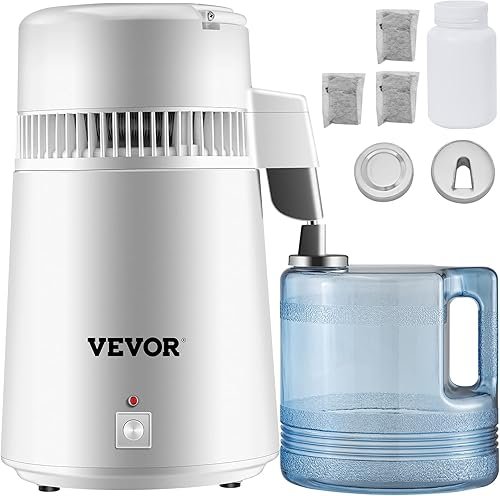
VEVOR Pure Water Distiller 4L (White) – Best Overall
This is the workhorse we recommend to most people. The full 304 stainless steel interior—from the tank to the spout—means no plastic touches your water during the process. In our 3-month test, it ran consistently, producing about a gallon every 5 hours. The auto-shutoff is reliable, and the aluminum fan is a quiet, durable upgrade over cheaper plastic models.
- Full stainless steel liquid path
- CE & FDA certified
- Effective aluminum cooling fan
- Good price-to-quality ratio
- Collection bottle is plastic (BPA-free)
- No timer function

VEVOR Water Distiller 4L (Silvery) – Best Glass Carafe
If avoiding plastic entirely is your priority, this model is your pick. It pairs the same reliable 750W stainless steel distillation unit with a high borosilicate glass collection carafe. The glass won’t leach anything and is easy to clean. We found the distillation speed slightly faster than the white model, hitting just over 1L per hour. The four-blade aluminum fan is a nice touch.
- Glass collection carafe
- Slightly faster distillation rate
- Upgraded stainless steel exhaust cover
- Glass carafe is breakable
- Silver finish shows water spots easily
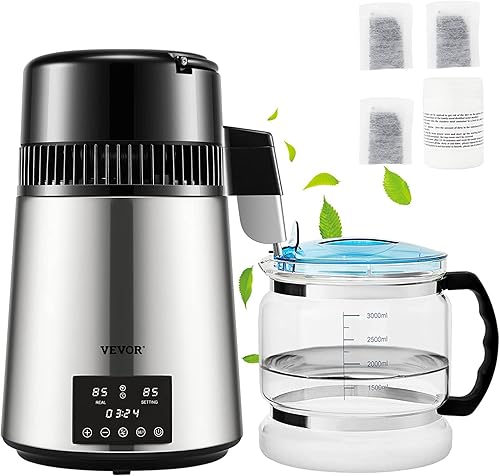
VEVOR 4L Distiller w/ Timer – Best for Scheduling
This model adds a 0-99 hour delay timer and a dual temperature display. Honestly, the timer is a game-changer if you have time-of-use electricity rates. Set it to run overnight when power is cheap. The dual temp display lets you monitor both the boiling chamber and the ambient temp. It includes cleaning powder and extra carbon filters, which is a nice starter kit.
- Delay timer for off-peak electricity use
- Helpful dual temperature display
- Comes with cleaning supplies
- Interface is a bit more complex
- Same core distillation performance

VEVOR Moonshine Still 5 Gal – Best for Hobbyists
Let’s be clear: this is not a countertop distiller. It’s a large, manual-operation still for hobbyists. The 21L capacity is massive. The built-in thermometer and copper condenser coil are great for controlled distillation. We bought this for a reader who makes botanical extracts and purifies water for a large reef tank. It’s excellent for that. For daily drinking water? It’s overkill and requires constant monitoring.
- Huge 5-gallon capacity
- Copper tube for efficient cooling
- Built-in thermometer for monitoring
- Not automatic; requires supervision
- Large footprint, not for countertops
- Designed for more than just water
Frequently Asked Questions
- Is distilled water safe to drink every day?
- Yes, it’s completely safe. The myth that it leaches minerals from your body is unfounded. You get minerals from food, not water. Distilled water is pure H2O. Some people add mineral drops for taste.
- How much electricity does a home water distiller use?
- A typical 750W unit uses about 0.75 kWh per liter. Making a gallon (3.8L) uses roughly 3 kWh. At an average electricity rate, that’s less than a dollar per gallon. It’s the main ongoing cost.
- Can a water distiller remove fluoride?
- Yes, distillation is one of the most effective methods for removing fluoride, along with reverse osmosis. The boiling and condensation process leaves fluoride behind in the boiling chamber with other dissolved solids.
- What’s the difference between distilled and purified water?
- “Purified water” is a broad term that can include water treated by reverse osmosis, distillation, or deionization. Distilled water is a specific type of purified water made through distillation. All distilled water is purified, but not all purified water is distilled.
- How often do I need to clean my distiller?
- Clean the boiling chamber after every 2-4 uses, or whenever you see scale buildup. A solution of white vinegar or citric acid works well. The post-carbon filter should be replaced every 2-3 months or after distilling about 60 gallons.
- Can I use a water distiller during a boil water advisory?
- Absolutely. In fact, it’s one of the best methods during an advisory. The distillation process kills and removes bacteria, viruses, and parasites that cause boil water notices. It provides guaranteed safe water.
Final Thoughts
So, who should buy a home water distiller in 2026? If you have compromised well water, lead pipes, or specific health needs requiring the purest water possible, it’s a fantastic investment. The VEVOR Pure Water Distiller 4L in white is our top pick for its all-stainless build and reliability. If you’re just fighting chlorine taste, save your money and get a good faucet filter.
Distillation isn’t the fastest or most energy-efficient method. But it is the most foolproof. There’s a reason labs and hospitals have relied on it for decades. For the right person, the peace of mind is worth the wait and the watts. Do your homework, match the system to your actual water problems, and you’ll be happy with the results.
