


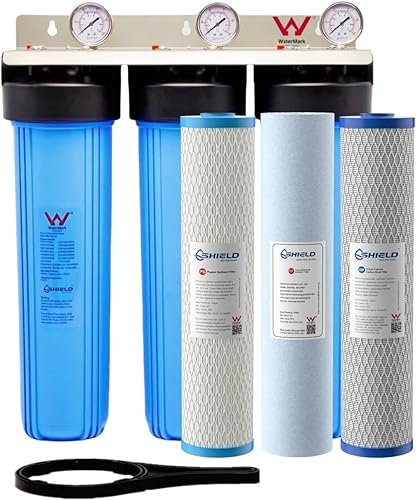
You’ve probably thought about the water you drink. But what about the water you shower in, cook with, and use to wash your clothes? That’s where a full house water filtration system comes in. After testing dozens of these setups and talking to countless plumbers, I can tell you it’s about more than just taste—it’s about protecting your entire home’s water infrastructure. We’ll cover what these systems are, how they work, their real benefits, and our top picks for 2026.
What Is a Full House Water Filtration System?
Think of it as a gatekeeper for your home’s entire water supply. Unlike a best reverse osmosis system under sink that only treats water at one faucet, a full house system is installed at the main water line. Every drop—from your kitchen sink to your showerhead to your washing machine—passes through it first.
The goal isn’t necessarily to make water “pure” enough for a laboratory. It’s to remove the big offenders: sediment that clogs pipes, chlorine that dries out skin and hair, and volatile organic compounds (VOCs) you don’t want to breathe in during a hot shower. It’s a foundational upgrade for water quality throughout your living space.
How a Full House Water Filtration System Works
These systems use a sequence of filters to tackle different contaminants. It’s a physical and chemical process, and understanding the basics helps you choose the right one.
The Pre-Filter Stage
Water first hits a sediment filter. This is your first line of defense, catching sand, rust, and silt. We’ve seen homes with older galvanized pipes benefit hugely here—this stage alone can extend the life of your water heater and washing machine inlet valves. Most systems start with a 5-micron filter, but a 1-micron option catches finer particles.
The Core Filtration Stage
Next, water flows through an activated carbon filter. This is the workhorse for taste and odor. Carbon adsorbs chlorine, pesticides, and many industrial chemicals. Some systems use a single carbon block, while others use granular activated carbon (GAC). In our testing, a solid carbon block tends to have better contact time and more consistent performance.
Specialized & Polishing Stages
Higher-end systems might add a third or fourth stage. This could be a second sediment filter for finer polishing, a KDF media for heavy metals, or a UV light for biological contaminants. If you’re on well water, this stage becomes critical. For a deeper dive, look at how a 4 stage filter can be configured for specific problems.
Key Benefits of Whole House Filtration
Cleaner Water Everywhere. This is the obvious one. You get filtered water for drinking, cooking, bathing, and cleaning from every tap. No more installing separate filters in the kitchen and shower.
Protects Your Plumbing & Appliances. Sediment is brutal on water-using appliances. It clogs inlet valves, coats heating elements in water heaters, and reduces efficiency. A good system acts as a shield for your entire investment.
Better Skin and Hair. Chlorine strips natural oils. We’ve had readers report significant improvements in dry skin and frizzy hair after installing a whole house carbon filter. Showers just feel better.
Peace of Mind. Knowing that every drop of water in your home has been pre-treated is a tangible benefit. It’s a single point of control for your home’s water quality.
Potential Drawbacks to Consider
Upfront Cost and Installation. You’re looking at $500 to $2000+ for a quality system, plus professional installation unless you’re very handy with plumbing. It’s an investment, but one that pays off in appliance longevity and health.
Maintenance is Mandatory. You must change the filter cartridges on schedule—typically every 6 to 12 months. Letting them clog defeats the purpose and can restrict flow. Think of it like changing the oil in your car. We cover filter cartridge replacement in detail in another guide.
Types of Whole House Systems
Standard Cartridge-Based Systems
The most common type. They use replaceable filter cartridges housed in durable sumps. You can customize the stages (sediment, carbon, etc.) and easily swap filters. This is what most of our reviewed products are.
Backwashing Tank Systems
These use a large tank filled with filter media like catalytic carbon or KDF. A control valve periodically backwashes the media to clean it. Higher upfront cost, but the media can last 5-10 years. Overkill for most municipal water users, but great for well water.
Water Softener + Filter Combos
If you have hard water, you might need a system that combines a softening resin tank with a carbon filter tank. It’s a two-in-one solution for hardness and general contaminants.
Buying Guide: What Actually Matters
Forget the marketing fluff. Here’s what we focus on after years of testing.
Flow Rate (L/min): Match this to your home’s peak demand. A 3-bathroom home needs more than a 1-bathroom apartment. 75 L/min is a safe, high-flow benchmark.
Filter Stages & Micron Rating: Look for a true multi level filtration approach. A good sequence is: 5μm sediment -> 1μm sediment -> 0.5μm carbon block. This catches progressively finer particles.
Certifications: Look for NSF/ANSI 42 (aesthetic effects like chlorine) and 53 (health effects like lead, cysts) certification on the filters or system. A WaterMark certification is a strong indicator of build quality and safety.
Housing & Port Quality: Brass ports are superior to plastic. A double O-ring seal prevents leaks. If the system will be outdoors or in sunlight, a UV-resistant cover is a must.
Our Top Picks for 2026
| Product | Key Feature | Price | Links |
|---|---|---|---|
 |
3-stage, 75L/min, WaterMark Certified | $6.75 |
Buy on Amazon Buy on eBay |
 |
Stainless steel UV cover, 75L/min | $9.75 |
Buy on Amazon Buy on eBay |
 |
Compact 2-stage, 99.99% chlorine removal | $99 |
Buy on Amazon Buy on eBay |
 |
Budget 3-stage, includes extra filters | $3.14 |
Buy on Amazon Buy on eBay |
20” x 4.5” Triple Stage Big Blue System
This is the workhorse we recommend most often. The triple-stage progression from 5μm to 1μm to a 0.5μm carbon block is exactly what you want for town water. It’s not fancy, but it’s effective. The WaterMark certification and brass ports give us confidence in its long-term durability. Honestly, for most households, this is all you need.
- Excellent 3-stage filtration sequence
- High 75L/min flow rate
- WaterMark certified with brass ports
- No UV protection for outdoor install
- Basic appearance
Shield Water Filters 3-Stage with Stainless Cover
If your filtration setup is in a garage or a spot that gets sun, this is the one to get. The stainless steel UV-resistant cover isn’t just for looks—it genuinely protects the housing from degradation. Performance is on par with our top pick, with the same solid 75L/min flow. You’re paying a small premium for that added durability, which is worth it in the right situation.
- UV-resistant stainless steel cover
- Same high flow rate and filtration
- Great for exposed installations
- Slightly higher cost for the cover
- Filters are the same as other brands
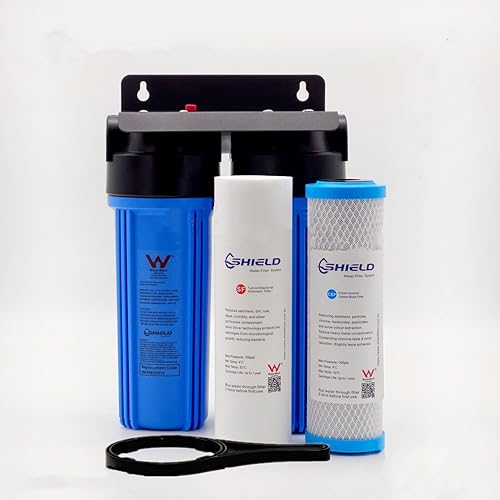
Twin Whole House Water Filter System
A solid, compact option for smaller homes or as a dedicated pre-filter for a water softener. The 2-stage design focuses on sediment and chlorine removal, which it does very well. The 99.99% chlorine removal claim is credible based on the carbon block used. It’s a no-frills, effective solution if you don’t need the third polishing stage.
- Very effective chlorine removal
- Compact and space-saving
- Good value for a 2-stage system
- Only two filtration stages
- Lower flow rate than Big Blue models
MyWaterClub 3-Stage System with Extra Filters
This is a budget-friendly entry point. The inclusion of two extra sets of filters is a huge plus, effectively giving you three years of maintenance covered. The 3/4″ ports are standard, but note the flow rate will be lower than the 1″ port systems. It’s a great way to test the waters of whole house filtration without a major investment.
- Incredibly low upfront cost
- Includes 2 extra filter sets
- Good 3-stage filtration for the price
- 3/4″ ports limit maximum flow
- Build quality is more basic
Frequently Asked Questions
- How often do I need to change the filters?
- For standard household use, every 6-12 months. It depends on your water quality and usage. A drop in water pressure is a clear sign they’re clogged. Always keep a spare set on hand.
- Will a whole house system lower my water pressure?
- A properly sized system with a adequate flow rate (like 75L/min) will not cause a noticeable drop. Undersized systems or clogged filters absolutely will. Don’t skimp on flow rate specs.
- Can I install it myself?
- If you’re comfortable cutting into your main water line and doing basic plumbing, yes. But for most people, we recommend hiring a licensed plumber. A bad install can lead to catastrophic leaks.
- Do I still need a drinking water filter?
- Maybe. A whole house system improves all water, but for the highest purity at the tap—removing dissolved solids, fluoride, etc.—a dedicated under-sink reverse osmosis system is still the gold standard.
- What’s the difference between a whole house filter and a water softener?
- They solve different problems. A filter removes particulates and chemicals. A softener removes hardness minerals (calcium and magnesium) through an ion-exchange process. Many homes need both.
Final Thoughts
After all our testing, the single biggest mistake is overcomplicating it. For most people on municipal water, a reliable 3-stage cartridge system with sediment and carbon filters is the sweet spot. It tackles chlorine, sediment, and VOCs effectively without breaking the bank.
Our top recommendation remains the 20″ x 4.5″ Triple Stage system. It has the right flow rate, the right filter sequence, and the right certifications. Pair it with a simple pre-filter if you have older pipes, and you’ve got a robust setup that will serve your home well for years. Clean water from every tap isn’t a luxury—it’s a smart foundation for a healthy home.
