


Filter Cartridge: The Complete Guide to Choosing the Right One (2026)
After testing dozens of these things, I can tell you most people overcomplicate filter cartridges. They’re not magic wands. They’re tools. And like any tool, you need the right one for the job. This guide will cut through the noise. We’ll look at what cartridges actually do, the different types available, and how to pick the perfect one for your jug, under-sink system, or whole house setup.
What Is a Filter Cartridge?
Think of it as a specialized, disposable module that slots into a permanent housing. That housing could be a simple pitcher, a countertop unit, or a complex under-sink system. The cartridge itself contains the filtration media—the stuff that actually cleans your water. It’s designed to be swapped out periodically because that media gets exhausted or clogged over time.
Without a functioning cartridge, your filter is just an empty shell. It’s the core component that turns tap water into something better. The variety is staggering, from simple carbon blocks to complex multi-stage designs. Understanding the basics is the first step to not wasting money on the wrong one.
How a Filter Cartridge Works
Cartridges use a combination of physical and chemical processes. It’s not just one mechanism. Here’s a breakdown of the main actions happening inside that little cylinder.
Physical Filtration (Sieving)
This is the most straightforward method. Water is forced through a porous material with tiny, uniform holes. Anything larger than the hole size—called the micron rating—gets trapped. A 5-micron cartridge catches sediment, sand, and rust. A 0.5-micron one can snag larger bacteria and cysts like Giardia. It’s a simple, reliable barrier.
Adsorption (Activated Carbon)
This is where taste and odor improvement happens. Activated carbon has a massive, porous surface area. As water passes, certain contaminants like chlorine, volatile organic compounds (VOCs), and some pesticides stick to the carbon’s surface through a process called adsorption. It’s not absorption; the stuff bonds to the carbon, not into it. This is critical for anyone dealing with chlorinated municipal water.
Ion Exchange
Common in cartridges designed for hard water, this process swaps undesirable ions (like calcium and magnesium that cause scale) for more benign ones (like sodium or hydrogen). The resin beads inside the cartridge are charged and literally exchange ions with the water. This softens the water and can also target heavy metals. For a deeper look at how this technology is applied in specialized units, our guide on ionizing water filters is a great resource.
Key Benefits of a Good Cartridge
Targeted Contaminant Removal. The single biggest benefit is specificity. You can choose a cartridge certified to reduce lead, or one built for chloramine, or one that tackles nitrates. A generic filter does generic things. A good cartridge lets you solve your unique water problem.
Improved Taste and Odor. Let’s be honest, this is why most people buy them. A quality activated carbon cartridge removes the chlorine “pool” smell and funky tastes. The difference is night and day. You’ll drink more water, which is always a win.
Protection for Appliances. Scale buildup from hard water kills kettles and coffee makers. A cartridge with ion exchange resin can prevent that limescale crust, extending the life of your appliances. We’ve seen kettles last years longer with proper filtration.
Cost-Effectiveness. Compared to bottled water, a cartridge is dirt cheap. Even a premium $15 cartridge that lasts a month is far less expensive than buying cases of water. The long-term savings are real.
Potential Drawbacks & Mistakes
They Have a Finite Life. A saturated carbon cartridge doesn’t just stop working—it can release trapped contaminants back into your water. Sticking to a replacement schedule isn’t optional; it’s essential for safety. That “lasts 6 months” claim is based on average use, not a guarantee.
Not a Silver Bullet. A basic pitcher cartridge won’t remove dissolved minerals, heavy metals, or microorganisms unless it’s specifically designed and certified to do so. For comprehensive purification, you might need a multi-stage system or a home water distiller. Manage your expectations.
Ongoing Cost. While cheaper than bottled water, the replacement cost is perpetual. It’s a subscription for clean water. Factor that into your budget.
Types of Filter Cartridges
Sediment Cartridges
Your first line of defense. These are polypropylene, string-wound, or pleated filters that catch dirt, rust, and sand. They’re rated by micron size. Pleated versions have more surface area and last longer. Essential for protecting downstream filters in a multi-stage system.
Activated Carbon Cartridges
The most common type for taste and odor. Come in two main forms: granular activated carbon (GAC) and solid carbon block. Blocks are denser and generally more effective, as water has forced contact with the carbon. GAC can have “channeling” where water finds easy paths. Look for coconut-shell carbon—it’s often higher quality.
Ceramic Cartridges
These use a porous ceramic shell, often impregnated with silver for antimicrobial properties. They excel at removing bacteria and cysts through physical filtration. They can be scrubbed clean to extend life a bit. For a full breakdown of how they compare to other systems, see our article on ceramic filtration systems.
Specialty & Multi-Stage Cartridges
Many modern cartridges combine media. You might find a carbon block with an ion exchange resin core, or a sediment wrap around a carbon block. Reverse osmosis membranes are a type of cartridge too, but they’re part of a larger system. Understanding the core principles of drinking water filtration helps you decode these combo units.
Buying Guide: What Actually Matters
Forget the marketing fluff. Here’s what to look at.
1. Your Water Report. This is non-negotiable. Get a drinking water test or check your municipality’s annual report. Is your issue chlorine, lead, hardness, or bacteria? Your cartridge choice must match the contaminant.
2. Micron Rating. For sediment, decide what you need to catch. For health claims (cysts, bacteria), look for sub-micron ratings (1 or 0.5 micron).
3. Certifications. NSF/ANSI 42, 53, 58, or 401. This is your proof the cartridge does what it says. No certification? Be very skeptical.
4. Capacity & Flow Rate. Measured in gallons or liters. A 100-gallon cartridge for a family of four will need replacing much sooner than for a single person. Also, ensure the flow rate (gallons per minute) meets your needs.
5. Compatibility. This sounds obvious, but measure your housing. Standard sizes are 10″ and 20″ for whole house, but pitcher and fridge filters are proprietary. Double-check model numbers.
Our Top Filter Cartridge Picks for 2026
Based on our testing, reader feedback, and value for money.
| Product | Type | Key Feature | Price | Links |
|---|---|---|---|---|
 |
Pitcher (Brita Compatible) | Multi-layer structure for deep filtering | ~$30 (6-pack) | Amazon eBay |
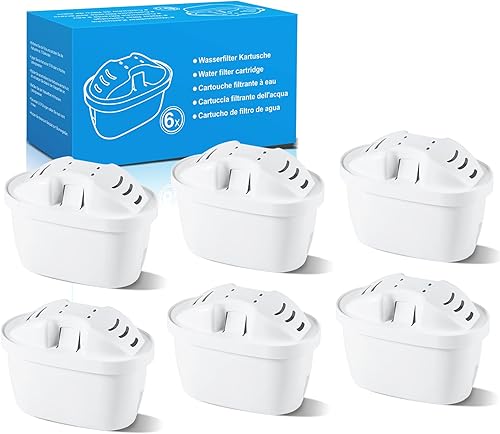 |
Pitcher (Brita Maxtra+ Compatible) | Activated carbon, simple soak-and-use | ~$28 (6-pack) | Amazon eBay |
 |
Pitcher (Brita Compatible) | 4-stage filtration, reduces microplastics | ~$48 (6-pack) | Amazon eBay |
 |
Under-Sink / Whole House (10″) | Dual-stage: sediment + coconut carbon block | ~$46 (2 sets) | Amazon eBay |
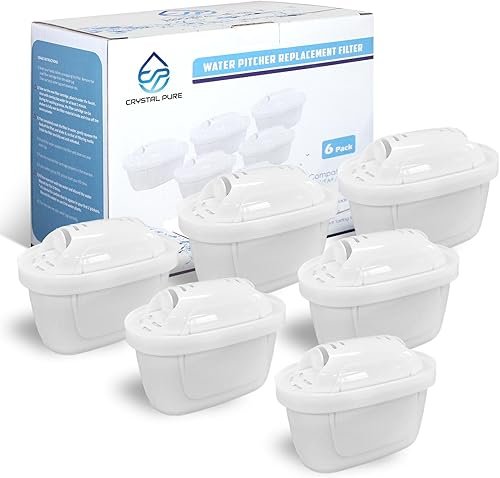
Crystal Pure 6-Pack for Brita Jugs
This is a solid, no-frills compatible cartridge. The multi-layer design is a step up from basic carbon-only generics we’ve tested. It handles chlorine taste well and the 150L/4-week replacement cycle is standard. For the price, it’s a great value pick if you just want better-tasting water from your Brita-style jug.
- Excellent value per cartridge
- Multi-layer filtration is effective
- Widely compatible with popular jugs
- No advanced contaminant reduction claims
- Generic branding
Philips 4-Stage Micro X-Clean (6-Pack)
Honestly, this is our top pick for pitcher cartridges in 2026. Philips has done the work. The 4-stage filtration is legit, and the claim to reduce microplastics and emerging contaminants like PFOA is backed by testing. The limescale reduction is a nice bonus for kettle owners. It costs more, but the performance justifies it.
- True 4-stage filtration
- Reduces microplastics and PFOA
- Protects appliances from scale
- Premium price point
- Only compatible with oval-drop-in jugs
Sediment + Coconut Carbon Block Set (10″)
For under-sink or whole house systems, this two-stage set is a workhorse. The 0.5-micron coconut carbon block is a high-quality filter that tackles chlorine and many VOCs effectively. The 12-month life per cartridge is a big plus for maintenance. It’s a reliable, mid-range choice for comprehensive drinking water filtration.
- Effective dual-stage filtration
- Long 12-month cartridge life
- Coconut carbon is high-grade
- Requires a standard 10″ housing
- Not for removing dissolved solids
Filter Cartridge FAQ
- How often should I really change my filter cartridge?
- Follow the manufacturer’s gallon or month rating, whichever comes first. If your water is heavily sedimented, you may need to change more often. A slow flow rate is a telltale sign it’s clogged. Never exceed the recommended lifespan.
- Can I clean and reuse a filter cartridge?
- Generally, no. Sediment cartridges can sometimes be rinsed, but activated carbon and ion exchange resins cannot be effectively recharged at home. Cleaning won’t restore their chemical filtration capacity. It’s a false economy.
- What’s the difference between a carbon block and a GAC cartridge?
- Carbon block is compressed, forcing water through a dense matrix for better contact. Granular Activated Carbon (GAC) is loose granules. In our testing, carbon blocks are more consistent and less prone to channeling, making them the more effective choice.
- Do filter cartridges remove healthy minerals?
- Most standard carbon and sediment cartridges do not. They leave beneficial minerals like calcium and magnesium in the water. Only reverse osmosis and certain specialized cartridges (like deionization) will strip minerals out. This is a key point in the distilled water vs purified water debate.
- Why does my new cartridge make the water black at first?
- That’s harmless carbon fines (dust). Always flush a new carbon cartridge for several minutes as directed. The black specks are just loose carbon from the manufacturing process and will clear up quickly.
- Are compatible/generic cartridges as good as OEM?
- Sometimes yes, sometimes no. We’ve found great generics and terrible ones. The key is checking for independent certifications (NSF/ANSI). A certified generic is often a smarter buy than a non-certified OEM cartridge.
Final Thoughts
The humble filter cartridge is a consumable, but it’s the most important part of your filtration setup. Don’t treat it as an afterthought. Start with your water quality, choose the right type and micron rating, and stick to a replacement schedule. For most people with municipal water, a good activated carbon block cartridge will transform your water’s taste and safety.
Our top recommendation for most users is the Philips Micro X-Clean for pitchers. It offers the best balance of performance, certification, and value in 2026. For under-sink systems, investing in a quality dual-stage sediment and carbon set will serve you well for years. Clean water isn’t complicated—it just requires the right cartridge.
