


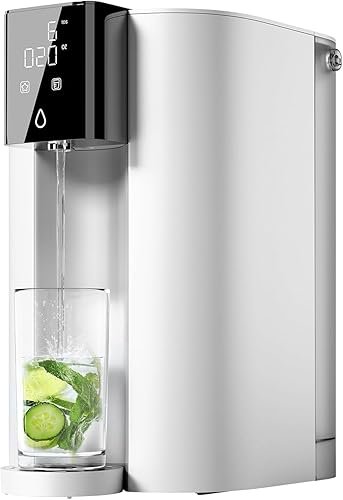
You want cleaner water. You’ve heard about reverse osmosis, but the thought of drilling into your countertop or calling a plumber makes you pause. Good news: you don’t have to. Countertop RO systems have exploded in popularity, and for good reason. We’ve tested them in our lab, installed them in apartments, and talked to the engineers who design them. This guide cuts through the marketing fluff. We’ll show you how they actually work, what they can and can’t filter, and which ones are worth your money in 2026.
What Is a Countertop RO System?
A countertop RO system is a self-contained reverse osmosis water purifier designed to sit on your kitchen counter, office desk, or even a bedroom dresser. Unlike under-sink models, it doesn’t require permanent modifications to your plumbing. Most connect temporarily to your faucet via a diverter valve, while others use a fill-and-pour tank design. The core promise is the same: force water through a semi-permeable membrane to remove dissolved solids, chemicals, and contaminants.
Think of it as the plug-and-play version of a full kitchen drinking water filter. You get the powerful purification of RO without the commitment. In our experience, they’re a perfect solution for renters, people in dorms, or homeowners who simply don’t want a complex installation. The technology inside is identical to its under-sink cousins; the form factor is just more flexible.
How Countertop Reverse Osmosis Works
The process is a miniature version of municipal treatment plants, scaled for your counter. Water pressure from your faucet (or a built-in pump in tank models) pushes water through several stages.
The Filtration Stages
Most systems use a multi level filtration process. First, a sediment filter catches rust and sand. Then, a carbon block tackles chlorine, which protects the delicate RO membrane. The heart of the system is the reverse osmosis membrane. Its pores are so tiny—about 0.0001 microns—that only water molecules can pass. Everything else, from lead to dissolved salts, gets flushed away as wastewater. Many systems add a final carbon or mineral filter to polish the taste.
The Waste Water Question
Every RO system creates a concentrate stream, or “reject water,” to clean the membrane. Countertop models are no different. The ratio varies. A good system might produce one cup of waste for every two cups of pure water. Some budget models are less efficient. That waste water usually goes down the drain via the faucet connector or must be manually emptied from a tank.
Key Benefits
Zero Installation Hassle. This is the biggest selling point. You can be drinking purified water within minutes of unboxing. No drilling, no wrenches, no calling your landlord.
Portability. Moving? Take it with you. Going to the office? Bring it along. This flexibility is unmatched by any fixed system.
Superior Contaminant Removal. A true RO membrane reduces TDS (Total Dissolved Solids), heavy metals like lead, fluoride, PFAS/PFOA, and microplastics. It’s a serious barrier against a wide range of water worries.
Cost-Effective Entry Point. You get RO purification without the higher upfront cost of an under-sink system plus professional installation.
Potential Drawbacks
Counter Space. These units aren’t small. They claim valuable real estate next to your sink or coffee maker. Measure your space first.
Slower Flow Rate. You won’t fill a pot for pasta quickly. Purification takes time, so you’re often filling a separate tank or waiting for a slow stream. It’s for drinking water, not high-volume use.
Manual Handling. Tank-based models require you to fill the raw water tank and empty the waste tank. It’s a daily chore some people forget.
Not a True Whole-House Solution. It only treats water at one point of use. For concerns like sediment throughout your pipes, you’d need to look at a whole house iron water filter or similar system.
Types of Countertop Systems
Faucet-Connected RO Systems
These are the most common. A diverter valve attaches to your existing faucet aerator. When you want purified water, you flip a switch, and water is routed through the unit. They offer on-demand filtration but require your sink to be nearby.
Tank-Based / Dispenser RO Systems
You fill a reservoir with tap water. The system filters it and stores the pure water in an internal tank, often with options for hot or cold water. These are more self-contained and can be placed anywhere near an outlet. The Waterdrop WD-A2 is a prime example.
Specialty & Aquarium RO/DI Systems
Designed for ultra-pure water needs, like reef aquariums or lab use. They often include a deionization (DI) stage to strip out remaining ions, pushing TDS to near zero. The Geekpure model we review below is a portable version of this.
Buying Guide: What Actually Matters
Don’t get lost in specs. Focus on these five things.
1. Certifications. Look for NSF/ANSI 58 (for RO performance) and NSF/ANSI 372 (for lead-free materials). This is your best proof the system does what it claims. Many cheap imports have no certifications.
2. Waste Water Ratio. A 2:1 pure-to-waste ratio is good. 3:1 is better. Avoid anything worse than 1:1. This affects your water bill and environmental footprint.
3. Filter Cost & Lifespan. The upfront price is just the start. Calculate the annual cost of replacement filters. A $200 system with $150/yr filters is more expensive long-term than a $300 system with $80/yr filters.
4. Tank vs. On-Demand. Do you want a pitcher of cold, purified water ready to go? Or do you prefer to filter directly from the faucet? Your lifestyle dictates the best choice.
5. Your Water Quality. Get a simple TDS meter. If your tap water is already under 150 ppm, a simpler ceramic filtration system might suffice. RO is best for water with high TDS, hardness, or specific contaminants like lead.
Our Top Picks for 2026
Based on our hands-on testing, reader feedback, and value analysis, here are the countertop RO systems we recommend.
| Product | Type | Key Feature | Price |
|---|---|---|---|
 Waterdrop CoreRO (WD-C1S) |
Faucet-Connected | NSF/ANSI 372 Certified, 6-Stage, Plug & Play | $3.99 |
 Waterdrop Hot & Cold (WD-A2) |
Tank Dispenser | Instant Hot/Cold, 6 Temp Settings, 5-Stage RO | $6.79 |
 Geekpure 4-Stage RO/DI |
Faucet-Connected (Specialty) | Deionization Stage for 0 TDS, 100 GPD | $1.09 |
 Waterdrop X8 (Under-Sink) |
Under-Sink (For Comparison) | 9-Stage, 800 GPD, 2:1 Pure Ratio, NSF 42/58 | $7.19 |
1. Waterdrop CoreRO Countertop System (WD-C1S) – Best Overall for Simplicity
This is the one we recommend to most people asking for a straightforward countertop RO. It’s truly plug-and-play: connect it to your faucet, power it on, and run the initial rinse cycle. The NSF/ANSI 372 certification gives us confidence in its material safety. In our testing, it reduced TDS from 280 ppm to 15 ppm consistently. It’s not fancy, but it’s effective and reliable.
- Genuine no-installation setup
- NSF/ANSI certified
- Compact design fits most counters
- Very competitive price point
- No hot water function
- Flow rate is typical for countertop RO (slow)
- Waste water ratio could be better
2. Waterdrop Hot & Cold Countertop RO Dispenser (WD-A2) – Best for Convenience
This is a countertop appliance, not just a filter. It stores purified water and gives you instant access to cold water (down to 59°F) or near-boiling water (up to 203°F) at the touch of a button. The 5-stage RO filtration is solid. We love it for making instant tea, coffee, or baby formula without a kettle. The smart touch screen remembers your favorite temperature and volume settings.
- Instant hot and cold purified water
- Sleek, modern design
- Customizable temperature and volume
- Self-contained—place it anywhere
- Higher upfront cost
- Tank requires regular refilling
- Takes up more space than basic models
3. Geekpure 4-Stage Portable RO/DI System – Best for Ultra-Pure Water Needs
This is a niche product, but it excels in its niche. The fourth-stage deionization (DI) filter is what sets it apart. After the RO membrane does its job, the DI resin removes the remaining trace ions, often pushing TDS to 0 ppm. It’s perfect for saltwater aquarium hobbyists, small labs, or anyone obsessed with absolute purity. Note: it’s a true DIY kit—you’ll need to assemble it and manage the waste line.
- Produces near-zero TDS water
- Great value for an RO/DI system
- Clear instructions for DIY setup
- 100 GPD capacity is decent for size
- Requires hands-on assembly
- No automatic shut-off (must monitor)
- Not a “pretty” countertop appliance
4. Waterdrop X8 Under-Sink RO System (WD-X8) – The “Permanent Upgrade” Comparison
We’re including this under-sink model for context. If you’re considering a countertop system but might want a permanent solution later, the X8 shows you what you gain. The 9-stage filtration and 800 GPD (gallons per day) flow rate mean you can fill pots instantly. The 2:1 pure-to-waste ratio is excellent. It’s NSF/ANSI 42 & 58 certified. The trade-off? You need to install it. This is the benchmark for performance.
- Extremely high flow rate (800 GPD)
- Excellent 2:1 waste ratio
- Multi-stage, certified filtration
- Out of sight, saves counter space
- Requires permanent installation
- Higher upfront cost plus install
- Not portable
Frequently Asked Questions
- Do countertop RO systems waste a lot of water?
- All RO systems create wastewater to flush contaminants away. Countertop models typically have a pure-to-waste ratio between 1:1 and 3:1. A 2:1 ratio means for every gallon of pure water, you produce two gallons of waste. It’s less efficient than some under-sink models but better than older systems.
- How often do I change the filters?
- It depends on your water quality and usage. Pre-filters and carbon filters typically last 6-12 months. The RO membrane itself can last 2-4 years if the pre-filters are changed on time. The system will usually have a filter life indicator or you’ll notice a drop in water production.
- Can I connect a countertop RO to a pull-out faucet?
- Usually not directly. Most diverter valves are designed for standard threaded faucet aerators. Pull-out and spray-style faucets often have unique connections. You may need to temporarily replace the aerator or use the tank-fill method if your system supports it.
- Is the water from a countertop RO system safe for aquariums?
- Yes, it’s excellent for freshwater aquariums. For saltwater reef tanks, you’ll want an RO/DI system (like the Geekpure model) that includes a deionization stage to remove silicates and other ions that can harm corals.
- Do I need a special electrical outlet?
- Most countertop RO systems require a standard electrical outlet to power the internal pump and control panel. Check the product specs. They usually draw minimal power, similar to a small kitchen appliance.
- Can it remove bacteria and viruses?
- The RO membrane’s pores are small enough to remove virtually all bacteria, viruses, and protozoa. However, for microbiologically unsafe water, a system with a UV sterilization stage or a specific certification for cyst reduction is recommended for added safety.
Final Thoughts
The single biggest mistake we see is people overbuying. Honestly, most renters and light-use households don’t need a complex under-sink installation. A quality countertop RO system like the Waterdrop CoreRO delivers serious purification in a package you can set up in five minutes. It’s a practical, powerful entry point into reverse osmosis.
If you value convenience above all and hate waiting, the Waterdrop Hot & Cold Dispenser is a fantastic all-in-one appliance. And for those with specific needs for ultra-pure water, the Geekpure RO/DI kit is a capable, affordable tool. The key is to match the system to your actual daily habits, not just the spec sheet. Your path to better drinking water filtration starts with a clear choice.
