


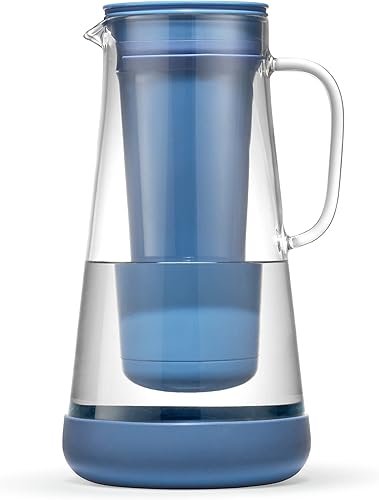
LifeStraw vs Clearly Filtered: The Ultimate Water Pitcher Comparison (2025)
Updated March 2025 — by the OsmosisInfo Editorial Team
Table of Contents
At a Glance: The Two Pitchers

LifeStraw Home 7-Cup Best for Pathogens

Clearly Filtered Pitcher Most Contaminants Removed
LifeStraw — Contaminants Removed
Clearly Filtered — Contaminants Removed
LifeStraw — Filter Life
Clearly Filtered — Filter Life
Filtration Performance
This is where the two pitchers diverge most dramatically, and understanding those differences will determine which one is right for your situation.
LifeStraw Home: The Pathogen Specialist
LifeStraw’s pitcher uses a two-stage system. Stage one is a hollow-fibre membrane microfilter with a 0.2-micron pore size — the same technology LifeStraw pioneered in its iconic personal straws. This stage removes:
- 99.9999% of bacteria (including E. coli, salmonella)
- 99.999% of parasites (including Giardia, Cryptosporidium)
- 99.999% of microplastics
Stage two is an activated carbon + ion exchange filter that addresses chemical contamination: PFAS reduction exceeds 99%, lead and mercury are significantly reduced, and chlorine taste and odour are eliminated. In total, the LifeStraw Home targets 30+ contaminants.
For households on municipal tap water where biological contamination isn’t a primary concern, stage two does most of the practical heavy lifting. But for anyone on a private well or in regions with known pathogen risks, LifeStraw’s membrane filter is genuinely best-in-class.
Clearly Filtered: The Chemical Contaminant Champion
Clearly Filtered uses its proprietary Affinity Filtration Technology, which combines activated carbon, ion exchange, and a ceramic barrier into a single multi-layer filter. This allows it to target an extraordinary 365+ contaminants — the most of any pitcher tested by major independent labs.
Notable removals include:
- Fluoride (up to 99.5%) — not removed by most pitchers including LifeStraw
- PFAS / PFOA / PFOS — exceeds 99% removal
- Lead — exceeds 99.5% removal
- Arsenic (over 99%)
- Nitrates / Nitrites — important for households with well water or agricultural runoff
- Pharmaceuticals and hormones
- THMs (trihalomethanes) — disinfection byproducts from chlorination
- Chromium-6
- Microplastics
The key distinction: Clearly Filtered removes fluoride and nitrates, two contaminants that LifeStraw does not address. If you’re concerned about these — or if you’re on well water with agricultural runoff, live in an older area with lead pipes, or simply want the most comprehensive chemical filter available in a countertop pitcher — Clearly Filtered is in a league of its own.
Filter Life & Cost to Run
| Cost Factor | LifeStraw Home | Clearly Filtered |
|---|---|---|
| Pitcher price | ~AU $85–$130 | ~AU $120–$160 |
| Membrane filter life | 264 gallons (~1 year) | N/A |
| Carbon/Affinity filter life | 40 gallons (~2 months) | 100 gallons (~4 months) |
| Replacement filter cost (single) | ~AU $30–$45 (carbon only) ~AU $50–$60 (combo pack) |
~AU $45–$65 |
| Estimated annual filter spend | ~AU $90–$135 | ~AU $135–$195 |
| Cost per gallon filtered | ~AU $0.18–$0.25 | ~AU $0.20–$0.28 |
The LifeStraw is cheaper to buy and cheaper to run annually. The carbon filter needs replacing every 40 gallons — roughly every 2 months for a family — while the membrane microfilter lasts the full year. Clearly Filtered’s single filter lasts 100 gallons (about 4 months), but replacement cartridges cost more. Over a full year, Clearly Filtered runs about AU $50–$60 more expensive to operate.
🛒 Shop LifeStraw Home Pitcher — Australia
🛒 Shop Clearly Filtered Pitcher — Australia
Design, Capacity & Usability
| Feature | LifeStraw Home | Clearly Filtered |
|---|---|---|
| Capacity | 7-cup (1.65L) or 10-cup (2.4L) | 10-cup (2.4L) |
| Material | BPA-free plastic or glass | BPA/BPS-free plastic |
| Height | ~33cm (large; may not fit some fridge shelves) | ~27cm (compact; fits standard fridges) |
| Filtration speed | Fast (~10–12 min to fill) | Slow (~20–30 min to fill) |
| Fill lid design | Easy flip-top; handle positioned near top | Standard fill lid; easy grip handle |
| Filter indicator | Yes (electronic filter-life indicator) | Manual tracking required |
| Colours available | Multiple (Midnight Blue, Seafoam, White, Glass) | Clear/white only |
| Fridge door fit | Difficult (too tall for many fridge doors) | Fits most standard fridge door shelves |
One notable ergonomic issue with the LifeStraw Home 7-cup: it stands nearly 33 centimetres tall, making it the largest pitcher we’ve tested. This can make it awkward to pour when full — the handle sits very close to the top, often requiring two hands. The Clearly Filtered, while similarly sized in capacity, has a more conventional shape that handles more naturally.
On the plus side, LifeStraw’s electronic filter-life indicator takes the guesswork out of replacement timing. Clearly Filtered requires you to track gallons manually (or count months), which many users find inconvenient.
Pros & Cons of Each
LifeStraw Home
✅ Pros
- Best-in-class biological protection (bacteria, parasites)
- Faster filtration speed
- Lower purchase price
- Lower annual running cost
- Electronic filter-life indicator
- Available in glass or plastic
- Multiple colour options
- Reduces PFAS by over 99%
❌ Cons
- Does NOT remove fluoride
- Does NOT remove nitrates or arsenic
- Carbon filter needs replacing every ~2 months
- Very tall — difficult to fit in many fridges
- Awkward to pour when full
- Targets only 30+ contaminants vs 365+
Clearly Filtered
✅ Pros
- Removes 365+ contaminants — most of any pitcher
- Removes fluoride (up to 99.5%)
- Removes arsenic, nitrates, pharmaceuticals
- Longer filter life (100 gallons per cartridge)
- BPA and BPS free plastic
- Fits standard fridge door shelves
- NSF/ANSI tested & certified
❌ Cons
- Higher upfront purchase price
- Higher annual filter running cost
- Slow filtration speed (20–30 min)
- No filter-life indicator
- Limited colour options
- Does NOT remove biological pathogens like bacteria
Head-to-Head Ratings
Who Wins Each Category?
| Category | LifeStraw | Clearly Filtered |
|---|---|---|
| Biological pathogens | 🏆 LifeStraw wins | ❌ Not effective |
| Total contaminants removed | 30+ | 🏆 Clearly Filtered wins (365+) |
| Fluoride removal | ❌ Not removed | 🏆 Clearly Filtered wins (99.5%) |
| PFAS removal | Tie (both >99%) | Tie (both >99%) |
| Lead removal | Good | 🏆 Clearly Filtered wins (99.5%) |
| Filtration speed | 🏆 LifeStraw wins | Slower |
| Filter life (main filter) | 🏆 LifeStraw wins (264 gal membrane) | 100 gal |
| Annual running cost | 🏆 LifeStraw wins (lower) | Higher |
| Fridge fit | Often too tall | 🏆 Clearly Filtered wins |
| Filter-life indicator | 🏆 LifeStraw wins (electronic) | Manual only |
| Purchase price | 🏆 LifeStraw wins | Higher |
| Nitrate/arsenic removal | ❌ Not removed | 🏆 Clearly Filtered wins |
Where to Buy in Australia
LifeStraw Home Pitcher — AU Stores
LifeStraw Home 7-Cup Glass Pitcher
Clearly Filtered Pitcher — AU Stores
Clearly Filtered Water Filter Pitcher
Frequently Asked Questions
Does LifeStraw remove fluoride?
No. LifeStraw’s activated carbon + ion exchange filter does not remove fluoride from tap water. If fluoride removal is a priority for you — whether due to personal health preferences or concerns about naturally high fluoride in your local water supply — Clearly Filtered is the better choice, removing up to 99.5% of fluoride.
Can Clearly Filtered remove bacteria and viruses?
Clearly Filtered’s pitcher filter is not designed or certified for biological pathogen removal. Its Affinity Filtration Technology excels at chemical contaminant removal, but for bacteria and parasites, LifeStraw’s hollow-fibre membrane is far superior. If you’re filling your pitcher from a well or a potentially compromised source, LifeStraw is the safer choice.
Which pitcher is better for Australian tap water?
Most Australian metropolitan tap water is biologically safe and chlorinated, which means the main concerns are typically chlorine taste, PFAS, and heavy metals from older pipes. For the majority of Australian city dwellers, both pitchers handle chlorine and PFAS effectively. However, if you’re in an older home with lead solder plumbing, or on rural tank/bore water, Clearly Filtered’s broader contaminant coverage (especially for lead, arsenic, and nitrates) makes it the better choice. LifeStraw is particularly suited to anyone who wants pathogen backup protection alongside chemical filtration.
Are the filters available in Australia?
Yes — replacement filters for both brands are available via Amazon AU and eBay AU. LifeStraw’s carbon filters are more widely stocked due to the brand’s global popularity. Clearly Filtered filters can sometimes take longer to ship, so it’s worth buying 2–3 ahead to avoid running out.
How often do I need to replace filters?
For LifeStraw, the carbon filter needs replacing approximately every 40 gallons (~150 litres), which is about every 6–8 weeks for a family of 4. The membrane microfilter lasts 264 gallons (~1,000 litres) — approximately 12 months. For Clearly Filtered, the single filter lasts 100 gallons (~380 litres) — roughly every 3–4 months for a typical household.
Which pitcher has better taste?
Most users report both pitchers significantly improve taste by removing chlorine and chloramine. LifeStraw’s filtration is faster, so you spend less time waiting for clean water. Clearly Filtered water is often described as “purer” tasting — likely because it removes more total dissolved contaminants — but the difference is subtle for most people on standard chlorinated tap water.
Final Verdict
Our Recommendation
Choose Clearly Filtered if: you want the most comprehensive chemical filtration available in a pitcher, particularly if you want fluoride removal, are on well water with nitrates or arsenic, live in an older home with lead pipes, or are particularly concerned about PFAS and pharmaceutical contamination. It’s the most thorough pitcher filter money can buy.
Choose LifeStraw if: you want faster filtration, prefer a lower upfront and running cost, need biological pathogen protection (well water, travel, or uncertain water sources), or want the peace of mind of knowing your pitcher removes bacteria and parasites on top of chemical contaminants. The electronic filter indicator is a genuine convenience advantage.
For most Australian households on treated municipal water, either pitcher will deliver noticeably cleaner, better-tasting water. The choice comes down to whether you prioritise chemical depth (Clearly Filtered) or biological safety + speed + value (LifeStraw).
| Overall Winner | Clearly Filtered for raw filtration breadth |
| Best Value | LifeStraw Home |
| Best for Pathogen Safety | LifeStraw Home |
| Best for Fluoride/Chemical | Clearly Filtered |
Final Buy Links — Australia
Affiliate Disclosure: OsmosisInfo participates in affiliate advertising programs including Amazon Associates and eBay Partner Network. When you click our links and make a purchase, we may earn a small commission at no extra cost to you. This helps us keep our reviews free and independent. All opinions are our own.
