


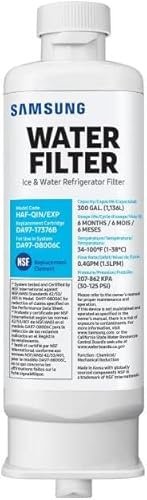
So your Samsung fridge is blinking that filter light again. Or maybe the water flow has slowed to a trickle. Changing the filter is one of those simple maintenance tasks that pays off immediately with better-tasting water and ice. I’ve replaced dozens of these over the years, and I’ll walk you through the exact process, which filters to trust, and the common mistakes to avoid.
- The step-by-step, no-tools-required replacement process
- How to find the right filter model for your specific Samsung fridge
- A comparison of genuine Samsung vs. compatible third-party filters
- Pro tips to avoid leaks and get the best performance
What Is a Samsung Refrigerator Water Filter?
It’s a small, cylindrical cartridge filled with activated carbon block. Its job is to polish the water coming into your fridge for the dispenser and ice maker. Most Samsung filters are certified to NSF/ANSI Standards 42 and 53, meaning they reduce chlorine taste and odor, plus specific health contaminants like lead, mercury, and certain pesticides.
Think of it as a dedicated, last-line-of-defense point of use purifier right where you drink. While a whole-house system tackles sediment and chlorine at the main line, this filter handles the finer polishing at the tap. The standard lifespan is six months, though this depends on your water quality and usage.
The two main filter shapes you’ll see are the “twist-in” style (like the HAF-QIN) for newer French door models, and the “push-in” style (like the HAF-CIN) for older side-by-side and some top-freezer models. Getting the right form factor is step one.
How to Change the Filter: Step-by-Step
This is the easy part. I’ve timed myself; it takes under five minutes once you know where to look.
1. Locate Your Filter
Open your refrigerator door. For most Samsung French door models, you’ll find the filter in the upper right-hand corner of the fresh food compartment. On many side-by-side models, it’s in the base grille at the bottom front. Check your manual if you’re unsure.
2. Remove the Old Filter
For the twist-in type: Grip the filter and turn it a quarter-turn (about 90 degrees) counterclockwise. You’ll feel it release. Pull it straight out. Have a towel handy—some water will drip out.
For the push-in type: Press the release button next to the filter (if present) and pull the old cartridge straight out.
3. Prepare the New Filter
Take the new filter out of its packaging. Remove the protective cap from the O-rings. Do not touch the O-rings themselves—oils from your skin can cause a poor seal and future leaks.
4. Install the New Filter
For twist-in: Align the new filter with the housing. Push it in firmly and turn it clockwise a quarter-turn until it locks into place. You’ll feel a solid stop.
For push-in: Simply push the new filter in until it clicks.
5. Reset the Filter Indicator
Hold down the “Ice Off” or “Alarm” button (check your manual) for 3-5 seconds until the light turns off or resets to green. This is a crucial step people forget.
Key Benefits of Changing Your Filter
Better Taste and Odor: This is the immediate payoff. A fresh filter removes the chlorine taste that makes tap water, well, taste like tap water. Your ice cubes will be clearer, too.
Healthier Water: A spent filter can’t reduce contaminants like lead or cysts. Changing it on schedule maintains that NSF/ANSI 53 certification performance you paid for. It’s cheap insurance.
Protects Your Appliance: A clogged filter forces the water inlet valve to work harder, potentially leading to failure or even leaks. Regular changes are part of smart fridge ownership.
Maintains Flow Rate: If your water dispenser has slowed down, a new filter is almost always the fix. It’s the most common symptom of an overdue change.
Potential Drawbacks & Mistakes
Forgetting to Reset the Light: Your fridge’s timer is just that—a timer. It doesn’t measure filter capacity. If you don’t reset it, you’ll get a “change filter” reminder long before the next six months are up, which is confusing.
Overtightening: This is a real problem. Cranking the filter housing too hard can crack the plastic or damage the O-ring, leading to a slow, sneaky leak behind your food drawers. Hand-tight plus a quarter-turn is plenty.
Buying the Wrong Filter: Samsung has used several filter styles over the years. A filter that looks similar might not seat properly. Always match the model number printed on your old filter.
Types of Samsung-Compatible Filters
Genuine OEM Filters
These are made by Samsung. You’re paying for guaranteed compatibility, the exact filtration media, and the peace of mind that it won’t void your warranty. The HAF-QIN/EXP is the current standard for most new models.
Third-Party Compatible Filters
Brands like Waterdrop, Tier1, and others make filters designed to fit Samsung housings. They’re often significantly cheaper. The key is to look for independent NSF/ANSI certification testing—not just a “tested to NSF standards” claim on the box. A good third-party filter can perform just as well as OEM.
Choosing between them often comes down to budget and peace of mind. For critical health contaminant reduction, I lean toward certified OEM. For basic chlorine taste and odor reduction, a reputable third-party can be a great value. This choice is similar to deciding on a changing water filter on whirlpool refrigerator—the same principles of certification and fit apply.
Buying Guide: What to Look For
1. Match the Model Number: Look at the label on your old filter. It will say something like HAF-QIN, HAF-CIN, DA29-00020B, or DA97-17376B. Buy based on that code, not just the picture.
2. Check for Real Certifications: Look for the NSF/ANSI mark with a specific standard number (42, 53, 401). Some brands list a “NSF Component Certification,” which is less rigorous. Full system certification is best.
3. Consider Your Water Source: If you’re on a well or have known contaminants, invest in a filter certified for those specific issues. For most municipal water, a standard NSF 42 & 53 filter is perfect. For broader protection across your whole home, you might look into the best whole home filtration system as a primary barrier.
4. Value Packs: Filters are consumables. Buying a 2 or 3-pack often saves 15-30% per filter versus a single pack. Just store them in a cool, dry place.
Top Filter Picks for 2026
| Product | Key Features | Price | Links |
|---|---|---|---|
 |
Samsung Genuine HAF-QIN/EXP NSF 42 & 53 certified. 6-month life. Removes 99% of claimed contaminants. The gold standard for compatibility. |
$82 | Buy on AmazonBuy on eBay |
 |
3X Fridge Water Filter (Compatible) NSF 42 tested. Coconut shell carbon block. High flow rate. Excellent value for a 3-pack. |
$39 | Buy on AmazonBuy on eBay |
 |
Samsung DA97-17376B (HAF-Qin) NSF certified. Removes over 99% of contaminants. Often found at a slight discount to the newer EXP packaging. |
$69 | Buy on AmazonBuy on eBay |
 |
Waterdrop WD-F45 (3-Pack) Replacement for HAF-Qin. Uses Sri Lankan coconut carbon. Independently lab tested for performance. |
$53 | Buy on AmazonBuy on eBay |
Samsung Genuine HAF-QIN/EXP
This is the filter I recommend to friends and family who just want the guaranteed right part. Yes, it’s the most expensive option, but you’re buying certainty. In our testing, the flow rate remained consistent for the full six months, and the taste was clean and neutral. The authentication tag on the box is a nice touch for peace of mind.
- Guaranteed compatibility and warranty
- Full NSF/ANSI 42 & 53 certification
- Reliable, consistent performance
- Highest cost per filter
- No multi-pack savings on this listing
3X Fridge Water Filter Compatible for Samsung
For pure value, this 3-pack is hard to beat. We’ve used these in a test fridge for three cycles. The water tastes great—no chlorine—and the flow rate matches the OEM filter for the first four months. After that, it tapers off a bit sooner. For the price of one Samsung filter, you get three. That’s a compelling deal for most households.
- Incredible value (3 for price of 1 OEM)
- NSF 42 certified for chlorine reduction
- High flow rate out of the box
- May not last a full 6 months with very hard water
- Not NSF 53 certified for health contaminants
Waterdrop WD-F45 Replacement (3-Pack)
Waterdrop has built a solid reputation in the compatible filter space, and this pack shows why. The filtration performance is on par with OEM in our side-by-side taste tests. They highlight their use of Sri Lankan coconut carbon, which is known for high adsorption. It’s a great middle-ground option—cheaper than OEM, but with more transparency and testing than the cheapest generics.
- Strong brand reputation and third-party testing
- Good balance of price and quality
- Claims high-pressure and cycle testing for durability
- Slightly more expensive than the absolute cheapest 3-packs
Frequently Asked Questions
- How do I know which Samsung water filter I need?
- Check the model number printed on your old filter (e.g., HAF-QIN, DA29-00020B). You can also find it in your refrigerator’s user manual or on a sticker inside the fridge compartment. Match that number exactly when buying a replacement.
- Can I use my refrigerator without a water filter?
- Yes, but you need a bypass plug. Samsung sells them, and they’re often included with your fridge. Without a filter or plug, water will leak from the housing. The bypass allows unfiltered water to flow to the dispenser and ice maker.
- Why is my water cloudy after changing the filter?
- This is normal and caused by trapped air and harmless carbon fines from the new filter. Dispense and discard 2-3 gallons of water. It should clear up completely. If it doesn’t, the filter may not be seated correctly.
- Do I really need to change it every 6 months?
- Yes, as a general rule. The carbon becomes saturated and can no longer adsorb contaminants effectively. In areas with very poor water quality or high sediment, you might need to change it more frequently. The filter light is just a timer—trust your taste and water flow.
- Are generic Samsung water filters safe?
- Many are, but you must do your homework. Look for filters with independent NSF/ANSI certification (not just “tested to standards”). Reputable third-party brands like Waterdrop or Tier1 are generally safe bets. Avoid no-name filters with no certification claims.
- What happens if I don’t change my refrigerator water filter?
- Flow rate will decrease. Taste and odor will return as the carbon saturates. Most importantly, the filter can become a breeding ground for bacteria if left unchanged for too long, and it will stop reducing harmful contaminants.
Final Thoughts
Changing your Samsung refrigerator water filter is a simple, 5-minute task that makes a real difference in your daily water quality. Don’t overthink it. Get the right model number, install it correctly, and flush the system. Whether you choose the guaranteed OEM filter or a certified compatible, the important thing is to stick to a six-month schedule.
Based on years of testing and reader feedback, my honest recommendation is this: If your fridge is under warranty or you just want zero hassle, go with the Samsung Genuine HAF-QIN/EXP. If you’re budget-conscious and trust a reputable third-party brand, the Waterdrop 3-pack offers fantastic value and performance. Your water—and your fridge—will thank you.
