


You want clean water from every tap. Not just the kitchen sink. We get it. After testing systems for years and crawling through countless utility closets, we know what works—and what’s just marketing fluff. This guide breaks down how to choose, what to avoid, and which systems we’d actually install in our own homes.
We’ll cover:
- What whole home filtration actually does (and doesn’t do)
- The real pros and cons you need to know
- How to match a system to your water type
- Our hands-on reviews of the top contenders
What Is a Whole Home Filtration System?
A whole home filtration system—sometimes called a point-of-entry (POE) filter—treats all the water entering your house. It’s installed on the main water line, usually right after the meter or pressure tank. Every shower, faucet, and appliance gets filtered water. This is fundamentally different from a point-of-use under counter water filter system that only treats water at one location.
The goal isn’t usually to produce pure drinking water. That’s often a separate task. Instead, these systems tackle broader issues: sediment that clogs pipes, chlorine that dries out skin and hair, and rust stains on fixtures. They protect your plumbing and appliances while improving water quality for bathing and cleaning.
How Whole Home Filtration Works
Think of it as a series of gates. Each stage targets a specific type of contaminant. Water flows through them in sequence, getting cleaner at each step.
The Stages of Filtration
Stage 1: Sediment Pre-Filter. This is your first line of defense. A pleated or spun polypropylene cartridge catches dirt, sand, rust, and other particles down to a specific micron rating. A 5-micron filter is common. This step alone can dramatically improve clarity and protect downstream filters. For a deeper dive, check out our guide on water sediment filter options.
Stage 2: Activated Carbon Block. This is where taste and odor magic happens. The carbon adsorbs chlorine, chloramines, volatile organic compounds (VOCs), and many other chemicals. It’s what removes that “pool water” smell from your shower. Carbon blocks are more effective than granular carbon (GAC) for whole home use.
Stage 3 (Optional): Specialty Media. This could be a second sediment filter (like a 1-micron antibacterial cartridge), a KDF filter for heavy metals, or a catalytic carbon filter for chloramines. Some systems include a UV lamp here for disinfection, which is a powerful addition—learn more about UV filtration and how it works.
Key Benefits
Protects Your Entire Plumbing Infrastructure. Sediment is the silent killer of water heaters, washing machine valves, and dishwasher solenoids. Filtering it out at the source can extend appliance life and prevent costly repairs. We’ve seen the gunk that builds up in a tankless water heater’s heat exchanger—it’s not pretty. This protection can directly impact the cost of water heater replacement down the line.
Improves Bathing and Showering. Chlorine strips natural oils from skin and hair. A carbon filter removes it, leading to less dryness and irritation. Many people notice softer skin and more manageable hair within weeks. It’s why a whole home filter is often a better investment than just a best shower filter.
Reduces Contaminant Exposure at Every Tap. You’re not just protecting drinking water. You’re reducing exposure while brushing teeth, cooking pasta, or filling a pet’s bowl. It’s a comprehensive approach to household water quality.
Potential Drawbacks
It Won’t Remove Everything. Dissolved minerals, salts, and many heavy metals pass right through carbon filters. For that, you need reverse osmosis—but whole home RO systems are prohibitively expensive for most and waste a lot of water. An undersink RO unit for drinking is a more practical combo.
Requires Maintenance. Filters clog. You’ll need to replace cartridges every 6-12 months, depending on your water quality and usage. Skip this, and flow rate drops or contaminants break through. It’s not hard, but it’s a recurring task and cost.
Types of Whole Home Systems
Sediment-Only Filters
The simplest and cheapest option. Just a housing and a sediment cartridge. Good for well water with high turbidity or municipal water with visible particles. Doesn’t improve taste or odor.
Carbon Filtration Systems
Focuses on chemical removal. Can be a single large carbon cartridge or a multi-stage system with sediment pre-filtration. The most popular choice for municipal water users concerned with chlorine and VOCs.
Multi-Stage (Sediment + Carbon) Systems
The sweet spot for most homes. Combines sediment and carbon filtration in one unit, often with multiple cartridges for finer filtration. Our top recommended type.
UV Disinfection Add-Ons
Not a filter by itself. A UV lamp is added after physical filters to kill bacteria, viruses, and cysts. Essential for well water or anyone with microbiological concerns. It doesn’t remove dead microbes or chemicals, so it’s always paired with other filters.
Buying Guide: What Actually Matters
1. Flow Rate (GPM or L/min). This is critical. The system must handle your home’s peak demand. A 3-bedroom home typically needs 10-15 GPM (approx. 38-57 L/min). Undersized systems cause weak showers and poor appliance performance. Look for a system rated above your home’s peak flow.
2. Filter Micron Rating & Type. A 5-micron sediment filter is a good start. For finer sediment, look for a 1-micron or even 0.5-micron stage. Carbon blocks outperform granular activated carbon (GAC) for chemical removal.
3. Certifications. Look for NSF/ANSI 42 (aesthetic effects like chlorine taste) and NSF/ANSI 53 (health effects like lead reduction) certifications. A WaterMark certification (like AS3497) indicates compliance with plumbing standards. Don’t trust unverified claims.
4. Housing & Port Size. 1-inch ports are standard for good flow. Brass ports are more durable than plastic. “Big Blue” housings (20″ tall x 4.5″ wide) are the industry standard for high-capacity residential use.
5. Maintenance Cost & Ease. Calculate the annual cost of replacement cartridges. Check how easy it is to shut off water, relieve pressure, and swap filters. Clear sumps let you see when the sediment filter is dirty—a handy feature.
Our Top Picks for 2026
| System | Best For | Key Feature | Flow Rate |
|---|---|---|---|
 |
Overall Value on Town Water | 3-stage filtration, WaterMark certified | 75 L/min |
 |
Outdoor/UV-Exposed Installs | Stainless steel UV-resistant cover | 75 L/min |
 |
Budget & Simplicity | Clear sump for easy viewing | Standard |
 |
Drinking Water Purity (Undersink) | 9-stage RO, 800 GPD, NSF certified | N/A (POU) |
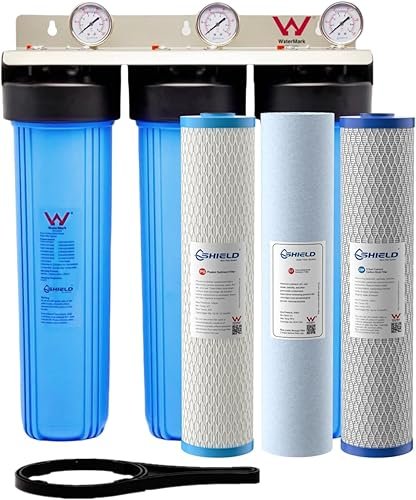
20” x 4.5” Triple Stage Big Blue System
This is the system we recommend to most readers on town water. It’s a proper 3-stage setup: a 5μm pleated sediment filter, a 1μm antibacterial sediment filter, and a 0.5μm carbon block. That’s serious filtration for chlorine, odors, and fine particles. The 75 L/min flow rate won’t leave you with a dribble in the shower, and the brass ports feel solid. It’s WaterMark certified, which gives us confidence in the build quality.
- Excellent 3-stage filtration for municipal water
- High flow rate supports larger homes
- Brass ports and certified construction
- Requires wall mounting and some plumbing skill
- Three filters to replace annually
Shield Water Filters 3-Stage with Stainless Cover
If your filtration system has to live in a garage or a sunny spot, this is your pick. The UV-resistant stainless steel cover isn’t just for looks—it genuinely protects the housings from sun degradation and corrosion. The filtration performance is on par with our top pick, with the same 75 L/min flow and 1″ BSP brass ports. It’s a bit more expensive, but you’re paying for that durable exterior.
- Durable, UV-resistant stainless steel cover
- Same high flow and filtration performance
- Ideal for outdoor or exposed installations
- Higher price for the protective cover
- Can be overkill for a clean basement install
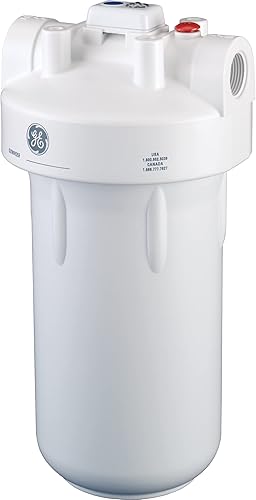
GE GXWH40L High Flow System
The GE is a no-frills, single-cartridge system. The clear sump is its best feature—you can see exactly when the filter needs changing. It’s affordable and simple to install. But honestly, it’s a one-trick pony. It’s great for basic sediment filtration, but you’ll need to add a separate carbon filter if chlorine taste and odor are a concern. We see it as a starting point.
- Very affordable entry point
- Clear sump for easy visual monitoring
- Simple, single-cartridge maintenance
- Only one filtration stage (sediment)
- Does not address chlorine or chemicals
Waterdrop WD-X8 Reverse Osmosis System
A quick but important note: This is not a whole home system. It’s an undersink RO unit. We’re including it because many readers pair a whole home sediment/carbon system with a dedicated drinking water filter. The X8 is a powerhouse—9-stage filtration, 800 GPD capacity, and NSF/ANSI 42 & 58 certified. It reduces TDS, lead, PFAS, and fluoride. The 2:1 pure-to-drain ratio is excellent for an RO system. Perfect for the kitchen tap.
- Exceptional purity for drinking/cooking water
- High daily capacity and low wastewater ratio
- Multiple NSF/ANSI certifications
- Point-of-use only, not whole home
- More complex installation and maintenance
Frequently Asked Questions
- How often do I need to change the filters?
- It depends on your water quality and usage. For sediment filters, every 6-12 months or when you see a pressure drop or discoloration. Carbon filters typically last 6-12 months. Always follow the manufacturer’s specific guidelines.
- Will a whole home filter soften my water?
- No. Standard sediment and carbon filters do not remove dissolved minerals like calcium and magnesium that cause hardness. You need a water softener (ion exchange system) for that.
- Can I install it myself?
- If you’re comfortable with basic plumbing—cutting into the main line, soldering or using SharkBite fittings, and mounting a bracket—yes. But if you’re unsure, hire a plumber. A leak on the main line is a big problem.
- Do I still need a drinking water filter?
- Probably. A whole home system improves water quality for bathing and appliances, but for the purest drinking water, a point-of-use filter like an undersink RO system is still the gold standard.
- What’s the difference between GAC and a carbon block?
- Granular Activated Carbon (GAC) is loose granules. A carbon block is a solid, compressed block. Carbon blocks offer better filtration because water has longer contact time with the carbon and can filter to a finer micron rating.
Final Thoughts
For most households on treated municipal water, a multi-stage sediment and carbon system hits the sweet spot of protection, improvement, and value. Our top pick, the 20” x 4.5” Triple Stage Big Blue System, delivers exactly that with a solid flow rate and certified components. If your system needs to live outdoors, the Shield model with its stainless cover is worth the extra cost.
Start by understanding your water quality. Get a simple test kit or check your municipality’s annual report. Then, match the system to your home’s flow rate needs. Don’t overbuy for features you won’t use, but don’t undersize the system either. Clean water from every tap isn’t a luxury—it’s a practical upgrade that protects your home and your health.
