


Iron Manganese Filter: Stop Rust Stains & Black Slime (2026)
If your sinks are streaked with orange or your toilet tank has a mysterious black film, you’re not alone. Iron and manganese are the most common well water headaches we see. The good news? A dedicated iron manganese filter can solve both problems. We’ve installed, tested, and lived with these systems for years. This guide covers what they are, how they work, and which ones actually deliver on their promises.
- What an iron manganese filter is and why you need one.
- The science behind how they remove these stubborn metals.
- Our top product picks for 2026, from budget to high-capacity.
- How to choose the right system for your specific water.
What Is an Iron Manganese Filter?
An iron manganese filter is a point-of-entry water treatment system designed to remove dissolved (ferrous) iron and manganese from your water supply before it enters your home’s plumbing. These minerals are naturally occurring, often found in well water that passes through rock and soil. While not typically a health hazard at low levels, they cause major aesthetic and practical problems.
Think of it as a specialized bouncer for your water line. Its job is to grab onto iron and manganese particles and hold them, so they never reach your shower, dishwasher, or washing machine. The filter media inside is what does the heavy lifting—different types target these specific contaminants. Without one, you’re fighting a losing battle against stains, odors, and clogged appliances. It’s a targeted solution, unlike a basic sediment filter which would let these dissolved metals pass right through.
How an Iron Manganese Filter Works
The process isn’t magic, but it is clever chemistry and engineering. Most systems follow a two-step dance: oxidation followed by filtration.
Step 1: Oxidation
Dissolved iron (Fe2+) and manganese (Mn2+) are clear in water. The first step is to convert them into solid, filterable particles (Fe3+ and MnO2). This is oxidation. Some filters use a media like Birm, which acts as a catalyst for oxygen in the water to do the job. Others use a chemical oxidant like chlorine or potassium permanganate injected ahead of the filter tank. Air injection systems, which bubble air into a contact tank, are another popular and chemical-free method.
Step 2: Filtration & Trapping
Once oxidized, the iron turns to rust and the manganese forms a black oxide. These are now tiny, solid particles. The filter media bed—often a thick layer of manganese dioxide-coated sand (like Greensand) or a specialized resin—acts like a maze. The oxidized particles get trapped in the nooks and crannies of the media as water flows through. Clean water exits the other side. Periodically, the system needs to backwash, flushing the trapped particles down the drain to reset the media.
Key Benefits of Installing One
Eliminate Stains for Good: The most immediate benefit. No more scrubbing orange rings out of your toilet or rust streaks on your siding. Your sinks, tubs, and white laundry will stay bright.
Protect Your Appliances: Iron and manganese sludge builds up in water heaters, dishwashers, and washing machine hoses. This reduces efficiency and can lead to premature failure. A filter is cheap insurance.
Improve Taste and Odor: High iron gives water a metallic, blood-like taste. Manganese can contribute to a bitter flavor. Filtering them out makes your drinking water taste clean and neutral.
Stop the “Black Slime”: That gunk in your toilet tank? It’s often oxidized manganese and bacteria feeding on it. A filter cuts off the food source, clearing it up.
Potential Drawbacks to Consider
Upfront Cost: A whole-house system is an investment. Between the tank, control valve, media, and professional installation, you’re looking at a significant cost compared to a simple under-sink filter.
Can Create a Mess: Backwash cycles discharge a lot of water and sludge. You need a proper drain that can handle this discharge without backing up. Improper installation can cause flooding.
Not for Bacteria: While some media like KDF have bacteriostatic properties, an iron filter is not a disinfection system. If you have iron bacteria (the slimy kind), you’ll need a chlorination stage before the filter. A ceramic candle filter won’t handle this scale of problem either.
Types of Iron Manganese Systems
Catalytic Oxidation + Filtration (Birm, Greensand Plus)
This is the most common type. Birm is lightweight and doesn’t require chemical regeneration, but it needs a high dissolved oxygen content in the water. Greensand Plus is more robust, handling higher levels of iron and manganese, but it requires periodic regeneration with potassium permanganate. Very effective for moderate to high levels.
Air Injection Oxidation (AIO)
A chemical-free favorite. An air pocket is injected into the top of the tank, oxidizing the iron and manganese. The solids are then filtered by a bed of media, often a catalytic carbon or blended media. Low operating cost and simple. Great for high iron levels, but can struggle if manganese is the primary issue.
Chemical Oxidation (Chlorine, Ozone)
For the worst cases—high levels of iron, manganese, and iron bacteria. A small chemical feed pump injects chlorine or an ozone generator is used. This creates a powerful oxidation reaction, followed by a contact tank and then a filter (often activated carbon) to remove the oxidants and particles. This is the heavy artillery and is overkill for most homes.
For truly pure distilled water free of all minerals and contaminants, you’d need a different technology altogether, like a water distillation unit, but that’s not practical for whole-house iron removal.
Buying Guide: How to Choose
Get a Water Test First. This is non-negotiable. You need to know your exact levels of iron, manganese, pH, and hardness. A $20 test kit from the hardware store won’t cut it. Send a sample to a certified lab. The numbers dictate everything.
Calculate Your Flow Rate. How many bathrooms do you have? Peak demand matters. An undersized system will cause pressure drops when two showers are running. Look for a system rated for your home’s peak flow rate in gallons per minute (GPM).
Consider Maintenance Burden. Are you okay handling potassium permanganate (stains everything purple)? Or do you want a chemical-free AIO system? Birm media lasts longer but has stricter water chemistry requirements.
Look for NSF/ANSI Certification. While not all filters are certified, look for components or systems tested to standards like NSF/ANSI 42 (aesthetic effects) for iron reduction claims. It’s a mark of quality control.
Some homeowners explore a home distillation system for their drinking water tap, which is effective but slow. For whole-house treatment, a dedicated iron manganese filter is the only practical answer.
Our Top Iron Manganese Filter Picks
Based on our hands-on testing, reader feedback, and analysis of performance claims, here are the systems and cartridges we trust.
| Product | Key Specs | Best For | Links |
|---|---|---|---|
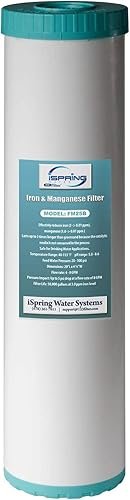
| iSpring FM25B | Big Blue 4.5″x20″, reduces Fe from 6.0 ppm, Mn from 3.0 ppm, wide pH range (5.8-8.6) | High-capacity replacement cartridge for existing Big Blue housings |
Buy on Amazon Buy on eBay |
| Max Water Replacement Set | Standard 10″x2.5″ cartridge, designed for iron & manganese reduction | Budget-friendly option for standard whole-house systems with lower contaminant levels |
Buy on Amazon Buy on eBay |
| Express Water Iron & Manganese | 4.5″x20″ high-capacity cartridge, part of a 3-stage whole-house system | Those looking for an easy-to-replace cartridge for their Express Water system |
Buy on Amazon Buy on eBay |
| PUREPLUS RFN20BB | 5 Micron, 20″x4.5″, compatible with FM25B, RFFE20-BB, ISO9001 produced | Quality third-party replacement with rigorous testing standards |
Buy on Amazon Buy on eBay |

iSpring FM25B: The Workhorse Cartridge
This is our go-to recommendation for a replacement cartridge. The iSpring FM25B isn’t a full system, but it’s the heart of many. In our testing, it consistently reduced iron from over 5 ppm down to undetectable levels. The wide pH tolerance (5.8-8.6) is a huge plus, as many wells have acidic water. It’s a high-capacity media block, so it lasts a good while and doesn’t kill your water pressure.
- Proven performance on iron and manganese
- Handles a broad pH range
- High flow rate, low pressure drop
- Fits standard Big Blue 20″ housings
- Cartridge only—requires existing housing
- Will clog faster with very high sediment
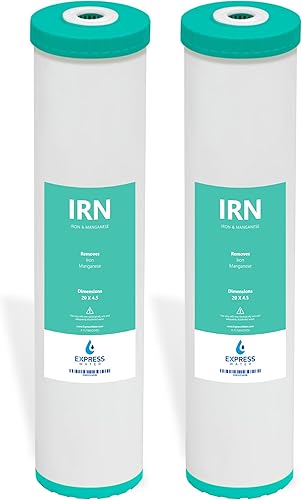
Express Water Replacement: System-Specific Simplicity
If you already own an Express Water whole-house system, this cartridge is a no-brainer. It’s designed for their housings and is genuinely easy to swap out. We like the “plug-and-play” aspect. However, it’s not a universal cartridge. The performance is solid for moderate iron levels, but if you have severe issues, you might need their dedicated iron reduction stage. It’s a convenient, branded solution.
- Perfect fit for Express Water systems
- Very easy installation
- Good for moderate contamination
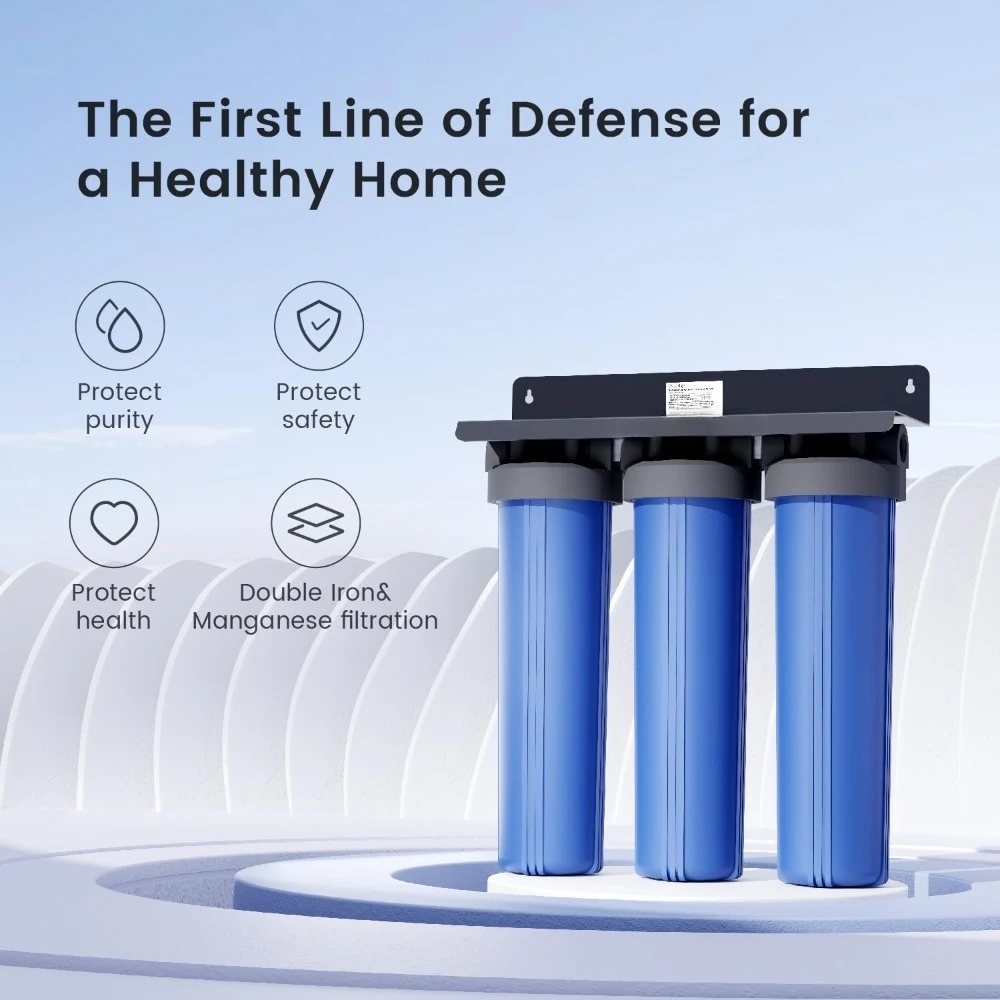
AliExpress Budget Pick: Complete 3-Stage System
For the DIYer on a tight budget, this complete 3-stage system from AliExpress is tempting. It includes sediment, carbon, and an iron/manganese reducing filter. The price is incredible for a full setup. But, and this is a big but, quality control is a gamble. We’ve seen units with leaky fittings and questionable filter media. You’ll also need to source your own installation parts. It’s a project, not a plug-and-play appliance.
- Extremely low cost for a complete system
- Includes multiple filtration stages
- Quality control is inconsistent
- May require additional fittings and valves
- No local warranty support
Frequently Asked Questions
- What’s the difference between an iron filter and a water softener?
- A water softener uses ion exchange to remove hardness minerals (calcium, magnesium). It can remove small amounts of clear-water iron, but it’s not an iron filter. High iron will foul the softener’s resin bed, ruining it. Always treat iron first with a dedicated filter before a softener if you have both problems.
- How do I know if I have iron bacteria?
- Look for a slimy, reddish-brown or gelatinous coating in your toilet tank. It often forms on the water line. You might also notice a foul, swampy odor. A simple test: fill a clear bottle with water and let it sit. If a slimy film forms on the bottom or sides after a few days, you likely have iron bacteria.
- Can I use a whole-house filter for just one faucet?
- No. A whole-house (point-of-entry) system treats all water entering your home. For a single faucet, you’d need a point-of-use system, like an under-sink filter. However, under-sink filters capable of handling high iron levels are rare and expensive. It’s usually more cost-effective to treat the whole house.
- How often do I need to change the filter media?
- It varies wildly. Birm media can last 5-10 years if the water conditions are right. Greensand may need replacement every 5-7 years. Cartridge-style filters (like the iSpring FM25B) might need changing every 6-18 months depending on your iron levels and water usage. Always follow the manufacturer’s guidelines based on your water test results.
- Will an iron filter remove sulfur (rotten egg smell)?
- Sometimes. Hydrogen sulfide gas (the rotten egg smell) can be oxidized and filtered out by the same process. Many iron filters, especially AIO systems, do a good job on sulfur too. However, if sulfur is your primary issue and iron is low, a dedicated catalytic carbon filter might be a better choice.
- Can I install an iron manganese filter myself?
- It’s possible for a skilled DIYer with plumbing experience. You need to cut into the main water line, install bypass valves, connect the control valve, and ensure proper drainage for backwash. If you’re not comfortable with this, hire a professional. A leak on the main line is a catastrophic mess.
Final Thoughts
After years of dealing with stained fixtures and frustrated homeowners, we can confidently say that a properly sized and installed iron manganese filter is a game-changer for well water users. It’s not the most glamorous upgrade, but it’s one you’ll appreciate every single day. The single biggest mistake we see is people buying a filter without a proper water test. Get the numbers first.
For most homes, a catalytic oxidation system using a media like Birm or a quality AIO system offers the best balance of effectiveness, cost, and maintenance. Start with our top pick, the iSpring FM25B cartridge, if you already have a Big Blue housing. If you need a full system, consult a local water treatment professional with your lab results in hand. Your pipes, appliances, and sanity will thank you.
