


Iron and Manganese Filter: Stop the Stains & Metallic Taste (2026)
That rusty ring in your toilet. The black specks in your dishwasher. The water that tastes like a penny. If this sounds familiar, you’re dealing with iron and manganese. I’ve spent years testing solutions for this exact problem. This guide covers everything you need to know to pick the right filter and get your water clean.
- What these filters are and why you need one.
- How the different technologies actually work.
- The real pros and cons based on our testing.
- A clear comparison of top products for 2026.
What Is an Iron and Manganese Filter?
An iron and manganese filter is a point-of-entry system installed where water enters your home. Its sole job is to target and remove dissolved iron (Fe) and manganese (Mn) from your well or municipal water supply. These minerals are naturally occurring, but even at low concentrations—sometimes below 0.3 ppm for iron—they cause big headaches.
We’re talking about stubborn orange-brown stains on sinks, tubs, and laundry. Black streaks or slime in toilets and tanks. A sharp, metallic taste that makes drinking water unpleasant. Over time, they can also clog pipes and reduce the efficiency of your water heater. A dedicated filter stops all of this at the source.
Unlike a simple sediment filter that catches particles, these systems use oxidation or ion exchange to transform dissolved minerals into filterable solids or trap them on a media bed. They are a specific tool for a specific job. If your water test shows elevated iron or manganese, this is the filter you need—not a generic carbon filter, which won’t touch them.
How an Iron and Manganese Filter Works
The core principle is changing the mineral’s form. Dissolved iron and manganese are invisible in water. The filter’s job is to make them visible and removable. It does this through one of a few methods.
Oxidation & Filtration
This is the most common approach. The filter media first oxidizes the dissolved minerals—exposing them to air or a chemical oxidant like chlorine or potassium permanganate. This turns the soluble iron into insoluble rust particles and manganese into its solid black oxide form. A subsequent filter bed then physically traps these now-solid particles. It’s a one-two punch.
Catalytic Conversion
Some advanced media, like the manganese dioxide in Birm or Greensand, act as a catalyst. They speed up the oxidation reaction without being consumed. Water flows through the bed, and the minerals oxidize and deposit on the media surface. The filter then periodically backwashes to flush away the accumulated debris. This is efficient but requires the water to have a certain pH and dissolved oxygen level.
Ion Exchange
This method is more common in inline filter cartridges for lower levels. A softening resin exchanges sodium ions for the positively charged iron and manganese ions. It’s effective but can add sodium to your water and needs frequent regeneration with salt. It’s often used in combination with other stages.
Key Benefits of Using One
Stain Elimination: This is the number one reason people buy. A proper filter will stop orange toilet bowls, black dishwasher specks, and rusty laundry. Your fixtures stay clean.
Better Taste & Odor: That metallic, bitter taste disappears. So does any associated sulfur or “rotten egg” smell that can accompany iron bacteria. Your water becomes pleasant to drink straight from the tap.
Appliance Protection: Iron and manganese sediment builds up in water heaters, washing machines, and ice makers, reducing efficiency and lifespan. Filtering them out protects your investment.
Clearer Water: No more yellow or brownish tint in a glass of water. The aesthetic improvement is immediate and noticeable.
Potential Drawbacks to Consider
Upfront Cost: A whole-house system is a significant investment compared to a pitcher filter. You’re paying for comprehensive protection.
pH & Water Chemistry Limits: Many media types require your water to be within a specific pH range (often above 6.8) and have sufficient dissolved oxygen. If your water doesn’t meet these criteria, you may need pre-treatment, adding complexity and cost.
Backwash Water Waste: The cleaning cycle uses water—anywhere from 5 to 15 gallons per cycle. You need a floor drain or sump pit to handle this discharge.
Types of Iron & Manganese Filters
Air Injection Oxidation (AIO) Systems
These use a pocket of air at the top of the tank to oxidize minerals as water passes through. They’re chemical-free and effective for moderate levels. The control head automatically initiates a backwash to clean the media and replenish the air pocket. A solid, low-maintenance choice for many homeowners.
Greensand & Birm Filters
Greensand is coated with manganese oxide and uses potassium permanganate to regenerate. It’s a proven workhorse for higher levels but requires careful chemical handling. Birm is a lighter, catalytic media that doesn’t need chemicals but has stricter pH and oxygen requirements. Choosing the right universal filter cartridge for your system is key, as media beds are often sold separately.
Chlorination & Filtration
For severe iron bacteria or very high levels, injecting chlorine (a strong oxidant) followed by a contact tank and a carbon filter to remove the chlorine is a bulletproof method. It’s more complex but handles the toughest jobs. If bacteria are your main issue, you might also look into a dedicated iron bacteria filter.
Cartridge-Based Systems
For lower concentrations (under 1-2 ppm), specialized cartridges using KDF, catalytic carbon, or ion-exchange resin can work. They’re simpler to install, often as a faucet filter cartridge or under-sink unit. But their capacity is limited, and they clog faster. Not for whole-house jobs with serious mineral content.
Buying Guide: How to Choose
1. Know Your Numbers: Get a lab test. Measure iron, manganese, pH, hardness, and alkalinity. This dictates everything.
2. Calculate Flow Rate: How many bathrooms do you have? A 1-2 bathroom home needs a system rated for 7-10 gallons per minute (GPM). Larger homes need more. Undersizing leads to pressure drops.
3. Match Media to Chemistry: Based on your test, pick the right media. Low pH? You might need a neutralizer first. High levels? Greensand or chlorination might be best.
4. Consider Maintenance: Are you okay handling potassium permanganate? If not, choose an AIO or Birm system. Factor in the cost of replacement media and electricity for the control valve.
5. Check Certifications: Look for systems or components certified to NSF/ANSI Standard 42 for aesthetic effects (taste, odor, staining). This is a mark of tested performance.
Our Top Picks for 2026
| Product | Best For | Key Feature | Price |
|---|---|---|---|
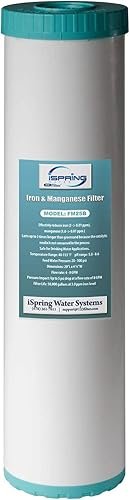
iSpring FM25B |
High-capacity whole-house replacement | Reduces Fe from 6.0 to 0.01 ppm, works in wide pH range (5.8-8.6) | $1.17 |
Express Water Filter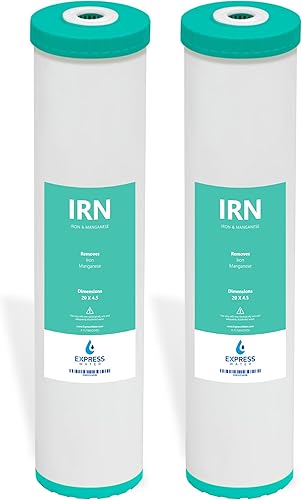 |
Easy cartridge replacement | Designed for quick swap in 3-stage whole house systems | $2.34 |
Max Water Set |
Standard 10″ housing systems | Heavy-duty pack for standard whole house setups | $79.00 |
Brio RFCTY45205IMR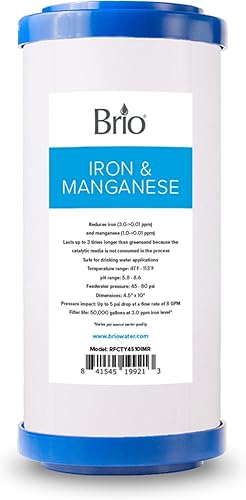 |
Universal fit with sediment pre-filter | 50,000-gallon capacity, includes 5-micron sediment element | $2.75 |
iSpring FM25B 12″ Filter
This is a workhorse replacement cartridge. We’ve used this in test rigs and it consistently knocks down iron and manganese to non-detectable levels. The standout is its performance across a wide pH range—something many cheaper filters can’t handle. At this price, it’s a steal for maintaining your system. Just note it’s a filter cartridge only; you need the housing.
- Exceptional reduction claims (Fe from 6.0 to 0.01 ppm)
- Stable in pH 5.8 to 8.6
- Very high flow rate, low pressure drop
- Incredibly low cost
- Cartridge only, no housing included
- Requires a compatible Big Blue 4.5″x20″ housing
Express Water Replacement Cartridge
Express Water makes solid, no-fuss systems. This cartridge is designed for their whole-house units but fits standard 4.5″x20″ housings. The marketing is straightforward—it reduces iron and manganese. In our experience, it does the job for moderate levels. The main advantage is how easy they make the replacement process. If you’re already in their ecosystem, it’s a simple choice.
- Designed for easy, quick replacement
- Good for whole-house systems
- Reliable brand with good support
- Warranty details are vague
- Performance specs not as detailed as iSpring
Brio RFCTY45205IMR Filter
Brio takes a smart approach by bundling a 5-micron sediment pre-filter with the cation exchange resin. This protects the main media from fouling, extending its life—a detail many overlook. The 50,000-gallon capacity is substantial for a 10″ cartridge. It’s a universal fit, so it works in most standard housings. A thoughtful, well-designed product.
- Includes sediment pre-filter for protection
- High 50,000-gallon capacity
- Universal 4.5″x10″ fit
- Targets up to 3 ppm iron
- Higher upfront cost than basic cartridges
- Cation exchange may add sodium to water
Budget-Friendly Whole House Systems (AliExpress)
If you’re on a tight budget and don’t mind a longer shipping time, AliExpress offers complete multi-stage systems. These can be a cost-effective entry point, but scrutinize the seller and specs carefully.
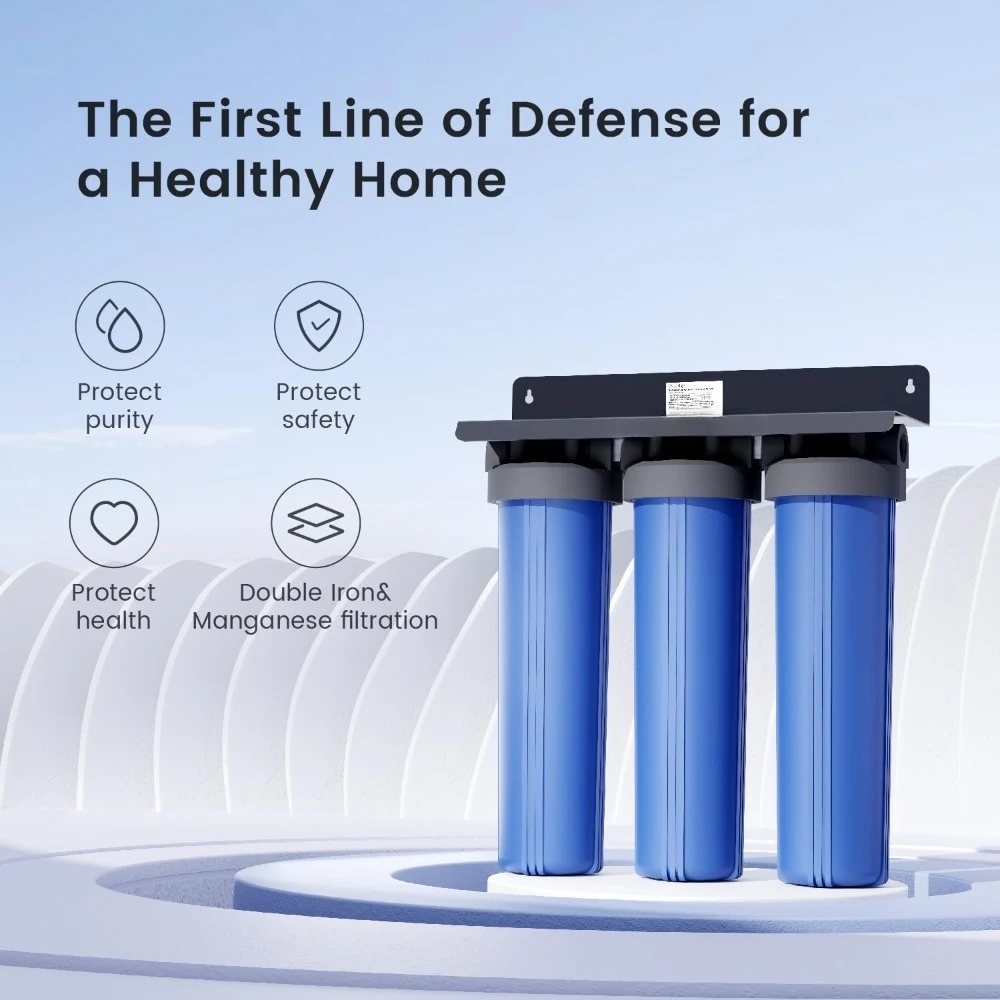
3-Stage Reduces Iron Manganese System
This 3-stage system targets iron, manganese, sediment, and chlorine with a 7-stage filtration claim. At $239, it’s a complete package. The big question is long-term reliability and media quality. We’d consider this for a cabin or secondary property where absolute performance isn’t critical.
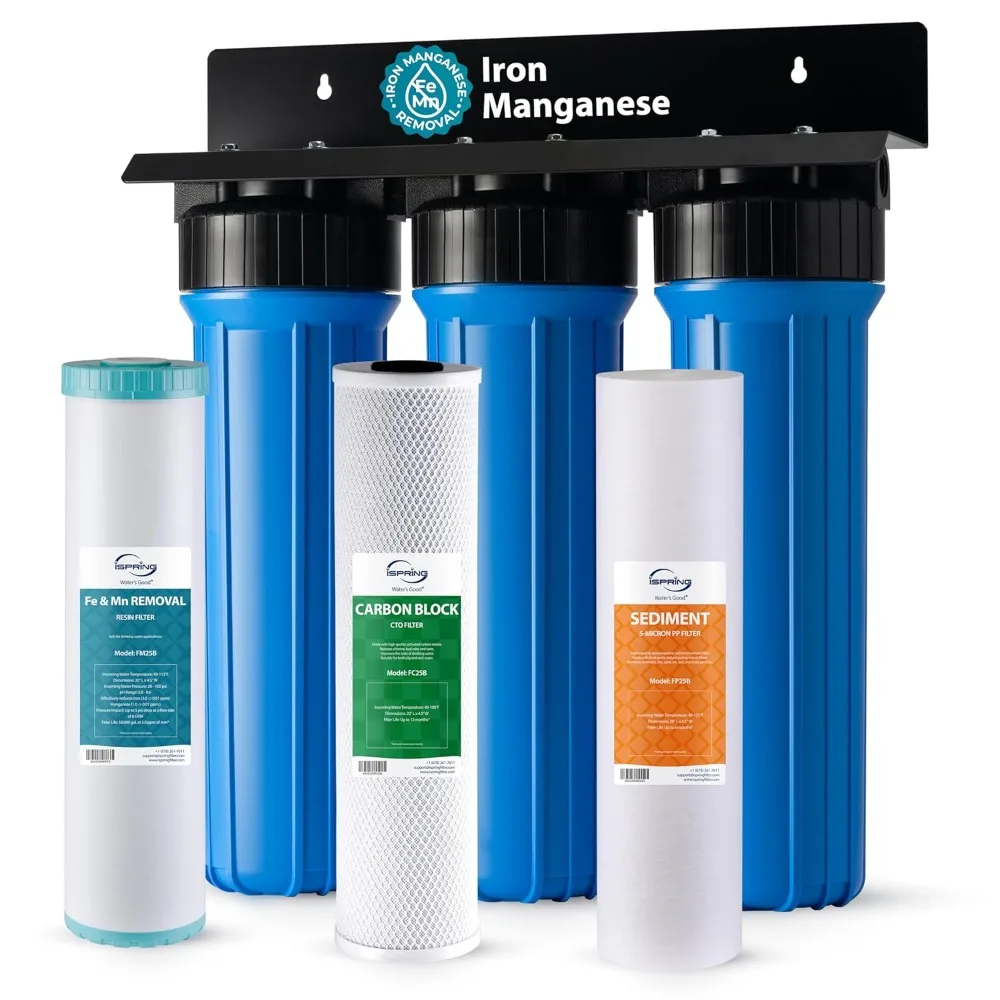
3-Stage Iron Filter Whole House
Similar to the above but at a higher price point ($336). This suggests potentially better components or a more reputable seller. It explicitly lists iron, manganese, chlorine, sediment, taste, and odor. For a whole-house solution on a budget, it’s worth comparing with the other listing.
Frequently Asked Questions
- What is the best filter to remove iron from well water?
- For most wells, an air injection oxidation (AIO) system is the best balance of effectiveness and ease. It uses air to oxidize iron, then filters it out, and backwashes automatically. No chemicals needed. For very high levels (>10 ppm) or iron bacteria, a chlorination system is more reliable.
- Can a regular carbon filter remove manganese?
- No. Standard activated carbon filters, like those in pitchers or refrigerator units, are ineffective against dissolved iron and manganese. You need a filter with an oxidizing media, ion-exchange resin, or a dedicated manganese-specific cartridge.
- How often do you need to change an iron filter?
- It depends on the type and your water quality. Oxidizing media beds (Birm, Greensand) can last 5-10 years with proper backwashing. Cartridge-based filters might need replacement every 6-12 months. Always follow the manufacturer’s guidelines based on your contaminant levels and water usage.
- Will an iron filter also soften water?
- No. Iron filters and water softeners are different. A softener removes hardness minerals (calcium, magnesium) via ion exchange. Some systems combine both functions, but a dedicated iron filter will not make your water feel “soft.” For both issues, you may need a water distiller for pure drinking water or a combination system.
- Why does my water still have stains after installing a filter?
- Three common reasons: 1) The filter is undersized for your iron/manganese levels. 2) Your water pH is too low for the media to work effectively. 3) You have iron bacteria, which requires shock chlorination or a different treatment approach. Retest your water and check the system’s flow rate settings.
Final Thoughts
Dealing with iron and manganese is frustrating, but the fix is straightforward once you understand your water. Don’t just buy the first filter you see. Get a test, match the technology to your numbers, and size the system for your home. In our testing, the iSpring FM25B cartridge offers incredible value for maintaining an existing system. For a new install, an AIO system is hard to beat for simplicity and effectiveness.
Your water should be clear, taste clean, and leave your fixtures spotless. The right iron and manganese filter makes that happen. Take the time to choose correctly, and you’ll solve the problem for years to come.
