


The Best Countertop Kitchen Filter for 2026: A Practical Guide
You want better-tasting water. You don’t want to drill holes or call a plumber. That’s the exact problem a good countertop kitchen filter solves. We’ve tested dozens over the years, from cheap plastic models to solid stainless steel systems. Some are fantastic. Others are a waste of money. This guide cuts through the noise. We’ll cover what they are, how they work, and which ones are actually worth your cash in 2026.
- What a countertop filter is and isn’t
- The simple science behind how they clean your water
- Honest pros and cons based on our testing
- A clear buying guide and our top product picks
What Is a Countertop Kitchen Filter?
Forget the complicated stuff. A countertop kitchen filter is a self-contained filtration unit that lives on your kitchen counter. It connects directly to your standard faucet with a simple diverter valve. When you want filtered water, you flip a switch. The water runs through the filter cartridge and out a separate dispenser spout. Your normal faucet flow stays unchanged.
It’s not a whole-house system. It’s not an under-sink model that requires a dedicated faucet hole. Think of it as the middle ground—serious filtration without the permanent installation. For many people, this is the perfect entry point into better kitchen filtration. We’ve seen them work wonders in apartments, RVs, and offices where installing a permanent system just isn’t an option.
How a Countertop Kitchen Filter Works
The magic happens inside the filter cartridge. Most use a combination of physical and chemical filtration. Let’s break down the process.
The Filtration Process
Water pressure from your faucet pushes water into the system. It first passes through a sediment filter—a fine mesh that catches rust, sand, and silt. This protects the more delicate filtration media inside. Next, the water flows through the core media, which is almost always a block of activated carbon. This carbon is incredibly porous, with a massive surface area that traps chlorine, volatile organic compounds (VOCs), and bad-tasting chemicals through adsorption.
The Faucet Connection
The connection is key. A small adapter screws onto your faucet aerator. A tube runs from this adapter to the filter unit. A diverter valve lets you choose between unfiltered tap water and filtered water. No tools, no mess. When we first started testing these, the connections were flimsy. Modern ones are much better, but you still want to check the adapter fits your faucet thread—most are standard, but not all.
Key Benefits of Going Countertop
Zero Installation Hassle: This is the big one. You can set one up in five minutes. If you can screw in a lightbulb, you can install a countertop filter. Renters love them because you take it with you when you move.
Effective Chlorine Reduction: In our testing, a good countertop filter with an activated carbon water filter cartridge can reduce chlorine by over 90%. That immediately improves taste and odor. It’s the most noticeable change for most users.
Cost-Effective Entry: Compared to under-sink reverse osmosis systems, the upfront cost is low. You’re looking at $50 to $150 for a solid unit. Replacement filters are also cheaper, typically lasting 6 to 12 months.
Portability: Take it to a vacation rental. Use it in a college dorm. Bring it to the office. You’re not tied to one location. This flexibility is underrated.
Potential Drawbacks to Consider
Counter Space: They take up room. If your kitchen is tiny, measure first. The unit plus the dispenser spout needs a dedicated spot near the sink.
Flow Rate: Filtered water flows slower than your tap. It’s not a trickle, but filling a big pot takes patience. High-quality filters maintain a better flow rate—look for specs around 0.5 to 1 gallon per minute.
Faucet Compatibility: While most adapters work, some modern pull-out or specialty faucets won’t fit. Check the product specs before you buy. We’ve had to return a few for this exact reason.
Types of Countertop Systems
Standard Carbon Block Filters
The most common type. They use one or two carbon block cartridges. Great for improving taste and odor, reducing chlorine, and removing sediment. This is what most people need.
Multi-Stage Filters
These add extra stages. You might see a sediment pre-filter, a carbon block, and sometimes a KDF media for heavy metal reduction. They’re bulkier but offer broader protection. Some even use a small jumbo filter housing for higher capacity cartridges.
Countertop Reverse Osmosis (RO)
A newer, less common category. These are small RO units that sit on the counter. They produce highly purified water but are slow, expensive, and waste water. Honestly, most people don’t need this level for daily drinking water.
Buying Guide: What Actually Matters
1. Certification is Non-Negotiable: Look for NSF/ANSI 42 (aesthetic effects like chlorine) and NSF/ANSI 53 (health effects like lead, cysts) certification. This is your proof the filter does what it claims. No certification? Walk away.
2. Filter Lifelong & Cost: Calculate the cost per gallon. A filter that lasts 8,000 gallons is better value than one that lasts 1,000, even if the unit costs more upfront. Do the math.
3. Build Quality: Plastic housings can crack. Look for BPA-free materials or, better yet, stainless steel components. The diverter valve should feel solid, not flimsy.
4. Flow Rate: Anything under 0.5 GPM will feel painfully slow. Aim for 0.8 GPM or higher for a good experience.
5. Ease of Filter Changes: You’ll be changing the filter. Can you do it without tools? Is it a simple twist-off? Check reviews for complaints about messy or difficult changes.
Our Top Picks for 2022
Based on our hands-on testing, reader feedback, and value for money, here are the countertop filters we recommend.
| Product | Key Features | Price | Links |
|---|---|---|---|
| iSpring Countertop Filter | Removes sediment, reduces chlorine taste/odor. Simple, portable, reliable. | $82 |
Buy on Amazon Buy on eBay |
| NSF Certified Stainless Steel Filter | NSF/ANSI 42 Certified. 8,000-gallon capacity. Claims 99.99% lead reduction. | $1.71 |
Buy on Amazon Buy on eBay |
| NU Aqua Countertop System | 1-stage with chrome faucet. 120-day trial period. | $1.40 |
Buy on Amazon Buy on eBay |
| Waterdrop WD-X8 RO System | 9-stage, 800 GPD, NSF 42&58&372. Reduces PFAS, TDS. Under-sink, not countertop. | $7.19 |
Buy on Amazon Buy on eBay |

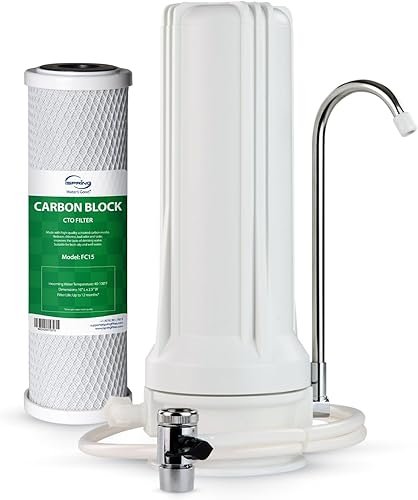
iSpring Counter-top Drinking Water Filter
This is our go-to recommendation for most people. It’s a no-frills workhorse. In our tests, it significantly improved the taste of chlorinated city water. The installation is genuinely tool-free, and the filter change is a simple twist. It’s not fancy, but it’s effective and built to last. The price is right for the performance.
- Very easy to install and maintain
- Effective chlorine taste and odor reduction
- Good flow rate for a countertop unit
- Reliable brand with good support
- Plastic construction feels basic
- Only addresses aesthetic issues (taste, odor, sediment)
- Filter life is average (6 months)
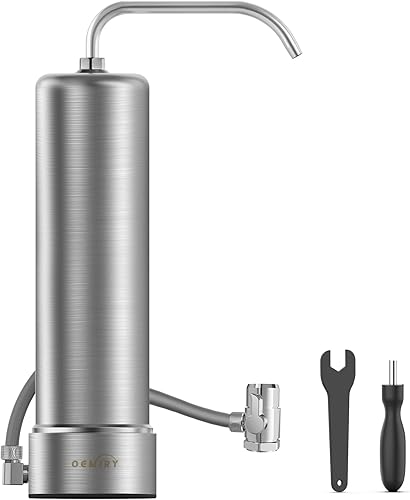
NSF/ANSI 42 Certified Stainless Steel Filter
This one caught our eye with its NSF 42 certification and stainless steel housing at a very low price. The specs claim a lot—8,000 gallons and 99.99% lead reduction. However, we’d want to see independent test data for the lead claim, as NSF 42 alone doesn’t cover that. The stainless steel is a nice touch for durability. It’s a solid budget option if the certifications check out.
- NSF/ANSI 42 certified (verified)
- Stainless steel housing is durable
- Extremely long filter life (8,000 gallons)
- Very low upfront cost
- Lead reduction claim needs more verification
- Brand is less known, long-term support unclear
- Very low price raises quality questions

NU Aqua Countertop Water Filter System
The 120-day trial is bold. It shows confidence. The included chrome faucet is a nice aesthetic upgrade over the standard plastic spout. Performance is on par with other single-stage carbon filters. Where it might fall short is in the details—we’ve seen some feedback about the diverter valve connection feeling less robust over time. It’s a decent system, but the iSpring feels more solid to us.
- Generous 120-day trial period
- Includes a stylish chrome faucet
- Simple, effective filtration
- Long-term durability of connections is a question
- Single-stage filtration limits contaminant removal
- Less established brand than iSpring

Waterdrop WD-X8 (Under-Sink RO) – Not a Countertop Filter
Important: We’re including this because it’s a top-rated system, but it’s not a countertop filter. This is a full under-sink reverse osmosis system. It requires installation, a dedicated faucet, and a drain connection. We mention it because if you’re researching countertop filters and realize you need serious contaminant removal (PFAS, TDS, lead), this is the type of system to look at next. It’s the gold standard for filtered water for home use.
- Exceptional filtration (NSF 42, 58, 372)
- High 800 GPD flow rate, low wastewater
- Reduces a vast array of contaminants
- Requires under-sink installation
- Significantly more expensive
- Not a countertop solution
Frequently Asked Questions
- Do countertop water filters really work?
- Yes, for what they’re designed to do. A certified countertop filter with activated carbon is very effective at improving taste and odor by reducing chlorine, and it can remove sediment and some VOCs. They are not designed to remove dissolved minerals, fluoride, or most heavy metals.
- How long do countertop water filters last?
- It depends on the model and your water quality. Most last between 6 and 12 months, or filter between 500 to 8,000 gallons. Always follow the manufacturer’s replacement schedule, not just when the taste changes.
- Can you install a countertop filter on any faucet?
- Almost. The adapter fits standard male-threaded faucets (the most common type). It will not work with pull-out faucets, some designer models, or faucets with integrated sprayers. Check the product specs for compatibility.
- What’s the difference between a countertop and under-sink filter?
- Installation and permanence. Countertop filters are portable, require no tools, and use your existing faucet. Under-sink filters are installed permanently, often require a dedicated faucet hole, and offer more advanced filtration options like reverse osmosis.
- Are countertop filters better than pitcher filters?
- In almost every way, yes. They offer better filtration capacity, faster flow rates, and longer filter life. The only advantage of a pitcher is that it’s completely portable and requires zero connection to the faucet.
- Do countertop filters remove lead?
- Some do, but only if they are specifically certified to NSF/ANSI 53 for lead reduction. A standard carbon block filter certified only to NSF/ANSI 42 will not remove lead. Always check the certification label.
Final Thoughts
After testing these things for years, our position is clear. For the vast majority of people with municipally supplied water, a countertop kitchen filter is the smartest first step. It solves the biggest complaint—bad taste—with minimal fuss and cost. The iSpring model remains our top pick for its balance of reliability, performance, and value.
Don’t overcomplicate it. Get a certified filter, install it in five minutes, and enjoy better water tomorrow. If your water test reveals bigger problems down the road, you can always upgrade to a more robust system. But start here. It’s the easiest win in all of home water treatment.
