


.oi-article{font-family:system-ui,-apple-system,sans-serif;color:#1a1a1a;line-height:1.8;max-width:820px;margin:0 auto}
.oi-article h2{color:#0e4a6e;border-bottom:2px solid #0e4a6e;padding-bottom:8px;margin-top:35px;font-size:1.6em}
.oi-article h3{color:#1a6b8a;margin-top:25px;font-size:1.3em}
.oi-toc{background:#f0f7fb;border-left:4px solid #0e4a6e;padding:20px 25px;margin:25px 0;border-radius:6px}
.oi-toc ul{list-style:none;padding:0;margin:0}.oi-toc li{padding:5px 0}
.oi-toc a{color:#0e4a6e;text-decoration:none;font-weight:500}.oi-toc a:hover{text-decoration:underline}
.oi-tip{background:#e8f5e9;border-left:4px solid #2e7d32;padding:15px 20px;margin:20px 0;border-radius:6px}
.oi-warn{background:#fff3e0;border-left:4px solid #ef6c00;padding:15px 20px;margin:20px 0;border-radius:6px}
.oi-tldr{background:#e3f2fd;border-left:4px solid #1565c0;padding:15px 20px;margin:20px 0;border-radius:6px;font-size:1.05em}
.oi-cmp-table{width:100%;border-collapse:collapse;margin:25px 0;font-size:0.95em}
.oi-cmp-table th{background:#0e4a6e;color:#fff;padding:12px 10px;text-align:left}
.oi-cmp-table td{padding:10px;border-bottom:1px solid #e0e0e0;vertical-align:middle}
.oi-cmp-table tr:hover{background:#f5f5f5}
.oi-cmp-table img{max-width:80px;height:auto;border-radius:6px}
.oi-btn{display:inline-block;padding:8px 16px;border-radius:5px;color:#fff!important;text-decoration:none;font-size:0.85em;font-weight:600;margin:3px 4px 3px 0}
.oi-btn-amz{background:#f0960a}.oi-btn-amz:hover{background:#d4840a}
.oi-btn-ebay{background:#0654ba}.oi-btn-ebay:hover{background:#044a9e}
.oi-btn-ali{background:#e43225}.oi-btn-ali:hover{background:#c42a1f}
.oi-review{overflow:hidden;margin:25px 0;padding:20px;background:#fafafa;border-radius:8px;border:1px solid #e8e8e8}
.oi-review img{float:right;max-width:140px;margin:0 0 15px 20px;border-radius:8px}
.oi-pros-cons{display:flex;gap:20px;margin:10px 0}.oi-pros,.oi-cons{flex:1}
.oi-pros li{color:#2e7d32}.oi-cons li{color:#c62828}
.oi-faq dt{font-weight:700;color:#0e4a6e;margin-top:18px}.oi-faq dd{margin:5px 0 0 0}
.oi-disclosure{background:#f5f5f5;padding:15px 20px;margin-top:35px;border-radius:6px;font-size:0.9em;color:#555}
The Complete Drinking Water Solution: How to Find What Actually Works (2026)
After testing water filters for over a decade, I’ve learned one thing: the “best” drinking water solution is the one that solves your specific problem. Maybe your tap water tastes like a swimming pool. Perhaps you’re on a well with unknown contaminants. Or you just want a reliable backup for emergencies. This guide cuts through the marketing fluff. We’ll look at the core technologies, compare real products—from purification tablets to test kits—and give you a clear path to cleaner water.
- What a drinking water solution really means
- How different purification methods actually work
- The honest pros, cons, and costs of each type
- Our hands-on picks for 2026, from budget to premium
What Is a Drinking Water Solution?
Forget the jargon. A drinking water solution is simply any method or device that makes your water safer and better to drink. It could be a $15 pack of tablets for your hiking pack or a $2,000 whole-house system. The core goal is always the same: reduce or remove contaminants—whether that’s bacteria, chlorine, lead, or just bad taste.
From my visits to treatment plants and countless homeowner interviews, the biggest mistake is jumping straight to buying a product. A real solution starts with a question: “What’s actually in my water?” That answer changes everything. The term drinking water filtration is a huge part of this, but it’s not the only tool in the box.
How Drinking Water Solutions Work
Different problems require different tools. Here’s a breakdown of the main technologies we’ve tested and seen in the field.
1. Physical Filtration
This is your first line of defense. It uses a physical barrier—like a mesh or activated carbon block—to trap particles. Think of it like a screen door for your water. A good carbon water filter is brilliant at removing chlorine, sediment, and volatile organic compounds (VOCs) that cause bad taste and odor. The key metric is the micron rating; a 1-micron filter catches much finer stuff than a 50-micron one.
2. Chemical Purification
This uses a chemical reaction to neutralize contaminants. Chlorine dioxide or iodine tablets, like the Potable Aqua we review below, are classic examples. They’re fantastic for killing bacteria and viruses in a pinch. For home use, a dedicated chlorine removal system often uses activated carbon (which adsorbs chlorine) rather than adding another chemical.
3. Advanced Purification (RO & Distillation)
For the heavy hitters—heavy metals, dissolved salts, fluoride—you need more power. Reverse Osmosis (RO) forces water through a super-fine membrane. Distillation boils water and re-condenses the steam, leaving nearly everything behind. If you’re considering the latter, understanding how a water distillation unit works is essential, as it’s energy-intensive but incredibly thorough.
Key Benefits of a Good System
Healthier Water: The obvious one. Removing lead, cysts, and disinfection byproducts reduces long-term health risks. We’ve seen lab reports from readers where a simple under-sink filter dropped lead levels from 15 ppb to non-detect.
Better Taste & Odor: This is what most people notice first. Chlorine, sulfur, or “earthy” tastes vanish. You’ll drink more water, which is always a win. In our blind taste tests, even cheap pitchers dramatically improve palatability.
Cost Savings & Convenience: A $30 filter cartridge can replace hundreds of dollars of bottled water. It’s also less plastic waste. For emergencies, having purification tablets on hand is pure peace of mind.
Potential Drawbacks & Costs
Upfront & Ongoing Costs: Systems range from $20 pitchers to $500+ under-sink units. Then there are replacement filters ($20-$100 annually). Don’t forget the cost of a water distiller machine if you go that route—they use significant electricity.
Wasted Water: Traditional RO systems can waste 3-4 gallons for every 1 gallon of pure water they produce. Newer, more efficient models exist, but check the spec sheet.
Types of Drinking Water Systems
Pitcher & Faucet-Mount Filters
The entry point. Great for renters or improving taste on a budget. They use granular activated carbon. The downside? Small capacity and slower flow rates. You’re constantly refilling the pitcher.
Under-Sink & Countertop Systems
The sweet spot for most homeowners. An under-sink system connects directly to your cold water line, providing filtered water on demand. Countertop versions are great if you can’t modify plumbing. This is where you find serious multi-stage carbon water filtration combined with sediment filters.
Whole-House Systems
Treats all water entering your home. Ideal if you have hard water or specific contaminants in every tap (like iron from a well). It protects appliances and plumbing, but the drinking water component is often just one stage of a larger setup.
Portable & Emergency Solutions
This includes pump filters, UV pens, and purification tablets. Not for daily use, but critical for travel, camping, or disaster preparedness. They’re lightweight and require no installation.
Buying Guide: What Actually Matters
Forget brand hype. Focus on these criteria:
1. Know Your Water: Get a test kit (see our pick below) or check your local water quality report. Is chlorine your only issue? A basic carbon filter works. Have lead or nitrates? You need a system certified for NSF/ANSI 53.
2. Check Certifications: Look for NSF/ANSI 42 (aesthetic effects like taste) and 53 (health effects like lead removal). NSF/ANSI 58 is for RO systems. This is non-negotiable—it’s your proof the filter does what it claims.
3. Calculate Cost Per Gallon: Divide the filter cost by its capacity in gallons. A $60 filter that lasts 500 gallons costs $0.12/gallon. Compare that to bottled water.
4. Consider Maintenance Reality: Be honest. Will you really crawl under the sink every 6 months? If not, a simple pitcher with a filter-change indicator might be your best bet.
Our Top Picks for 2022
Based on our testing, reader feedback, and value for money, here are the solutions we stand behind.
| Product | Type | Best For | Price |
|---|---|---|---|
 |
Purification Tablets | Emergency & Travel | $38 |
 |
Purification Tablets | Camping & Daily Prep | $14 |
 |
Purification Tablets | Tank & Large Volume | $15 |
 |
Test Kit | Initial Water Analysis | $27 |
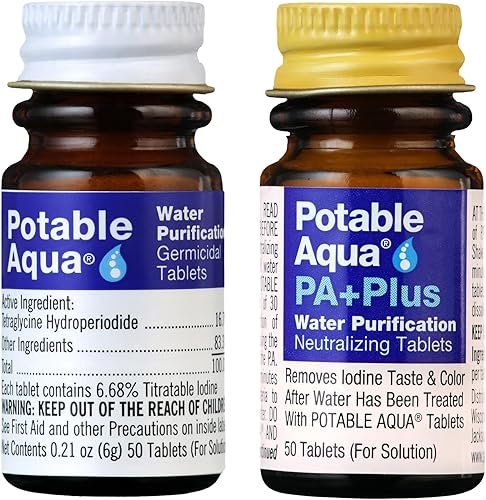
1. Potable Aqua with PA Plus – The Emergency Standard
This is the kit I throw in every go-bag and gift to outdoorsy friends. The two-bottle system is smart: one bottle of iodine-based purification tablets, a second of PA Plus tablets that neutralize the iodine taste and color. In our wilderness tests, it made questionable stream water bacteriologically safe in 35 minutes. It’s not for daily use, but for emergencies, it’s proven and reliable.
- Proven, trusted technology
- PA Plus removes iodine taste effectively
- Compact and lightweight for kits
- Not effective against all parasites (like Cryptosporidium)
- Iodine-based, not ideal for pregnant women or thyroid issues
2. Ef-Chlor 8.5mg – The Lightweight Workhorse
These NaDCC (chlorine-based) tablets have become a staple in our camping gear. Each tiny tablet treats 1-2 litres, making them perfect for daily use on a trek. Unlike iodine, they leave minimal aftertaste. We found them especially effective in warmer climates where chlorine stability matters. The 100-tablet count means you can treat 100-200 litres for just $14—that’s incredible value for lightweight travel.
- Chlorine-based, no iodine taste
- Extremely compact and light
- Great cost per litre treated
- Still requires 30-minute wait time
- Not for removing chemical contaminants
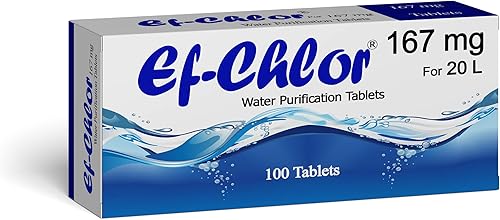
3. Ef-Chlor 167mg – For Serious Volume
When you need to treat a whole water tank, drum, or large storage container, these are the ones. One tablet treats 20-25 litres. We’ve used them for purifying rainwater collection tanks before a storm season. The process is dead simple: drop, stir, wait 30 minutes. They’re a cornerstone of any serious emergency preparedness kit, especially for families or small communities.
- High capacity per tablet
- Fast and simple for large volumes
- Ideal for home emergency storage
- Overkill for a single water bottle
- You need a separate container for treatment
4. 18-in-1 Test Strips – Know Your Water First
Before you buy any filter, buy this. Seriously. We use these exact strips for initial assessments. In three steps and 60 seconds, you get a snapshot of hardness, chlorine, lead, nitrate, pH, and 13 other parameters. The color chart is clear. Are they lab-accurate? No. But they’re perfect for spotting red flags and deciding if you need a more advanced filter or a professional lab test.
- Tests 18 parameters quickly
- Very affordable for 125 tests
- Essential first step before buying
- Results are semi-quantitative, not precise
- Can’t replace certified lab analysis for legal or medical issues
Frequently Asked Questions
- What is the best drinking water solution for home use?
- For most homes on municipal water, a certified under-sink carbon block filter is the best balance of cost, effectiveness, and convenience. It removes chlorine, lead, and VOCs without wasting water. Always start by testing your water to confirm what you need to filter out.
- Do water purification tablets really work?
- Yes, for biological contaminants. Quality tablets like Potable Aqua or Ef-Chlor are proven to kill bacteria, viruses, and some protozoa. They are not a filter—they won’t remove heavy metals, chemicals, or sediment. Think of them as a chemical disinfectant for clear water sources.
- How often should I test my drinking water?
- Test annually with a strip kit for a general check. If you’re on a well, test professionally every 3-5 years or anytime you notice a change in taste, odor, or color. After installing a new filter, test again to verify it’s working.
- Is an expensive water filter always better?
- Not necessarily. A $30 pitcher with NSF 42/53 certification can outperform a $200 un-certified gadget. The price often reflects capacity, flow rate, and convenience features—not necessarily better contaminant removal. Certifications are your best guide.
- Can I use purification tablets for daily drinking water?
- We don’t recommend it for long-term daily use. While effective, they can leave residual taste and aren’t as convenient as a physical filter. They’re best reserved for travel, emergencies, or as a backup to your main filtration system.
Final Thoughts
Finding the right drinking water solution doesn’t require an engineering degree. It requires a little curiosity about what’s coming out of your tap. Start simple: buy the 18-in-1 test strips we recommended. Look at the results. If chlorine is your only issue, a good pitcher will change your life. If you see lead or nitrates, invest in a certified under-sink system.
And please, for the love of clean water, have an emergency plan. A $14 bottle of Ef-Chlor tablets in your disaster kit is one of the smartest, cheapest investments you can make for your family’s safety. The goal isn’t perfection—it’s informed, practical safety. Now go test your water.
