


.oi-article{font-family:system-ui,-apple-system,sans-serif;color:#1a1a1a;line-height:1.8;max-width:820px;margin:0 auto}
.oi-article h2{color:#0e4a6e;border-bottom:2px solid #0e4a6e;padding-bottom:8px;margin-top:35px;font-size:1.6em}
.oi-article h3{color:#1a6b8a;margin-top:25px;font-size:1.3em}
.oi-toc{background:#f0f7fb;border-left:4px solid #0e4a6e;padding:20px 25px;margin:25px 0;border-radius:6px}
.oi-toc ul{list-style:none;padding:0;margin:0}.oi-toc li{padding:5px 0}
.oi-toc a{color:#0e4a6e;text-decoration:none;font-weight:500}.oi-toc a:hover{text-decoration:underline}
.oi-tip{background:#e8f5e9;border-left:4px solid #2e7d32;padding:15px 20px;margin:20px 0;border-radius:6px}
.oi-warn{background:#fff3e0;border-left:4px solid #ef6c00;padding:15px 20px;margin:20px 0;border-radius:6px}
.oi-tldr{background:#e3f2fd;border-left:4px solid #1565c0;padding:15px 20px;margin:20px 0;border-radius:6px;font-size:1.05em}
.oi-cmp-table{width:100%;border-collapse:collapse;margin:25px 0;font-size:0.95em}
.oi-cmp-table th{background:#0e4a6e;color:#fff;padding:12px 10px;text-align:left}
.oi-cmp-table td{padding:10px;border-bottom:1px solid #e0e0e0;vertical-align:middle}
.oi-cmp-table tr:hover{background:#f5f5f5}
.oi-cmp-table img{max-width:80px;height:auto;border-radius:6px}
.oi-btn{display:inline-block;padding:8px 16px;border-radius:5px;color:#fff!important;text-decoration:none;font-size:0.85em;font-weight:600;margin:3px 4px 3px 0}
.oi-btn-amz{background:#f0960a}.oi-btn-amz:hover{background:#d4840a}
.oi-btn-ebay{background:#0654ba}.oi-btn-ebay:hover{background:#044a9e}
.oi-btn-ali{background:#e43225}.oi-btn-ali:hover{background:#c42a1f}
.oi-review{overflow:hidden;margin:25px 0;padding:20px;background:#fafafa;border-radius:8px;border:1px solid #e8e8e8}
.oi-review img{float:right;max-width:140px;margin:0 0 15px 20px;border-radius:8px}
.oi-pros-cons{display:flex;gap:20px;margin:10px 0}.oi-pros,.oi-cons{flex:1}
.oi-pros li{color:#2e7d32}.oi-cons li{color:#c62828}
.oi-faq dt{font-weight:700;color:#0e4a6e;margin-top:18px}.oi-faq dd{margin:5px 0 0 0}
.oi-disclosure{background:#f5f5f5;padding:15px 20px;margin-top:35px;border-radius:6px;font-size:0.9em;color:#555}
After testing filters for over a decade, I’ve seen the good, the bad, and the outright useless. Choosing a drinking water purifier isn’t about buying the most expensive gadget. It’s about matching the right technology to your specific water problems. Let’s cut through the marketing noise.
This guide will cover:
- What actually qualifies as a water purifier
- How different filtration technologies work
- The real benefits and hidden drawbacks
- A clear breakdown of system types
- Actionable buying criteria
- Our hands-on top picks for 2026
What Is a Drinking Water Purifier?
Forget the fancy marketing terms. A drinking water purifier is a device designed to reduce or eliminate specific contaminants from your tap water. That’s it. The key word is “specific.” No single filter removes everything. A pitcher with a basic carbon filter is a purifier. So is a complex reverse osmosis system mounted under your sink.
The real question is: what are you trying to purify your water from? Chlorine taste? Lead? Bacteria? The answer dictates the technology you need. We’ve seen people spend hundreds on a high-end system when a $40 pitcher would have solved their taste issues perfectly. Always start with a water test report, either from your municipality or a home kit.
How Drinking Water Purifiers Work
They work by forcing water through a barrier that catches contaminants. The magic is in the barrier’s material and pore size. Think of it like different sieves in your kitchen—a colander for pasta, a fine mesh for flour.
Physical Filtration
This is the simplest method. Water passes through a material with tiny pores. Sediment filters catch dirt, sand, and rust particles. The pore size is measured in microns. A 5-micron filter catches visible particles. A 0.5-micron filter can catch cysts like Giardia. It’s your first line of defense.
Adsorption (Carbon Filtration)
This is where carbon filtration shines. Activated carbon has a massive surface area full of nooks and crannies. Contaminants like chlorine, volatile organic compounds (VOCs), and some pesticides get chemically bonded to the carbon as water flows past. It’s incredibly effective for improving taste and odor. Most pitcher and faucet filters rely on this.
Reverse Osmosis (RO)
RO is the heavyweight champion. It forces water through a semi-permeable membrane with pores so small (about 0.0001 microns) that only water molecules get through. It removes dissolved salts, heavy metals, fluoride, and even some bacteria. The downside? It wastes some water and removes beneficial minerals, which is why some systems add a remineralization stage.
Other Methods
UV light purifiers use ultraviolet radiation to scramble the DNA of bacteria and viruses, rendering them harmless. Distillers boil water and capture the steam, leaving nearly all contaminants behind. You can learn more about whether distilled water is safe for long-term drinking. For chlorine-specific issues, a dedicated chlorine removal filter can be very effective.
Key Benefits of Using a Purifier
Better Taste and Odor. This is the number one reason people buy a filter. Removing chlorine and other treatment chemicals makes water taste crisp and clean. You’ll drink more of it. Your coffee and tea will taste noticeably better.
Removal of Harmful Contaminants. Depending on the system, you can reduce lead from old pipes, disinfection byproducts, pesticide runoff, and microbial cysts. This is a health investment, especially for families with young children or compromised immune systems.
Cost Savings Over Bottled Water. A good filter pays for itself quickly. We calculated that a family of four spending $20 a week on bottled water can save nearly $1,000 a year with a $200 under-sink system. The math is simple.
Environmental Benefit. You’ll stop hauling cases of plastic bottles home. Less plastic waste in landfills and oceans. It’s a small change with a tangible impact.
Potential Drawbacks to Consider
Ongoing Cost. Filters and membranes aren’t free. A $40 pitcher needs a new $7 filter every 40 gallons or two months. An RO membrane might cost $60 and last two years. Factor this into your budget.
Reduced Flow Rate. Some systems, especially countertop RO units, produce water slowly. You might wait a minute for a glass of water. Under-sink systems are faster but still slower than a plain tap.
Installation Complexity. Pitchers and faucet-mount filters are easy. Under-sink systems often require drilling a hole for a dedicated faucet and connecting to your cold water line. Not everyone is comfortable with that.
Types of Drinking Water Purifiers
Pitcher Filters
The most common entry point. Affordable, no installation, fits in the fridge. Perfect for renters or small households. They use granular activated carbon to reduce chlorine taste and some heavy metals. Capacity is limited, and you have to refill them constantly.
Faucet-Mount Filters
Screws onto your existing faucet. Gives you filtered water on demand with a switch. More convenient than a pitcher but can be bulky and may not fit all faucets. Flow rate can be reduced.
Under-Sink Systems
The sweet spot for most homeowners. Installed out of sight, they provide high-quality water from a dedicated faucet. Options range from simple carbon block filters to multi-stage reverse osmosis. Higher upfront cost and installation required.
Countertop Units
These sit on your counter and often connect to your faucet via a diverter valve. Include everything from simple filters to full RO systems. Good for those who can’t modify plumbing. They take up counter space.
Whole-House Systems
Installed at the point of entry, they treat all water coming into your home. More for general sediment and chlorine removal. Not typically recommended for drinking water purification alone, as they lack the fine filtration of point-of-use systems.
Buying Guide: How to Choose
Step 1: Know Your Water. Get a water quality report. If you’re on a municipal supply, it’s free online. If you have a well, get it tested professionally. This tells you what contaminants you need to target.
Step 2: Match Technology to Contaminants. Chlorine taste? A basic carbon filter will do. Lead and cysts? You need a system certified to NSF/ANSI 53. Dissolved solids and heavy metals? Look at reverse osmosis (NSF/ANSI 58).
Step 3: Consider Your Space and Lifestyle. Renting? Go for a pitcher or faucet mount. Own your home? An under-sink system is a great investment. Hate refilling things? Avoid pitchers.
Step 4: Calculate Total Cost. Don’t just look at the purchase price. Divide the cost of replacement filters by their lifespan in months. That’s your true monthly cost. A cheap system with expensive filters isn’t a bargain.
Step 5: Check Certifications and Reviews. NSF, WQA, or IAPMO certifications are non-negotiable. Then, read real-world reviews. We test for flow rate, ease of filter change, and actual taste improvement.
Our Top Picks for 2026
Based on our testing and reader feedback, here’s a comparison of standout options across different categories.
| Product | Best For | Key Feature | Price |
|---|---|---|---|
 |
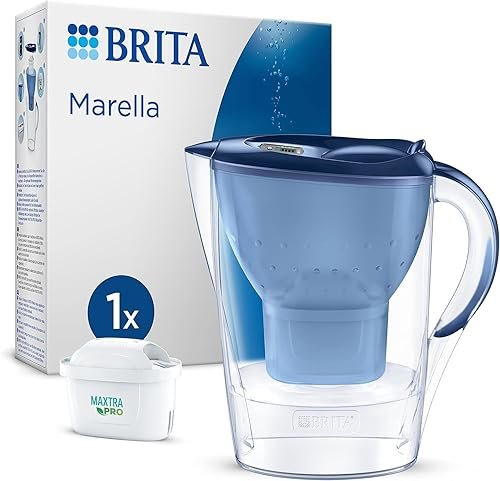
Budget & Simplicity | 2.4L capacity, MAXTRA PRO cartridge reduces chlorine | $39 |
 |
Emergency & Travel | 100 tablets, treats 100-200L, NaDCC chlorine formula | $14 |
 |
Faucet-Mount Convenience | 1000L capacity, digital display, 3 water settings | $77 |
 |
Advanced Purification | 6-stage RO, 3s instant heating, no installation | $509 |
BRITA Marella Water Filter Jug, 2.4L
This is the pitcher we recommend to everyone starting out. It’s dead simple. The 2.4L size is perfect for one or two people, and the flip-top lid means you can fill it with one hand. In our testing, the MAXTRA PRO cartridge does a solid job on chlorine taste and odor. It won’t remove lead or viruses, but for making tap water taste better, it’s fantastic value.
- Extremely affordable entry point
- No installation required
- BPA-free and fridge-friendly
- Limited contaminant removal
- Small capacity means frequent refills
- Ongoing filter cost adds up
Ef-Chlor Water Purification Tablets (100 Pack)
These aren’t for daily kitchen use. But if you camp, hike, or want a serious emergency preparedness item, keep these in your bug-out bag. Each tablet treats 1-2 litres using NaDCC, a stable chlorine compound used in global water safety. They’re lightweight, have a long shelf life, and just work. We’ve used them on multi-day treks with no issues.
- Ultra-compact and lightweight
- Effective against bacteria and viruses
- Long shelf life for emergencies
- Leaves a slight chlorine taste
- Not for daily home use
- Doesn’t remove chemical contaminants
Philips Water Ontap Filter AWP3705P3/10
This is a slick faucet-mount option. The digital display that tracks filter life is genuinely useful—no more guessing. The 1000L capacity means you’ll only change the cartridge every 6 months or so for a typical household. The three settings (filtered, unfiltered, shower) are a smart touch, letting you conserve the filter for drinking water only. Installation was straightforward in our test.
- High filter capacity reduces long-term cost
- Digital filter life indicator is accurate
- Easy switch between filtered/unfiltered water
- Higher upfront cost than basic pitchers
- May not fit all faucet types
- Still limited to carbon filtration
Waterdrop CoreRO Countertop RO System (WD-C1H)
This thing is impressive. It’s a full 6-stage reverse osmosis system that requires zero installation—just plug it in. The instant hot water feature (3 seconds!) is a game-changer for tea and oatmeal. The 3:1 pure-to-waste ratio is excellent for an RO unit. Yes, it’s expensive. But for renters or anyone wanting top-tier purification without plumbing work, it’s currently the best we’ve tested. The NSF/ANSI 372 certification for lead-free materials adds trust.
- Powerful RO purification without installation
- Instant hot water is incredibly convenient
- High efficiency with minimal water waste
- Very high upfront cost
- Takes up significant counter space
- Requires electricity
Frequently Asked Questions
- What is the best type of drinking water purifier for home use?
- For most homeowners, an under-sink carbon block or reverse osmosis system offers the best balance of performance, convenience, and cost. Pitchers are great for taste, while RO is best for comprehensive contaminant removal.
- How often should I change my water purifier filter?
- Follow the manufacturer’s schedule exactly. It’s based on capacity, not time alone. A pitcher filter might last 2 months or 40 gallons. An RO pre-filter might last 6-12 months. A clogged filter stops working and can release trapped contaminants.
- Do water purifiers remove beneficial minerals?
- Reverse osmosis and distillation systems do remove minerals like calcium and magnesium. Carbon filters generally do not. Some RO systems add a remineralization stage. The mineral contribution from water is minor compared to food, so this is rarely a health concern.
- Are expensive water purifiers worth it?
- Sometimes. A $500 RO system is worth it if your water has lead or high TDS. A $500 carbon filter is not worth it if a $100 model has the same NSF certifications. Pay for verified performance, not fancy lights or brand names.
- Can a water purifier remove bacteria and viruses?
- Only specific technologies can. Reverse osmosis (with intact membrane), UV purification, and distillation are effective. Standard carbon filters and sediment filters cannot. Check for NSF/ANSI Standard 55 (UV) or 58 (RO) certification for microbiological claims.
- What’s the difference between a water filter and a water purifier?
- Technically, a “purifier” must remove 99.9999% of bacteria and 99.99% of viruses (log 6 and log 4 reduction). Most consumer products are “filters” that reduce contaminants but don’t meet this strict microbiological standard. The terms are used loosely in marketing.
Final Thoughts
After all these years, my advice is simple: don’t overcomplicate it. Start with your water report. If your main complaint is taste, a quality pitcher or faucet filter will transform your water for under $100. If you have known contaminants like lead or want the purest glass possible, invest in a certified under-sink RO system.
The single biggest mistake we see is buying a purifier based on someone else’s needs. Your water is unique. Your kitchen is unique. Use this guide to make an informed choice, stick to a maintenance schedule, and you’ll have great-tasting, safe water for years. For more on specific technologies, explore our deep dives on carbon filtration and other methods.
