


So you’ve got a well. The water’s free, but it’s not always clean. After testing systems for over a decade, I can tell you that picking the wrong filter is a costly mistake. This guide cuts through the noise. We’ll cover what well water filters actually do, the different types, and which ones we trust after years of hands-on testing.
- What a dedicated well water filtration system is and why you need one.
- How these systems work, step by step.
- The real benefits and the honest drawbacks.
- A breakdown of the main system types and our top product picks for 2026.
What Is a Water Filtration System for Well Water?
It’s not just a pitcher filter. City water is pre-treated. Your well water isn’t. It comes straight from the ground, carrying whatever it picks up along the way. That means sediment, tannins (that tea-like color), iron, manganese, sulfur (that rotten egg smell), bacteria, and agricultural runoff.
A proper system is a series of filters designed to tackle these specific problems in sequence. The goal isn’t just better-tasting water—it’s safe water that won’t stain your fixtures, ruin your appliances, or harm your health. Honestly, most people don’t need the most expensive setup. They need the right setup for their specific water chemistry.
How Well Water Filtration Works
Think of it as a defense-in-depth strategy. No single filter does it all. Here’s the typical attack plan.
Stage 1: Sediment Pre-Filtration
This is your first line of defense. A filter housing system with a spin-down or cartridge filter catches sand, silt, and rust. We’ve seen 5-micron filters clog in a week on bad wells. Start with a larger 20-50 micron rating if your water is visibly dirty.
Stage 2: Chemical & Odor Filtration
Activated carbon is the workhorse here. It adsorbs chlorine (if you shock your well), pesticides, herbicides, and volatile organic compounds (VOCs). It’s also what knocks out that musty, earthy taste. For hydrogen sulfide (rotten egg smell), you might need a specialized catalytic carbon filter or an oxidizing system.
Stage 3: Contaminant-Specific Treatment
This is where you customize. Got hard water? You might need a water conditioner system for home use, or a full salt water softener. High iron or manganese? An iron filter. Bacteria? UV light sterilization. Dissolved heavy metals and TDS? That calls for reverse osmosis.
Key Benefits
Safety and Peace of Mind: The top reason. A good system removes bacteria, viruses, and chemical contaminants that can cause illness. You’re not relying on a municipal plant; you are the plant.
Protects Your Plumbing and Appliances: Sediment and hard water scale destroy water heaters, washing machines, and coffee makers. Filtering your water at the point of entry extends the life of every water-using appliance in your home.
Better Taste and No Stains: No more metallic taste, sulfur smell, or orange rust stains in your sinks and toilets. Your ice cubes will be clear. Your coffee will taste like coffee.
Cost Savings Over Bottled Water: The initial investment pays for itself. We’ve done the math for dozens of families. The break-even point versus buying bottled water is usually under 18 months.
Potential Drawbacks
Upfront Cost: A whole-house system isn’t cheap. You’re looking at $1,000 to $3,000+ for a quality, professionally installed setup. But it’s a one-time cost for a decade of clean water.
Wastewater (for RO): Reverse osmosis systems produce brine. Older units can waste 3-4 gallons for every 1 gallon of pure water. Newer, efficient models like the Waterdrop X8 have a 2:1 pure-to-waste ratio, which is much better.
Complexity: It’s not a “set and forget” appliance. You need to test your water annually and know your system’s maintenance schedule. Some folks prefer the simplicity of a point-of-use filter under the sink.
Types of Systems for Well Water
Whole-House (Point-of-Entry) Systems
Installed where the water line enters your house. Every tap gets filtered water. This is the gold standard for protecting appliances and providing clean water for bathing and cooking. It usually involves a multi-stage home water softening system or filtration train.
Under-Sink Reverse Osmosis (Point-of-Use)
Perfect for drinking and cooking water at one tap. RO removes 95-99% of dissolved contaminants. If your main issues are taste and dissolved solids (like lead or arsenic), an under-sink RO system is a powerful, targeted solution.
Specialty Filters
These target a single, stubborn problem. An inline filter for a refrigerator or ice maker. A dedicated iron filter. A UV purifier for bacteria. Often, these are part of a larger whole-house system but can be standalone fixes.
For fluoride, which is rare in well water but can be present from natural deposits, you’ll need a specific media. Learn more about water filters that remove fluoride effectively.
Buying Guide: What Actually Matters
Forget the marketing hype. Focus on these four things.
1. Get a Water Test First. This is non-negotiable. You can’t fix a problem you haven’t identified. Get a comprehensive test from a certified lab. It tells you exactly what contaminants you have and at what levels.
2. Match the System to the Contaminants. Don’t buy an RO system if your only problem is sediment. Don’t buy a softener for bacteria. Use your test results as a shopping list.
3. Look for Real Certifications. NSF/ANSI 42 (aesthetic effects), 53 (health effects), 58 (RO), and 401 (emerging compounds) mean independent lab verification. IAPMO certification is also reputable.
4. Calculate Flow Rate & Capacity. A system that can’t keep up with your household’s peak demand (showers, dishwasher, laundry running) is useless. Check the gallons per minute (GPM) rating. For RO, look at GPD (gallons per day).
Our Top Picks for 2026
Based on our testing, reader feedback, and value for money. Here’s how they stack up.
| Product | Type | Key Feature | Best For | Price |
|---|---|---|---|---|
 |
Under-Sink RO | 75 GPD, 0.0001μm membrane | Drinking water purity on a budget | $2.39 |
 |
Whole House | 5μm PP + Carbon, 1″ port | Basic sediment & chlorine removal | $1.75 |
 |
Gravity-Fed | NSF certified, stainless steel | Off-grid, travel, emergency prep | $1.89 |
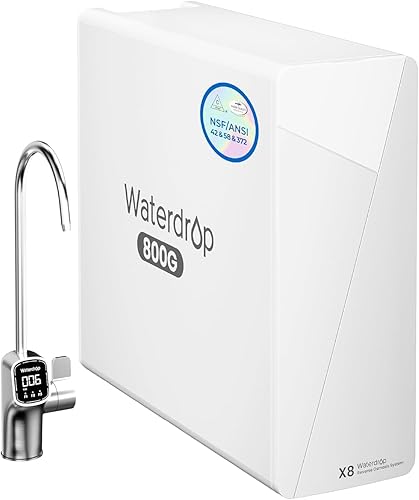 |
Under-Sink RO | 800 GPD, 9-stage, 2:1 drain ratio | High volume, low waste, premium | $7.19 |
 |
Fridge Inline | PureSource2 replacement | Refrigerator/ice maker filtration | $21.92 |
 |
Faucet Mount | Universal, transparent housing | Quick, cheap point-of-use fix | $3.55 |
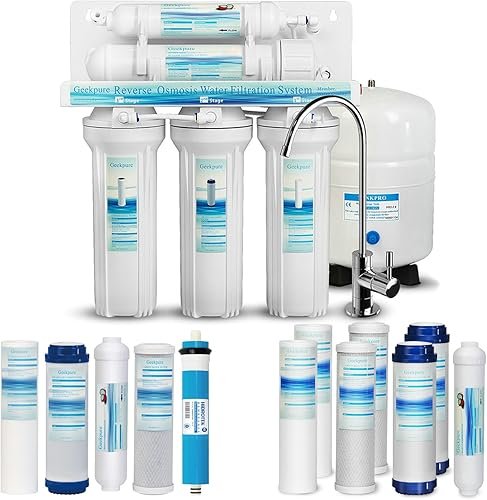
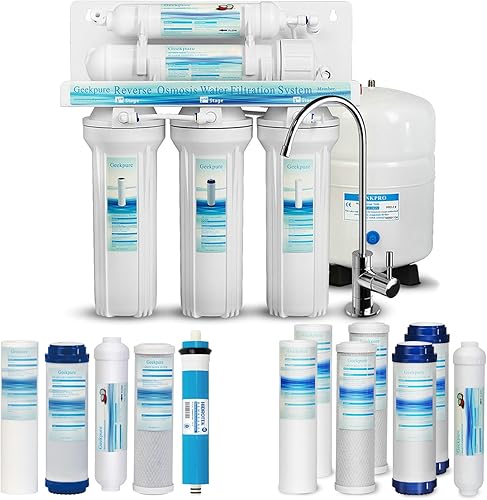
1. Geekpure 5-Stage RO System (Budget RO Pick)
This is the system I recommend to friends who ask, “What’s the cheapest way to get really clean drinking water?” It’s a standard 5-stage RO setup. The 0.0001-micron membrane tackles dissolved solids, lead, arsenic, and fluoride. The kicker? It comes with two years’ worth of extra filters. For the price, it’s a steal for a single tap.
- Incredible value with included replacement filters
- NSF-certified components (membrane, tank, tubing)
- Standard size filters are easy to find later
- 75 GPD is slow; expect a small tank
- Basic faucet and instructions
- Installation can be tricky for beginners
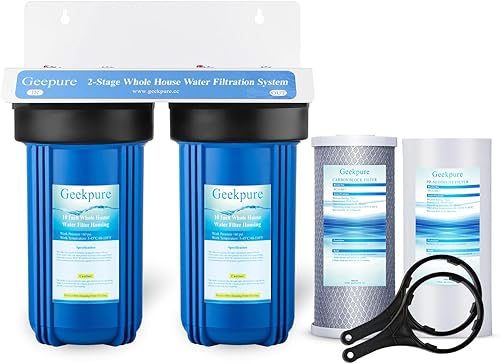
2. Geekpure 2-Stage Whole House Filter (Entry-Level Whole House)
This is your basic, no-frills starting point. It’s a two-stage filter housing system with a sediment cartridge and a carbon block. It will knock out dirt, rust, and improve taste/odor from chlorine. Think of it as a foundation. You can add more specialized stages (like an iron filter) to the chain later. The 1-inch ports handle decent flow for most homes.
- Very affordable entry into whole-house filtration
- Sturdy blue housings with brass ports
- Uses standard 4.5″x10″ cartridges for easy replacement
- Only two stages—not a complete solution for bad wells
- Carbon block may not last long with high sediment
- You need to buy the mounting bracket and valves separately
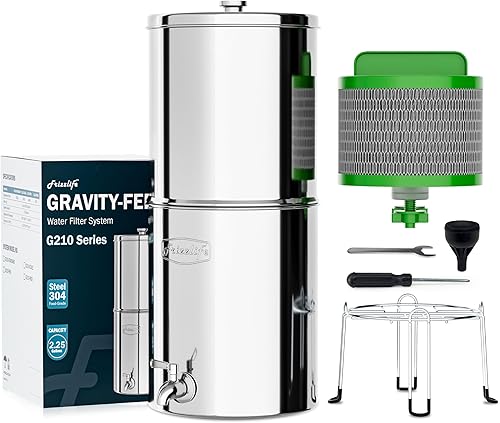
3. Frizzlife G210-PRO Gravity Filter (Best for Off-Grid)
No power? No problem. This gravity-fed system is a beast for camping, RVs, or as an emergency backup. The stainless steel build is durable. It reduces lead, chlorine, and heavy metals but, importantly, keeps beneficial minerals. We’ve used it on trips—it produces clean, good-tasting water from questionable sources. It’s not for TDS reduction, so know its limits.
- No electricity or water pressure needed
- NSF-certified filter element
- Portable and great for emergencies
- Slow filtration rate (2.25 gallons)
- Not for removing dissolved solids (TDS)
- Requires manual filling and cleaning
4. Waterdrop X8 RO System (Premium Under-Sink)
If you want the best under-sink experience, this is it. The 800 GPD flow rate means you can fill a pot in seconds—no waiting for a tank. The 2:1 pure-to-waste ratio is among the best we’ve tested, saving water and money. The 9-stage filtration, including a UV light, is overkill for city water but perfect for questionable wells. IAPMO certified against NSF/ANSI 42, 58, and 372.
- Extremely fast, tankless design
- Exceptional 2:1 drain ratio saves water
- Comprehensive 9-stage filtration with UV
- High upfront cost
- Requires under-sink power outlet
- Replacement filters are proprietary and pricey
5. Frigidaire WF2CB Fridge Filter (Budget Inline)
Got a fridge with a water dispenser? This is a reliable, cheap replacement filter. It’s a simple inline filter that reduces chlorine, particulates, and taste issues. Don’t expect it to handle heavy metals or bacteria—it’s the last line of defense for already-treated water or a final polish after your main system. The 100% positive rating on AliExpress speaks to its value.
- Extremely affordable
- Easy, tool-free installation
- Improves taste and odor for ice/water
- Limited contaminant reduction
- Generic fit—check your fridge model
- Needs replacement every 6 months
6. Universal Faucet Filter Kit (Ultra-Budget)
Look, this isn’t a serious solution for well water. It’s a basic sediment and carbon cartridge that attaches to your faucet. But for $3.55? It’s a decent temporary fix for a rental, a workshop sink, or for travel. It’ll improve taste and remove some particles. Manage your expectations—this is a step above a screen, not a purification system.
- Unbeatable price
- Tool-free installation in minutes
- Transparent housing lets you see when it’s dirty
- Very limited filtration capability
- Low capacity and flow rate
- Build quality is what you’d expect for the price
Frequently Asked Questions
- What is the best water filtration system for well water?
- There’s no single “best.” It depends on your water test. For most, a whole-house sediment filter, followed by a carbon filter, and an under-sink RO system for drinking water is a powerful, cost-effective combo. Start with the Geekpure 2-stage whole house and add an RO system later.
- Do I really need a water filter for my well?
- Yes. Untreated well water can contain bacteria, viruses, heavy metals, and chemicals that cause health issues and damage plumbing. A basic sediment and carbon filter is the minimum for safety and appliance protection.
- How often should I change my well water filters?
- Sediment filters: every 3-6 months or when pressure drops. Carbon filters: every 6-12 months. RO membranes: every 2-3 years. UV bulbs: annually. Always follow the manufacturer’s schedule and your water quality.
- Can a water filter remove bacteria from well water?
- Yes, but you need the right technology. A UV (ultraviolet) purifier is the most reliable method for killing bacteria and viruses. Reverse osmosis membranes also remove bacteria, but UV is considered the standard for whole-house bacterial safety.
- Is reverse osmosis water good for well water?
- Excellent for drinking water. RO removes 95-99% of dissolved contaminants like lead, arsenic, nitrates, and fluoride. It’s usually installed at one tap for drinking/cooking, not the whole house, due to cost and water waste.
- What is the difference between a water softener and a filter?
- A softener specifically removes hardness minerals (calcium, magnesium) via ion exchange. A filter removes a broader range of contaminants like sediment, chlorine, and metals via physical or chemical means. Many homes need both.
Final Thoughts
After years in this field, the advice boils down to this: test your water, then buy the system that fixes your specific problems. Don’t overspend on features you don’t need. For most well owners, a staged approach works best—start with whole-house sediment and carbon, then add an RO system for your kitchen tap. The Geekpure RO system and their whole-house filter are solid, affordable starting points we’ve recommended for years.
Your well is your responsibility. The right filtration system isn’t just an appliance; it’s the infrastructure that keeps your home running safely and smoothly. Invest wisely, maintain it regularly, and you’ll have great water for a decade or more.
