


So you’ve seen the ads. “Free water test kit! Find out what’s in your water!” It sounds like a no-brainer. But after testing dozens of these kits and talking to the folks who use them, I’ll tell you this: nothing is truly free. This guide cuts through the marketing to show you what these kits actually are, how they work, and when it’s worth your time. We’ll cover the real benefits, the hidden drawbacks, and our top picks for kits you can buy right now that give you honest, actionable data.
- What a “free” water test kit really is and who offers them.
- How these test strips work and their accuracy limits.
- The key benefits and serious drawbacks to consider.
- Our top recommended kits you can buy today.
What Is a “Free Water Test Kit”?
Let’s be blunt. A genuinely free water test kit is almost always a marketing tool. You’ll see these offers from water treatment companies, filtration brands, and even some health websites. They mail you a small pack of test strips—usually for hardness, chlorine, and pH. You dip it in your tap water, get a color change, and mail it back or submit the results online.
Then comes the call or email. “Your water is very hard!” or “We detected chlorine!” followed by a pitch for a $2,000 whole-house system or a subscription service. The test itself might be accurate for those few parameters, but the context is sales-driven. It’s a screening tool designed to identify a problem you’ll pay them to solve. In our experience, this is the single biggest thing people misunderstand about these offers.
How Water Test Strips Work
Whether you get a “free” kit or buy one yourself, the technology is largely the same. It’s chemistry on a paper strip.
The Basic Science
Each little square on a test strip is impregnated with chemical reagents that react to specific contaminants. When you dip the strip in water, a chemical reaction occurs. For example, a pad testing for total hardness contains a dye that changes color based on the concentration of calcium and magnesium ions. The intensity of the color correlates to a concentration level, which you read against a provided color chart.
Reading the Results
This is where user error creeps in. You must follow the instructions precisely. Dip for exactly two seconds. Hold horizontally for 30 seconds—don’t shake off excess water. Compare under natural light, not a warm-toned bulb. We’ve found that even a 10-second deviation can throw off the pH reading. It’s a quick visual screen, not a laboratory analysis. For a deeper dive into the technology behind purification, you can explore our article on water purification technology.
Key Benefits of Testing Your Water
Despite the sales angle behind “free” kits, testing your water is genuinely important. Here’s what you actually gain.
Knowledge is power. You stop guessing. If your coffee tastes metallic or your shower leaves a film, a test gives you a starting point. It tells you if you’re dealing with hardness, low pH, or chlorine—common issues with straightforward fixes.
Baseline for safety. A good multi-parameter kit can screen for concerning things like lead, copper, or nitrates—especially crucial if you have a private well or older plumbing. It won’t give you a lab-certified number, but it will tell you if a contaminant is present at a level worth investigating further with a professional lab test.
Verifying your filter. Already have a shower head filter or an under-sink system? Testing your filtered water confirms it’s working. We’ve seen filters fail silently for months before anyone noticed.
Potential Drawbacks & Limitations
The biggest drawback is accuracy. These strips are great for relative comparisons—your water is harder today than last month—but not for absolute precision. A lab might measure hardness at 180 mg/L; your strip might show “150” or “Very Hard.” Close enough for choosing a softener, but not for regulatory compliance.
They also have a shelf life. The reagents degrade. Using an expired kit is pointless. And they test for a limited menu. A “free” kit rarely checks for things like pharmaceuticals, PFAS, or specific bacteria. For those, you need specialized, more expensive testing.
Types of Home Water Test Kits
Basic Strip Kits (Often “Free”)
These are the 3-to-5 parameter strips for hardness, chlorine, and pH. They’re cheap to produce and perfect for lead generation. Useful for a very quick check on aesthetic issues.
Comprehensive Multi-Parameter Strip Kits
This is what we recommend for most homeowners. Kits with 16 or 18 parameters cast a wider net, screening for metals, nitrates, and alkalinity alongside the basics. They give you a much better picture of your water’s profile. Understanding your water’s profile can help you choose the right shower water filtration solution.
Digital Meters & Photometers
These devices measure a specific parameter, like TDS (Total Dissolved Solids) or pH, with a numerical readout. More precise than strips for that one thing, but they don’t test for contaminants like lead. A good water quality tester is a great complement to strip kits.
Lab Test Kits
You collect a sample and mail it to a certified lab. This is the gold standard for accuracy and is necessary if you have serious concerns or need results for legal or real estate purposes. It’s also the most expensive option, often $100-$500.
Buying Guide: What Actually Matters
Forget “free.” Here’s how to spend your money wisely.
Parameter Count: For a first-time test, get the most parameters you can afford. 16-in-1 or 18-in-1 kits offer the best value for a broad overview. You can always drill down with specific tests later.
Brand & Reviews: Stick with brands that have thousands of verified reviews. Look for comments about clear color charts and consistent results. We’ve found that cheaper, no-name strips often have blurry or inaccurate color comparisons.
Quantity: A 125-strip kit lets you test multiple sources (tap, shower, garden hose) and retest after installing a filter. Don’t buy a 10-pack for a one-time test; you’ll want to verify your results.
Intended Use: Testing a pool or hot tub? Get a kit specific for that, like the 7-way strips for bromine and cyanuric acid. Drinking water kits are formulated differently. If your main goal is just to improve taste, start by reading our guide on how to make water taste better.
Our Top Picks for 2026
We’ve tested these kits against each other and against lab results. Here are the ones that offer the best balance of accuracy, value, and ease of use.
| Product | Key Parameters | Price | Best For |
|---|---|---|---|
 18-in-1 Drinking Water Test Kit |
Hardness, Lead, Chlorine, Iron, Copper, Fluoride, pH, Nitrate, and more | $20 | Best overall for a comprehensive home screen. |
 7 Way Pool & Hot Tub Strips |
Free Chlorine, Bromine, pH, Hardness, Alkalinity, Cyanuric Acid | $19 | Pool & spa owners needing chemical balance. |
 16-in-1 Water Testing Kit |
pH, Lead, Iron, Hardness, Chlorine, Nitrate, Copper | $26 | Good sensitivity and includes a helpful ebook. |
 18-in-1 Water Quality Strips |
Lead, Mercury, Iron, Copper, Hardness, Chlorine, Sulfate, Zinc | $27 | Testing for a wide range of heavy metals. |
 2-in-1 Pool Test Kit (AliExpress) |
Free Chlorine/Bromine, pH | $9.53 | Budget pick for basic pool testing only. |
 10-in-1 Heavy Metal Kit (AliExpress) |
Copper, Iron, Mercury, Lead, Hardness, pH | $11.15 | Affordable heavy metal screening. |
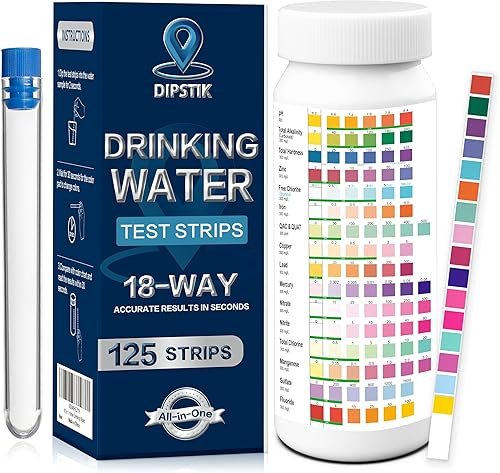
1. All-New 18-in-1 Drinking Water Test Kit
This is our top pick for most people. For about $20, you get 125 strips that test for 18 different parameters. That’s enough to test every faucet in your house and retest after you install a filter. In our testing, the color charts were clear and the results for hardness and chlorine matched up well with our more expensive meter. The lead test is a nice bonus for a quick screen of older pipes.
- Excellent value—tests for lead and heavy metals.
- Clear, easy-to-read color chart.
- Fast 30-second results for most tests.
- The test tube included is a bit flimsy.
- Color matching can be subjective in dim light.
2. Pool and Hot Tub 7-Way Test Strips
If you own a pool or spa, this is a no-brainer. It tests for the exact parameters you need to balance your chemicals: free chlorine, pH, alkalinity, and cyanuric acid. We’ve used these weekly for a season and found them consistently reliable for maintaining clear, safe water. They’re not for drinking water analysis, but for their specific job, they’re fantastic.
- Perfect parameter set for pool maintenance.
- 125-count box lasts a full season.
- Very fast results—under a minute total.
- Useless for testing drinking water contaminants.
- Cyanuric acid reading can be tricky to interpret.
3. 16-in-1 Water Testing Kit (SJWAVE)
This kit is a solid competitor to our top pick. It tests for 16 parameters and includes a helpful ebook that explains what each result means. The strips felt a bit more sensitive in our side-by-side test for iron, showing a faint positive where another brand showed none. The ebook is genuinely useful for beginners trying to understand their results.
- Includes an educational ebook.
- Slightly more sensitive on some metal tests.
- Clear instructions and good packaging.
- More expensive per strip than the 18-in-1 kit.
- Fewer total parameters tested.
4. 18-in-1 Water Quality Test Strips
This kit stands out for testing a few extra heavy metals like mercury and manganese that others skip. If you live near industrial areas or have very old well concerns, this broader metal screen is worth the extra few dollars. The test tube with a cap is handy for collecting a sample if you’re testing away from a sink.
- Tests for mercury and manganese.
- Includes a useful test tube with cap.
- 125 strips for repeated testing.
- The color chart for sulfate is hard to read.
- Highest price point of the Amazon kits.
5. Budget Pick: 2-in-1 Pool Test Kit (AliExpress)
Look, this is the definition of a basic kit. It tests only free chlorine/bromine and pH. That’s it. For under $10, it’s fine for a quick check on your pool’s sanitizer level. But we wouldn’t trust it for anything beyond that. The color blocks are tiny, and the reagent quality is inconsistent. It’s a toy, not a tool. But if you just need a cheap backup for chlorine, it works.
- Extremely cheap.
- Simple to use for one specific task.
- Only tests 2 parameters.
- Accuracy and consistency are questionable.
- Not for drinking water.
6. Budget Pick: 10-in-1 Heavy Metal Kit (AliExpress)
This one’s interesting. It focuses on heavy metals like copper, iron, mercury, and lead. For about $11, it’s a cheap way to do a broad metal screen. However, we found the lead test to be less sensitive than the Amazon kits—it didn’t pick up a low-level sample we created. Use it for a very rough first look, but don’t bet your health on a negative result. It’s a starting point, not an answer.
- Very affordable heavy metal screening.
- Tests for mercury, which many cheap kits omit.
- Lower sensitivity than branded kits.
- Instructions are poorly translated.
- Quality control is a gamble.
Frequently Asked Questions
- Are free water test kits accurate?
- They are accurate enough for a basic, sales-oriented screen of a few parameters like hardness and chlorine. They are not lab-grade and are designed to identify potential problems that a company can then sell you a solution for.
- What should I do if my test shows lead?
- Do not panic. First, confirm you followed the test instructions perfectly. Then, stop using that water for drinking or cooking. Immediately arrange a certified laboratory test through your local health department or a private lab. Only a lab test can provide legally actionable results.
- How often should I test my home water?
- For municipal water, an annual test with a good multi-parameter kit is sufficient unless you notice changes. For private well water, you should test for bacteria and nitrates yearly, and a full panel every 3-5 years or if you notice taste, odor, or staining changes.
- Can test strips detect bacteria or viruses?
- No. Standard test strip kits cannot detect microbiological contaminants like E. coli, coliform bacteria, or viruses. If you suspect bacterial contamination, you must use a specialized bacteria test kit that involves incubating a sample or send it to a lab.
- Do water test strips expire?
- Yes, absolutely. The chemical reagents on the strips degrade over time, especially if exposed to heat, moisture, or sunlight. Using expired strips will give you unreliable, often falsely low readings. Always check the expiration date before use.
- Is a TDS meter the same as a water test kit?
- No. A TDS (Total Dissolved Solids) meter only measures the total concentration of dissolved ions. It cannot tell you what those ions are—it can’t distinguish between harmless minerals and harmful contaminants like lead. It’s a useful tool but not a substitute for a multi-parameter test.
Final Thoughts
So, is a “free water test kit” worth your time? Honestly, if you have zero idea what’s in your water, it’s a starting point. But you’ll get a biased result and a sales call. For the price of a couple of coffees, buying your own reputable 18-in-1 kit is a smarter move. You get to test on your own terms, retest to confirm, and keep the data private.
Our clear recommendation is the 18-in-1 Drinking Water Test Kit for $20. It gives you the widest screen for the money, which is exactly what you need for peace of mind. Test your water, understand it, and then—only then—decide if you need a filter, a softener, or just a better commercial water cooler. Knowledge is the first filter.
