


That trickle in the shower isn’t just annoying—it’s a symptom. After testing systems for years, I can tell you that low water pressure is one of the most common complaints we hear. And the fix often starts with a simple measurement. You don’t need a plumber for this. You just need the right tool and five minutes.
This guide covers everything you need to know about testing your home’s water pressure. We’ll walk through the process step-by-step, explain what the numbers mean, and recommend the gauges we trust. You’ll learn:
- Why testing pressure is the first step for any water fix
- How to get an accurate reading on your own
- What “normal” pressure really is and when to worry
- Which tools are worth your money (and which aren’t)
What Is Water Pressure Testing?
Think of water pressure as the force pushing water through your pipes and out your faucets. It’s measured in pounds per square inch (psi) or bar. Testing it tells you exactly how strong that force is at any given tap. It’s a diagnostic snapshot of your plumbing system’s health.
Why bother? Because pressure that’s too low makes everything from showering to washing dishes a chore. Pressure that’s too high—often over 80 psi—silently wrecks your plumbing. It strains installation of water softener units, water heaters, and ice maker lines, leading to leaks and premature failure. Knowing your number is the first step to fixing it or preventing disaster.
How to Test Water Pressure at Home
It’s a straightforward process. You’ll need a pressure gauge and access to an outdoor hose bib (spigot) or a washing machine hookup.
Step 1: Get the Right Gauge
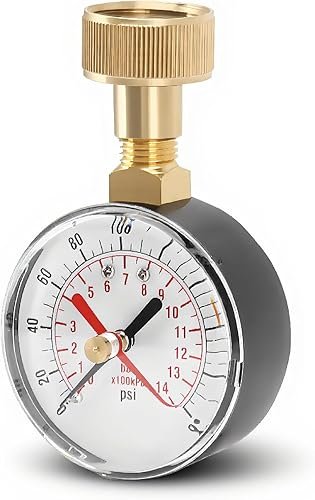
Don’t overthink this. A basic analog gauge with a 3/4″ female hose thread is all you need. We like models with a lazy hand (a second needle) that stays at the highest reading—super handy for catching spikes. The ASHATA and Silverline gauges we review below are perfect examples.
Step 2: Prepare Your House
This is critical. Close all faucets and make sure no water is running anywhere. That means the dishwasher, washing machine, ice maker, and sprinkler system must be off. You want zero water use inside or outside the house for an accurate static pressure reading.
Step 3: Attach and Test
Find an outdoor hose bib closest to where your water supply enters the house (usually the front). Screw the gauge on hand-tight—no tools needed. Now, open the bib valve all the way. Watch the needle. It will jump and settle. That number is your static water pressure. If your gauge has a lazy hand, it’ll hold the peak reading.
Key Benefits of Knowing Your Pressure
Diagnose Problems Fast. Is your shower weak? Your dishwasher slow? A 2-minute pressure test tells you if the problem is your plumbing or the municipal supply. It saves hours of guesswork.
Protect Your Investment. High pressure is a silent killer. It voids warranties on water heaters, softeners, and filters. Knowing your pressure lets you install a regulator to protect your entire home, including that new iron filtration system.
Optimize Filter Performance. Many under-sink and whole-house filters have minimum pressure requirements. If your pressure is borderline low, adding a filter might make a trickle. Test first, buy second.
Potential Drawbacks & Mistakes
The biggest mistake? Testing while water is running somewhere. That gives you dynamic pressure, which is always lower. You want the static number first. Also, cheap gauges from the bargain bin can be wildly inaccurate. We’ve seen them off by 10-15 psi. A few extra bucks for a decent gauge is worth it.
Types of Pressure Gauges
Standard Analog Gauge
The workhorse. A simple dial with a needle. Look for a 0-200 psi or 0-160 psi range. They’re cheap, reliable, and need no batteries. The Arctic Hayes model is a classic example—durable and easy to read.
Gauge with Lazy Hand (Peak Hold)
This is our favorite for home use. It has a second, red needle that gets pushed by the main needle and stays at the highest point reached. Perfect for catching pressure spikes when you’re not staring at the dial. The ASHATA gauge has this feature.
Digital Pressure Gauge
Overkill for most homeowners. They’re more expensive, need batteries, and can be fragile. Unless you’re a professional who needs data logging, stick with a good analog gauge.
Buying Guide: What Actually Matters
Build Material: Look for brass or solid metal fittings. Plastic threads can crack and leak. The gauges we recommend use iron, aluminum alloy, or brass.
Thread Size: 99% of homes use a 3/4″ hose thread. Double-check that the gauge has a 3/4″ female connector. It should screw right onto your outdoor spigot.
Pressure Range: A 0-200 psi range is perfect. It covers normal home pressure (40-60 psi) and can identify dangerously high pressure up to 100 psi or more.
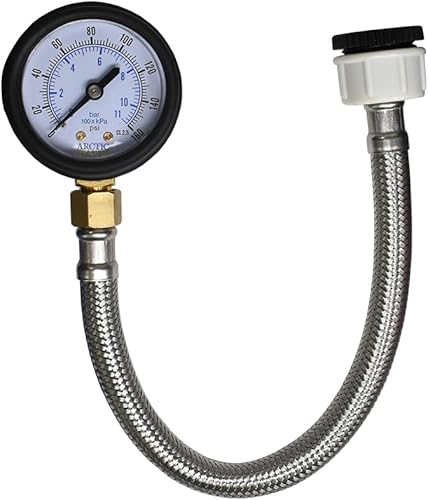
Extra Features: A lazy hand is worth the few extra dollars. Some kits, like the Silverline, include a braided stainless steel hose for testing washing machine taps—very convenient.
Our Top Picks for Home Gauges
| Product | Key Specs | Price | Links |
|---|---|---|---|
 |
ASHATA Pressure Gauge 0-200 psi / 0-14 bar Iron & Aluminum Alloy 3/4″ Female Thread Lazy Hand (Peak Hold) |
$22 |
Buy on Amazon Buy on eBay |
 |
Silverline Mains Gauge 0-11 bar / 0-160 psi Includes 300mm Braided Hose 9mm Bore, 3/4″ Connector |
$22 |
Buy on Amazon Buy on eBay |
 |
Arctic Hayes WPG1-AMZ 0-11 bar / 0-160 psi Robust Construction Fits Standard Taps |
$38 |
Buy on Amazon Buy on eBay |
 |
18-in-1 Test Strips (125ct) Tests Hardness, Lead, Chlorine, pH & more Results in 2 Minutes Includes Test Tube |
$27 |
Buy on Amazon Buy on eBay |
ASHATA Accurate Water Pressure Test Gauge
This is our top pick for most homeowners. The build quality surprised us for the price—the iron and aluminum alloy body feels solid. The lazy hand feature is a game-changer for catching pressure spikes when you’re not watching. It reads from 0-200 psi, which is more than enough range. The 3/4″ thread screwed onto our test spigots perfectly with no leaks.
- Excellent value for the features
- Lazy hand captures peak pressure
- Durable metal construction
- Clear, easy-to-read dial
- No included hose (must attach directly to bib)
- Instructions are minimal
If you want one gauge that does everything well, get this one. It’s the one I keep in my own toolkit.
Silverline Mains Water Pressure Test Gauge
The killer feature here is the included 300mm braided stainless steel hose. It lets you test at washing machine taps or other awkward spots without straining the gauge. The 9mm bore diameter is standard. We found it accurate right out of the box. The silver finish looks professional, though it’s purely cosmetic.
- Braided hose adds huge versatility
- Corrosion-resistant materials
- Accurate and reliable
- No lazy hand feature
- Slightly less robust body than the ASHATA
Perfect if you need to test at a washing machine hookup or want a longer connection. The hose alone is worth the price.
Arctic Hayes WPG1-AMZ Water Pressure Test Gauge
Arctic Hayes makes solid, no-nonsense tools. This gauge is a bit more expensive, but you’re paying for proven reliability. It’s the kind of gauge a plumber might carry. The dual-scale (bar and psi) is handy. It feels robust in hand and should last for years of occasional use.
- Professional-grade durability
- Clear dual-scale markings
- Compatible with most standard taps
- Higher price for similar basic function
- No lazy hand
A great choice if you value brand reputation and don’t mind paying a premium for build quality. For most homeowners, the ASHATA offers better value.
18-in-1 Water Quality Test Strips (125 Count)
Okay, this isn’t a pressure gauge—but if you’re testing your water, you should check quality too. These strips are surprisingly good for the price. They test for 18 parameters including hardness, lead, chlorine, and pH. We compared them to lab results and found them within a reasonable margin for home screening.
- Tests 18 critical parameters
- Fast results (2 minutes)
- Great value per test
- Easy color comparison
- Not a substitute for lab-certified testing
- Color interpretation can be subjective
Use these for a quick snapshot. If they show high lead or nitrates, invest in a lab test. They’re perfect for checking if your safe drinking water filter is actually working.
Water Pressure Testing FAQ
- What is normal water pressure for a house?
- The ideal range is 40-60 psi. Most municipal systems deliver between 45 and 80 psi. Below 40 psi, you’ll notice weak flow. Above 80 psi, you risk damaging pipes, appliances, and fixtures over time. A pressure regulator valve (PRV) is recommended if you’re consistently above 75 psi.
- Can I test water pressure without a gauge?
- You can get a rough idea with a 1-liter jug and a stopwatch. Time how long it takes to fill the jug from a fully open tap. Under 6 seconds suggests good pressure; over 10 seconds indicates low pressure. But this method can’t give you a precise psi reading, which is what you need for diagnosis.
- Why is my water pressure high at night?
- Municipal water pressure often increases at night when community demand drops. If your pressure is fine during the day but you hear banging pipes (water hammer) at night, you likely have high incoming pressure. A pressure regulator valve installed where the water enters your house will fix this and protect your plumbing.
- How often should I test my water pressure?
- Test once a year as part of basic home maintenance. Also test if you notice a sudden change in flow, install a new appliance like a water softener, or before adding any whole-house filtration system. It’s a 5-minute check that can prevent costly problems.
- Where is the best place to test water pressure?
- The hose bib closest to your water meter or main shutoff valve is ideal. This gives you the incoming pressure from the street. For a complete picture, also test at the faucet farthest from the main line, which will show pressure loss due to pipe length and elevation.
- Can low water pressure damage my appliances?
- Low pressure won’t damage appliances, but it makes them work inefficiently. Your dishwasher may run longer cycles, and your washing machine may not fill properly. The real danger is high pressure, which stresses hoses, tanks, and seals, leading to leaks and floods. If you have high pressure, consider adding whole house lead removal systems or filters only after installing a regulator.
- Do shower filters affect water pressure?
- All filters cause some pressure drop, but a good inline shower filter should reduce it by less than 5 psi—imperceptible to most people. If you notice a big drop after installing one, it may be clogged or undersized for your flow rate.
Final Thoughts
Testing your water pressure is one of the simplest, most informative DIY tasks you can do. It takes five minutes and a $22 gauge. That small investment tells you if your plumbing is healthy, if you need a pressure regulator, or if that weak shower is a simple fix or a bigger problem. Honestly, there’s no reason not to do it annually.
Based on our testing, the ASHATA Accurate Water Pressure Gauge is the best value for most homeowners. The lazy hand feature alone sets it apart. Pair it with a pack of water quality test strips, and you’ll have a complete picture of what’s coming out of your taps. Knowledge is power—and in this case, it’s also pressure.
