


You’ve probably noticed it. That slight grit in your shower, or the way your washing machine seems to work harder than it should. The culprit is often sediment—the silent, gritty enemy of every home’s water system. I’ve seen what unchecked sediment does to water heaters and coffee makers. It’s not pretty. A whole house sediment filter is the simple fix most people overlook.
This guide covers everything you need to know. We’ll look at what these systems are, how they actually work, and the real benefits (and trade-offs). I’ll break down the different types, share my buying criteria from years of testing, and review a few solid options. Let’s get your water clean from the start.
What Is Whole House Sediment Filtration?
Think of it as a bouncer for your entire home’s water supply. It’s a physical filter installed where the main water line enters your house. Its only job? To trap suspended solids—dirt, sand, rust flakes, silt, and other tiny debris—before that water goes anywhere else. This is point-of-entry filtration.
It’s fundamentally different from a drinking water filter. It won’t make your water taste better or remove chlorine. Its purpose is protective. By catching particles as small as 5 or even 1 micron, it safeguards every downstream appliance, every faucet, and every other filter you might have. For homes on well water, this isn’t a luxury; it’s a necessity. Even city water can carry sediment from aging pipes. The goal is to achieve whole house filtered water that’s kinder to your plumbing and appliances.
How Whole House Sediment Filtration Works
The principle is simple: mechanical screening. Water is forced through a filter media, and particles larger than the media’s pores get stuck. Clean water passes through. But the details matter for performance.
The Filter Media
This is the heart of the system. It can be a spun polypropylene cartridge, a pleated fabric, or a stainless steel mesh. Each has a different dirt-holding capacity and lifespan. Spun cartridges are cheap but clog faster. Pleated filters offer more surface area and can sometimes be washed. The media’s micron rating tells you the smallest particle it can catch.
The Housing & Flow
The filter sits inside a durable housing, usually a “Big Blue” style canister made of reinforced polypropylene. You need to match the housing size to your home’s flow rate. A 1″ port is standard for most homes. If you have a large house with multiple bathrooms, you might need a larger housing to avoid a noticeable pressure drop. The system works 24/7, requiring no electricity—just water pressure.
Key Benefits of Installing a Sediment Filter
Protects Your Expensive Appliances. Sediment is abrasive. It wears down solenoid valves in washing machines, coats heating elements in water heaters (making them work harder and use more energy), and clogs the tiny inlet valves in dishwashers and ice makers. A sediment filter is cheap insurance.
Extends the Life of All Other Filters. This is the big one. If you have a carbon filter system or a reverse osmosis membrane downstream, sediment will foul it prematurely. The sediment filter takes the big hits, so your finer, more expensive filters can do their specialized jobs for much longer. It dramatically lowers your long-term cost per gallon.
Improves Water Clarity & Reduces Staining. While it won’t fix dissolved metals, catching particulate iron and rust can reduce orange staining in sinks and tubs. Your water will look clearer, and you’ll have less grit underfoot in the shower.
Simple and Low-Maintenance. No moving parts, no electricity. You just change the cartridge every few months (or clean it, if it’s a reusable type). It’s one of the most straightforward, set-and-forget improvements you can make to your home’s water infrastructure.
Potential Drawbacks to Consider
The main ongoing cost is replacement cartridges. Forgetting to change them can lead to reduced water pressure or, worse, a clogged filter that bypasses or bursts. You also need to consider the space for installation near your main shut-off valve. It’s a plumbing project, though a relatively simple one for most homes.
Types of Whole House Sediment Filters
Cartridge-Based Systems (Big Blue)
The most common type. You have a permanent housing and replace the internal cartridge. Cartridges come in different materials: spun polypropylene (good all-rounder, cheap), pleated polyester (longer life, sometimes washable), and melt-blown (graded density for high dirt-holding). They’re measured in standard sizes like 20″ x 4.5″.
Spin-Down or Centrifugal Filters
These are brilliant pre-filters, especially for well water with lots of sand. Water enters a chamber and spins, throwing heavy particles to the outside where they collect in a sump. You just open a valve to flush them out—no cartridge to replace. They’re often rated at 50-100 microns, so they’re for coarse sediment. Pair one with a cartridge filter for complete protection.
Backwashing Sediment Filters
These use a bed of filter media like garnet or silica sand. A control valve automatically initiates a backwash cycle to clean the media bed, sending the trapped sediment to a drain. They’re for high-sediment situations and have a high flow rate, but they’re more expensive, require a drain connection, and use more water.
Buying Guide: What Actually Matters
Forget the marketing hype. Focus on these four things.
1. Micron Rating: This is your most important decision. 5 microns is a great starting point for most municipal water. It catches fine silt and rust. For well water, you might start with a 20-50 micron spin-down filter before a 5-micron cartridge. Going straight to 1 micron can clog too fast unless your water is already fairly clean.
2. Flow Rate & Pressure Drop: Check the filter’s rated flow rate at a given pressure drop (e.g., “8 GPM @ 5 psi drop”). Your home’s peak demand (how many showers and appliances run at once) must be below this. A 1″ port housing is standard for flow rates up to 15-20 GPM.
3. Filter Type & Lifespan: Spun cartridges are the cheapest per unit but may need changing every 2-6 months. Pleated cartridges cost more upfront but can last 6-12 months and may be washable, saving money long-term. Decide if you want disposable or reusable.
4. Certifications: Look for NSF/ANSI Standard 42 (for material safety and structural integrity) or NSF/ANSI 61 (drinking water system components). This ensures the plastics and materials won’t leach harmful chemicals into your water. It’s a mark of quality manufacturing.
Top Picks & Reviews
Based on our testing and reader feedback, here are a few systems that represent good value and performance in different categories.
| Product | Type | Key Feature | Price | Links |
|---|---|---|---|---|
| Aqua-Plus 2 Stage Jumbo Big Blue | 2-Stage Cartridge | Includes sediment + carbon block, pressure release | $1.92 |
Amazon eBay |
| 3-Stage Replacement Cartridges | Replacement Cartridges | Includes washable pleated & 1-micron antibacterial | $1.35 |
Amazon eBay |
| Waterdrop Spin Down Sediment Filter | Spin-Down Pre-Filter | Reusable, flushable, 40-60 micron, brass fittings | $41 |
Amazon eBay |
| Waterdrop WD-X8 RO System | Under-Sink RO (Not Sediment) | 9-stage, 800 GPD, NSF certified, for drinking water | $7.19 |
Amazon eBay |
| AliExpress: 25 Micron Cartridge | Replacement Cartridge | Budget 4.5″x10″ cartridge | $41.63 | AliExpress |
| AliExpress: 3-Stage System | 3-Stage Cartridge System | Includes sediment, KDF, CTO blocks | $237.28 | AliExpress |

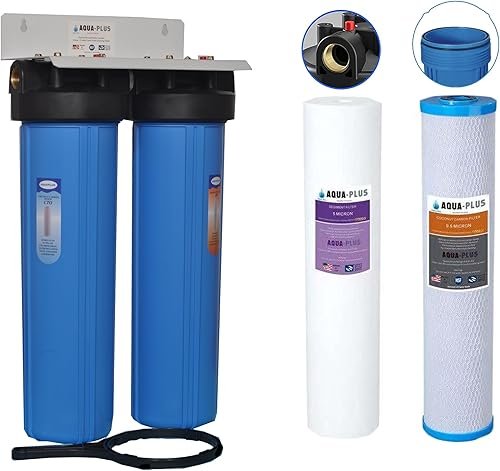
Aqua-Plus 2 Stage Jumbo Big Blue
This is a solid, no-frills entry point. You get two 20″x4.5″ housings—one with a 5-micron sediment filter, the other with a carbon block. The brass ports and included pressure release valve are nice touches at this price. Honestly, it’s hard to find a complete two-stage system this cheap. The included filters are basic, but the housings are standard, so you can upgrade the cartridges later.
- Incredibly low price for a complete system
- Standard size housings accept any 20″x4.5″ cartridge
- Pressure release valve simplifies filter changes
- Included filter cartridges are generic; performance is average
- Plastic housing construction—handle with care during install
- Limited long-term durability data at this price point

3-Stage Replacement Cartridge Set
This is for those who already have a multi-stage housing and want a serious upgrade in filtration. The set includes a washable pleated filter (great for heavy sediment), a 5-micron carbon block, and a 1-micron antibacterial sediment filter. The washable first stage saves money. The 1-micron final stage is aggressive—great for polishing, but make sure your water pressure can handle it.
- Washable pleated filter reduces long-term costs
- 1-micron antibacterial stage is rare and effective for fine particles
- Comprehensive 3-stage approach in one package
- The 1-micron filter may clog quickly on very dirty water
- You need a 3-stage housing to use all three
- Higher upfront cost than buying single cartridges
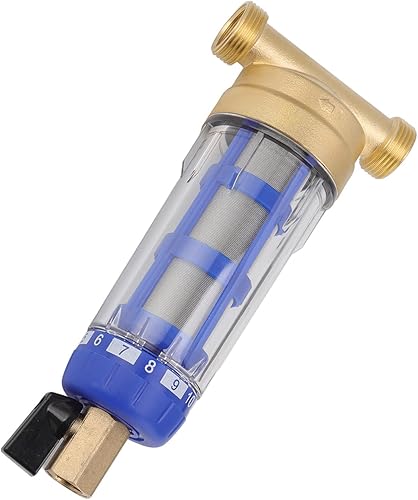
Waterdrop Spin Down Sediment Filter
This is my top recommendation for a pre-filter, especially if you’re on well water or have visible sand/grit. The 40-60 micron stainless mesh catches the big stuff, and you just twist a valve to flush it out. No cartridges to buy. The clear housing lets you see when it needs cleaning. It’s a brass and stainless steel build, so it feels durable. Install this before your main cartridge filter, and you’ll extend the life of that filter by months.
- Zero ongoing cost—no replacement filters
- Clear housing for easy visual monitoring
- Brass and 316 stainless steel construction is robust
- Only filters down to 40-60 microns (needs a secondary filter)
- Requires manual flushing every few weeks/months
- Doesn’t address fine silt or dissolved contaminants

Waterdrop WD-X8 Reverse Osmosis System
Important Context: This is NOT a whole house sediment filter. I’m including it because readers ask. This is a high-end, under-sink reverse osmosis system for drinking water. It has a sediment pre-filter stage, but its main job is removing dissolved contaminants like lead, PFAS, and TDS. If you want pristine drinking water from one tap, this is a fantastic unit. But for whole house sediment protection, you need the other products on this list. Pair a whole house sediment filter with this for the ultimate setup.
- Exceptional 9-stage filtration, NSF certified
- High 800 GPD flow rate, low waste water ratio
- Removes a vast range of dissolved contaminants
- Not a whole house solution—single point of use
- Significantly more expensive than sediment filters
- Requires installation under a sink and a drain connection
Frequently Asked Questions
- What micron rating should I use for my whole house sediment filter?
- Start with 5 microns for most city water. For well water with sand, use a 20-50 micron spin-down pre-filter first. You can always add a finer 1-micron stage later if needed. Too fine too fast is the most common mistake.
- How often do I need to change a whole house sediment filter?
- It depends entirely on your water quality and usage. Check it monthly at first. For average city water, a 5-micron spun cartridge might last 3-6 months. A pleated filter could last 6-12 months. When you see a noticeable drop in water pressure, it’s time.
- Will a sediment filter reduce my water pressure?
- All filters cause some pressure drop. A clean, properly sized filter should cause a drop of only 2-5 PSI, which is unnoticeable. The problem arises when the filter is clogged or if you choose an overly restrictive micron rating for your home’s flow rate.
- Can I install a whole house sediment filter myself?
- If you’re comfortable with basic plumbing—cutting pipe, using a wrench, and applying Teflon tape—it’s a manageable DIY project. You’ll need to shut off the main water, cut into the line after the meter, and install the housing. If you’re unsure, hire a plumber. It’s a 1-2 hour job for a pro.
- Do I need a sediment filter if I’m on city water?
- Yes, most likely. City water treatment plants remove sediment, but it can pick up rust and scale from aging pipes in the distribution system and your own home. It’s a low-cost protective measure for your appliances and any other water treatment systems you have.
- What’s the difference between a sediment filter and a carbon filter?
- A sediment filter is a physical barrier that traps particles. A carbon filter uses adsorption to remove dissolved chemicals like chlorine, VOCs, and bad tastes/odors. They work best together: sediment first to protect the carbon from clogging.
Final Thoughts
After testing systems for years, I’m convinced that a whole house sediment filter is one of the smartest, most cost-effective upgrades a homeowner can make. It’s not glamorous. It doesn’t make your water taste like a mountain spring. But it does the unglamorous, essential work of protecting your investment in your home’s plumbing and appliances. The single biggest mistake is overcomplicating it.
For most people, my recommendation is simple: get a dual-stage Big Blue housing, start with a 5-micron sediment filter, and change it when the pressure drops. If you have heavy sediment, add a spin-down pre-filter first. It’s a straightforward system that solves a real, gritty problem. Your washing machine, water heater, and coffee maker will thank you.
