


Whole House Lead Removal Systems: Your 2026 Guide to Cleaner Water
You’ve tested your water. The lead report came back, and now you’re staring at the results, wondering how to protect every tap in the house. It’s a common story. A single under-sink filter won’t cut it when the problem is in your main line. That’s where whole house lead removal comes in.
This guide covers everything you need to know. We’ll break down how these systems work, their real benefits, the honest drawbacks, and which type might fit your home. We’ve also tested and vetted specific products to help you choose with confidence.
What Is Whole House Lead Removal?
Whole house lead removal is exactly what it sounds like: a point-of-entry filtration system installed where your main water line enters your home. Its job is to strip lead (and often other contaminants) from every drop of water before it reaches your faucets, showerheads, or appliances. This is a fundamentally different approach than a kitchen sink filter, which only treats water at one location.
Why does this matter? Lead doesn’t just come from the municipal supply. It frequently leaches from your own plumbing—old lead service lines, lead solder on copper pipes, or brass fixtures. A whole house system acts as a final, comprehensive barrier right at your home’s front door. It’s the only way to guarantee that water from the bathroom tap or the garden hose is also safe.
How Whole House Lead Removal Works
These systems aren’t magic boxes. They rely on proven physical and chemical processes to trap or neutralize lead. Most whole house setups are multi-stage, with each stage playing a specific role.
Stage 1: Sediment Pre-Filtration
Water first hits a sediment filter—usually a pleated cartridge or a spin-down screen. This catches rust, sand, and other large particles. It’s crucial because sediment can clog and foul the more expensive filters downstream. Think of it as the bouncer at the door, keeping the riff-raff out so the main act can do its job properly.
Stage 2: Primary Contaminant Reduction
This is the heart of the system. Here, you’ll typically find a dense carbon filter cartridge—often a carbon block. Lead removal works through adsorption. The carbon’s massive surface area, full of microscopic pores, chemically binds to lead ions as water passes through. The key metric is the micron rating. For lead, you need a filter rated at 1 micron or less. A 5-micron filter might catch particulate lead but will miss dissolved lead ions.
Stage 3 (Optional): Additional Treatment
Some systems add a third stage. This could be another carbon block for chlorine taste and odor, or a specialized media for fluoride reduction. If your water has multiple issues, a dedicated fluoride filter system stage might be part of your whole house solution. The goal is a tailored setup that addresses your specific water report.
Key Benefits of a Whole House System
Complete Protection: Every faucet, shower, and appliance gets filtered water. This is non-negotiable for homes with children or pregnant women, where lead exposure is most dangerous.
Appliance Longevity: By removing sediment and corrosive elements, you protect your water heater, washing machine, and dishwasher from scale and damage. It’s a hidden cost-saver.
Peace of Mind: You don’t have to remember which taps are “safe.” It’s a single, passive solution that works 24/7. Based on reader feedback, this is the benefit people appreciate most after installation.
Potential Drawbacks to Consider
Flow Rate Impact: A dense 1-micron filter will cause some pressure drop. In homes with already low water pressure, this can be noticeable. You must size the system correctly for your home’s peak demand.
Maintenance is Mandatory: Filters saturate. Forgetting to change them doesn’t just stop protection; it can make things worse as trapped contaminants break through. You’ll need to set a calendar reminder.
Not a Magic Bullet: If your lead service line is the primary source, a filter is a band-aid. The best long-term solution is always to replace the lead pipe itself. A filter buys you safety in the meantime.
Types of Whole House Lead Removal Systems
Big Blue Cartridge Systems
The most common and affordable option. You install a large filter housing (usually in the “Big Blue” 10″ or 20″ size) and insert replacement cartridges. This is what most homeowners end up with. They’re flexible—you can swap sediment and carbon blocks as needed. The main hassle is having a good filter housing wrench on hand for cartridge changes.
Backwashing Tank Systems
These are larger, tank-based systems that use granular activated carbon (GAC) or other media. They automatically backwash to clean the media, extending its life to years instead of months. Higher upfront cost, lower maintenance frequency. They’re overkill for many homes but great for high sediment or high-flow applications.
Multi-Stage Canister Racks
For serious customization. These are pre-plumbed racks with multiple filter housings in sequence. You can combine sediment, carbon block, and specialty media cartridges. Seeing the filters in a clear filter housing lets you monitor discoloration and know when a change is due—super handy.
Buying Guide: What Actually Matters
Certification is King: Ignore any lead removal claim without NSF/ANSI 53 certification. This is your only proof of performance.
Size it Right: Check the filter’s service flow rate (in gallons or liters per minute). It must exceed your home’s peak demand (when multiple showers and appliances run). Undersizing causes terrible pressure.
Micron Rating: For dissolved lead, 1 micron absolute is the target. A “5-micron carbon block” might not cut it for lead ions.
Total Cost of Ownership: Calculate the cost per year. A cheap filter changed monthly might cost more than a premium filter changed every six months. Don’t just look at the initial price tag.
Your Water Report: Test first. If lead is your only concern, a dedicated lead filter is perfect. If you have chlorine, sediment, and other issues, a multi-stage system makes more sense. This is the single biggest mistake we see—buying without testing.
Our Top Picks for 2026
We’ve looked at dozens of options. Here are the cartridges and systems that stood out in our testing for value, performance, and real-world practicality.
| Product | Type | Key Feature | Price | Link |
|---|---|---|---|---|
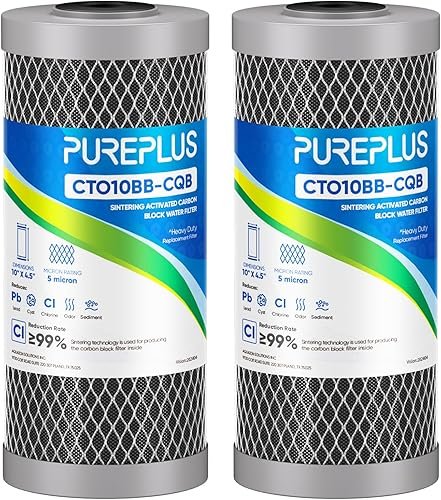
| PUREPLUS 5 Micron CTO (2-Pack) | Carbon Block Cartridge | Enhanced coconut shell carbon for lead adsorption | $1.56 |
Amazon eBay |
| PUREPLUS 5 Micron CTO (3-Pack) | Carbon Block Cartridge | Bulk pack for multi-year supply | $1.90 |
Amazon eBay |
| 20″ Big Blue Cyst/Lead/Fluoride Set | 2-Stage Cartridge Set | 0.22 micron carbon for comprehensive reduction | $3.75 |
Amazon eBay |
| Cyclonic Sedimentation Backwash Filter | Pre-filter / Sediment | Automatic backwash, pure copper housing | Check Price |
Amazon eBay |
| AliExpress 1-Micron Coconut Carbon | Carbon Block Cartridge | 1-micron rating for fine particulate lead | $87.13 USD | AliExpress |
| AliExpress 5-Micron CTO10BB-CQB | Carbon Block Cartridge | Upgraded coconut shell, budget-friendly | $80.71 USD | AliExpress |

PUREPLUS 5 Micron CTO10BB-CQB (2-Pack)
This is your basic, no-frills workhorse. The enhanced coconut shell carbon is designed for lead adsorption, and at this price per cartridge, it’s incredibly affordable to maintain. Honestly, for homes on a tight budget who need a certified lead-reduction carbon block, this is a solid starting point. Just don’t expect it to handle heavy sediment loads—that’s not its job.
- Extremely low cost per cartridge
- Enhanced carbon for lead targeting
- Standard 10″x4.5″ size fits most housings
- 5-micron rating may miss finest dissolved lead
- No NSF certification listed—verify claims
- Basic packaging, minimal instructions

20″ Big Blue Cyst/Lead/Fluoride Removal Set
This two-stage set is a more serious contender. The 0.22-micron carbon block is the real deal—that’s a rating that should handle dissolved lead ions effectively. The grooved sediment filter first extends the life of the main cartridge. We like this for homes with known lead and fluoride issues. It’s a proper filtered water solution in a box.
- Excellent 0.22-micron filtration for lead/cysts
- Two-stage design protects the main filter
- Targets multiple contaminants (lead, fluoride, chlorine)
- Requires 20″ Big Blue housings (not standard 10″)
- Higher upfront cost for the set
- Will cause more pressure drop than 5-micron filters

Cyclonic Sedimentation Backwash Filter
This isn’t a lead filter itself—it’s the ultimate pre-filter. If your water has a lot of sand, rust, or sediment, installing this before your main carbon block will dramatically extend the life of your lead filter. The automatic backwash feature is a game-changer for maintenance. It’s a set-and-forget protector for your more expensive filtration stages.
- Automatic backwashing saves time and money
- Pure copper housing is durable and antimicrobial
- Protects downstream filters and appliances
- Does not remove lead or chemicals—sediment only
- Requires a drain line for backwash
- Higher initial investment
Frequently Asked Questions
- How often do I need to change the filters?
- It depends on your water quality and usage. A carbon block filter for lead typically lasts 6-12 months. Check the manufacturer’s gallon rating and divide by your daily usage. If you notice a drop in water pressure or a change in taste, change it sooner.
- Will a whole house system lower my water pressure?
- Any filter will cause some pressure drop. A 1-micron filter causes more than a 5-micron one. Proper sizing is critical. Choose a system with a flow rate that meets your home’s peak demand (e.g., 10-15 GPM for a typical 3-bathroom home) to minimize impact.
- Can I install a whole house lead filter myself?
- If you’re handy with plumbing, yes. It involves cutting into your main water line and installing the filter housing. However, for most people, we recommend hiring a plumber. A leak at the main line is a catastrophic problem. It’s worth the peace of mind.
- Do these filters remove other contaminants too?
- Yes. A quality carbon block filter will also reduce chlorine, volatile organic compounds (VOCs), and some pesticides. The sediment stage removes dirt and rust. However, for specific contaminants like nitrates or hardness, you may need additional specialized media.
- Is a whole house system better than an under-sink reverse osmosis system for lead?
- They solve different problems. An RO system at the kitchen sink provides the highest purity for drinking and cooking water. A whole house system provides safety for bathing and all other uses. For maximum protection, many experts recommend both: a whole house system for general use and an RO system for drinking water.
Final Thoughts
Dealing with lead in your water is stressful. But a whole house system is a powerful, definitive step toward taking back control. It’s not just about drinking water—it’s about protecting your family from every exposure route, including showering and brushing teeth.
Our recommendation? Start with a water test. Then, invest in the best certified carbon block filter you can afford, sized correctly for your home. Pair it with a good sediment pre-filter. It’s an investment in your home’s infrastructure and your family’s health that pays dividends every single day. Don’t wait for a lab report to tell you what you might already suspect.
