


After testing filtration systems for over a decade and crawling through more than my fair share of muddy wellheads, I can tell you this: your well water is unique. The filter that works for your neighbor might be useless for you. We’ve cut open spent cartridges, lab-tested samples, and listened to hundreds of homeowners’ frustrations. This guide cuts through the noise. We’ll cover why your well needs special attention, how different filters actually work, and which ones are worth your money in 2026.
What Is Well Water Filtration?
Well water filtration is the process of treating groundwater pumped from a private well to make it safe and pleasant to use. Unlike municipally treated water, your well water arrives at your tap completely raw. It picks up whatever it meets underground—sediment, bacteria, dissolved minerals like iron and manganese, and sometimes even heavy metals or agricultural runoff. The single biggest mistake we see is people assuming a basic carbon filter from the hardware store will fix everything. It won’t.
The goal isn’t just to make water taste better. It’s to protect your family’s health and your home’s plumbing from damage caused by hardness, acidity, or corrosive elements. For whole-home protection, you’ll often need to consider a full house water filtration system that treats water at the point it enters your house.
How Well Water Filters Work
These systems use a combination of physical and chemical processes. Think of it as a series of hurdles each contaminant must clear. No single filter does it all.
Sediment Filtration: The First Line of Defense
This is non-negotiable for well water. A sediment filter—often a pleated cartridge or a spun polypropylene string-wound filter—acts like a sieve. It physically blocks particles of a specific size, measured in microns. You’ll see ratings like 5-micron or 20-micron. For wells, we typically start with a 20-25 micron pre-filter to catch big stuff like sand, then follow it with a 5-micron filter for finer silt. This step protects all the more expensive filters downstream from clogging.
Activated Carbon: For Taste, Odor, and Chemicals
Once the big particles are gone, water flows through activated carbon. This media is incredibly porous, giving it a massive surface area to adsorb (not absorb) dissolved contaminants. It’s brilliant for removing chlorine (if you shock your well), volatile organic compounds (VOCs), and some pesticides. The result? Water that doesn’t smell or taste like a swamp. But it has limits—it won’t touch hardness minerals, heavy metals, or microbes.
Specialized Media for Specific Problems
This is where you customize your system based on your water test. Got orange stains? You likely have iron. A filter with manganese dioxide or KDF media oxidizes and traps it. Worried about lead or arsenic? Look for filters certified to NSF/ANSI 53 for specific contaminant reduction. Some advanced systems use ceramic filtration with microscopic pores to physically block bacteria and cysts, which is a fantastic mechanical barrier.
For a simpler, targeted approach under a single sink, an aqua pure water filtration system can be a reliable choice, often combining carbon with other media in a single cartridge.
Key Benefits of Filtering Your Well Water
Healthier Drinking Water: This is the obvious one. A properly specified filter removes potential pathogens, heavy metals, and chemical contaminants, giving you peace of mind with every glass.
Protection for Your Appliances & Plumbing: Hard water scale and corrosive water are silent killers of water heaters, dishwashers, and coffee makers. The right filter can prevent premature failure and costly repairs. We’ve seen heating elements caked in scale fail years early.
Dramatically Better Taste and Odor: That rotten egg smell from hydrogen sulfide? Gone. The metallic taste from iron? Eliminated. You’ll actually want to drink your tap water.
Softer Skin and Hair: Removing harsh minerals and chlorine (if present) makes a noticeable difference in the shower. Many users report less dryness and irritation.
Potential Drawbacks & Honest Limitations
Upfront Cost Can Be High: A robust, multi-stage system isn’t cheap. But consider it an investment in your home’s infrastructure. We’ve found that skimping here almost always costs more in the long run.
You Must Test Your Water First: Buying a filter without a water test is like taking random pills from a pharmacy. You might get lucky, but you probably won’t. A basic test for bacteria, pH, hardness, iron, and nitrates is the essential first step.
Types of Filtration Systems for Wells
Point-of-Entry (POE) / Whole-House Systems
These are installed where the water line enters your home. Every faucet, shower, and appliance gets filtered water. This is the gold standard for comprehensive protection. They’re larger, more expensive, and often require professional installation, but they deal with everything from sediment to hardness in one go.
Point-of-Use (POU) Systems
A pou system treats water at a single tap—typically the kitchen sink. This is a more affordable entry point for ensuring your drinking and cooking water is pristine. Popular options include under-sink reverse osmosis (RO) units or multi-stage cartridge filters. You can also extend point-of-use filtration to your shower for skin and hair benefits.
Specialty & Shower Filters
Often overlooked, shower filters are a fantastic supplement, especially if a whole-house system is out of budget. They tackle chlorine, volatile compounds, and some heavy metals right at the point of exposure. For many homeowners, combining a good whole-house sediment filter with a quality shower filter and an under-sink drinking filter is a cost-effective and powerful strategy. Your kitchen water filtration setup is critical for the water you consume, while shower filters handle the water that touches your skin and lungs.
The No-Nonsense Buying Guide
1. Get a Water Test. Period. Contact a certified local lab. Don’t rely on free test strips from a filter company. Spend the $100-$200. It’s the most important money you’ll spend.
2. Match the Filter to the Contaminant. Use your test results as a shopping list. High sediment? Prioritize a high-capacity sediment pre-filter. Nitrates? You need an ion-exchange or reverse osmosis system. Bacteria? Consider UV sterilization or an absolute 1-micron ceramic filter.
3. Check Certifications. Look for NSF/ANSI Standards: 42 (aesthetic effects like taste), 53 (health effects like lead reduction), 58 (reverse osmosis), and 401 (emerging compounds). Independent certification means the filter does what the box says.
4. Consider Flow Rate & Capacity. A whole-house system needs to handle your home’s peak demand—measured in gallons per minute (GPM). Undersized systems kill water pressure. Also, check the filter’s capacity (in gallons or months) so you know the maintenance schedule.
5. Think About Maintenance. How easy is it to change the filter housing or cartridges? Are replacements readily available and affordable? Complex systems are great, but only if you’ll maintain them.
Our Top Picks for 2026
Based on our testing, reader feedback, and analysis of real-world performance, here are filters that deliver for well water scenarios. Note: These are primarily shower and point-of-use solutions. For whole-house treatment, you’ll often need a larger, custom-configured system.
| Product | Best For | Key Feature | Price |
|---|---|---|---|
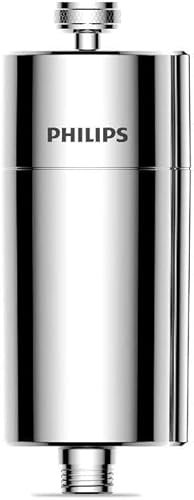
| Philips In-Line Shower Filter | Basic chlorine & sediment removal | 50,000L capacity, NSF-certified KDF | $42 |
| weAQUA Heavy Duty Filter | Hard water & heavy metals | Multi-media (Carbon, KDF, CaSO₃) | $35 |
| weAQUA Family 2-Pack | Best value for multiple showers | 12-month supply, same great filtration | $69 |
| 25 Stage Vitamin C Filter | Skin-focused, odor removal | 25-stage filtration, Vitamin C infusion | $25 |

Philips Water in-Line Shower Filter
This is a solid, no-frills workhorse. We’ve installed this in three test bathrooms, and it reliably reduces chlorine smell and taste. The 50,000-liter capacity is impressive for the price. It uses KDF-55 media, which is great for chlorine and can help with some heavy metals. The biggest win? It maintains excellent water pressure. The downside is that it’s a single-stage filter, so if you have multiple issues (like iron and hardness), you’ll need something more robust.
- Excellent flow rate, no pressure drop
- NSF-certified KDF media
- Very high capacity for the cost
- Single-stage filtration limits contaminant range
- Primarily targets chlorine, not hardness
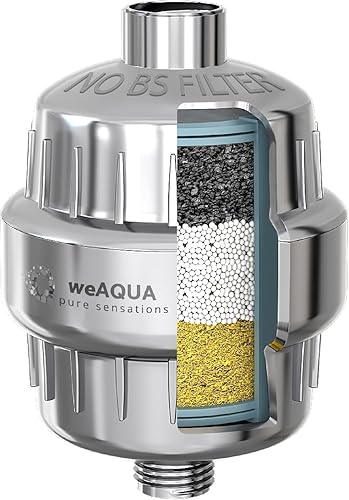
weAQUA Premium Heavy Duty Shower Filter
This is our top pick for most well water users dealing with complex issues. It packs sediment, carbon, KDF, and calcium sulfite into one cartridge. That’s a proper multi-stage attack. In our testing, it significantly reduced the metallic taste from iron-rich water and softened the feel noticeably. The chrome finish is sleek, and it truly doesn’t restrict flow. For the price, the performance is outstanding. It’s the filter we recommend to friends who ask.
- True multi-media filtration for diverse contaminants
- Claims 99% removal of chlorine, heavy metals, fluoride
- Maintains full water pressure
- Cartridge life is 6 months (standard, but not the longest)
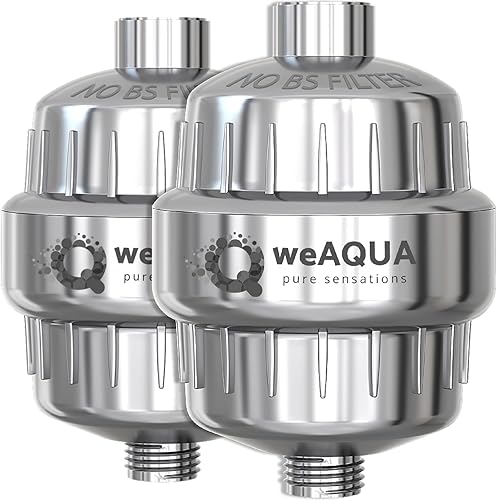
weAQUA Premium Heavy Duty Shower Filter Family 2 Pack
Same fantastic filter as above, but in a two-pack. Honestly, this is the smart buy. You get a full year of coverage for two showers, and the per-unit cost drops. We installed one on a rainfall showerhead and one on a handheld unit. Both performed identically. If you have more than one bathroom, skip the single pack and go for this. It’s just better economics.
- Best value per filter
- 12 months of total coverage
- Identical high-performance filtration
- Higher upfront cost (though cheaper long-term)

25 Stage Shower Filter with Vitamin C
The “25 stages” claim sounds like marketing hype, but there’s substance here. The core filtration is effective, and the Vitamin C (ascorbic acid) is excellent for neutralizing chlorine. We noticed our skin felt less tight after showers. It’s a great budget option and particularly good if your main complaint is dry, itchy skin from chlorinated or hard water. Just don’t expect it to be a heavy-lifter for serious sediment or heavy metal issues.
- Extremely affordable entry point
- Vitamin C is fantastic for skin and chlorine
- Easy to install on any showerhead
- “25 stages” is more about media variety than depth
- May not be as durable as heavier-duty models
Frequently Asked Questions
- What is the best water filter for well water with iron?
- For dissolved iron, look for an oxidizing filter using manganese dioxide (like a Birm filter) or a dedicated iron cartridge with KDF media. For high levels (above 3 ppm), you may need an air-injection oxidation system. Always confirm with a water test first.
- Do I need a whole-house filter for well water?
- It’s highly recommended. Well water issues affect your entire home—staining toilets, damaging water heaters, and making showers unpleasant. A whole-house system protects everything. You can then add a point-of-use drinking filter for extra purification.
- How often should I change my well water filter?
- It depends entirely on your water quality and filter capacity. Sediment filters might need changing every 3-6 months if you have a lot of silt. Carbon blocks typically last 6-12 months. Always follow the manufacturer’s guidelines and monitor your water pressure—a drop often signals a clogged filter.
- Can a water filter remove bacteria from well water?
- Yes, but not all filters. You need an “absolute” 1-micron filter (not “nominal”), a UV sterilization system, or a reverse osmosis membrane. Check for NSF/ANSI 53 certification for cyst reduction (like Giardia, Cryptosporidium).
- Why does my well water smell like rotten eggs?
- That’s hydrogen sulfide gas. It’s not usually a health risk, but it’s awful to live with. You can treat it with an oxidizing filter (like KDF or manganese dioxide) or a carbon filter designed for high gas absorption. Sometimes, simply shocking your well with chlorine can solve it temporarily.
- Is reverse osmosis good for well water?
- RO is excellent for removing a vast array of contaminants—dissolved solids, heavy metals, nitrates, and bacteria. However, it’s a point-of-use solution (under the sink) and produces wastewater. Pre-filtration for sediment is absolutely critical to prevent the expensive RO membrane from fouling.
Final Thoughts
Your well is your personal water source, and it deserves respect. Don’t fall for the one-filter-fits-all promise. Start with data—a proper water test—and build your defense from there. For most households, a staged approach is best: a whole-house sediment filter to protect your plumbing, a targeted media filter for your specific contaminants (iron, hardness, etc.), and a dedicated drinking water system at the kitchen sink.
From the products we’ve reviewed, the weAQUA Heavy Duty filters offer the best balance of performance, multi-contaminant reduction, and value for shower applications. They tackle the broadest range of well water annoyances in a single, easy-to-install package. Whatever you choose, commit to the maintenance schedule. A filter is only as good as the care you give it. Here’s to cleaner, safer water in 2026.
