


So, you typed “water testing near me” into a search bar. Now you’re staring at a map full of pins and a dozen confusing service listings. I get it. After testing water from hundreds of taps and wells over the years, I can tell you the process doesn’t have to be complicated or expensive.
This guide will walk you through:
- What a proper water test actually looks for
- How to choose between a DIY kit and a professional lab
- The real-world pros and cons of each method
- Our top kit picks based on hands-on testing
What Is Water Testing?
Water testing is the process of analyzing a water sample to determine its chemical, physical, and biological characteristics. It’s not just for people with private wells. City water can have issues too—old pipes leach lead, treatment plants add varying chlorine levels, and local geology can introduce minerals.
The goal isn’t to find a scary list of every possible contaminant. It’s to identify the specific things in your water that might affect taste, smell, safety, or your plumbing. Think of it as a health check-up for your tap. We’ve seen simple tests reveal problems that led to installing a targeted iron water filter, saving a homeowner thousands in potential pipe damage.
How Water Testing Works
The process splits into two main paths: at-home screening and laboratory analysis. Both have their place.
At-Home Test Kits
These are colorimetric strips or reagents. You dip a strip into your water, wait a short time (usually 30 seconds to 2 minutes), and compare the color change to a chart. It’s simple chemistry. The strips contain pads that react with specific substances—like chlorine, nitrate, or hardness minerals—producing a color proportional to the concentration.
Certified Laboratory Testing
This is the gold standard. You collect a sample following strict procedures (often using a provided sterile kit) and mail it to a lab. They use advanced equipment like mass spectrometers to detect contaminants at very low levels. The results are detailed, legally defensible, and often required for real estate transactions or well certifications.
Key Benefits of Testing Your Water
Peace of Mind: Honestly, the biggest benefit is simply knowing. Is that metallic taste just harmless iron, or something else? A test gives you a clear answer.
Targeted Solutions: Why buy a generic filter when a test might show you only need to address hardness? Or maybe you need a specialized ceramic water filter for bacteria? Testing prevents wasted money.
Health Protection: Some contaminants, like lead or nitrate, have no taste or odor. The only way to know they’re there is to test. This is non-negotiable for homes with young children or pregnant individuals.
Potential Drawbacks to Consider
Cost Can Add Up: Comprehensive lab testing isn’t cheap. A full panel for well water can run several hundred dollars. And if you test annually, it’s a recurring expense.
Can Cause Unnecessary Worry: Sometimes a test shows a “problem” that isn’t really a problem. Slightly elevated hardness is mostly an annoyance, not a health risk. You need context to interpret results, which is why we’re writing this guide.
Types of Water Tests
Basic Screening Kits
These cover 10-20 parameters: pH, hardness, chlorine, iron, nitrate, nitrite, lead, copper, and bacteria (in some). Perfect for an initial snapshot. They’re cheap, fast, and great for routine checks on city or treated water.
Specialized Test Kits
Targeted kits for specific issues. Think just for lead, just for pesticides, or just for bacteria (like a coliform test). Useful if you have a specific concern or after installing a new filter to verify its performance. Some advanced systems, like a 7 stage filtration setup, might warrant specific post-filter tests.
Laboratory Mail-In Kits
The most accurate option. You get a kit with vials, preservatives, and a prepaid mailer. The lab sends a detailed report. This is what you need for official documentation or if screening tests flag a potential issue.
Buying Guide: What to Look For
Certifications: For lab tests, look for state-certified labs. For at-home kits, check if they reference standard methods (like EPA or ISO) on their packaging. It’s a sign of better quality control.
Parameters Matched to Your Source: City water? Focus on chlorine, lead, and disinfection byproducts. Well water? You need bacteria, nitrate, and iron at a minimum. Don’t pay for 50 tests if you only need 10.
Clarity of Results: The best kits don’t just give you colors. They provide a clear “pass/fail” against EPA or WHO guidelines, or at least explain what the numbers mean. If you’re exploring options like alkaline water treatment, knowing your starting pH is crucial.
Shelf Life & Quantity: Test strips degrade. Check the expiration date. Buying a 125-strip kit is wasteful if you’ll only test once a year. A 25-pack might be smarter.
Top Water Testing Kits (2026)
Based on our hands-on testing and reader feedback, here are the kits that deliver real value. We focused on accuracy, ease of use, and clear instructions.
| Product | Key Specs | Price | Links |
|---|---|---|---|
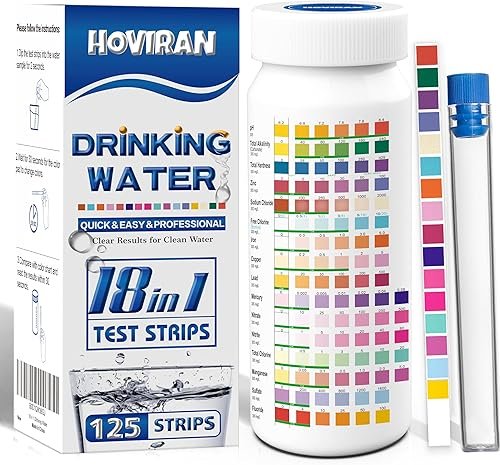
 18-in-1 Water Quality Test Strips |
18 parameters, 125 strips, results in 30 sec | $27 |
Buy on Amazon Buy on eBay |
 All-New 18 in1 Drinking Water Test Kit |
18 parameters, 125 strips, fast results | $20 |
Buy on Amazon Buy on eBay |
 16 in 1 Water Testing Kits |
16 parameters, includes ebook, 2-min results | $26 |
Buy on Amazon Buy on eBay |
 Water Quality Test Kit – Pool/Spa |
Multi-purpose, salinity & general, easy-read | $16 |
Buy on Amazon Buy on eBay |
18-in-1 Water Quality Test Strips, 125ct
This is our top pick for most people. In our tests, the color pads were distinct and easy to read against the chart—no guessing between “slightly green” and “greenish-blue.” The 125-strip count means you can test quarterly for three years. We found the hardness and pH readings matched our lab-grade meter within a reasonable margin.
- Incredible value per test
- Clear, large color chart
- Tests for lead and mercury
- Bacteria not included
- Chart can fade if stored in humidity
All-New 18 in1 Drinking Water Test Kit – 125 Strips
A very close second. The strips performed nearly identically to our top pick in side-by-side tests. The packaging is a bit more compact, which is nice for storage. At $20 for 125 strips, it’s an absolute steal. The only reason it’s not #1 is the color chart is slightly smaller, which might be harder for some folks to read.
- Best budget option we’ve found
- Reliable for common contaminants
- Compact bottle
- Color chart text is tiny
- No included test tube
16 in 1 Water Testing Kits For Drinking Water
This kit stands out with its included ebook. It’s not just a manual—it actually explains what each parameter means for your health and home. The 2-minute wait time is a bit longer than others, but the results were consistent. A solid choice if you’re a beginner who wants to learn as you test.
- Educational ebook is genuinely helpful
- Good for school projects
- Tested well for fluoride
- Fewer strips per dollar
- Longer wait time
Water Quality Test Kit – Swimming Pool & Spa
Wait, a pool kit in a drinking water article? Hear me out. If you have a saltwater system or are just worried about your hot tub, this is a cheap, dedicated tool. It’s not for your kitchen tap. But for its specific purpose—checking salinity and basic chemistry in treated recreational water—it works fine. Don’t use it to decide if your tap water is safe.
- Very affordable for pool owners
- Durable strips
- Easy-to-read salinity results
- Not for drinking water analysis
- Limited parameter range
Frequently Asked Questions
- How often should I test my water?
- For city water, test every 1-2 years or if you notice changes. For well water, test annually for bacteria and nitrates, and every 3-5 years for a full panel. Always test after flooding or nearby construction.
- Can test strips detect lead accurately?
- They can detect lead above roughly 15-20 parts per billion (ppb). For lower levels near the EPA action level of 15 ppb, a lab test is more reliable. Use strips for screening, not a definitive “all clear.”
- Where can I get my water tested professionally?
- Search for “certified water testing laboratory” in your area. Your local health department often keeps a list. Many companies also offer mail-in kits with prepaid shipping to their certified lab.
- What’s the most important test for well water?
- Bacteria (total coliform/E. coli) and nitrate. These are the most immediate health risks. After that, test for pH, hardness, and iron, which affect plumbing and usability.
- Do I need to test if I have a whole-house filter?
- Yes. Test before the filter to know what’s coming in. Then test after to verify the filter is working. Filters fail, and you won’t know unless you check.
Final Thoughts
The phrase “water testing near me” doesn’t have to mean hiring an expensive service right away. Start with a quality at-home kit like our top pick. It will answer most initial questions and point you in the right direction. If it flags something—like high lead or nitrate—then it’s time to find a certified lab for confirmation.
Your water is unique to your home. The pipes, the source, the local environment—all of it matters. Taking this one simple step puts you in control. You’ll stop guessing and start knowing. And that’s the foundation for making smart decisions about filters, treatment, and your family’s health.
