


You turn on the tap, and the water looks clear. So you assume it’s clean. But what you can’t see—the fine grit, the rust flakes, the silt—can wreak havoc on your plumbing, appliances, and even your health. We’ve spent years testing filters, and the single biggest mistake we see is people ignoring sediment. It’s the unsexy workhorse of water filtration, and getting it right saves you a ton of headaches (and money) down the line.
This guide breaks down everything you need to know. We’ll cover what sediment actually is, how these filters catch it, the different types you’ll encounter, and exactly what to look for when buying one. Plus, we’ll share our hands-on picks after testing dozens of cartridges and housings.
What Is Sediment in Water?
Sediment is a catch-all term for the suspended solid particles in your water. Think of it as the “dirt” in your water supply. It’s not a single contaminant but a mixture, and its composition depends entirely on your water source and the journey it takes to your tap.
Common culprits include rust flakes from aging city pipes or your own plumbing, sand and silt from well water or municipal main breaks, and organic matter like tiny bits of decaying plant material. Even if your water comes from a treatment plant, it can pick up sediment traveling through miles of pipes to get to you. The particles vary wildly in size, from large grains of sand you can feel to microscopic specks that just make your water look cloudy.
How a Sediment Filter Works
The principle is simple mechanical filtration: water passes through a barrier, and particles too big to fit through get stuck. But the execution and materials make all the difference in the world.
The Role of the Micron Rating
This is the most important number you’ll see. A micron is a unit of measurement—one millionth of a meter. A human hair is about 70 microns wide. A sediment filter’s micron rating tells you the size of the smallest particle it can reliably catch. A 20-micron filter will trap sand and larger rust. A 5-micron filter catches much finer silt. A 1-micron filter gets you into near-clarity, removing even some cysts. The lower the number, the finer the filtration, but also the faster the filter can clog if your water has a high sediment load.
Depth vs. Surface Filtration
Filters work in two main ways. Surface filters, like pleated cartridges, have a flat, screen-like barrier. Particles lodge on the surface. They’re often cleanable and have a high dirt-holding capacity for their size. Depth filters, like spun polypropylene or string-wound cartridges, have a thick, dense matrix. Particles get trapped throughout the entire thickness of the filter, which is great for varying particle sizes. For a deeper dive into filtration mechanics that also remove dissolved substances, you might find our guide on ionizing water filters interesting.
Key Benefits of Filtering Sediment
Protects Your Plumbing and Appliances: Sediment is abrasive. It wears down washers in faucets, clogs aerators, and can damage the solenoid valves in your washing machine, dishwasher, and ice maker. A simple pre-filter can extend the life of these expensive appliances by years.
Improves Water Clarity and Taste: While sediment itself isn’t usually a health hazard, it causes cloudiness and can carry other contaminants or create a gritty mouthfeel. Removing it is the first step toward truly clean drinking water.
Extends the Life of Downstream Filters: This is the big one. A sediment pre-filter can make your carbon filter or reverse osmosis membrane last two to three times longer. Those filters aren’t cheap, so protecting them pays for the sediment cartridge many times over.
Essential for Well Water: If you’re on a well, sediment isn’t a maybe—it’s a guarantee. A robust sediment filter is non-negotiable for dealing with sand, silt, and turbidity that can fluctuate with rainfall.
Potential Drawbacks to Consider
Pressure Drop: All filters create some resistance to flow. A very dense or clogged sediment filter can noticeably reduce your water pressure. This is especially important for whole-house systems where flow rate (measured in gallons per minute, GPM) matters.
They Don’t Remove Dissolved Contaminants: Sediment filters are physical barriers. They won’t touch dissolved stuff like lead, chlorine, fluoride, or hard water minerals. For those, you need other technologies. For example, if you’re concerned about specific contaminants, you might ask does Brita remove fluoride (hint: standard pitchers don’t, but some specialized filters do).
Types of Sediment Filters
Spun Polypropylene (PP) Cartridges
The most common and affordable type. These are a dense block of melted polypropylene fibers. They offer true depth filtration and are excellent for general-purpose sediment removal. They’re disposable and not cleanable. Great for a wide range of applications, from under-sink to whole-house.
Pleated Cartridges
Made of a folded, membrane-like material (often polyester). The pleats dramatically increase the surface area, which means they hold more dirt and last longer than a same-sized spun filter before the pressure drops. Many are cleanable and reusable several times, which saves cash. Ideal for water with moderate sediment and where filter life is a priority.
String-Wound Cartridges
These look like a tightly wrapped spool of string (usually polypropylene or cotton). They offer graded density filtration—tighter toward the core—which is effective for mixed particle sizes. They’re a good, cost-effective choice for high-sediment well water, though they can sometimes shed fibers initially.
Inline and Specialty Filters
These are small, self-contained filters you screw directly onto a garden hose, a washing machine inlet, or an RV hookup. They’re convenient for point-of-use protection. Some whole-house systems also use larger, reusable stainless steel mesh or pleated filters inside a housing that you can hose off. These are a bigger upfront investment but can last for years.
For homes with specific issues like orange staining or slimy buildup, sediment alone won’t cut it. You may need to pair it with a specialized iron bacteria filter or other treatment.
Buying Guide: What Actually Matters
Forget the marketing hype. Focus on these four factors:
1. Micron Rating: Match it to your water. Start with a 20-micron if you have city water or moderate well sediment. Step down to 5 or 1 micron if you have persistent cloudiness or fine silt. You can always use a two-stage setup: a 20-micron first, then a 5-micron.
2. Filter Type & Lifespan: For a disposable, “set it and forget it” option, spun PP is hard to beat. If you want to save long-term and don’t mind rinsing a filter, go for a cleanable pleated cartridge. Check the stated capacity—in gallons or months—but treat it as a rough estimate.
3. Size and Flow Rate: For a whole-house system, the standard 10″x2.5″ or 20″x4.5″ “Big Blue” housings are common. A 10″ filter is fine for an apartment or one bathroom. A 20″ filter is better for a family home to maintain good water pressure and have longer change intervals.
4. Certifications: Look for filters certified to NSF/ANSI Standard 42 for material safety and structural integrity. It’s a good baseline for trust. It won’t guarantee performance claims, but it means the filter won’t add anything bad to your water.
Our Top Sediment Filter Picks (2026)
After years of testing and reader feedback, here are the sediment solutions we consistently recommend.
| Product | Type | Key Spec | Best For | Price |
|---|---|---|---|---|
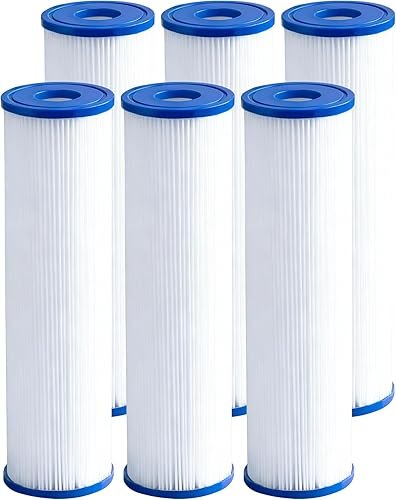
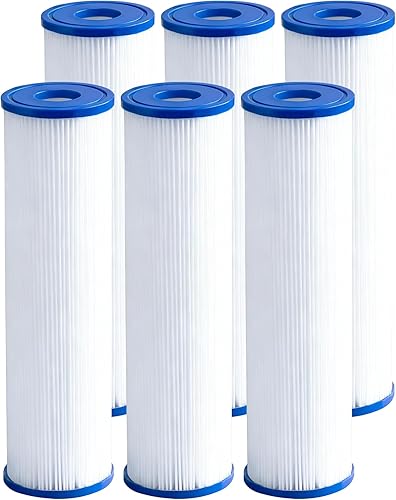
| 6-Pack 20-Micron Pleated | Pleated, Cleanable | 20 Micron, 10″x2.5″ | Value & long life for coolers/ice baths | $30 |
| 2-Set Sediment + Carbon | Spun PP + Carbon Block | 0.5 Micron, 10″x2.5″ | Complete pre-filtration for under-sink systems | $46 |
| Garden Hose Inline Filter | Inline Mesh | For Hose/Pressure Washer | Protecting outdoor gear & appliances | $24 |
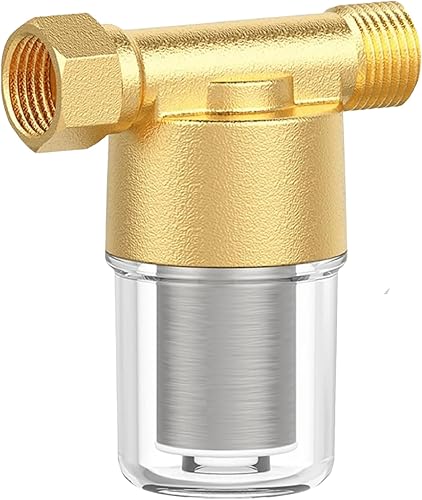
| 40-Micron Brass Inline | Reusable Stainless Mesh | 40 Micron, 1/2″ Ports | Durable whole-house or appliance pre-filter | $41 |
6 Pack 20 Micron Pleated Sediment Water Filter
This is our go-to recommendation for anyone needing replacements for cold water coolers, ice bath setups, or small point-of-use systems. The 20-micron rating is the sweet spot—fine enough to clear up water but not so fine that it clogs instantly. The pleated design means you can rinse and reuse them a few times, which makes this 6-pack an incredible value. We’ve found they last about 3-4 months each in typical city water.
- Excellent value in a 6-pack
- Cleanable and reusable
- Good balance of flow and filtration
- Only fits 10″x2.5″ housings
- Not for heavy sediment loads

2 Set Replacement Water Filters (Sediment + Carbon)
If you’re setting up a standard two-stage under-sink system, this bundle is a no-brainer. You get two 0.5-micron sediment filters and two matching coconut carbon blocks. The 0.5-micron rating is very fine, so it’s perfect for polishing water after a coarser pre-filter or for city water that’s already pretty clean. The carbon handles chlorine, taste, and odor. Honestly, most people don’t need to buy these separately—this combo saves the guesswork.
- Perfectly matched set
- Sediment filter may clog fast on dirty water
- Not a primary sediment pre-filter

Garden Hose Inline Sediment Filter
This little guy is a lifesaver for your outdoor gear. We use it on the hose feeding our pressure washer, and it’s stopped the nozzle from clogging with grit. It’s also great for RV hookups or filling a pool to keep sand out of the pump. The key is to take it off when you’re done—don’t leave it under constant pressure. It’s cheap insurance for any hose-end appliance.
- Extremely easy to install
- Protects expensive equipment
- Very affordable
- Limited capacity
- Must be removed when not in use
40 Micron High Flow Brass Inline Sediment Filter
This is a serious piece of kit. The brass body and stainless steel mesh filter feel indestructible. We installed one on the main line entering our workshop, and it catches the big stuff—sand and rust flakes—before they hit the water heater and softener. The 40-micron rating is coarse, so it won’t clog your pressure, and you just unscrew it and hose off the screen every few months. It’s a set-and-forget solution for whole-house pre-filtration.
- Durable brass and stainless construction
- Reusable and easy to clean
- High flow rate with minimal pressure drop
- Higher upfront cost
- Only filters large particles (40 micron)
Sediment Filter FAQ
- What micron rating should I use for my sediment filter?
- Start with a 20-micron filter if you have city water or unknown sediment levels. For well water with fine silt, try 5 microns. If your water is visibly cloudy, a 1-micron filter might be needed. You can always use two filters in sequence: a coarse one first to catch big stuff, then a finer one.
- How often should I change my sediment filter?
- There’s no set schedule. Change it when you notice a drop in water pressure, a change in water clarity, or after the manufacturer’s recommended gallon capacity—whichever comes first. In our testing, a typical 5-micron filter on city water lasts 2-4 months. On dirty well water, it might be just a few weeks.
- Can a sediment filter make water safe to drink?
- No. Sediment filters only remove physical particles. They do not remove dissolved chemicals, heavy metals, bacteria, or viruses. For microbiologically unsafe water, you need disinfection (like UV) or a certified purifier. Think of sediment filtration as the essential first step, not the final solution.
- Do sediment filters reduce water pressure?
- All filters cause some pressure loss, but a properly sized one for your flow rate will have a negligible effect. A clogged filter, however, will cause a significant pressure drop. If you have a large home with multiple bathrooms, opt for a larger 20″ housing or a high-flow model to maintain good pressure.
- What’s the difference between a sediment filter and a carbon filter?
- A sediment filter is a physical barrier that traps particles. A carbon filter uses adsorption to remove dissolved chemicals like chlorine, volatile organic compounds (VOCs), and improves taste and odor. They work best together, with the sediment filter protecting the carbon filter from getting clogged. For a deep dive on carbon, see our guide to whole house carbon filtration.
- Can I clean and reuse a sediment filter?
- It depends on the type. Pleated polyester filters are often designed to be rinsed off and reused several times. Spun polypropylene and string-wound filters are generally disposable—their structure breaks down when cleaned. Always check the manufacturer’s instructions. Reusing a disposable filter can risk channeling, where water finds a path through the filter without being filtered.
Final Thoughts
After all our years in this field, we keep coming back to the same conclusion: sediment filtration is the most overlooked, most cost-effective upgrade you can make to your water system. It’s not glamorous, but it’s foundational. Whether you’re protecting a high-end espresso machine, a whole-house softener, or just want clearer ice cubes, getting the sediment out first is the smart play.
Our advice? Start simple. If you’re on city water, grab a 10″x2.5″ housing and a 5-micron pleated cartridge. If you’re on a well, consider a two-stage system with a 20-micron followed by a 5-micron. And remember, the goal isn’t just filtered water—it’s protecting everything that water touches. For a truly comprehensive system, you’ll eventually pair this with other technologies to get the distilled water-level purity or specific contaminant removal you need. But it all starts with the sediment.
