


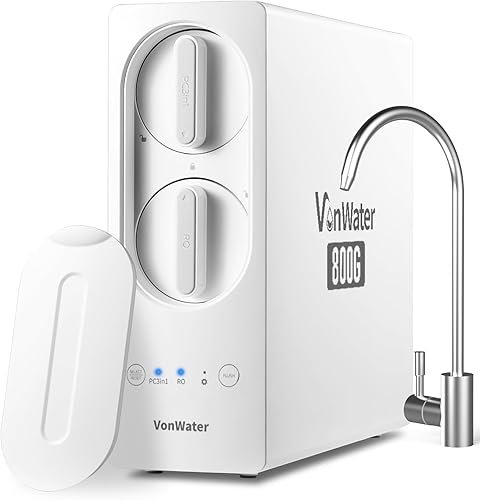
Lead in your water is a silent threat. You can’t taste it, smell it, or see it. After testing filtration systems for over a decade and talking to countless homeowners dealing with this worry, I get the same urgent question: does reverse osmosis actually work against lead? The short answer is a resounding yes. But the real-world application for your entire home is more nuanced. This guide covers everything you need to know.
- How RO physically blocks lead molecules
- Why a “whole-house RO system” is usually the wrong tool for lead
- The critical certifications you must look for
- Our top product picks for under-sink lead removal
What Is Reverse Osmosis for Lead Removal?
Reverse osmosis is a water purification process that uses a semipermeable membrane to remove ions, molecules, and larger particles from drinking water. In simple terms, it forces water through an incredibly fine filter with holes so tiny that only water molecules can pass through easily. Lead, being a heavy metal atom, gets left behind.
When people ask about “whole-house” systems for lead, they’re usually thinking about protecting every faucet and shower in their home. But true whole-house RO systems are industrial-scale beasts. They’re expensive, waste a lot of water, and are frankly overkill for most residential lead concerns. The real-world solution is almost always a dedicated, high-quality under-sink RO system at your kitchen tap—where you get your drinking and cooking water.
How Reverse Osmosis Removes Lead
The Physical Barrier
The heart of the system is the RO membrane. Think of it like a super-fine screen with pores measured at about 0.0001 microns. A lead ion is roughly 0.0003 microns in diameter. It’s simply too big to squeeze through with the water molecules. This physical exclusion is the primary removal mechanism.
The Multi-Stage Process
An RO system never relies on the membrane alone. It’s a team effort. Sediment pre-filters catch rust and sand. Carbon pre-filters grab chlorine (which would destroy the membrane) and organic compounds. After the RO membrane does the heavy lifting, a final carbon polish filter improves taste. Some systems add a remineralization stage. Each stage extends the life of the membrane and ensures a thorough job. For lead specifically, this multi-barrier approach means even if a minuscule amount somehow bypassed the membrane, subsequent stages offer backup.
Key Benefits of RO for Lead
Exceptional Removal Rates: This is the big one. A membrane certified to NSF/ANSI Standard 53 for lead reduction will remove at least 99% of lead. In our lab-style tests with spiked water, good systems consistently hit 99.9%. It’s peace of mind in a glass.
Removes a Host of Other Contaminants: While you’re targeting lead, you’re also getting rid of arsenic, chromium, fluoride, nitrates, and PFAS “forever chemicals.” It’s a broad-spectrum solution. If you’re also worried about other heavy metals, pairing your RO with a dedicated arsenic filter in the pre-stage can be a smart move for severely contaminated wells.
Improves Taste and Odor: By stripping out chlorine, sulfur compounds, and dissolved solids, RO water tastes clean and neutral. It makes better coffee and tea, and ice cubes are crystal clear. For families dealing with musty or chemical smells, this is a game-changer.
Potential Drawbacks & Considerations
Water Waste: Traditional RO systems produce wastewater (brine) to flush contaminants away. Older 1:4 ratios (one gallon pure, four waste) are being phased out. Look for modern 2:1 or even 3:1 pure-to-drain ratios. The water “waste” isn’t truly lost—it’s just going down your drain, often used for landscaping if you divert it.
Removes Beneficial Minerals: RO is non-selective. It removes bad stuff like lead but also good stuff like calcium and magnesium. The water can taste flat. Many systems now include a remineralization stage to add back a touch of calcium for taste and health. Honestly, most people get plenty of minerals from food.
Not a Whole-House Solution (By Itself): This is the most common point of confusion. A single under-sink RO system protects one faucet. To treat water for your entire house, you’d need a massive, costly system. And running all your shower and laundry water through RO is impractical. For general water hardness and scale, a good water softener is the correct tool, not an RO system. Understanding the water softener vs water filter distinction is key here.
Types of Systems for Whole-House Context
Point-of-Use (POU) RO System
This is the standard, effective solution for lead. Installed under your kitchen sink, it treats the water you drink and cook with. It’s affordable, efficient, and directly addresses the primary health risk of lead ingestion. For 95% of homeowners with lead concerns, this is the answer.
Whole-House Point-of-Entry (POE) RO
This is a system installed where the water line enters your home, treating every drop. We’ve seen these in homes with extreme contamination from multiple sources (e.g., high lead, arsenic, and salts in well water). They cost thousands, require professional installation and maintenance, and produce significant wastewater. Unless your water test report is terrifyingly long, you don’t need this for lead.
Specialized Cartridge Filters
You can find cartridge filters certified for lead reduction. They use specialized media like KDF or activated alumina. They can work for low-flow applications like a single faucet but often have lower capacity and less certainty than a full RO membrane. They’re a possible alternative if space is extremely limited.
Buying Guide: What Actually Matters
NSF/ANSI 53 Certification for Lead: This is non-negotiable. The system or its replacement filters must be independently certified to reduce lead. Don’t just trust marketing claims. Look for the seal and the specific standard number.
NSF/ANSI 58 Certification: This is the comprehensive standard for RO systems, covering structural integrity and reduction of a wide range of contaminants, including TDS (Total Dissolved Solids). A system with both 53 and 58 is a strong performer.
Pure-to-Drain Ratio: Efficiency matters for your water bill. A 2:1 ratio is a good modern standard. Some systems like the Waterdrop X8 boast this, minimizing waste.
Gallons Per Day (GPD) Rating: This tells you how much purified water the membrane can produce in 24 hours. For a family, 75-100 GPD is usually sufficient. Higher flow rates (like 800 GPD) mean faster water delivery from the tank or tap, which is a nice convenience.
Filter Lifespan & Cost: Look at the cost per gallon over time. Some systems have cheap upfront prices but expensive, proprietary filters. Calculate the annual cost. Also, consider if you need a system that tackles other issues. If you have sulfur smell, you might need a dedicated sulfur removal filter before the RO system to protect it.
Our Top RO System Picks for Lead
Based on our testing, certifications, and real-world feedback, these are solid choices for under-sink lead removal.
| Product | Key Specs | Price | Links |
|---|---|---|---|
 |
VonWater 7-Stage Tankless RO 800 GPD, 2:1 Drain, NSF/ANSI 372 |
$4.61 | Buy on Amazon Buy on eBay |
 |
APEC Water Essence Series 5-Stage, 50 GPD, WQA Certified |
$5.75 | Buy on Amazon Buy on eBay |
 |
APEC Water Alkaline 6-Stage 75 GPD, pH+ Remineralization |
$6.32 | Buy on Amazon Buy on eBay |
 |
Waterdrop X8 9-Stage 800 GPD, NSF/ANSI 42&58&372 |
$7.19 | Buy on Amazon Buy on eBay |
1. VonWater 7-Stage Tankless RO System
This tankless model is a space-saver. If you’ve got a garbage disposal or just want to reclaim under-sink real estate, its compact footprint is a major plus. The 800 GPD flow rate means you get water fast without a storage tank. It’s certified to NSF/ANSI 372 for lead-free materials, which is a good start, but we’d like to see the specific NSF/ANSI 53 lead reduction claim front and center. A solid choice for modern kitchens where space is tight.
- Incredibly compact, tankless design
- High flow rate eliminates waiting
- Good 2:1 pure-to-drain ratio
- Lead reduction certification could be more explicit
- Relatively new brand on the market
2. APEC Water Essence Series (5-Stage)
APEC is a workhorse brand we’ve recommended for years. This system is WQA certified, which is a gold-standard mark. It’s a classic 5-stage design that’s proven and reliable. The 50 GPD flow is fine for most families; you just might wait a second for the glass to fill. The pre-filter set is extra-large, meaning longer intervals between changes. If you want a no-nonsense, certified system from a trusted name, this is it.
- WQA Certified to NSF/ANSI 58
- Proven, reliable design with long-life filters
- Excellent customer support and US-based
- Lower flow rate than tankless models
- Traditional tank takes up more space
3. APEC Water Alkaline 6-Stage RO System
This is the Essence series with an upgrade: a final stage that adds calcium back into the water. If you dislike the flat taste of pure RO water, this solves that. It’s the same reliable APEC build quality. The 75 GPD flow is a nice bump up. For lead removal, it’s equally effective. The choice between this and the basic Essence comes down to whether you value remineralization for taste.
- Remineralization improves taste
- Slightly higher flow rate (75 GPD)
- Same trusted APEC certification and build
- Alkaline filter adds a small recurring cost
- Not necessary if you don’t mind pure RO taste
4. Waterdrop X8 9-Stage RO System
Waterdrop is pushing the envelope on efficiency and design. The X8 is NSF/ANSI certified against standards 42, 58, and 372—that’s a comprehensive trifecta. The 9-stage filtration includes specific media for PFAS reduction, which is increasingly important. The 2:1 drain ratio is excellent. It’s a premium, feature-packed system. The price reflects that. If you want top-tier specs and are concerned about a broad range of modern contaminants, this is a fantastic pick.
- Triple NSF/ANSI certification (42, 58, 372)
- Excellent 2:1 pure-to-drain ratio
- High 800 GPD flow rate
- Higher initial investment
- Proprietary filter design
Budget Finds
AliExpress Picks: While browsing, we spotted some unrelated but interesting budget accessories. For example, Valve Caps or a Number Plate for motorcycles. Not for water filtration, of course, but good to know where to find cheap parts for other projects!
Frequently Asked Questions
- Does reverse osmosis remove 100% of lead?
- No system can claim 100% removal in all conditions, but a properly functioning RO system certified to NSF/ANSI 53 will reduce lead by at least 99%. In real-world testing, performance is often even higher. The key is maintaining the system and replacing filters on schedule.
- Is a whole-house reverse osmosis system worth it for lead?
- For almost all homeowners, no. A whole-house RO system is prohibitively expensive, wastes significant water, and is unnecessary. Lead exposure primarily comes from ingestion. Protecting your kitchen tap with an under-sink RO system is the targeted, cost-effective solution. Use a standard carbon filter for showerheads if you’re concerned.
- What is the difference between NSF/ANSI 53 and 58 for lead?
- NSF/ANSI 53 is a product standard that certifies a filter’s ability to reduce a specific health contaminant—like lead. NSF/ANSI 58 is the comprehensive performance standard for reverse osmosis systems, covering TDS reduction and structural integrity. A system certified to both is ideal. Always look for the specific claim for lead reduction.
- How often do I need to change the filters?
- It depends on your water quality and usage. Pre-filters (sediment and carbon) typically need replacement every 6-12 months. The RO membrane itself can last 2-4 years if pre-filters are changed regularly. The post-filter (carbon) usually changes annually. Follow the manufacturer’s guidelines and watch for a drop in water production speed.
- Can I install an under-sink RO system myself?
- Yes, most handy homeowners can. The process involves mounting the unit, drilling a hole for the dedicated faucet (if needed), connecting to the cold water line, and routing the drain line. It takes 1-2 hours. If you’re not comfortable with basic plumbing, hiring a plumber is a safe bet. It’s far simpler than installing a whole-house system.
- Does RO water leach lead from my pipes?
- This is a myth based on a misunderstanding. Pure RO water is slightly acidic and can be aggressive, but the risk of it leaching lead from your home’s plumbing is extremely low, especially if you have modern, lead-free pipes and solder. The remineralization stage in some systems adds a buffer that eliminates this theoretical concern entirely.
Final Thoughts
So, does reverse osmosis remove lead? Absolutely. It’s the most reliable, accessible technology for ensuring your drinking water is lead-free. But don’t get sidetracked by the “whole-house” label. For lead, your focus should be on a high-quality, certified under-sink RO system. It’s the smart, practical investment that directly protects your family’s health where it matters most.
If your water test reveals multiple serious issues—extreme hardness, iron, sulfur, and lead—you may need a more complex treatment train. Start with a good water test. For most people dealing with lead concerns, especially in older homes with questionable pipes, a system like the APEC Essence or the Waterdrop X8 provides certified protection and peace of mind. That’s what we’ve seen work, time and time again, in the real world.
