


Forget the under-sink filter. When you’re dealing with thousands of gallons an hour, the game changes completely. Industrial water treatment isn’t just scaled-up home tech—it’s a different beast with different rules, different chemicals, and way higher stakes. We’ve spent years touring plants and talking to the engineers who keep this stuff running. Here’s what actually matters.
- What industrial water treatment really is (and isn’t)
- The core processes that make it work
- Key benefits and honest drawbacks
- The main types of systems you’ll encounter
- How to choose the right setup for your operation
What Is Industrial Water Treatment?
Industrial water treatment is the process of preparing water for a specific industrial purpose. That purpose could be boiler feedwater, cooling, rinsing, product ingredient, or safe discharge back into the environment. It’s a tailored approach. You’re not just making water “clean”—you’re making it fit for a precise job.
The scale is massive. We’re talking systems that handle millions of litres daily. The contaminants can range from simple hardness minerals to complex organic compounds, heavy metals, and bacteria. The treatment goal is always defined by the end use. Water for a pharmaceutical process has radically different purity requirements than water for a concrete plant.
Think of it like this: a home filter is a kitchen knife. Industrial treatment is a whole machine shop with specialized tools for every cut. The chemistry, the engineering, the monitoring—it’s all dialed in for one outcome: reliable, consistent water quality that protects your equipment, your product, and your compliance status.
How Industrial Water Treatment Works
The process is a sequence. Raw water enters, and through a series of steps, contaminants are removed or neutralized. The exact sequence depends on the incoming water quality and the final specification required.
Pre-Treatment: The First Line of Defense
This stage gets the big stuff out. Screens remove debris. Coagulation and flocculation clump tiny particles together so they can be settled or filtered out. Think of it like using a net before you use a fine sieve. It protects the expensive downstream equipment from fouling and clogging.
Primary Treatment: Chemical and Physical Separation
Here’s where the heavy lifting happens. Filtration through media like sand, anthracite, or activated carbon removes finer particles. Chemical addition is key. You’ll use acids or bases for pH adjustment. For instance, Caustic Soda Liquid (50% Sodium Hydroxide) is a workhorse for raising pH. On the flip side, Sulphuric Acid 50% is used to lower pH and control alkalinity. These chemicals are critical for optimizing subsequent steps like disinfection and preventing scale.
Advanced Polishing: Getting to Ultra-Pure
For demanding applications like boiler feedwater or electronics manufacturing, you need to remove dissolved ions. This is where reverse osmosis (RO), ion exchange, and electrodeionization come in. RO systems use pressure to force water through membranes that block salts. Ion exchange resins swap out hardness ions for sodium or hydrogen ions. It’s this stage that produces water with near-zero total dissolved solids.
Disinfection and Final Conditioning
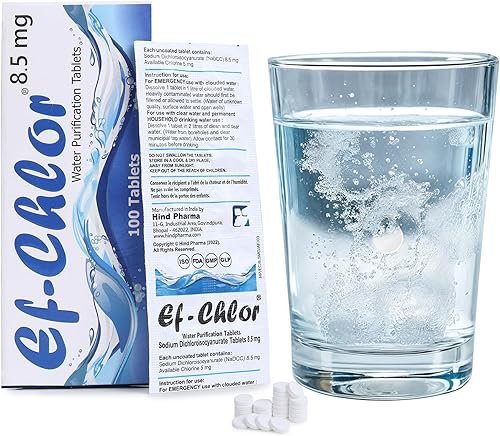
The last step ensures microbiological safety. Chlorination is common, but UV light and ozonation are also used, especially where chlorine residual is undesirable. Disinfection by-products are a real concern, so the method is carefully chosen. For smaller-scale or emergency applications, like treating a remote camp’s water supply, stabilized chlorine tablets like Ef-Chlor offer a portable, effective solution using NaDCC.
Key Benefits
Protects Your Capital Equipment. This is the big one. Scale, corrosion, and biological fouling destroy boilers, heat exchangers, and cooling towers. Proper treatment extends equipment life by years, saving you a fortune in replacement and downtime costs.
Ensures Product Quality and Consistency. If water is an ingredient or used in rinsing (like in food, beverage, or semiconductor production), its quality directly impacts your final product. You can’t have variable water quality.
Keeps You Compliant. Environmental regulations on discharge water are strict. Industrial treatment ensures your effluent meets legal limits for BOD, COD, pH, heavy metals, and other parameters. Fines for non-compliance are brutal.
Improves Energy Efficiency. A clean boiler transfers heat better. A clean cooling tower runs more efficiently. The energy savings from preventing scale buildup alone can pay for the treatment system over time.
Potential Drawbacks
High Upfront and Operational Costs. These are not cheap systems. The capital expenditure is significant, and the ongoing costs for chemicals, energy, membrane replacement, and skilled labor add up. It’s a major line item.
Complexity Requires Expertise. You can’t just set it and forget it. These systems need constant monitoring, calibration, and adjustment. You need trained operators or a service contract with a reputable provider. Mismanagement can lead to catastrophic failure.
Chemical Handling and Safety Risks. You’re storing and using concentrated acids, bases, and disinfectants. This requires proper safety protocols, storage facilities, and personal protective equipment (PPE). It’s a liability.
Waste Stream Management. The treatment process itself creates waste—sludge from clarification, spent regenerant from ion exchange, and concentrate from RO. You have to dispose of these streams responsibly, which has its own cost and regulatory burden.
Types of Industrial Treatment Systems
Clarification and Filtration Systems
The backbone for removing suspended solids. Includes sedimentation basins, dissolved air flotation (DAF) units, and multi-media filters. Essential for pre-treatment and primary treatment of surface water or wastewater.
Membrane Systems
Reverse Osmosis (RO) is the gold standard for desalination and producing high-purity water. Nanofiltration (NF) and Ultrafiltration (UF) are used for softer water or as pre-treatment for RO. They’re physical barriers with precise pore sizes.
Ion Exchange Systems
Used for water softening (removing calcium and magnesium) and for demineralization. They work by swapping ions in the water with ions on a resin bead. The resin needs periodic regeneration with chemicals like salt, acid, or caustic soda.
Disinfection Systems
Chlorine gas, sodium hypochlorite (liquid bleach), chlorine dioxide, UV irradiation, and ozone generation. The choice depends on water quality, contact time, residual requirements, and by-product formation concerns.
Chemical Feed and Dosing Systems
The pumps, tanks, and controllers that precisely deliver treatment chemicals like coagulants, pH adjusters, scale inhibitors, and biocides. Precision here is everything. Overdosing wastes money and can cause problems; underdosing fails to protect.
Buying Guide
Choosing a system isn’t about picking the “best” one off a shelf. It’s a engineering decision. Start here:
1. Get a Full Water Analysis. You cannot skip this. Test your source water for everything: hardness, TDS, silica, iron, manganese, chlorides, alkalinity, pH, bacteria. And test it over different seasons. If your best water softener for well water search led you here, know that industrial well water has even more variables.
2. Define Your End-Use Specification. What does the water need to be? Boiler feed? Cooling tower makeup? Rinse water for electronics? The purity requirement dictates the treatment train.
3. Calculate Your Flow Rate and Demand. How many litres per minute, hour, or day? Peak and average. This sizes every component.
4. Consider Waste and Footprint. Where will the system go? What will you do with the reject water or sludge? Space and waste disposal are often limiting factors.
5. Plan for Operation and Maintenance. Who will run it? What’s the budget for consumables (chemicals, membranes, filters)? Can you handle the complexity, or do you need a fully automated, serviced system? Sometimes, a simpler, more robust design is better than a high-tech one you can’t maintain. This applies from massive plants down to a water softener system for well water at a rural facility.
Pro Tip: Always design with a safety margin. If your analysis shows 300 ppm TDS, don’t spec a system that maxes out at 300 ppm. Go for 400-450 ppm capacity. Conditions change, and you need headroom. This is where consulting a seasoned engineer pays for itself.
Top Picks for 2026
These aren’t whole treatment plants—they’re essential chemical and portable treatment components we’ve seen used reliably across countless operations. They’re the building blocks.
| Product | Key Feature | Best For | Price |
|---|---|---|---|
 |
Each tablet treats 1-2L with NaDCC chlorine | Emergency kits, remote site water, small-scale disinfection | $14 |
 |
50% high-purity NaOH for pH control | pH adjustment, cleaning, regenerant for ion exchange | $95 |
 |
50% H2SO4 for pH lowering & scale control | Alkalinity reduction, coagulation aid, scale inhibition | $61 |
 |
Higher dose, treats 4-5L per tablet | Larger volumes for field operations, rainwater tank treatment | $13 |
Ef-Chlor Water Purification Tablets 8.5mg – 100 Tablets
These are a staple in our emergency kit. They use NaDCC (Sodium Dichloroisocyanurate), which is more stable and less harsh-tasting than traditional chlorine bleach. Perfect for treating questionable water sources at a remote job site or during a boil-water advisory. Not for primary industrial process water, but absolutely critical for safe drinking water in the field.
- Extremely compact and lightweight
- Proven NaDCC formula, WHO-recognized
- Long shelf life
- Only for disinfection, not sediment or chemical removal
- Requires 30-minute contact time
Caustic Soda Liquid 20L Drum – 50% Sodium Hydroxide Solution
This is a fundamental industrial chemical. We use it for pH adjustment in boiler water treatment and as a regenerant for anion exchange resins. The 50% concentration is potent—handle with extreme care. The 20L drum is a practical size for many facilities. It’s not fancy, but it’s absolutely essential for raising pH and controlling corrosion in high-purity water systems.
- High-purity, effective pH raiser
- Essential for ion exchange regeneration
- Secure, chemical-resistant packaging
- Corrosive, requires strict safety protocols
- Can cause scaling if overdosed
Sulphuric Acid 50% Solution – 20L Industrial-Grade
The counterpart to caustic soda. We use this to lower pH, especially in cooling tower water treatment and to neutralize alkaline waste streams. It’s also a coagulation aid in clarification. A key player in preventing calcium carbonate scale. Respect it—it’s a strong acid. But in the hands of a trained operator, it’s a precise tool for water chemistry control.
- Effective for lowering pH and alkalinity
- Helps optimize coagulation
- Cost-effective for bulk chemical treatment
- Highly corrosive, hazardous to handle
- Can increase sulfate levels in water
Ef-Chlor 33 mg Water Purification Tablets – Pack of 100
The bigger sibling to the 8.5mg tablet. Each one treats 4-5 litres, making it more efficient for larger groups or longer operations. Same trusted NaDCC chemistry. We keep a pack of these for treating larger volumes of rainwater or for team deployments. It’s a simple, reliable backup when your primary disinfection system is down for maintenance.
- Higher dosage for greater volume
- Ideal for rainwater tanks and field camps
- Easy to store and transport
- Still requires wait time for full effect
- Not a substitute for proper filtration
FAQ
- What’s the difference between industrial and commercial water treatment?
- Scale and purpose. Commercial usually refers to buildings like hotels or hospitals. Industrial is for manufacturing, power generation, or resource extraction, with much higher flows and stricter quality specs for process protection. If you’re looking at a whole home water filter and softener, that’s residential/light commercial.
- How often do industrial water treatment chemicals need to be replenished?
- It depends entirely on usage and system design. Dosing tanks might be refilled weekly or monthly. Ion exchange resins might need regeneration every 8-24 hours of operation. Monitoring is constant—the system will tell you when it’s running low.
- Can I use a water softener for my industrial boiler?
- A softener is often the first step for boiler feedwater to remove hardness. But it’s rarely enough on its own. Boiler water also needs oxygen scavengers, alkalinity builders, and often reverse osmosis for higher-pressure boilers. A how to install a water softener guide won’t cover this complexity.
- What is the most common failure in industrial treatment systems?
- From our experience, it’s poor monitoring and control. Letting pH drift, missing a membrane cleaning cycle, or ignoring a rising pressure differential. The equipment is robust; the failure is almost always human or procedural. If your water softener seems to be clogged, in an industrial context, that’s a major process interruption.
- How do I choose between chlorine and UV disinfection?
- Chlorine provides a residual that protects water in pipes and tanks. UV leaves no residual but doesn’t add chemicals. If you need ongoing protection in a distribution system, chlorine wins. If by-products are a major concern (like in food/beverage), UV or ozone might be better.
Final Thoughts
Industrial water treatment is a non-negotiable cost of doing business for any serious operation. It protects your assets, your product, and your license to operate. Don’t try to piece it together from consumer-grade parts. Start with a professional water analysis and consult with a treatment engineer. The upfront cost of doing it right is always less than the downstream cost of doing it wrong.
For smaller-scale applications—like a workshop, a remote facility, or a large rural property—the principles are the same, just scaled down. A good recommended water softener might be your starting point, but understand its limits. The chemicals and tablets we’ve highlighted here are essential tools in that broader toolkit. Use them wisely, respect their power, and your water will serve you well.
