


You just got your well water test back. The word “coliform” is circled in red. Now what? Don’t panic. But don’t brush it off, either. I’ve dealt with this on my own property and helped countless readers through it. This guide cuts through the noise. We’ll cover what coliform really is, how it gets into your well, the best ways to test for it, and exactly how to treat it for good.
In this article, we’ll look at:
- What coliform bacteria actually means for your water safety
- The common (and surprising) ways it contaminates wells
- A head-to-head comparison of home test kits vs. lab tests
- Step-by-step treatment options, from shock chlorination to permanent systems
What Is Coliform in Well Water?
Let’s get specific. “Coliform” isn’t a single scary germ. It’s a group of bacteria. They live everywhere—in soil, in plant matter, and yes, in the digestive tracts of warm-blooded animals. Finding them in your well water is like finding a “Check Engine” light on your car’s dashboard. It’s a signal that something is wrong with the pathway from the contamination source to your tap.
The group breaks down into three main types. Total coliforms are the broadest category. They’re the general indicator. Think of them as the “canary in the coal mine.” Their presence suggests your well’s sanitary seal might be compromised. Then there’s E. coli, a specific type of fecal coliform. This is the serious one. Finding E. coli means fecal matter—human or animal—has almost certainly gotten into your water. That’s a direct health risk.
Here’s the thing most people miss: a positive test for total coliforms but not E. coli is still a problem. It means your water system is vulnerable. The next heavy rain or snowmelt could carry worse pathogens right in. Based on reader feedback, this is where homeowners get complacent. They think, “No E. coli, no problem.” That’s a risky gamble.
How Coliform Contamination Happens
So, how do these bacteria get into your water? It’s rarely a mystery once you know where to look. Your well is a direct hole into an underground aquifer. Its integrity is everything.
Surface Intrusion After Heavy Rain
This is the most common cause we see. Your well casing—the steel or plastic pipe in the ground—is supposed to be sealed at the top with a sanitary well cap and grout. If that seal is cracked, loose, or was never installed properly, surface water runs right down the outside of the casing and into the aquifer. That water carries bacteria from the soil, your lawn, or nearby animal waste.
A Failing or Overwhelmed Septic System
If you have a septic system, it’s a major suspect. A leach field that’s too close to the well (less than 50-100 feet is often too close), or one that’s failing due to age or poor maintenance, can leak bacteria-laden effluent into the groundwater. This is a common finding in older rural properties we’ve investigated.
Direct Contamination at the Wellhead
This one’s simple. Storing chemicals, letting animals graze, or piling manure too close to the wellhead invites trouble. Bacteria can seep down through the soil. It sounds obvious, but you’d be surprised how often we find this during site visits.
Health Risks: From Mild to Serious
Not everyone who drinks contaminated water gets sick. But the risk is real. Symptoms can range from an upset stomach, cramps, and diarrhea (often mistaken for a stomach bug) to more severe issues, especially for infants, the elderly, or those with weakened immune systems. E. coli O157:H7 is a particularly nasty strain that can cause serious kidney complications. It’s not about fear-mongering; it’s about informed caution.
Why Testing for It Matters
Early Warning System. Catching coliforms early is your best defense. It flags a vulnerability before a more dangerous pathogen, like giardia or norovirus, makes your family sick. Think of it as cheap insurance.
Pinpoints the Problem. A positive test result tells you to start inspecting your well’s physical components. Is the cap tight? Is the casing cracked? Is the grout seal intact? Without the test, you’re guessing.
Peace of Mind is Priceless. There’s a real psychological benefit to knowing your water is safe. For families on well water, regular testing removes that nagging “what if” doubt. It’s a foundational part of responsible homeownership.
The Limitations and Costs
Ongoing Expense. This isn’t a one-and-done deal. You need to test annually, and more often if you have a known risk factor. That’s a recurring cost of well ownership.
False Positives and Negatives. User error is real. If you don’t sanitize the tap properly before collecting the sample, you can get a false positive. If the bacteria count is very low, a less sensitive test might miss it. This is why we recommend a two-tiered approach: use a quality home kit for frequent checks, but rely on a certified lab for your official annual test.
Types of Treatment Systems
If a lab confirms coliform bacteria, you need to treat the water. Here are the main weapons in your arsenal.
Shock Chlorination
This is your first line of defense for a one-time contamination event, like after a flood. It involves mixing a strong chlorine solution and circulating it through the entire well, pump, and pressure tank. It’s a DIY job, but it’s messy and must be done correctly. The chlorine kills bacteria in the well and water lines. The downside? It doesn’t fix the root cause. If the contamination pathway remains, the bacteria will be back.
Continuous Disinfection: Chlorine Injection
For persistent problems, you need a system that injects a measured amount of chlorine (or another oxidant) into your water line continuously. This treats water as it comes into your home. It’s effective but requires maintenance: storing chemicals, cleaning the injector, and dealing with the chlorine taste (which often requires a carbon filter afterward). It’s a whole-house solution.
Ultraviolet (UV) Light Purification
This is, in our testing, the most popular and effective method for ongoing bacterial disinfection. A UV light for well water system exposes water to a high-intensity ultraviolet light that destroys bacteria, viruses, and protozoa by scrambling their DNA. It adds no chemicals, doesn’t change taste, and is relatively low-maintenance (just an annual bulb change). The key is pre-filtration. You must have a sediment filter (usually 5-micron) before the UV unit to ensure clarity, or the light can’t penetrate to kill the pathogens.
Whole-House Systems with Multiple Barriers
Often, the best approach is a combination. A common and robust setup is a sediment filter, then a carbon filter (to remove organics that can shield bacteria), and finally a UV purifier. This is a true multi-barrier system. For homes with very hard water, you might integrate this with a whole house water softener and filtration system for a comprehensive solution.
Buying Guide: What to Look For
Choosing a test kit isn’t about grabbing the cheapest strip. Here’s what actually matters.
Certification & Sensitivity: Look for kits that specify they detect down to 1 CFU/ml (colony-forming unit per milliliter). That’s the gold standard for home tests. Avoid vague claims.
Clarity of Results: The best kits use a color-change method with a clear chart. A pink vial means positive. No guessing. Some digital readers exist, but for most homeowners, a simple visual test is more reliable and cheaper.
Lab Confirmation Path: The very best kits include a prepaid mailer to send your sample to a certified lab. This is the ultimate convenience and accuracy combo. It costs more but removes all doubt.
Your Water Quality Context: If your water is also very hard, rusty, or has high levels of other contaminants, those can interfere with some tests. When in doubt, start with a comprehensive test from a water testing company. They can guide you on the right specific tests.
Our Top Test Kit Picks
We’ve used and compared the most popular kits on the market. Here’s a quick overview.
| Product | Type | Best For | Price |
|---|---|---|---|
 |
Visual Colorimetric | Quick, reliable screening | $43 |
 |
Visual Colorimetric | Frequent testing, best value | $1.36/test |
 |
Visual Colorimetric | Comprehensive home screening | $64 |
 |
Multi-Parameter Strips | Broad overview, not just bacteria | $27 |
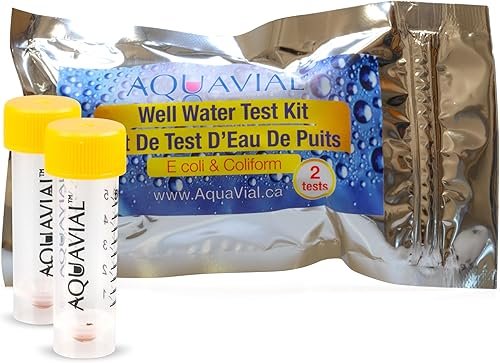
1. AquaVial Well Water Test Kit | Detect E.Coli and Coliform Bacteria
This is the kit we recommend most often. It’s dead simple. You pour your water sample into the provided test tube with the yellow reagent, wait 48 hours, and watch for a color change to pink. In our testing, the color chart was the easiest to read of any kit we tried. It’s sensitive enough to catch low-level contamination. The single-test format makes it perfect for your annual check.
- Very clear, unambiguous results
- Simple 48-hour process
- Reliable detection threshold
- Only one test per kit
- Doesn’t include lab confirmation
2. AquaVial Water Test Kit (8-Pack)
Same great test as our top pick, but in an 8-pack. This is the smart buy if you have multiple sources to test (well, pool, hot tub) or if you want to re-test after shock chlorination to confirm it worked. The cost per test plummets to about $1.36, which is unbeatable. Honestly, for the price of a few coffees, you get a year’s worth of peace of mind.
- Outstanding value per test
- Identical reliability to single kit
- Great for post-treatment verification
- Same 48-hour wait time
- Still requires lab confirmation for action
3. Coliform Bacteria Water Test Kit (8-Pack)
This is another solid 8-pack option. The process is nearly identical to the AquaVial. Where it differs slightly is in the vial design, which some users find a bit easier to handle. The results are just as reliable in our side-by-side tests. If the AquaVial is out of stock, this is an excellent alternative that won’t let you down.
- Clear, reliable color-change results
- Good value for multiple tests
- Easy-to-follow instructions
- Less brand recognition than AquaVial
- Not a substitute for a certified lab test
4. 18-in-1 Water Quality Test Strips
A word of caution. These multi-parameter strips are great for a general overview of your water’s chemistry—hardness, pH, chlorine, nitrates. But they are not a reliable method for detecting coliform bacteria. We’re including them because they’re popular, but they serve a different purpose. Use them for broad screening, but for bacteria, you need a dedicated test like the ones above.
- Tests 18 different parameters
- Fast results (30 seconds)
- Very affordable for broad screening
- Cannot detect bacteria
- Color charts can be hard to read precisely
View on AliExpress
Frequently Asked Questions
- Can you shower in water with coliform bacteria?
- Generally, yes, for healthy adults. The risk is from ingestion. Avoid getting it in your mouth. However, if you have open wounds, are immunocompromised, or if E. coli is present, bathing is not recommended. Use bottled water for brushing teeth until the issue is resolved.
- How often should I test my well water for bacteria?
- Test at least once per year. You should also test after any major flooding near your well, if you notice a change in water taste or odor, or if someone in the home has a persistent gastrointestinal illness. Consistency is key.
- Will a water softener remove coliform bacteria?
- No. A standard best water softener for home use removes hardness minerals like calcium and magnesium. It does not kill or remove bacteria. You need a disinfection method like UV light or chlorination.
- What’s the difference between a home test and a lab test?
- A home test is a screening tool—it tells you contamination is likely. A lab test from a certified facility is a diagnostic tool. It confirms the presence, identifies the specific type (total coliform vs. E. coli), and gives a quantified result. You need a lab test before investing in a treatment system.
- How much does it cost to fix coliform in well water?
- Costs vary widely. Shock chlorination as a DIY job might cost $50-$100 in supplies. A professional UV system installation typically runs $800-$1500. A full chlorine injection system can be $1500-$2500. The biggest factor is identifying and fixing the contamination source, which could be a simple well cap replacement or a major septic system repair.
- Can boiling water kill coliform bacteria?
- Yes. Bringing water to a rolling boil for one minute (or three minutes at higher elevations) will kill all coliform bacteria, including E. coli. This is your immediate stop-gap solution for drinking and cooking water while you arrange for testing and permanent treatment.
Final Thoughts
Finding coliform in your well water isn’t the end of the world, but it is the start of a very important project. Your first move is to confirm with a lab test. Your second is to find out how the bacteria got in—inspect that wellhead. Your third is to choose the right treatment. For most homeowners dealing with a persistent issue, a properly sized UV system is the most effective, low-maintenance solution.
Don’t fall into the trap of thinking one shock chlorination fixes everything. It might, but only if you also fix the physical vulnerability. Test regularly, treat appropriately, and you can enjoy safe, clean water from your well for decades to come. Based on our years of testing, the AquaVial kits offer the best balance of reliability and value for your ongoing screening needs.
