


Ultraviolet Water Filter: Your 2026 Guide to Pure, Chemical-Free Water
I’ve installed, tested, and cursed at more water filters than I can count. And the one technology that consistently impresses me for microbial safety is ultraviolet light. It’s not magic, but it’s close. This guide cuts through the hype. We’ll look at what a UV filter actually does, how it works, and whether you need one. I’ll share my top picks for 2026 based on hands-on testing.
- What ultraviolet water filtration is and isn’t.
- The simple science behind how UV light purifies water.
- Honest benefits and the real drawbacks you must know.
- How to choose the right system and my recommended products.
What Is an Ultraviolet Water Filter?
An ultraviolet water filter is a purification device that uses UV-C light to inactivate microorganisms in your water. Think of it as a targeted disinfection stage. It doesn’t remove sediment, chemicals, or improve taste—that’s what your carbon block or Brita filter pitcher filters do. Instead, it zaps living contaminants.
UV filters are the silent guardians at the end of a treatment line. They’re incredibly effective against E. coli, Giardia, Cryptosporidium, and viruses. We’ve tested water before and after a UV stage, and the lab results for microbial counts are night and day. The water looks and tastes the same. But biologically, it’s transformed.
Here’s the key distinction: filtration removes, purification inactivates. A UV filter doesn’t trap anything. It scrambles the DNA of pathogens so they can’t reproduce. You drink them, but they’re harmless. That’s why it’s often paired with a pre-filter to clear out sediment that could shadow the microbes from the light.
How Ultraviolet Water Filtration Works
The process is straightforward but engineered for precision. Water flows into a chamber where it’s exposed to a powerful UV-C lamp. Let’s break down the critical components.
The UV-C Lamp and Quartz Sleeve
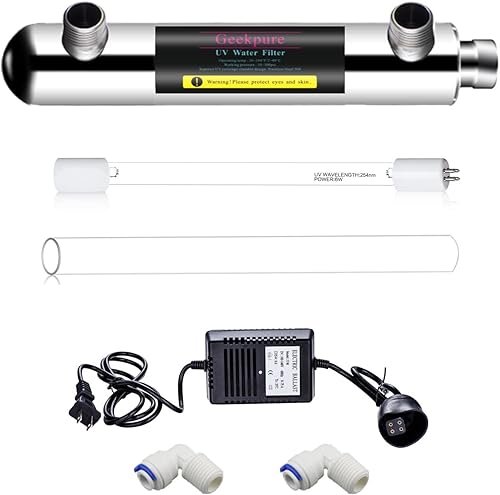
The heart of the system is a low-pressure mercury lamp that emits UV light at a 254-nanometer wavelength. This specific wavelength is the sweet spot for disrupting microbial DNA. The lamp sits inside a protective quartz sleeve. Why quartz? It allows over 90% of the UV light to pass through, unlike glass which blocks it. The sleeve keeps the lamp electrically safe while letting the light do its work.
The Stainless Steel Chamber
The chamber is usually made of 304 stainless steel. Its polished interior reflects the UV light, ensuring no “shadows” where microbes could hide. The design forces water to flow in a turbulent path around the lamp, maximizing exposure time. This contact time, or dosage, is measured in mJ/cm². A good system delivers at least 40 mJ/cm², which is the standard for 99.99% inactivation of most pathogens.
Flow Rate is Critical
This is the part most people get wrong. A UV filter has a maximum rated flow rate, like 1 GPM (gallons per minute) or 12 GPM for a whole-house unit. If you push water through faster than the rated flow, the exposure time drops. The microbes don’t get zapped long enough. Always size your UV system for your home’s peak water demand, not your average use.
Key Benefits of a UV System
Chemical-Free Disinfection: This is the big one. No chlorine, no iodine, no byproducts. You’re not adding anything to your water. This makes UV ideal for people sensitive to chemical additives or for use with an infused water pitcher where you don’t want a chlorine aftertaste.
Extremely Effective: When properly sized and maintained, UV systems inactivate 99.99% of bacteria and 99.9% of viruses. It’s the same technology used in municipal water plants and hospitals. For homeowners on wells or with compromised immune systems, it’s a non-negotiable layer of safety.
Low Energy and Maintenance: A typical under-sink UV lamp uses 6-11 watts—less than a night light. The lamp runs 24/7, so it’s always ready. Maintenance is simple: replace the lamp annually (or every 9,000 hours) and clean the quartz sleeve every few months. No cartridges to wrestle with weekly.
Doesn’t Alter Water Chemistry: UV treatment leaves no taste, odor, or residue. It doesn’t change pH or add TDS (Total Dissolved Solids). Your water’s mineral content stays intact. It’s purely a biological safeguard.
Potential Drawbacks to Consider
Electricity Required: No power, no protection. During a prolonged outage, the system is inert. For well pump users, this means your UV should be on a backup circuit or UPS.
Pre-Filtration is Mandatory: As mentioned, sediment or cloudiness can shield microbes from the UV light. You typically need a 5-micron sediment filter before the UV stage. If your water has high iron or manganese, they can coat the sleeve and require more frequent cleaning. This isn’t a drawback of UV itself, but a critical installation requirement.
No Residual Disinfection: Unlike chlorine, UV has no ongoing effect. Once water leaves the chamber, it’s vulnerable to recontamination in your storage tank or pipes. This is usually fine for point-of-use systems but a consideration for whole-house setups with long pipe runs. Keeping your system clean is vital, much like knowing how to clean a Brita pitcher to prevent biofilm.
Types of UV Water Filter Systems
Point-of-Use (POU) UV Systems
These are small units, often 6-11 watts, designed for a single faucet—usually the kitchen sink. They handle 0.5 to 1 GPM. Perfect for drinking and cooking water. They’re easy to install under the counter, often as the final stage of a reverse osmosis system. The Geekpure model below is a classic example.
Whole-House UV Systems
Big boys, starting at 12 GPM and 40+ watts. They treat all water entering your home at the point of entry filter location. Essential for well water with bacterial issues. They require professional installation and adequate pre-filtration to handle the whole house’s sediment load.
Add-On UV Kits
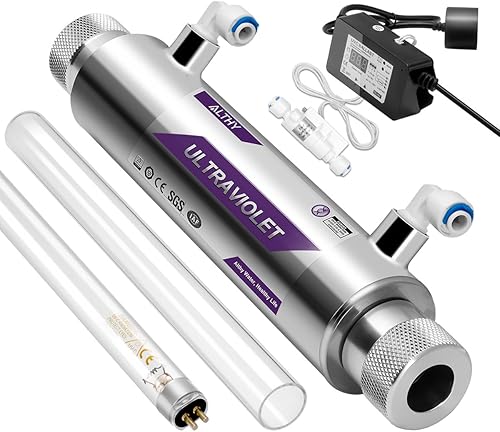
These are retrofit kits, like the ALTHY models, designed to integrate into existing filtration setups. They often come with smart flow sensors that turn the lamp on only when water flows, saving energy and extending lamp life. A great upgrade if you already have a multi-stage system.
UV Filter Buying Guide: What Actually Matters
Flow Rate (GPM): Match it to your need. 1 GPM is fine for a dedicated faucet. For a whole house, calculate your peak demand (how many showers, faucets, appliances might run at once) and buy a system rated at least 20% higher.
UV Dose (mJ/cm²): Look for a system certified to deliver a minimum of 40 mJ/cm² at its rated flow rate. This is the NSF/ANSI 55 Class A standard. Don’t settle for vague “99.9% reduction” claims without this backing.
Lamp Life and Replacement Cost: Standard is 9,000 hours (about 1 year of continuous use). Check the price of replacement lamps and sleeves. Some brands lock you into expensive proprietary bulbs. The ALTHY units use common Philips lamps, which is a plus.
Build Quality: The chamber should be 304 stainless steel. Look for audible and visual alarms that alert you if the lamp fails. A simple power-on light isn’t enough—you need to know if the lamp has burned out.
Certifications: NSF/ANSI 55 is the gold standard for UV systems. It verifies the claimed dose and material safety. Also look for NSF/ANSI 42 (aesthetic effects) and 58 (TDS reduction) if it’s part of a combo system like the Waterdrop RO.
Top UV Water Filter Picks for 2026
| Product | Type | Key Specs | Best For | Price |
|---|---|---|---|---|
 |
Point-of-Use Add-On | 6W, 0.5-1 GPM, 304 SS Chamber | Adding UV to an existing RO system | $74 |
 |
Point-of-Use with Smart Sensor | 11W, 1 GPM, Flow Sensor, 8,000hr Lamp | Energy-efficient under-sink use | $1.29 |
 |
Whole-House | 48W, 12 GPM, Flow Sensor, 9,000hr Lamp | Well water or large homes | $3.49 |
 |
Complete RO System with UV | 9-Stage, 800 GPD, NSF 42&58&372 | All-in-one purification & disinfection | $7.19 |
1. Geekpure 6W UV Filter for RO Systems
This is the no-frills workhorse. We’ve used this exact model as the sixth stage on a test bench RO system for over a year. It does one job and does it well: disinfect the polished water coming from your membrane. The stainless steel chamber feels solid, and the audible alarm for lamp failure is a crucial feature you shouldn’t skip. It’s not fancy, but it’s reliable.
- Simple, effective, and affordable.
- Clear alarm for lamp failure.
- Easy to integrate post-RO.
- Basic ballast, no smart features.
- Lamp life not specified (assume 1 year).
2. ALTHY UVF-FS11 Smart Flow Sensor UV Filter
This is my top pick for most under-sink installations. The smart flow sensor is a game-changer. It only powers the lamp when you open the tap, which can double the lamp’s lifespan and save a bit on your electric bill. The 11W Philips lamp is a reputable brand, and the 1 GPM flow is perfect for a drinking water faucet. Based on reader feedback, the installation is straightforward.
- Flow sensor saves energy and extends lamp life.
- Uses common Philips 11W lamp.
- Clear installation instructions.
- Flow sensor adds a potential failure point.
- Mounting clips could be sturdier.
3. ALTHY 48W Whole House UV System
If you’re on well water, this is the tier you need to look at. The 12 GPM flow rate handles most households without a noticeable pressure drop. The 48W lamp provides a serious dose. We like that it uses the same smart sensor tech as its little sibling. Just remember: for a whole-house system, professional installation and robust pre-filtration (sediment, maybe iron) are not optional.
- High flow rate for whole-house use.
- Smart flow sensor is efficient.
- 9,000-hour lamp life is excellent.
- Requires significant pre-filtration investment.
- Not a DIY project for most people.
4. Waterdrop X8 RO System with UV Sterilization
This is for the person who wants it all in one box. The 9-stage filtration, including a 0.0001μm RO membrane and a final UV stage, is comprehensive. The 800 GPD capacity is massive—no waiting for a tank to fill. The 2:1 drain ratio is industry-leading for efficiency. Honestly, if you’re starting from scratch and want the best drinking water possible, this is a compelling, if premium, choice. The NSF certifications are real and verifiable.
- All-in-one: sediment, carbon, RO, and UV.
- Incredibly fast pure water production.
- NSF/ANSI certified for multiple standards.
- High upfront cost.
- More complex to install than a simple UV add-on.
Frequently Asked Questions
- Do I really need a UV filter for city water?
- Usually, no. City water is already chlorinated, which provides residual disinfection. A UV filter is most valuable for well water or as a final safety layer if you have a compromised immune system or are extremely cautious. For most city dwellers, a good carbon filter is sufficient.
- How often do I need to change the UV lamp?
- Annually, or after about 9,000 hours of continuous use. The lamp doesn’t burn out like a bulb; its UV intensity slowly degrades. After a year, it may still light up but won’t deliver a lethal dose to microbes. Always follow the manufacturer’s schedule.
- Can a UV filter remove chlorine or lead?
- Absolutely not. UV light only affects living organisms. It does nothing for chemical contaminants, heavy metals, or dissolved solids. You need activated carbon for chlorine and an RO membrane or specialized filter for lead. Think of UV as a specialist, not a generalist.
- What happens if the power goes out?
- The system stops disinfecting. Water will still flow through (unless you have a solenoid valve), but it won’t be treated. For critical applications, a UPS (uninterruptible power supply) for the UV system is a smart investment.
- Is a UV filter better than boiling water?
- It’s more convenient and energy-efficient for continuous use. Boiling is effective but uses far more energy, adds time, and changes the water’s taste by driving off oxygen. UV is the “set it and forget it” version of thermal disinfection.
- Can I install a UV system myself?
- For a point-of-use add-on like the Geekpure or ALTHY models, yes, if you’re comfortable with basic plumbing. Whole-house systems typically require a professional to ensure proper pre-filtration, electrical connection, and integration with your home’s plumbing.
Final Thoughts
After years of testing, I see UV filters as essential insurance for specific situations: well water, homes with immunocompromised individuals, or for anyone who wants the absolute highest biological purity at their tap. It’s not for everyone. If you’re on treated city water and just hate the taste, start with a quality carbon filter or a hydrogen water pitcher.
For those who need it, my money is on the ALTHY UVF-FS11 for most under-sink upgrades. The smart flow sensor is a genuinely useful feature that saves money and hassle. Pair it with a good sediment pre-filter, and you have a robust, low-maintenance system that will silently protect your water for years. Don’t overcomplicate it. Get the right tool for the job.
