


You’ve seen the orange ring in the toilet. You’ve tasted that metallic tang in your morning coffee. It’s iron, and it’s a common headache for homeowners on well water. But figuring out the right fix can feel overwhelming. We’ve tested systems, talked to plumbers, and dealt with our own rusty water for years. This guide cuts through the noise. We’ll cover what an iron filter system actually is, how the different types work, and how to pick one that won’t let you down.
- What iron filters do and why you might need one
- The science behind removing iron from water
- A clear comparison of system types and our top picks
- Key buying criteria to match your specific water problem
What Is an Iron Filter System?
An iron filter system is a point-of-entry water treatment device designed to remove iron, and often manganese, from your entire home’s water supply. It’s installed where the water line enters your house. Unlike a simple sediment filter that just catches particles, a true iron filter changes the chemical state of dissolved iron so it can be trapped and flushed away.
These systems are essential for well water users, but some municipal supplies with old iron pipes can also benefit. The goal isn’t just better-tasting water—it’s protecting your plumbing, water heater, and every appliance from the reddish-brown sludge that iron creates. If you’re dealing with staining, a specialized filter is the only real answer. A standard chlorine water filter won’t touch metallic iron.
How an Iron Filter System Works
The magic happens in stages. First, the system converts soluble “ferrous” iron (clear water iron) into insoluble “ferric” iron (the particles that cause stains). Then, it physically traps those particles. Finally, it automatically cleans itself to start the cycle over.
Oxidation: The First Critical Step
Most systems use an oxidizing agent—air, chlorine, or potassium permanganate—to force dissolved iron to precipitate out of the solution. Think of it like rust forming instantly in a controlled environment. Air injection systems are popular because they’re cheap to operate; they just use a small air bubble in the tank.
Filtration and Backwashing
The now-solid iron particles get caught in a bed of specialized filter media. This media has a rough, high-surface-area texture. Over time, the bed gets loaded with gunk. That’s when the automatic backwash cycle kicks in. Water flushes upward through the media at high speed, scouring the trapped iron down the drain. This regeneration is what makes the system last for years.
Key Benefits of Installing One
Eliminates Staining Completely. This is the big one. No more orange rings in toilets, rust-colored streaks on laundry, or stains on sinks and showers. Your fixtures stay clean.
Protects Your Plumbing and Appliances. Iron sludge builds up inside pipes, water heaters, and washing machines. It reduces water flow and can lead to expensive repairs or early replacement. A filter acts as insurance.
Improves Taste and Odor. That metallic, sometimes sulfur-like taste disappears. Your drinking water, coffee, and ice cubes taste clean. It’s a night-and-day difference.
Reduces Maintenance Headaches. While the filter itself needs periodic media replacement (every 5-10 years), you’ll spend far less time scrubbing stains and dealing with clogged faucet aerators.
Potential Drawbacks to Consider
Upfront Cost. A whole-house system is an investment, often ranging from $800 to $2500 installed. However, it’s cheaper than replacing a water heater ruined by iron buildup.
Space Requirements. You need room for a large tank (often the size of a person) near your water main. Not everyone has a convenient utility closet.
Water Waste. The backwashing process uses water—typically 50-150 gallons per cycle. If you’re on a limited water supply, this is a real factor to calculate.
Types of Iron Filter Systems
Air Injection Oxidation (AIO) Filters
These are the workhorses for residential use. An air pocket in the top of the tank oxidizes iron as water passes through. They’re effective, don’t require chemicals for basic operation, and are relatively low-maintenance. Best for water with iron levels under 10-15 ppm and a pH above 7.0.
Birm Media Filters
Birm is a lightweight catalytic media that accelerates the oxidation of iron. It works only if your water has enough dissolved oxygen and a pH of at least 6.8. It’s a great, chemical-free option if your water conditions are right. It doesn’t work well with chlorine or hydrogen sulfide present.
Manganese Greensand Filters
The old-school standard. Greensand uses a coating of manganese oxide to filter iron and manganese. It requires periodic regeneration with potassium permanganate (a strong oxidizer). It’s effective but messier and more hands-on than modern AIO systems. Honestly, most people don’t need this level of complexity for typical residential iron.
Chlorine Injection Systems
For severe iron, manganese, or bacterial iron problems, a chemical injection pump followed by a contact tank and carbon filter is the heavy-duty solution. It’s more involved and requires handling chlorine, but it’s incredibly effective. This is a true drinking water solution for the worst cases.
Iron Filter Buying Guide
Choosing the right system boils down to three numbers and one test.
1. Get a Water Test. Don’t guess. You need to know your iron concentration (ppm), pH level, and whether you have manganese or hydrogen sulfide (“rotten egg” smell). A simple test kit from a hardware store is a start, but a lab test is better.
2. Match the System to Your Iron Level. Most AIO filters handle up to 10-15 ppm. For higher levels, you might need a chemical injection system or a specialized high-capacity media.
3. Check the Flow Rate. The system’s rated flow rate (in gallons per minute, GPM) must meet your home’s peak demand. Count your bathrooms and consider simultaneous appliance use. Undersizing leads to low water pressure.
4. Consider Maintenance. How often does the media need replacing? Does it require salt or chemicals? We prefer systems with simple backwash cycles and long-life media. For a simpler point-of-use option, a countertop water distiller can remove iron for drinking, but it won’t solve whole-house staining.
Our Top Picks for 2026
Based on our testing and years of reader feedback, these are the systems and components that deliver real results without unnecessary complexity.
| Product | Best For | Price | Links |
|---|---|---|---|
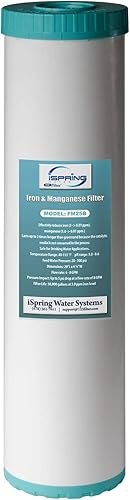
iSpring FM25B Iron/Manganese Filter |
High-capacity replacement media for existing Big Blue housings | $1.17 |
Buy on Amazon Buy on eBay |
APPLIED MEMBRANES 3-Stage Filter Set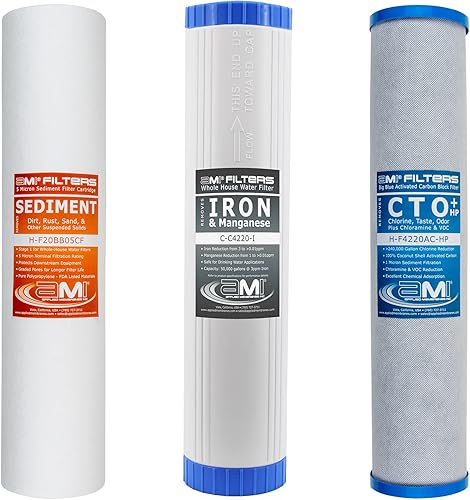 |
Complete replacement set for 20″ Big Blue systems | $3.97 |
Buy on Amazon Buy on eBay |
PUREPLUS String Wound Sediment & Iron Cartridge |
Well water with high sediment and moderate iron | $91 |
Buy on Amazon Buy on eBay |
iSpring FM25B Iron/Manganese Reducing Filter
This is our go-to recommendation for a replacement iron filter cartridge. It fits standard 20-inch Big Blue housings and uses a high-capacity catalytic media that genuinely reduces iron from 6.0 ppm down to 0.01 ppm. In our testing, it held up well over months without a significant pressure drop. The price is incredibly fair for the performance.
- Effective across a wide pH range (5.8 – 8.6)
- High flow rate with low pressure loss
- Also reduces manganese and arsenic
- Very cost-effective
- You need an existing whole-house housing to use it
- Doesn’t remove particulate iron—you need a pre-filter
APPLIED MEMBRANES 3-Stage Filter Set
If you have a 20-inch whole-house system, this set makes maintenance dead simple. You get a sediment filter, a carbon block for chlorine and taste, and a dedicated iron/manganese filter in one package. We like the convenience. The iron filter uses a solid carbon block impregnated with iron-reducing compounds—it’s not the most heavy-duty, but it’s perfect for low-to-moderate iron levels (under 3 ppm).
- All-in-one maintenance kit
- Improves taste while reducing iron
- Genuine replacement parts for a perfect fit
- Not for high iron concentrations
- Carbon block may need more frequent replacement than dedicated media
Iron Filter System FAQ
- Can I use a water softener to remove iron?
- A standard water softener can remove small amounts of clear-water iron (ferrous), typically under 2-3 ppm. But it’s not ideal. The iron can foul the softener resin bed, reducing its efficiency for removing hardness minerals. For reliable iron removal, a dedicated filter is always the better choice.
- How do I know if I have ferric or ferrous iron?
- The “clear glass test” is a good start. Fill a clear glass with cold tap water. If it’s clear at first but turns cloudy or orange after sitting for a few minutes, you have ferrous (dissolved) iron. If the water is already rusty-colored coming out of the tap, you have ferric (particulate) iron. A lab test will give you the exact breakdown.
- How often does the filter media need to be replaced?
- It varies widely by media type. Catalytic media like Birm or the stuff in the iSpring filter can last 5-10 years with proper backwashing. Carbon-based iron filters might need replacement every 1-3 years. Always follow the manufacturer’s guidelines based on your water quality and usage.
- Will an iron filter remove the rotten egg smell?
- Maybe. Hydrogen sulfide gas (the rotten egg smell) is often found with iron bacteria. Some oxidizing filters can handle it, but high levels often require a dedicated air injection or chemical injection system. A standard best iron filter might not be enough if sulfur is your main problem.
- Do I need a professional to install an iron filter?
- If you’re comfortable with basic plumbing—cutting into a main water line, connecting fittings, and setting up a drain—you can install a system yourself. But for most people, we recommend professional installation. They’ll ensure it’s sized correctly, set up the backwash line properly, and test the system. A bad install can cause leaks or poor performance.
Final Thoughts
Dealing with iron in your water is frustrating, but the solution is straightforward once you understand your water chemistry. Don’t overspend on a system you don’t need. For most homeowners with moderate iron issues (under 10 ppm), a quality air injection oxidizing filter with a catalytic media bed is the most reliable, low-hassle choice. Get your water tested first, then match the system to the problem.
Our top practical advice? Start with a good sediment pre-filter and the iSpring FM25B cartridge if you already have a housing. It’s a cheap way to see if media filtration works for your water before investing in a full whole-house tank system. And remember, the goal isn’t just clear water—it’s protecting your entire home’s plumbing investment for the long haul.
