


After testing dozens of these little devices over the years—from cheap imports to premium brands—I can tell you they’re not all created equal. Some are fantastic. Others are just plastic tubes with a bit of carbon inside. This guide cuts through the noise. We’ll look at what they actually do, how they work, and which ones are worth your money in 2026.
What Is an Inline Shower Filter?
An inline shower filter is a point-of-use water filtration unit designed specifically for your shower. Think of it as a mini treatment plant for the water that hits your body every morning. It’s called “inline” because it installs directly in the water line—usually between the shower arm and the shower head.
Unlike a whole house chlorine removal system that treats every drop of water entering your home, an inline filter focuses solely on your shower. That makes it cheaper, easier to install, and perfect for renters or anyone not ready for a major plumbing project.
Most models are about the size of a soda can. You simply unscrew your shower head, screw the filter onto the pipe, then reattach your shower head to the filter. No tools, no plumber. The whole job takes five minutes. Inside that canister is where the magic happens—a blend of filtration media that targets specific contaminants.
How an Inline Shower Filter Works
The Filtration Media
The heart of any shower filter is its media blend. Most use a combination of materials. KDF (Kinetic Degradation Fluxion) is a copper-zinc alloy that’s incredibly effective at reducing chlorine through a redox reaction. It also handles heavy metals like lead and mercury. You’ll often see calcium sulfite, which works great in hot water—unlike carbon, which can lose effectiveness at higher temperatures.
The Physical Process
Water enters the filter under pressure and flows through the media bed. As it passes, contaminants are either trapped, adsorbed, or chemically transformed. Sediment filters catch rust and sand particles. Carbon blocks adsorb organic compounds and chlorine. The treated water then exits through your shower head. It’s a simple, passive process that doesn’t require electricity or generate waste water.
Key Benefits of Using One
Chlorine Reduction: This is the big one. Municipal water is treated with chlorine to kill bacteria. That’s great for safe drinking water, but showering in it? Not so much. Chlorine strips natural oils from your skin and hair. A good inline filter removes up to 99% of it. You’ll notice the difference immediately—softer skin, less frizzy hair, and no more chemical smell.
Scale and Sediment Control: If you have hard water, you know the white crusty buildup on shower doors and fixtures. Many filters include media that helps reduce scale formation. They also catch rust and sediment that can make water look cloudy. Your bathroom stays cleaner, longer.
Easier on Skin Conditions: From reader feedback and our own testing, people with eczema, psoriasis, or dry, itchy skin often report significant improvement after installing a shower filter. Removing the chlorine and other irritants gives your skin a break. It’s not a cure, but it can help manage symptoms.
Simple Installation: We touched on this, but it’s worth repeating. You don’t need a plumber. You don’t need to modify your plumbing. If you can change a lightbulb, you can install one of these. That’s a huge advantage over under-sink or whole-house systems.
Potential Drawbacks to Consider
Flow Rate Impact: Any filter adds some resistance. Cheap ones can noticeably reduce your water pressure, making for a weak, dribbling shower. Better models are designed to minimize this, but it’s a trade-off to be aware of.
Ongoing Cost: The filter cartridge doesn’t last forever. Depending on your water quality and usage, you’ll need to replace it every 4 to 12 months. That means a recurring cost of $20-$60 per year. It’s not huge, but it’s a subscription you need to remember.
Limited Scope: It only treats water at that one shower point. If you’re concerned about chlorine in your drinking water or throughout your entire home, you’ll need a more comprehensive solution like a chlorine removal system for the whole house.
Different Types of Inline Filters
KDF-Based Filters
These are the most common and, in our experience, the best all-rounders for shower use. KDF media works effectively in hot water, lasts a long time, and is excellent at chlorine and heavy metal reduction. It’s often paired with carbon or calcium sulfite for broader contaminant removal.
Carbon Block Filters
Activated carbon is a fantastic adsorber of chlorine and organic compounds. However, its performance drops in hot water. Some manufacturers use catalytic carbon to improve this, but if you love long, hot showers, a pure carbon filter might not be your best bet.
Vitamin C (Ascorbic Acid) Filters
These neutralize chlorine through a chemical reaction. They’re very effective and leave no residue. The downside? They can deplete faster than other media types, especially in chlorinated water. They’re a good choice if chlorine is your primary concern.
Multimedia Filters
The top-tier filters combine several media types—like KDF, calcium sulfite, carbon, and sediment filters—in one cartridge. They offer the broadest protection. The ionizing water filter category sometimes overlaps here, though true ionizers are a different technology.
Buying Guide: What Actually Matters
1. Filtration Media & Certifications: Look for KDF 55 or KDF 85, calcium sulfite, and/or catalytic carbon. NSF/ANSI 42 certification is a strong trust signal. Avoid filters that don’t disclose what’s inside.
2. Capacity & Lifespan: This is measured in liters or gallons. A 50,000-liter capacity is good for a household for about 6 months. Don’t trust “6-month” claims without seeing the capacity number—it depends entirely on your water usage.
3. Flow Rate: Check the rated flow rate in gallons per minute (GPM) or liters per minute (LPM). A good filter should maintain at least 2.0 GPM. Anything lower might feel weak.
4. Build Quality & Connections: Look for solid brass or chrome-plated fittings, not cheap plastic. It should fit standard ½-inch shower arms and hoses. Check if it includes necessary washers.
5. Replacement Cartridge Cost & Availability: Before you buy the filter, check the price and availability of replacement cartridges. A cheap filter with expensive, hard-to-find refills is a bad deal.
Our Top Picks for 2026
| Product | Key Specs | Price | Links |
|---|---|---|---|
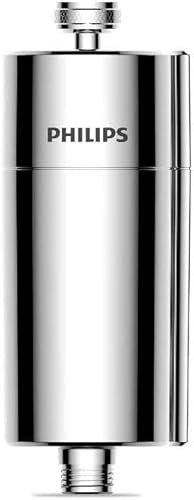
| Philips Water In-Line Shower Filter (Chrome) | 3-stage, KDF, 50,000L capacity, up to 99% chlorine reduction | $45 |
Buy on Amazon Buy on eBay |
| Philips Shower Filter 3-Stage Set | Double mesh + KDF, 50,000L, suits hot & cold water | $61 |
Buy on Amazon Buy on eBay |
| Philips Water In-Line Shower Filter (Black) | 3-stage, KDF, 50,000L, hair & skin protection | $42 |
Buy on Amazon Buy on eBay |
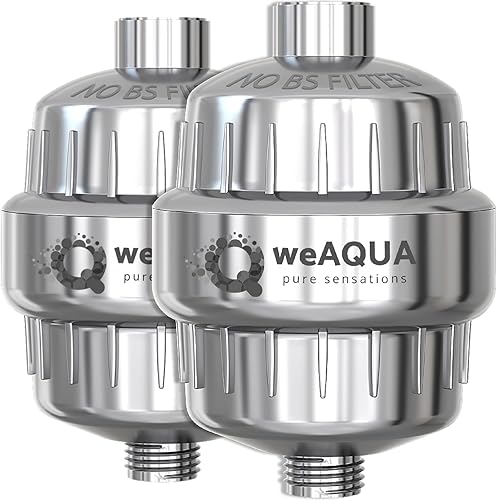
| weAQUA Premium Heavy Duty 2-Pack | Sediment, carbon, KDF, calcium sulfite, 12-month supply | $69 |
Buy on Amazon Buy on eBay |

Philips Water In-Line Shower Filter (Chrome) – $45
This is the model we recommend to most people. It’s been on the market for years, and the feedback is consistently positive. The 3-stage filtration with NSF-certified KDF is a proven combo. In our testing, it effectively killed the chlorine smell and left skin feeling less dry. Installation is a breeze. The 50,000-liter capacity means you’ll only need to think about a replacement twice a year, maybe less.
- Reliable, proven filtration media
- High 50,000L capacity
- Easy 5-minute install
- Chrome finish looks clean
- Basic design, no fancy features
- Replacement cartridges are proprietary

Philips Shower Filter 3-Stage Set – $61
This is essentially the same filtration tech as the chrome model above but packaged as a “set.” Honestly, we’re not entirely sure what justifies the higher price tag beyond the presentation. It handles both hot and cold water well, thanks to the anti-scald material. If you like the look or are buying it as a gift, it’s fine. But for pure value, the standard chrome version wins.
- Same trusted Philips filtration
- Explicitly rated for hot water
- Good for gifting
- More expensive for similar performance
- No extra cartridges included

Philips Water In-Line Shower Filter (Black) – $42
Functionally identical to the chrome version, just in a sleek black finish. This is for those with matte black shower fixtures who care about aesthetics. We appreciate that Philips doesn’t charge a premium for the color—it’s actually a bit cheaper. The “protection for hair & skin” claim is standard marketing, but the underlying KDF filter does help with that by removing chlorine.
- Matte black finish matches modern bathrooms
- Slightly lower price than chrome
- Identical filtration performance
- Finish may show water spots more easily
- Same proprietary cartridge issue
weAQUA Premium Heavy Duty 2-Pack – $69
This is our pick for families or anyone who hates remembering to reorder filters. You get two complete filters for a full year of coverage. The filtration media list is impressive: sediment, carbon, KDF, and calcium sulfite. It claims to tackle fluoride and heavy metals, which is a step beyond basic chlorine filter models. The European-style design is sturdy.
- 12-month supply in one purchase
- Broad-spectrum filtration media
- Maintains good water pressure
- Claims fluoride reduction
- Higher upfront cost
- Less brand recognition than Philips
Frequently Asked Questions
- How often should I replace my inline shower filter?
- It depends on the filter’s capacity and your water usage. A 50,000-liter filter typically lasts 4-6 months for a family of four. If you live alone, it could last 8-12 months. Don’t wait until you smell chlorine again—mark your calendar based on the manufacturer’s recommendation.
- Will a shower filter reduce my water pressure?
- All filters create some resistance, but a well-designed one should have minimal impact. If you notice a significant drop, the filter media might be clogged (time to replace it) or you bought a low-quality model with poor flow design.
- Can I install a shower filter with a handheld showerhead?
- Absolutely. Most inline filters have standard ½-inch fittings that work with both fixed and handheld showerheads. You’ll install it between the shower arm and the hose. It’s the same process.
- Do shower filters work with well water?
- They can, but well water often has different contaminants like iron, sulfur bacteria, or very high hardness. A standard chlorine-focused filter might not address these. For well water, you may need a more specialized automatic water distiller or treatment system.
- Is a shower filter the same as a water softener?
- No, and this is a common point of confusion. A filter removes contaminants like chlorine and sediment. A softener uses salt to remove hardness minerals (calcium and magnesium) through ion exchange. Some shower filters claim to “soften” water, but they’re really just reducing scale, not truly softening it.
Final Thoughts
After years of testing and reader feedback, we’re confident in saying that an inline shower filter is one of the best bang-for-your-buck upgrades you can make to your bathroom. The difference in how your skin and hair feel is real and noticeable. For under $50 and five minutes of installation, it’s a low-risk, high-reward change.
Our top recommendation for most people is the standard Philips Water In-Line Shower Filter. It’s reliable, effective, and reasonably priced. If you have a larger household or want a year’s supply upfront, the weAQUA 2-pack is a smart buy. Whichever you choose, just make sure it uses proven media like KDF and has a capacity that matches your usage. Your shower—and your skin—will thank you.
