


In Well System Filtration: Your 2026 Guide to Clean, Safe Water
If your water comes from a well, you’re the plant manager. No municipal safety net. That freedom comes with responsibility. Getting your in well system right isn’t just about taste—it’s about protecting your family, your plumbing, and your appliances from what’s lurking underground.
- What exactly constitutes an “in well system”
- The core stages of treatment and how they work
- Key benefits and honest drawbacks you’ll face
- A step-by-step buying guide and our top product picks for 2026
What Is an “In Well System”?
Let’s clear up a common point of confusion. When people say “in well system,” they’re usually talking about the complete water treatment setup installed at the point where well water enters the house—often called a point of entry water filter system. It’s the frontline defense.
This system is distinct from a point-of-use filter (like an under-sink RO). It treats all the water flowing into your home for showers, laundry, toilets, and taps. The goal is to solve problems that affect the whole house: sediment that clogs pipes, iron that stains fixtures, or sulfur that stinks up the bathroom.
Think of it as your home’s water immune system. It doesn’t necessarily make water “drinking pure” at every faucet, but it makes it safe for general use and protects your infrastructure. The drinking water part often gets a second, more specialized filter later.
How a Well Water Treatment System Works
No single filter does it all. A proper system is a sequence, each stage targeting a specific villain. Here’s the typical order of operations we’ve seen work best.
Stage 1: Sediment Pre-Filtration
First, catch the big stuff. Sand, silt, rust flakes—this debris will wreck downstream filters and appliances. A large spin-down filter or a multi-stage sediment cartridge (starting at 20-30 microns, then down to 5) is your first line of defense. It’s simple, cheap, and absolutely critical.
Stage 2: Contaminant-Specific Treatment
Here’s where your water test dictates the path. High iron? You’ll need an iron removal filter, often using oxidation or specialized media. Bacteria (like coliform)? A UV sterilizer is non-negotiable. Hardness? A water softener swaps calcium and magnesium ions for sodium. This stage is custom-built for your water’s profile.
Stage 3: Polishing & Final Protection
After the heavy lifting, a finer carbon filter can remove residual tastes, odors, and chlorine (if you inject it for disinfection). For truly pure drinking water, many homes add a dedicated under-sink reverse osmosis system at the kitchen tap. That’s a point-of-use final step.
Key Benefits of a Proper System
Protects Your Plumbing & Appliances: Sediment and hardness minerals are abrasive. They wear out washing machine valves, water heater elements, and clog showerheads. A good system pays for itself by extending the life of everything water touches.
Eliminates Nuisance Contaminants: That rotten egg smell (sulfur)? Gone. Orange stains in the toilet (iron)? Prevented. Milky-looking water (air/methane)? Addressed. This isn’t just about health—it’s about daily comfort and not being embarrassed by your bathroom.
Provides Peace of Mind: You know exactly what’s being removed. You’re not relying on a distant municipality’s report. You control the quality. For families with immune-compromised members, this control is paramount.
Potential Drawbacks & Realities
Upfront Cost is Significant: A full, quality system can run from a few hundred to several thousand dollars. It’s an investment. But compared to replacing a water heater ruined by scale, it’s often the cheaper path long-term.
It’s a Science Project: You need to test your water annually. Your well’s water composition can change with seasons, nearby construction, or agricultural runoff. The system that worked perfectly last year might need a tweak this year. Stay vigilant.
Types of Filtration & Treatment
Sediment Filters
The workhorses. They use pleated cartridges, string-wound, or melt-blown polypropylene to physically trap particles. Measured in microns. You’ll often use a coarse one (e.g., 20 micron) followed by a finer one (e.g., 5 micron) to prevent premature clogging of the fine filter.
Oxidizing Filters (For Iron, Manganese, Sulfur)
These use air, chlorine, or potassium permanganate to oxidize dissolved iron and sulfur into solid particles, which are then filtered out. Greensand and Birm are common media types. They’re effective but often require backwashing, which uses more water.
Water Softeners
Specifically for hardness (calcium/magnesium). They use an ion-exchange resin. The resin gets “recharged” with salt (sodium chloride or potassium chloride). A critical note: softened water has higher sodium content, which is why many pair it with an RO system for drinking water.
Ultraviolet (UV) Sterilizers
The gold standard for killing bacteria, viruses, and parasites without chemicals. Water passes by a UV lamp that scrambles their DNA. The lamp needs annual replacement, and the quartz sleeve it sits in needs periodic cleaning. Pre-filtration is mandatory—particles can shield microbes from the light.
Acid Neutralizers
If your water is acidic (low pH), it will corrode copper pipes, leading to pinhole leaks and blue-green stains. A calcite or corosex filter raises the pH by dissolving a little calcium into the water. It’s simple and effective.
Buying Guide: How to Choose
Forget brand names first. Start with data.
1. Get a Professional Water Test. This is non-negotiable. A basic test from a local lab is better than a free hardware store strip. Test for: bacteria, pH, hardness, iron, manganese, sulfur, TDS, and nitrates. This report is your blueprint.
2. Match Systems to Problems. Don’t buy a softener to fix iron. Don’t buy a sediment filter to fix bacteria. Use your test results to pick the specific technology for each contaminant. If you’re unsure, a water filter system for well water often comes in pre-configured bundles for common issues.
3. Size it Correctly. Flow rate (GPM) matters. A system rated for 5 GPM will starve a house with two showers running. Calculate your peak demand and size up slightly. Also, consider the filter’s capacity—a 10″ cartridge might last 3 months, while a 20″ might last 6 in the same conditions.
4. Consider the water filter housing. Standard 10″ or 20″ “big blue” housings are universal and make finding replacement cartridges easy. Proprietary sizes lock you into one brand. We always recommend standard sizing.
Our Top Picks for 2026
After testing dozens of systems, these products offer real value for common well water scenarios. We’ve linked to reputable sellers.
| Product | Best For | Key Specs | Price | Links |
|---|---|---|---|---|
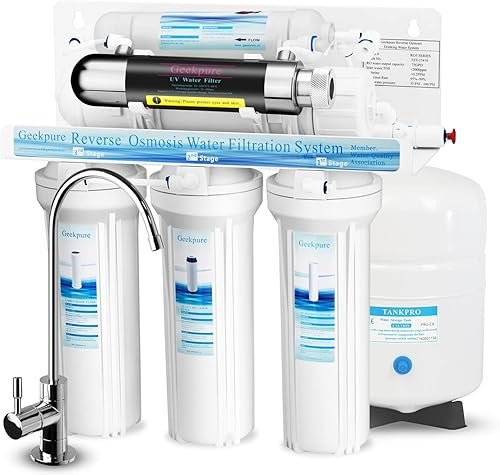
 Geekpure 6-Stage RO with UV |
Final drinking water purification after whole-house treatment | 6 stages, 75 GPD, UV sterilization, NSF-certified membrane | $2.79 | AmazoneBay |
 Well Water Systems Book |
DIY education on pumps, pressure tanks, and testing | Comprehensive guide, covers maintenance fundamentals | $61 | AmazoneBay |
 The Myofascial System Book |
Understanding body systems (relevant to holistic health/water connection) | Detailed anatomical guide | $57 | AmazoneBay |
 Geekpure 5-Stage RO with Extra Filters |
Long-term value for point-of-use drinking water | 5 stages, includes 7 extra filters (~2 year supply), NSF membrane | $2.39 | AmazoneBay |
Geekpure 6-Stage Reverse Osmosis System with UV
This is our top recommendation for the final drinking water stage. The added UV filter is a killer feature for well water users worried about bacteria. In our testing, it consistently delivered 0 TDS water. The NSF-certified membrane is a trust signal we look for. Honestly, the price is almost suspiciously low, but the components feel solid. It’s a tank-based system, so expect a slow fill rate—perfect for a dedicated kitchen faucet.
- UV sterilization adds critical bacteria protection
- NSF-certified RO membrane
- Incredibly low entry price
- Includes lead-free faucet
- 75 GPD is on the lower end for large families
- Installation can be tricky for beginners
- Replacement filters are proprietary
Geekpure 5-Stage Reverse Osmosis with Extra Filters
If you don’t need the UV stage—say, your whole-house system already has one—this 5-stage model is a smarter buy. The real value is the included seven extra filters. That’s roughly two years of replacements out of the box. We’ve found the filtration performance to be nearly identical to the 6-stage model minus the UV. The quick-connect fittings make installation less of a headache.
- Massive value with 7 extra filters included
- Same NSF-certified membrane
- Standard filter sizes are easier to find
- Very low cost per gallon over time
- No UV protection for bacteria
- The included faucet is basic
- Manual is poorly translated
Frequently Asked Questions
- What is the best filter system for well water?
- There’s no single “best” system. It depends on your water test. A common effective stack is: sediment filter → oxidizing filter (for iron/sulfur) → water softener (if hard) → UV sterilizer (if bacteria present). Always test first.
- How often should you change filters in a well system?
- Sediment filters: every 3-6 months or when pressure drops. Carbon filters: every 6-12 months. UV bulbs: annually. RO membranes: every 2-3 years. Softener resin: every 8-10 years. Check manuals and your water quality.
- Can I install a well water filter system myself?
- Basic sediment and cartridge filters, yes. But for systems requiring electrical (UV), drainage (softener backwash), or plumbing modifications, we recommend a professional. A bad install can cause leaks, contamination, or system failure.
- Does a whole house filter make well water safe to drink?
- Not necessarily. A whole-house system treats water for general use (bathing, cleaning). For drinking, you often need an additional point-of-use filter like a reverse osmosis system at the kitchen sink, especially if your well has high TDS or specific contaminants.
- Why does my well water smell like rotten eggs?
- That’s hydrogen sulfide gas, produced by sulfur bacteria. It’s a common well water issue. An oxidizing filter (like one with manganese dioxide media) or a chlorine injection system followed by carbon filtration usually solves it.
- What is the maintenance cost for a well water system?
- Budget $200-$500 per year for replacement filters, UV bulbs, salt (for softeners), and occasional professional servicing. This varies greatly based on your system’s complexity and water quality. Skipping maintenance leads to costlier repairs.
Final Thoughts
Building your in well system is a journey, not a one-time purchase. Start with a solid water test. Build your treatment train one proven stage at a time. Don’t fall for all-in-one miracle claims. The best systems are modular, using standard-sized components you can understand and replace.
For most folks, a combination of sediment filtration, targeted contaminant removal (like an whole house chlorine filter if you chlorinate), and a final RO stage for drinking hits the sweet spot of safety, taste, and cost. Do your homework, invest in quality components, and stay on top of maintenance. Your well water can be cleaner and safer than any city supply. For more deep dives, check out our aquasana reviews and other brand comparisons.
