


After testing filtration systems for over a decade, I keep coming back to one brand for under-sink reliability: APEC. Their systems aren’t flashy, but they work—and they last. This guide cuts through the marketing to show you what actually matters when choosing an APEC water filter system for your home.
- What makes APEC different from generic RO systems
- The real-world pros and cons based on our installs and reader feedback
- How to pick the right model for your water quality and budget
- Our hands-on review of their most popular systems
What Is an APEC Water Filter System?
APEC Water Systems is a US-based manufacturer specializing in point-of-use drinking water filters, with a heavy focus on reverse osmosis. They’ve been around since the late ’90s. Unlike some brands that outsource everything, APEC designs, engineers, and assembles their systems in California. That control over the process matters. It means consistent quality and real accountability if something goes wrong.
When people search for an “APEC water filter system,” they’re usually looking at their under-sink RO units. These are multi-stage systems that push water through a semi-permeable membrane. The result is water stripped of up to 99% of dissolved solids, from chlorine and lead to fluoride and arsenic. It’s not just a carbon filter. It’s a serious purification setup.
How APEC Reverse Osmosis Systems Work
Forget the complicated diagrams. Here’s the simple version. Your tap water enters the system and goes through a series of filters before it ever hits your glass.
The Multi-Stage Filtration Process
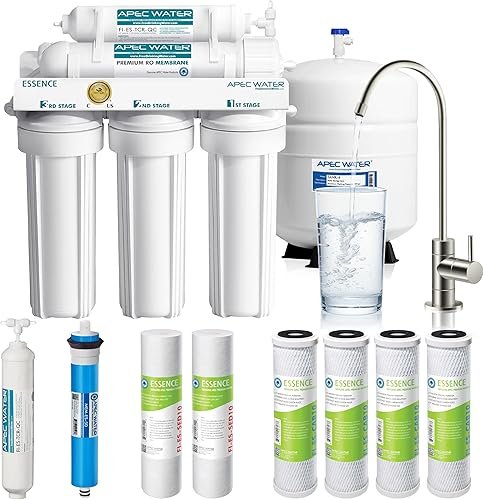
Most APEC systems use a 5-stage process. The first three stages are pre-filters. Stage one is a sediment filter that catches dirt and rust. Stages two and three are carbon blocks that knock out chlorine, which would otherwise destroy the delicate RO membrane. This is where a quality water filter cartridge makes all the difference—cheap cartridges clog fast.
Stage four is the heart: the reverse osmosis membrane. Water is forced through it under pressure. The membrane’s pores are so tiny—about 0.0001 microns—that only water molecules pass through. Everything else gets flushed down the drain. The final stage is a post-carbon filter that polishes the taste. Some models, like the ROES-PH75, add a sixth stage that reintroduces beneficial minerals for alkalinity.
Installation & Maintenance Reality
You’ll need to drill a hole in your sink for the dedicated faucet. It’s a standard job, but if you’re not handy, budget for a plumber. The system sits under the sink, connected to your cold water line. Filter changes are straightforward—twist-off, twist-on. Pre-filters need swapping every 6-12 months. The RO membrane lasts 2-4 years, depending on your water quality.
Key Benefits of Choosing APEC
Certified Contaminant Removal: This is the big one. APEC systems are WQA certified against NSF/ANSI Standards 42, 53, and 58. That means verified reduction of specific contaminants like lead, cysts, and TDS. You’re not just hoping it works; there’s independent proof.
Build Quality You Can Feel: The fittings, the tubing, the stainless steel filter housing on some models—it all feels robust. In our tear-downs, the internal components are well-assembled. This isn’t flimsy plastic that’ll crack in three years.
Excellent Customer Support: Based on years of reader emails, APEC’s support team is responsive and helpful. They stock parts for older models, which is huge. Nothing’s worse than a dead system because a proprietary filter is discontinued.
Long-Term Value: The upfront cost is higher than a pitcher filter. But the cost per gallon over time is pennies. You’ll also stop buying cases of bottled water. For a family of four, the system often pays for itself in under a year.
Potential Drawbacks to Consider
Wastewater Production: All RO systems create reject water. APEC’s ratio is typically 3:1—three gallons wasted for every one gallon of pure water made. If you’re on a metered water supply or live in a drought-prone area, this adds up. Look for their “high-efficiency” models if this is a major concern.
Installation Space & Complexity: You need a decent amount of under-sink space. The storage tank is the size of a small basketball. If you have a garbage disposal, instant hot water dispenser, or a bottleless water cooler already crammed in there, measure carefully.
Removes Beneficial Minerals: Standard RO strips everything out, including calcium and magnesium. The water is pure but can taste flat. The alkaline models (like the ROES-PH75) solve this by adding minerals back in. It’s a personal preference.
Types of APEC Systems
Standard Reverse Osmosis (ROES-50)
The flagship. Five stages of filtration, 50 gallons per day (GPD) capacity. This is the workhorse that handles 95% of municipal water problems. It’s what we recommend for most homes.
Alkaline Mineral RO (ROES-PH75)
Same core purification as the ROES-50, but with a sixth stage that adds calcium carbonate back into the water. This raises the pH and improves taste. Get this if you dislike the taste of pure RO water or want the mineral benefits.
Basic Carbon Filtration (WFS-1000)
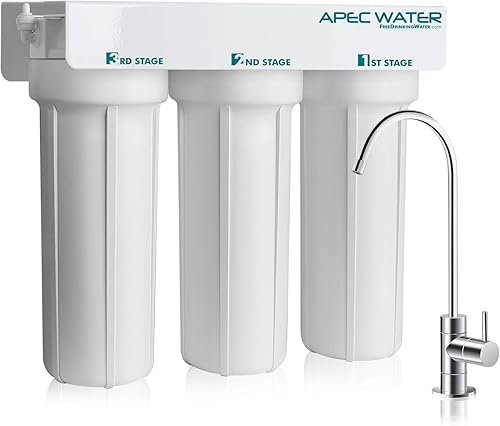
This isn’t an RO system. It’s a three-stage carbon block filter. It improves taste and odor by removing chlorine and some organics, but it won’t touch dissolved solids like lead or fluoride. Think of it as a heavy-duty filtered water solution for chlorinated city water where TDS isn’t a worry.
APEC Buying Guide: What Actually Matters
1. Know Your Water: Get a basic test report from your municipality or use a home kit. High sediment? You’ll need to change pre-filters more often. High TDS? You need RO. Just chlorine taste? A carbon system might suffice.
2. Check Certifications: Look for the WQA mark against NSF/ANSI 53 for lead and cyst reduction. It’s your guarantee. Don’t settle for vague “tested to” claims.
3. Consider Your Space: Measure your under-sink area. Account for the tank (about 11″ diameter x 14″ height) and clearance for filter changes. If space is tight, a countertop unit like the Waterdrop CoreRO might be a better fit, though it’s not an APEC product.
4. Factor in Long-Term Costs: Price out replacement filters for the model you’re eyeing. APEC’s filters are reasonably priced and widely available, which is a major plus over some proprietary brands. You can even compare them to other systems in our ecowater systems reviews.
Our Top APEC System Picks for 2026
| Product | Key Features | Price | Links |
|---|---|---|---|
| APEC ROES-50 Essence Series 5-Stage RO |
WQA Certified, removes 99% contaminants, 50 GPD, USA assembled | $3.82 | Buy on AmazonBuy on eBay |
| APEC ROES-PH75 Alkaline 6-Stage RO |
Adds calcium minerals, 75 GPD, improves taste & alkalinity | $3.88 | Buy on AmazonBuy on eBay |
| APEC WFS-1000 3-Stage Carbon |
Commercial-grade carbon block, no tank needed, for taste/odor only | $3.46 | Buy on AmazonBuy on eBay |
| Waterdrop CoreRO (Hot & Ambient) Countertop RO |
6-stage, instant hot water, no installation, portable | $5.09 | Buy on AmazonBuy on eBay |

1. APEC ROES-50 Essence Series Review
This is the one we recommend to friends and family. It’s the benchmark for a reason. The WQA certification against NSF/ANSI 53 for lead reduction gives real peace of mind. Installation is a weekend project if you’re moderately handy. The water quality is outstanding—crisp, clean, no taste or odor. We’ve seen these units run for a decade with just basic filter changes.
- Gold-standard certification and proven performance
- Excellent build quality and reliable components
- Wide availability of affordable replacement filters
- Standard 3:1 waste ratio
- Requires under-sink space and a dedicated faucet

2. APEC ROES-PH75 Alkaline Mineral System Review
If you’ve tried RO water before and found it tasteless or “flat,” this is your fix. The added calcium minerals make a noticeable difference. It tastes like good spring water. The 75 GPD capacity is also a bump up from the standard model, meaning faster tank refill if you’re draining it for cooking. Honestly, for the small price premium, we think the alkaline stage is worth it for most people.
- Mineral restoration improves taste significantly
- Higher daily output (75 GPD) than base model
- Same trusted APEC core filtration
- Alkaline filter adds a small recurring cost
- Still produces reject water like all RO systems
3. APEC WFS-1000 3-Stage Carbon Filter Review
This is not an RO system. Let’s be clear. It’s a heavy-duty carbon block filter. It’s perfect if your only complaint is chlorine taste and odor from city water. It won’t reduce TDS or remove lead. We see people buy this by mistake thinking it’s an RO unit. But for its intended purpose—improving taste on a budget—it’s excellent. No tank, no waste water, simpler install.
- No wastewater production, more efficient
- Simpler installation with no storage tank
- Very low long-term filter cost
- Does not remove dissolved solids, heavy metals, or fluoride
- Not suitable for well water or contaminated sources

4. Waterdrop CoreRO Hot & Ambient System (Alternative Pick)
This isn’t an APEC, but it’s a compelling countertop alternative if you can’t install an under-sink unit. The 6-stage RO filtration is legit, and the instant hot water feature is a genuine luxury for tea or oatmeal. The 3:1 pure-to-waste ratio is decent for a countertop model. Filter life is 12 months, which is good. The big trade-off? It’s a countertop appliance taking up space.
- Zero installation required—truly portable
- Instant hot water is a game-changer for convenience
- Effective 6-stage RO filtration
- Takes up valuable counter space
- Higher upfront cost than under-sink APEC models
Frequently Asked Questions
- How long does an APEC RO system last?
- With proper maintenance—changing filters on schedule—the main unit can easily last 10-15 years. The RO membrane itself typically needs replacement every 2-4 years. We’ve seen systems from the early 2010s still running perfectly.
- Is APEC better than iSpring or Home Master?
- They’re all solid US-based brands. APEC often edges ahead on build quality and customer support based on our long-term tracking. iSpring can be slightly cheaper. Home Master has some innovative features. For pure reliability, we give APEC the nod.
- Can I install an APEC system myself?
- Yes, if you’re comfortable with basic plumbing. You’ll need to drill a hole for the faucet and tap into the cold water line. APEC provides clear instructions and all parts. If you’re not confident, hire a plumber—it’s a 1-2 hour job.
- Do APEC systems waste a lot of water?
- All RO systems produce wastewater to flush contaminants away. APEC’s standard systems have a 3:1 ratio. Newer “high-efficiency” models improve this. The wastewater can be diverted for gardening or other non-potable uses to reduce waste.
- What’s the difference between the ROES-50 and ROES-PH75?
- The core filtration is identical. The ROES-PH75 adds a sixth stage that reintroduces calcium minerals, raising the pH and improving taste. The PH75 also has a higher 75 GPD capacity versus the 50 GPD of the standard model.
- Where are APEC water systems made?
- APEC systems are designed, engineered, and assembled in the USA, specifically in California. This domestic production is a key part of their quality control story.
Final Thoughts
After all these years, APEC remains a go-to recommendation. They’re not the cheapest, and they’re not the most technologically flashy. But they are consistently reliable. The ROES-50 is our top pick for a reason: it delivers certified, ultra-pure water year after year with minimal fuss.
If you’re on city water with standard contaminants, the ROES-50 is the workhorse you want. If taste is your primary concern and you dislike flat RO water, spend the extra few dollars on the ROES-PH75 alkaline model. Just avoid the WFS-1000 unless you’re sure you only need chlorine reduction. Your water, your health—it’s worth getting the right tool for the job.
