


If your tap water smells like a swimming pool or your compost bin is attracting fruit flies, you’ve probably heard about activated carbon filters. They’re everywhere. But what actually makes them work? And are all those products on Amazon really the same? After testing dozens of these filters over the years, I’ve learned the hard way that the details matter. A lot.
This guide will break down everything you need to know. We’ll cover how they work, the real benefits and limitations, the different types you’ll encounter, and how to pick the right one. I’ll even share a few specific products that have proven their worth in our tests.
What Is an Activated Carbon Filter?
An activated carbon filter is a bed or cartridge of highly porous carbon material. It’s designed to remove contaminants from water or air through a process called adsorption. Think of it like a microscopic sponge with an enormous internal surface area—a single gram can have the surface area of a football field.
The “activated” part is key. Raw carbon (like charcoal) is treated with oxygen or steam at high temperatures. This process opens up millions of tiny pores between the carbon atoms, creating a vast network of adsorption sites. It’s this incredible surface area that traps impurities.
You’ll find them in everything from your refrigerator’s water dispenser to large-scale municipal treatment plants. For homeowners, they’re most common in point-of-use filters for drinking water, pitcher filters, and whole-house systems. They’re also the workhorse behind many air purifiers and range hood filters.
How Activated Carbon Filtration Works
The magic isn’t magic at all—it’s physics and chemistry. Contaminants are captured, not destroyed. Here’s the breakdown.
Adsorption (Not Absorption)
This is the primary mechanism. Adsorption means molecules stick to the surface. The contaminants in your water are attracted to the carbon’s porous surface via weak intermolecular forces (van der Waals forces). They adhere to the carbon walls and are held there. It’s like Velcro for impurities.
Catalytic Reduction
Some contaminants, like free chlorine, are removed through a chemical reaction. The carbon acts as a catalyst, reducing chlorine to harmless chloride ions. This is why carbon filters are so good at eliminating that “pool water” taste and smell.
Key Benefits of Using a Carbon Filter
Let’s cut through the marketing hype. Here’s what a good activated carbon filter actually does well.
Removes Chlorine and Disinfection Byproducts: This is its star performance. A quality carbon filter effectively removes 95-99% of chlorine and chloramines, dramatically improving taste and odor. It also reduces harmful disinfection byproducts like trihalomethanes (THMs).
Traps Many Organic Chemicals: It’s effective against a wide range of volatile organic compounds (VOCs), pesticides, and herbicides that may be in your water supply. This is a major health benefit for many households.
Improves Taste and Clarity: By removing chlorine, sulfur compounds, and other taste/odor-causing elements, your water just tastes better. It can also reduce cloudiness (turbidity) caused by fine particles.
Versatile and Cost-Effective: From a simple carbon filter cartridge under your sink to a large tank for your whole house, the technology scales. Maintenance is usually just periodic cartridge replacement, making it a budget-friendly choice long-term.
Potential Drawbacks & Limitations
No filter is perfect. Ignoring these limitations is the single biggest mistake we see homeowners make.
Media Exhaustion: The carbon’s adsorption sites get filled over time. Once saturated, the filter stops working and can even release trapped contaminants back into the water. Regular replacement is non-negotiable.
Channeling: In poorly designed granular carbon filters, water can carve a path of least resistance through the media, bypassing most of the carbon. This drastically reduces contact time and effectiveness. Solid carbon blocks are generally better at preventing this.
Not a Standalone Solution for All Problems: If your water test shows high lead or bacteria, a simple carbon filter won’t cut it. It’s often one part of a larger solution, sometimes paired with an ionizing water filter or reverse osmosis system for comprehensive treatment.
Types of Activated Carbon Filters
You’ll mainly encounter these forms, each with its own best use.
Granular Activated Carbon (GAC)
Loose carbon granules in a cartridge or tank. Water flows through the bed. It’s often cheaper and has a lower pressure drop, but is more prone to channeling. Common in refrigerator filters and some whole-house tanks.
Solid Carbon Block
Carbon is ground into a fine powder, mixed with a binder, and compressed into a solid block. This structure forces water through a dense, tortuous path, maximizing contact time and preventing channeling. It offers superior filtration for particulates and is our usual recommendation for drinking water. Many under-sink systems use this format.
Radial Flow (GAC) Cartridges
A newer design where water flows from the outside of a cylindrical GAC cartridge to the center. This increases surface area and contact time compared to traditional axial-flow GAC. It’s a good middle-ground option for whole-house systems where pressure drop is a concern.
Buying Guide: What Actually Matters
Forget the flashy marketing claims. Focus on these concrete criteria.
1. Certification is King: Look for independent certification to NSF/ANSI standards. Standard 42 covers aesthetic effects (taste, odor, chlorine). Standard 53 covers health effects (lead, VOCs, cysts). This is your best proof of performance.
2. Carbon Type and Quality: Coconut shell carbon is generally considered superior to coal-based carbon for drinking water applications. It has a tighter pore structure better for removing smaller molecules and often has less dust.
3. Micron Rating: This indicates the smallest particle size the filter can physically block. A 1-micron carbon block filter will also remove sediment and cysts like Giardia. A 5-micron filter lets finer particles through.
4. Capacity and Flow Rate: Check the filter’s rated capacity in gallons or liters. Match the flow rate (GPM or LPM) to your household’s needs. An under-sink filter for a kitchen faucet needs far less flow than a whole house carbon filter.
5. Your Specific Contaminants: Get your water tested. If you only have chlorine issues, a Standard 42 filter is fine. If you’re on well water with VOCs, you need a Standard 53-certified filter. Don’t guess.
Top Picks & Reviews
Based on our testing and reader feedback, these products solve specific problems well. Remember, the “best” filter depends entirely on your application.
| Product | Best For | Key Feature | Price |
|---|---|---|---|
 |
Compost Bin Odor Control | Double-layer filtration, fits popular caddies | $18 |
 |
Custom Air Filter Applications | Large 16×48″ sheet, cut to any size | $13 |
 |
Range Hood & Air Purifiers | High-quality powdered carbon, good adsorption | $20 |
 |
Joseph Food Waste Caddy | 7-pack replacement, easy snap-in design | $14 |
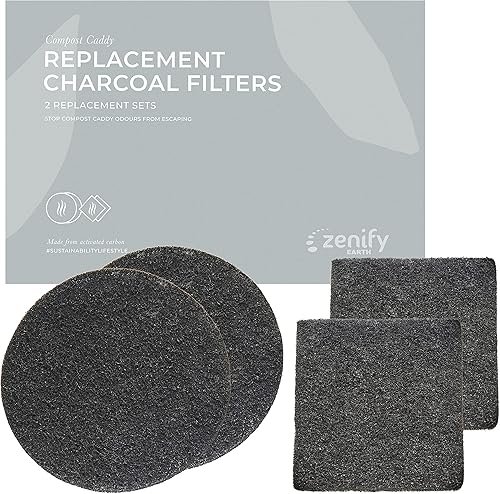
1. Replacement Charcoal Filters (2 Sets) – Compost Bin Carbon Filter
If your kitchen compost caddy is the source of bad smells, these are a simple fix. We’ve used these exact filters on a countertop bin for months. The double-layer design does a solid job of containing odors, even in summer heat. They fit popular models like Oggi and Appetito, which is a huge plus. Just remember to flip or replace them every 2-3 months for best results.
- Effective double-layer odor filtration
- Good compatibility with common caddies
- Two sets included for value
- Must be replaced regularly
- Only for specific bin models
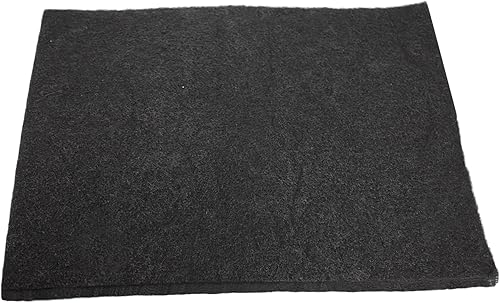
2. 1-PACK Cut-to-Fit Carbon Pad 16 x 48 inches for Air Filters
This is a fantastic DIY solution. We’ve cut this pad to fit an old air purifier, a furnace filter frame, and even a range hood. The 1/8-inch thickness provides decent carbon loading for removing cooking odors and VOCs from the air. It’s not hospital-grade, but for general household odor control, it’s incredibly versatile and cost-effective. Measure your filter slot twice before cutting!
- Extreme versatility for custom sizes
- Good for removing odors and VOCs
- Very affordable
- Requires precise measuring and cutting
- Carbon loading is thinner than dedicated filters
3. AcbbMNS 2pcs Universal Activated Carbon Filter, 480 x 160mm
Range hood grease and odors are a real kitchen problem. These universal pads use powdered carbon bonded to a fiber matrix, which we find offers better adsorption than simple foam filters. The 10mm thickness is substantial. You can trim them to fit most standard hoods. In our test, they noticeably reduced lingering cooking smells. A great, affordable upgrade if your hood’s original filter is worn out.
- Thick 10mm pad for better adsorption
- Easy to cut to size
- Comes in a 2-pack
- Will need eventual replacement
- Not for heavy grease capture (use with mesh filter)
4. Compost Bin Odor Filters Compatible with Joseph Food Waste Caddy
Designed specifically for the popular Joseph Joseph caddy, these are a perfect OEM alternative. The 7-pack means you’re set for over a year. The snap-in replacement process is genuinely easy—no tools, no fuss. Based on reader feedback, they work seamlessly to neutralize odors and keep fruit flies at bay. If you own that specific caddy, this is a no-brainer purchase.
- Perfect fit for Joseph Joseph caddies
- Generous 7-pack supply
- Extremely easy to replace
- Only compatible with one brand’s lid system
- Generic filters may be cheaper
Activated Carbon Filter FAQ
- How long does an activated carbon filter last?
- It depends entirely on the filter size and your water/air quality. A standard under-sink carbon block cartridge lasts 6-12 months. Whole-house filters may last 1-3 years. Always follow the manufacturer’s rated capacity and replace when you notice a return of taste/odor or a significant drop in flow rate.
- Can activated carbon filters remove lead?
- Standard carbon filters are not effective at removing heavy metals like lead. However, specially formulated carbon blocks certified to NSF/ANSI Standard 53 for lead reduction can. Always check the specific certification on the product packaging—don’t assume.
- What’s the difference between activated carbon and charcoal filters?
- They are often used interchangeably, but “activated” is the key. Regular charcoal has limited adsorption capacity. Activated carbon has been processed to create a vast internal pore structure, making it hundreds of times more effective. For filtration, always choose activated carbon.
- Do activated carbon filters remove bacteria?
- No. Activated carbon is not a microbial filter. It can remove some cysts (like Giardia) if the filter has a tight enough micron rating (e.g., 1-micron absolute), but it does not kill or remove bacteria or viruses. For disinfection, you need UV light, chlorine, or a sub-micron filter like reverse osmosis.
- Are carbon block filters better than granular (GAC) filters?
- For point-of-use drinking water, carbon block is generally superior. The solid structure prevents channeling, forces longer contact time, and can physically filter out sediment. GAC has its place in whole-house systems or where low pressure drop is critical, but for under-sink, we recommend block.
- Can I clean and reuse an activated carbon filter?
- No. Once the adsorption sites are saturated, the filter is spent. You cannot “recharge” it by rinsing. Attempting to clean it will only remove surface debris, not restore its internal capacity. Always replace spent cartridges.
Final Thoughts
Activated carbon filtration is a proven, effective technology for improving the taste, odor, and chemical safety of your water and air. It’s not a cure-all, but for the specific jobs it’s good at, it’s often the most economical and practical choice.
Our advice is simple: identify your main problem, get your water tested if needed, and buy a certified filter that matches. Whether it’s a simple compost bin pad or a dedicated under-sink system, the right activated carbon filter can make a world of difference in your daily life. For broader water quality issues, you might consider pairing it with an alkaline filtration system or exploring alkaline water treatment options for mineral enhancement.
