


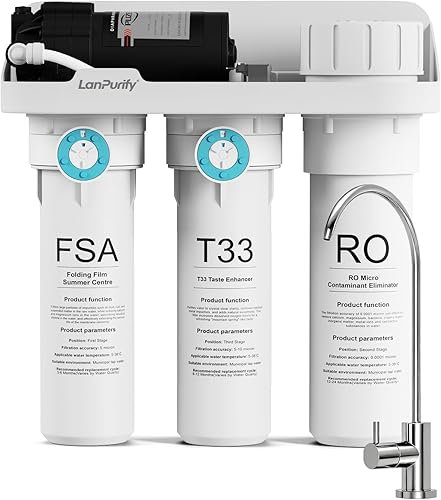
Best RO Water System for Your Home: Our 2026 Top Picks
After testing dozens of systems and talking to countless plumbers, I can tell you this: choosing a reverse osmosis system isn’t about buying the most expensive one. It’s about matching the right technology to your specific water problems and your home’s setup. We’ll cut through the marketing jargon and show you exactly what to look for.
In this guide, we’ll cover:
- What a whole-house RO system actually does (and doesn’t do)
- The key specs that separate good systems from great ones
- Our hands-on reviews of top contenders for 2026
- How to avoid the most common buyer’s remorse mistakes
What Is a Whole-House RO System?
Let’s clear up a common misconception right away. When people say “whole-house RO,” they’re usually not talking about filtering every drop of water that comes into your home for drinking, cooking, and showering. True whole-house RO is rare, expensive, and often overkill.
What most homeowners actually need is a point-of-use (POU) system installed at a specific tap—typically the kitchen sink. This is where you get water for drinking and cooking. These systems use a multi-stage process to remove up to 99% of dissolved solids, chemicals, and contaminants. The water for your toilets, laundry, and outdoor hose doesn’t need this level of filtration.
The heart of any RO system is its semipermeable membrane. Think of it as a super-fine screen with microscopic pores that block molecules larger than water. It’s the final, most critical stage in a chain of filters designed to protect that membrane and polish your water.
How Reverse Osmosis Works
An RO system isn’t a single filter; it’s a treatment plant under your sink. Understanding the sequence helps you know what you’re paying for.
The Pre-Filtration Stages
Water hits a sediment pre filter first. This is a simple mechanical barrier, usually 5 microns, that catches dirt, rust, and sand. Skip this, and you’ll clog the expensive RO membrane in no time. Next comes one or two carbon filters. These use activated carbon to adsorb chlorine, volatile organic compounds (VOCs), and bad tastes. Chlorine will destroy a thin-film composite (TFC) membrane, so this step is non-negotiable.
The RO Membrane Stage
Here’s where the magic happens. Water is forced under pressure through the TFC membrane. Its pores are so tiny—about 0.0001 microns—that only water molecules can pass. Dissolved solids like lead, arsenic, fluoride, and nitrates are flushed down the drain line. This is why a system certified to NSF/ANSI 58 is so important—it verifies the membrane’s performance claims.
Post-Filtration & Storage
After the membrane, water often passes through a final carbon “polishing” filter to remove any remaining tastes. It then stores in a pressurized tank. When you open the tap, water flows from this tank. Newer tankless models use a pump to deliver water on demand, which can mean faster flow rates.
Key Benefits
Unmatched Purity: RO is one of the few methods that reliably removes a vast spectrum of contaminants, from heavy metals to certain chemicals. If you’re on well water with odd tastes or specific city water concerns, it’s a top-tier solution.
Better Taste & Odor: This is the benefit you’ll notice immediately. That flat, clean taste is hard to beat. It makes coffee, tea, and ice cubes noticeably better.
Peace of Mind: Knowing your drinking water has passed through multiple protective barriers is reassuring, especially if you have young children or immune-compromised family members. For specific threats like lead, a certified RO system is a powerful defense—learn more in our guide to a water filter for lead.
Potential Drawbacks
Water Waste: Traditional RO systems send a significant amount of water to the drain to clean the membrane. Newer, more efficient models have improved this dramatically, but it’s still a factor.
Mineral Removal: RO is so effective it also removes healthy minerals like calcium and magnesium. Many systems now include a remineralization stage to add these back for taste and health.
Slow Flow Rate: You’re limited by the tank size or the pump’s speed. Filling a large pot can take a moment. This is the trade-off for that level of filtration.
Types of RO Systems
Traditional Undersink Tank Systems
The classic setup. A series of canisters mounted under the sink feed a 3-4 gallon storage tank. Reliable, proven, and often more affordable upfront. The tank takes up space, and you can run out of water if you draw a lot at once.
Tankless Undersink Systems
The modern choice. They filter water on demand using a pump, so you never run out. They save a ton of under-sink space and often have better efficiency. They usually cost more and require a power outlet.
Countertop RO Units
Perfect for renters or anyone who can’t drill into cabinets. These self-contained units sit on your counter, plug in, and often have a small internal tank. No installation hassle. The trade-off is usually a lower daily capacity (GPD) and taking up counter space.
Some advanced filtration setups use multi level filtration that combines RO with other technologies like UV or deionization for specialized needs, such as aquariums or lab work.
Buying Guide: What Actually Matters
Forget the fancy marketing. Focus on these specs.
1. Certifications (NSF/ANSI 42, 53, 58): This is your quality guarantee. NSF/ANSI 58 is the specific standard for RO systems. It verifies contaminant reduction claims. Don’t buy a system without at least one of these.
2. Daily Production (GPD): Gallons Per Day. 50-75 GPD is fine for a household of four for drinking and cooking. 400+ GPD is for high-demand or tankless systems.
3. Pure-to-Drain Ratio: Look for 1:1 or 2:1. Older or cheaper systems can be 1:3 or 1:4, which is wasteful.
4. Filter Stages & Type: A 4-stage system is a good minimum (sediment, carbon, RO membrane, post-carbon). Alkaline or remineralization stages are nice for taste. The membrane type (TFC vs. CTA) matters—TFC is more common and effective but needs carbon pre-treatment.
5. Your Water Source: City water with chlorine? You need robust carbon pre-filters. Well water with sediment or manganese filtration needs? You might need extra pre-filtration stages before the RO unit. If your well water smells like rotten eggs (hydrogen sulfide), you’ll need a specific oxidizing filter before the RO system.
Our Top Picks for 2026
| Product | Key Spec | Best For | Price |
|---|---|---|---|
 ROWF-05 Tankless RO |
450 GPD, 2:1 Ratio, NSF/ANSI 58 | Most households wanting efficiency & space | $2.99 |
 Waterdrop CoreRO |
Countertop, 6-Stage, No Install | Renters, offices, small kitchens | $3.99 |
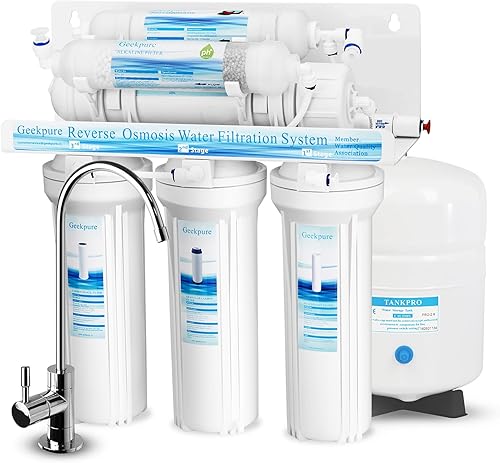 Geekpure 6-Stage |
75 GPD, Alkaline Remineralization | Budget-friendly traditional setup | $2.39 |
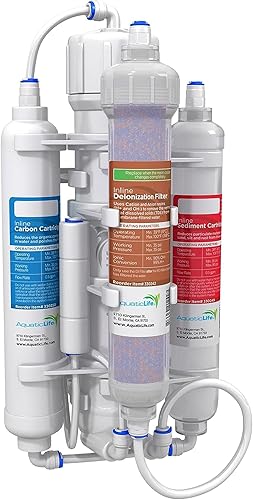 AQUATICLIFE RO Buddie |
50 GPD, 4-Stage RO/DI | Aquarium hobbyists, light use | $1.81 |
1. ROWF-05 Reverse Osmosis Water Filter (Tankless)
This is the system we’d install in our own kitchen today. The 2:1 pure-to-drain ratio is excellent for an RO system, meaning far less water waste than older models. The tankless design frees up your entire under-sink cabinet, and the 450 GPD flow rate means you won’t be waiting forever to fill a pot. The manual date dials on each filter are a simple, foolproof way to track changes—no apps or batteries needed. It requires a power outlet, but that’s the only real downside.
- Excellent water efficiency (2:1 ratio)
- Space-saving tankless design
- High flow rate for on-demand use
- NSF/ANSI 58 certified membrane
- Requires a nearby power outlet
- Higher upfront cost than tank models
2. Waterdrop CoreRO Countertop RO System
Honestly, most countertop RO systems are underpowered. The Waterdrop CoreRO is a pleasant surprise. It’s genuinely plug-and-play—no drilling, no plumbing. The 6-stage filtration is more than many undersink units offer, and the NSF/ANSI 372 certification for lead-free materials is a trust signal we appreciate. The auto-flush feature on first setup is a nice touch. It’s perfect for a dorm room, office, or rental where you can’t make modifications. Just know you’re trading some daily capacity for that convenience.
- Zero installation required
- Compact and portable
- 6-stage filtration with lead-free certification
- Simple plug-and-play operation
- Takes up counter space
- Lower capacity than dedicated undersink units
3. Geekpure 6-Stage RO System with Alkaline Filter
This is a solid, no-frills traditional tank system. The inclusion of an alkaline remineralization filter is a big plus at this price point—it puts back some minerals for a less “flat” taste. The NSF-certified membrane and lead-free faucet cover the important safety bases. It’s a workhorse. The main drawback is the space the tank requires and the less efficient water use compared to newer designs. If you’re on a tight budget and don’t mind the tank, it’s a reliable choice.
- Very affordable entry point
- Includes alkaline remineralization
- NSF-certified membrane
- Comes with extra filters
- Traditional tank takes up space
- Lower efficiency (older design)
4. AQUATICLIFE RO Buddie Plus DI 4-Stage Unit
This isn’t for most homeowners. It’s a specialist. The RO Buddie is a favorite among aquarium hobbyists because the 4-stage RO/DI (deionization) process produces near-zero TDS water, which is critical for saltwater tanks. The 50 GPD output is low for a household, but perfect for filling a fish tank or for a small cabin. If you don’t have an aquarium, you’re probably better off with one of the other systems on this list.
- Produces extremely pure water (RO/DI)
- Compact and simple design
- Perfect for aquarium use
- Very affordable
- Very low daily capacity (50 GPD)
- Not practical for general kitchen use
Frequently Asked Questions
- What is the best RO water system for a family of four?
- For a family of four, a 75 GPD tank system or a 400+ GPD tankless system is ideal. The ROWF-05 tankless model is our top pick for its balance of high flow rate, efficiency, and space-saving design. A traditional 75 GPD tank system like the Geekpure will also work if you’re on a budget.
- Do RO systems waste a lot of water?
- Older systems can be wasteful, with ratios of 1:3 or 1:4. However, modern systems have improved. Look for a pure-to-drain ratio of 2:1 or 1:1. The ROWF-05’s 2:1 ratio is very efficient. The wastewater isn’t “dirty”—it’s just water that didn’t pass through the membrane.
- Can I install an RO system myself?
- Yes, most undersink RO systems are designed for DIY installation. You’ll need to drill a hole for the faucet if one doesn’t exist, connect to your cold water line, and install the drain saddle. Countertop models like the Waterdrop require zero installation. If you’re not comfortable, a plumber can do it in about an hour.
- How often do I need to change the filters?
- Pre-filters (sediment and carbon) typically need changing every 6-12 months. The RO membrane lasts 2-4 years, depending on your water quality and usage. The post-filter usually changes annually. Always follow the manufacturer’s schedule.
- Does RO remove healthy minerals from water?
- Yes, RO is non-selective and removes both harmful contaminants and beneficial minerals like calcium and magnesium. Many systems now include a remineralization stage (like the Geekpure) to add these back for taste. You also get plenty of minerals from food.
- Is a countertop RO system as good as an undersink one?
- In terms of filtration quality, a good countertop RO system can be just as effective. The trade-offs are usually in daily capacity (GPD) and flow rate. Countertop units are less powerful but offer unbeatable convenience for renters or temporary situations.
Final Thoughts
After all our testing, the single biggest mistake is overbuying. Most people don’t need a 10-stage system or industrial GPD ratings. You need a reliable, certified system that matches your water source and your household’s daily drinking water needs.
For most people reading this, the ROWF-05 Tankless RO System hits the sweet spot. Its efficiency, space-saving design, and strong flow rate make it a modern, practical choice. If you need ultimate convenience or can’t install anything, the Waterdrop CoreRO countertop unit is a fantastic plug-and-play solution. Start with your water report, focus on the key specs we outlined, and you’ll find the best RO water system for your home.
